Celebrating Hampshire Historians: A Southampton Perspective
Published: 16th November 2022
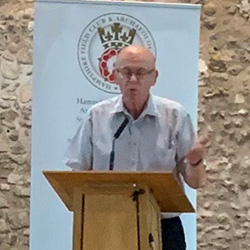
Roger Ottewill
After leaving school, Roger initially worked in the field of local government finance, but in 1973 secured a teaching post at Sheffield Polytechnic, later Sheffield Hallam University, where he remained until 2001. Here he taught on public administration and later business studies courses. Between 2001 and 2008 he had a part- time post in the Centre for Learning and Teaching (renamed Learning and Teaching Enhancement Unit) at the University of Southampton. Here he rediscovered his love of history, studying for an MRes at Southampton and, following retirement, for a PhD in Modern Church History at the University of Birmingham, which he completed in 2015. His particular interests are local political, administrative and religious history and he has contributed articles on many different aspects of these subjects to a wide variety of journals, a number of which will be mentioned in his presentation. In recent years he has been researching Nonconformity in, and the political life of, the north-east Hampshire town of Basingstoke between 1800 and 1925 for the new Victoria County History project. From 2015 to 2021 he was Chair of the Local History Section of the Hampshire Field Club.
For the past 18 months I have been a member of the Celebrating Hampshire Historian’s Project Team.
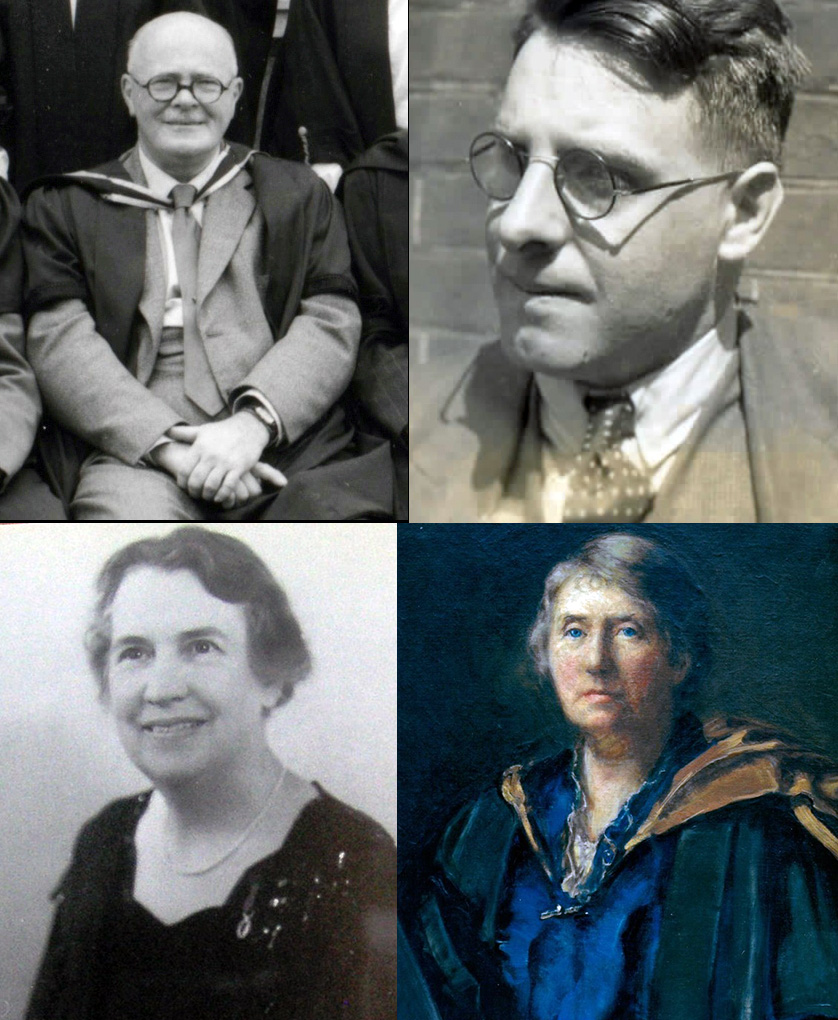
Clockwise from top left: Temple Patterson, Lawrence Burgess, Elinor Aubrey, Elsie Sandell
For the past 18 months I have been a member of the Celebrating Hampshire Historian’s Project Team. Details of the background and purpose of the project can be found at: https://www.hantsfieldclub.org.uk/ihr100/index.html. It will also be the subject of a short article by my colleague Dick Selwood in the January 2023 issue of Local History News. My particular role has been to research and prepare profiles for many of the historians of Southampton, where I have lived since 2001. Most of the sixteen profiles produced so far, for 13 men and three women, are now online. In this blog I want to share some thoughts about my experiences in discovering more about those upon whose shoulders later historians stand and, in particular, to highlight some features of Southampton’s historians collectively.
1. A particularly striking, although by no means unique, feature is the diversity of their backgrounds. A few were born and bred Sotonians and lived most of their lives in the town, namely Elinor Aubrey (1866-1951), a lecturer in the English Department at University College; Harry Gidden (1866-1948), a teacher at King Edward VI School; and Elsie Sandell (1891-1974), a writer and local councillor. The majority, however, grew up elsewhere and moved to Southampton for work, frequently remaining in the area for the rest of their lives. A good example is Lawrence Burgess (1901-1983), who was born in Chelmsford and appointed Southampton’s Deputy Librarian in 1934. Another is Bernard Knowles (1890-1957), who grew up in Rotherham and secured the post of Secretary to the Southampton Chamber of Commerce in 1920. A third was John Pannell (1899-1966), who came from Plymouth and moved to Southampton in 1935 to take up the post of engineer to the Harbour Board. Two were born overseas. Ernest Brieger/Blake (1923-2000) hailed from Breslau in Germany and changed his surname during the Second World War for security reasons. The other was Paul Studer (1879-1927), from Biel in Switzerland. Both Blake and Studer were academics. Similarly, there were others who moved to Southampton and remained for either short or long periods to pursue their academic careers (see below).
2. A second feature relates to the central role played by the Southampton Record Society, which was established in the summer of 1905. Here a key figure was Fossey John Cobb Hearnshaw (1869-1946). His profile has been researched by Jo Bailey, the current Present of the Hampshire Field Club and Archaeological Society. At a meeting held to consider the desirability of forming the Society, Hearnshaw explained that:
… it should seek to publish some of the more important borough documents. This had been done in Manchester, Bristol, Nottingham and London, and he ventured to say no town had records more interesting and valuable than Southampton had [They were held at the Audit House]. If these, or the principal part of them, were put into the press, not necessarily in an expensive form, they would prove not only of interest to Southampton, but would attract attention from different parts of the kingdom.
Later in his presentation he referred to the Court Leet records consisting of 205 volumes, one for each year. Originally covering 355 years 150 had been lost, but what survived provided ‘a wonderfully full review of the social life of the town during the Medieval and early Modern periods (Hampshire Independent, 10 June 1905).
As a follow up to this meeting Hearnshaw, together with Elinor Aubrey, jointly appealed to the wider public by means of a letter to the editor of the Hampshire Advertiser (see below).
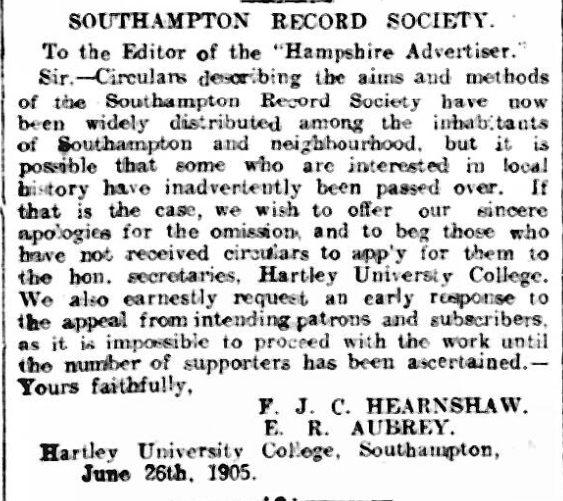
This initiative was a considerable success and over the course of the next 30 or so years 40 limited edition volumes were published in the first Southampton Record Series, the last being in 1940. During the Second World War, however, its stocks were destroyed and it suffered from the dispersal of many of its editors and supporters. After the Second World War, University College (from 1952 the University of Southampton) took over responsibility, with an advisory committee consisting of borough and University representatives, and a second series was launched in the early 1950s. To date, nearly 50 volumes have been published (see https://files.royalhistsoc. org/wp-content/uploads/2015/07/ 17210408/ sotonrecordsseries.pdf). Both series have served to raise the profile of Southampton’s archival material both nationally and internationally.
.
Many of the historians profiled in the Celebrating Hampshire Historian’s Project contributed to these series by transcribing and writing commentaries on historic documents. These included, in the first series, the borough charters for the years 1199-1480; the assembly books covering the period from 1602 to 1616; the history of land tenure between 1388 and 1620, as recorded in the so-called Black Books, because of the colour of their covers; and the steward’s books for the years 1428-1439. In the second series there are volumes devoted to the third book of remembrance of Southampton, 1514-1602; a selection from the Southampton Corporation journals, 1815-35, and Borough Council minutes, 1835-47; and the cartulary of the priory of St Denys near Southampton.
3. A third and unsurprising feature is the part played by historians employed by University College, Southampton, and from 1952 the University of Southampton. These are, in alphabetical order, the previously mentioned Ernest Blake (from 1952 to 1992); John Wesley Horrocks (1912-1930); Allen Merson (1945-late 1970s); Temple Patterson (1949-1968); and James Rutherford (1928-1933). Their contribution, plus that of two other academics Elinor Aubrey (late 1890s to 1931) from the English Department and Paul Studer (1908-1913) a Professor of French, was considerable. Arguably, however, the one who made the greatest contribution, with respect to not only Southampton’s history, but local history more generally was Temple Patterson, appointed Professor of Regional History in 1967 (see https://specialcollections universityofsouthampton.wordpress.com/2022/10/19/t-is-for-temple-patterson-one-of-southamptons-foremost-historians/). When he died in 1983, his reputation was such that he was honoured with an obituary in The Times. To some extent, Patterson can be said to have personified the gradual move from the study of the history of a particular locality to the recognition of local history as a sub-discipline in its own right.
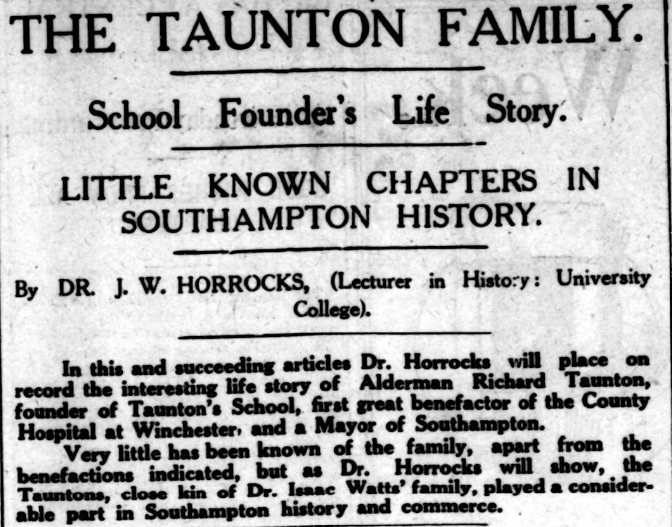
4. Finally, there were those who sought to popularise local history in a variety of ways. At least four did so through regular articles in the local press. Some were academics, such as John Wesley Horrocks (1877-1930) who published regularly in the Hampshire Advertiser during the late 1920s, with a number in a series entitled ‘Little Known Chapters in Southampton History’ (see below for an example)
Another was Edgar Mitchell (1877-1939) who moved to Southampton in 1913 to take up a post with the Southern Daily Echo, initially as a sub-editor, theatre critic and leader writer. In due course, under the pen name ‘Townsman’ he contributed a popular column ‘Occasional Notes’. These originally consisted of reflections on his own experiences, but later they incorporated his thoughts on, and researches into, the history of Southampton. As the extract below illustrates, one topic was St Mary’s Church.
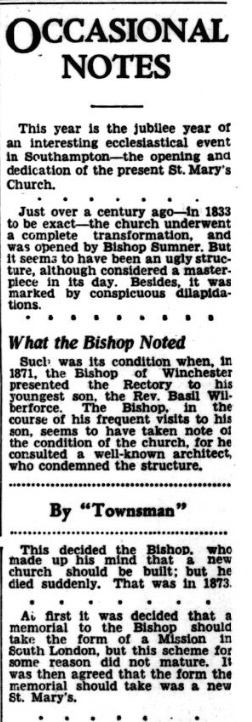
Other topics included ‘The Coming of the Railway’; ‘Mid Victorian changes’ to the town’s architecture; and ‘The Town’s Eastern Defences’.
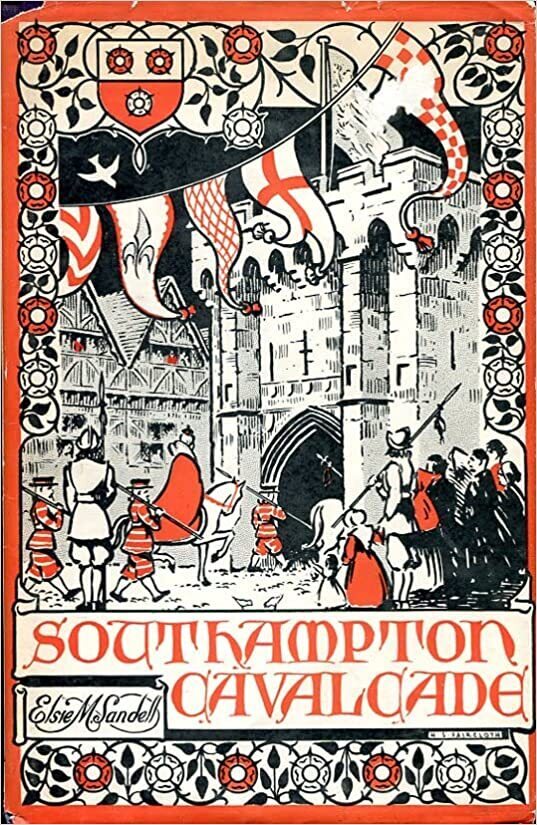
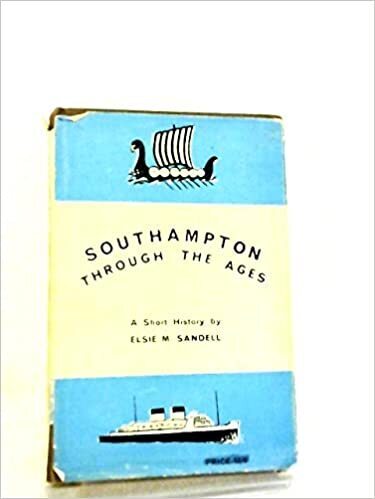
During the Second World War Elsie Sandell, who was mentioned earlier, also began writing articles for the Southampton Daily Echo. Much of this material subsequently formed the basis for her post-War publications, some of which were targeted at children as well as the general public. One of the best known is Southampton Cavalcade (see below). In his foreword to another of Sandell’s books, Southampton Through the Ages F.L. Freeman, Southampton’s Chief Education Officer, described it as ‘an extremely readable and authoritative History which will be welcomed by the citizens of Southampton in general and by the schools in particular.’ However, from the point of view of later historians, one criticism that has been made of Sandell is her failure to provide references – a common complaint.
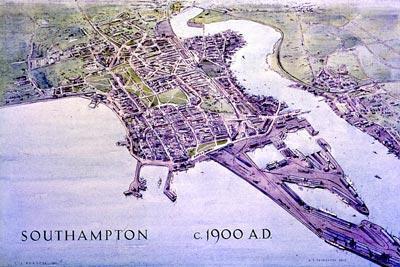
Another strand has been the use of what might termed ‘visual aids’ to add interest and aid understanding. One notable contribution was by Laurence Burgess, with his series of ten historical perspective maps of Southampton from 250BC to 1950AD (see below for an example).
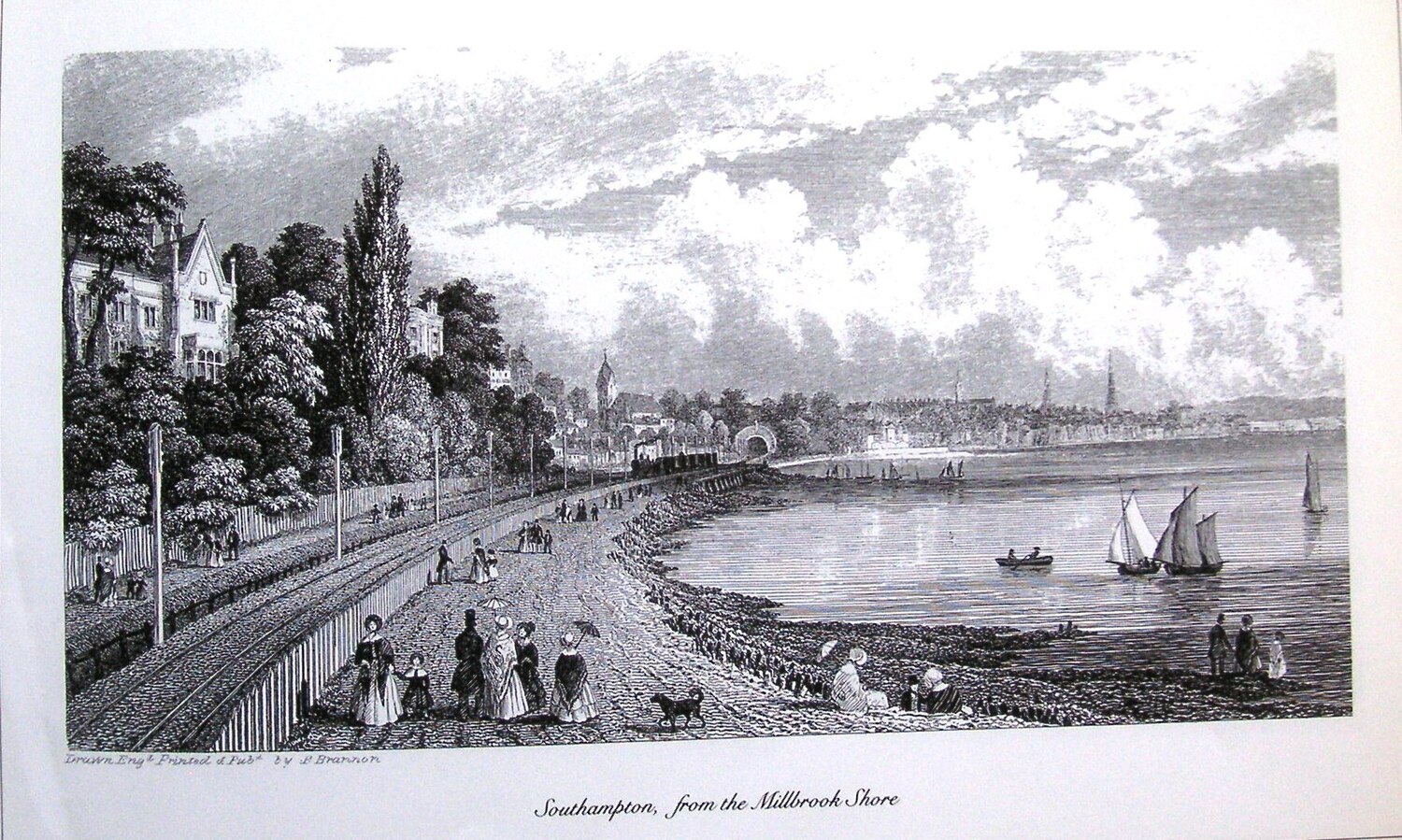
In this context, mention must also be made of Philip Brannon (1817-1890). Although many of Brannon’s publications were not strictly history, since they contain contemporary information about Southampton and environs in the mid 19th century, material from them has been used extensively by historians. In particular, his lithographs have been used to illustrate subsequent histories (see below for an example).
One concluding thought is that, despite the abundant output of publications covering many aspects of Southampton’s rich history, it is surprising that there has never been the equivalent of the Portsmouth Papers or Hampshire Papers series for the town/city. These offer a means of engaging with a wider audience and of covering a much broader range of historical subjects than the more specialist record series publications, which are primarily targeted at academics.
Overall, participation in the Celebrating Hampshire’s Historians Project has provided a wealth of insights into the manner in which local history has evolved in Southampton. To be included, historians had to have died by 2000, thus many of those who have made valuable and insightful contributions in recent decades are outside its scope. Hopefully, in years to come their work will receive due acknowledgement in a similar manner.
The views and opinions expressed in this blog are those of the author and do not necessarily reflect the official policy or position of the British Association for Local History (BALH). Any content provided by our contributors is of their own opinion and is not intended to malign any individual, group, organisation, or entity.