English Synagogues and Local Jewish Identities
Published: 27th September 2022

Jessie Clark
jrc78@bath.ac.uk
@C14Jess
Jessie is a PhD student at the University of Bath funded by the Arts and Humanities Research Council through their Collaborative Doctoral Programme in partnership with Historic England. Her PhD research is looking at how Jewish heritage and identity is reflected in synagogue buildings. Before her studies she worked in the heritage sector and undertook a masters degree in cultural heritage management.
Synagogues are Jewish places of worship. However, unlike some religious buildings, they are not in themselves sacred. It is the people and the rituals which take place within them that makes the building sacred. This means that there are few, if any, religious prescriptions as to how a synagogue should be built.

Leicester Hebrew Congregation (LHC)
However, over time traditions have emerged. The Aron Kodesh – the ark where the Torah scrolls are kept – is almost always placed on the east wall so that worshippers can face it during the prayers which require the worshipper to face towards Jerusalem. There is usually a raised platform known as the bimah from which prayers and sermons are read. In traditional orthodox practice men and women pray separately and so, many larger synagogues have a ladies gallery above the main prayer hall for women. However, none of these are required for a synagogue. A community can pray in any space and may choose to ignore, or be unable to fulfil, any of these traditions. This would not stop their building from being a functioning synagogue. The design, layout and use of a synagogue therefore reflects the needs, desire, history and religious practice of the congregation it serves. Very often these reflect local trends both within Jewish communities and in the wider society.
Jews have been living openly in England since 1656. However, until the mid-nineteenth century restrictions were placed on Jewish communities. These included the owning of property. This affected how synagogues were built with many having plain exteriors and being set back from the street. Despite this, congregations often chose to have ornately decorated interiors. As Jewish communities gained more civic freedoms, some communities wanted to express their identity more openly. This led to the rise of so called ‘cathedral synagogues’. These were grand expressions of Jewishness, but which had the aim of showcasing that Jewish communities were equal partners in Victorian English society. English Jews were exactly that: English and Jews. Whilst some have been lost, many that do survive are in London, where there was a large Jewish population. However, some provincial communities, with smaller congregations, also followed this trend but on a smaller scale.
One example of this style is Leicester Hebrew Congregation (shown above).
Leicester Hebrew Congregation was built in 1898 and is a Grade II listed building (fig one). Sharman Kadish, a foremost scholar of Jewish Architecture, calls it a ‘Romanesque…[with] a slightly exotic note’(Kadish, 2015, p.156). It has Moorish influence which was a theme common for synagogues of this period. There was a trend in synagogue building to reinforce the myth of the orientalism of Jewish ancestry. In Leicester however, this was perhaps not made by the community. The synagogue was designed by a local Wesleyan Methodist architect, although there is no reason to think that the community did not agree to designs. The exterior is generally consistent with wider synagogue architect of the time although there are a few ‘quirks’. The dome for example, was an addition made purely by the architect, although it can be assumed the congregation had no particular objection to it.
Similarly, the interior of the synagogue reflects wider Jewish traditions and the identity of the local community. Following the traditional patterns of an English orthodox community there is a central raised bimah, the Aron Kodesh is on the east wall, a Ner Tamid (a lamp that is kept lit all the time) above the ark and a ladies’ gallery to the rear. However, on the ceiling of the prayer hall, the cinquefoil emblem of the city of Leicester can be seen within the Star of David (fig 2). The congregation believes that when these decorations were added the President of the Congregation was also the Mayor of the City and he wanted to show his loyalty to both communities (LHC).

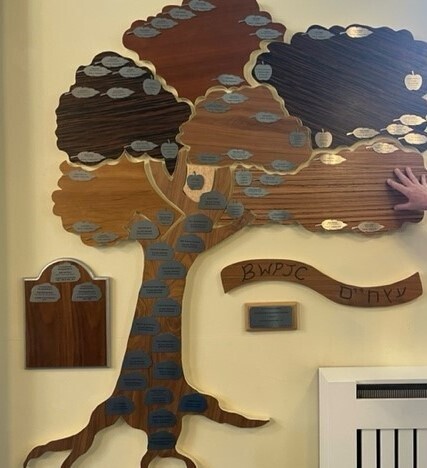
Synagogues are also a meeting point for Jewish communities and Jewish life. They therefore often become depositories for local community history. Whilst this is often through archives, committee meeting minutes and other records, the synagogues buildings themselves also reveal a communities history. Synagogues are built and maintained by the donations of congregation members. In order to thank and recognise the contribution of members, plaques and dedications are common features in synagogues. Sometimes these can also take the form of memorials. For example, at Bristol and West Progressive Synagogue the congregation has a wooden ‘Tree of Life’ (fig 3). Members can buy metal leaves which commemorate important life events like a birth; bar or bat mitzvah; marriage or in memorial to a loved one. In this way the history of the congregation can quite literally be seen on the walls of the synagogue as members can be traced through the imagery.
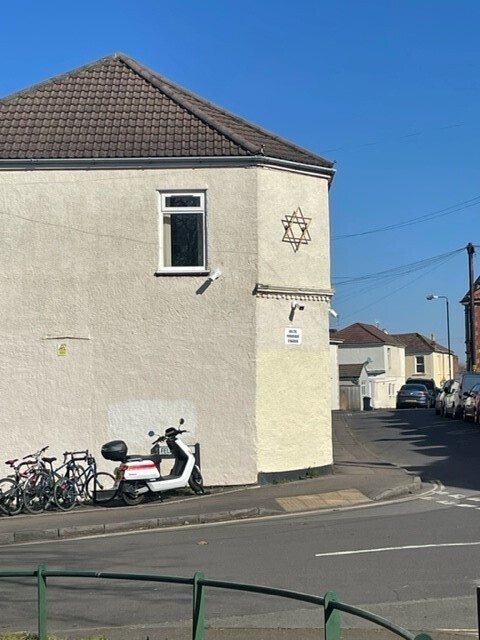
Bristol and West Progressive Jewish Congregation (fig 4) is also a wonderful example of a modern synagogue showcasing its local nature. It is housed in three former terraced houses and shops. However, when the congregation first bought the property in 1974, they were only able to purchase one, the end terrace house (Bristol-and-West-Progressive-Jewish-Congregation, 2021). As the congregation grew so did the building, with the congregation acquiring the adjacent properties over time. The layout of the building is a testament to the growth of the community. It reflects how the community has expanded into more space over time. The interior shares some similar to Leicester Hebrew Congregation – an Aron Kodesh and a Ner Tamid – there are differences which reflects this particular community. There is no raised bimah, although the community has a purpose-built reading desk which acts in a similar capacity. Men and women also pray together in this congregation and so there is no ladies’ gallery. Again, broader traditions are fused with local identity.
Synagogues in England, as all over the world, often share some common features. However, as they are made for a specific community, they reflect that specific community’s identity and history. They are reflection of both a global religion and the local expression of it.
References
Bristol and West Progressive Jewish Congregation 2021. Community Website [Online]. Bristol-and-West-Progressive-Jewish-Congregation. Available from: https://bwpjc.org/ [Accessed 30th October 2020].
Kadish, Sharman, 2015. Jewish Heritage in Britain and Ireland: An Architectural Guide. Swindon: Historic England.
Leicester Hebrew Congregation Community Website [Online]. LHC. Available from: http://jewish-leicester.co.uk/ [Accessed 26th October 2020].
The views and opinions expressed in this blog are those of the author and do not necessarily reflect the official policy or position of the British Association for Local History (BALH). Any content provided by our contributors is of their own opinion and is not intended to malign any individual, group, organisation, or entity.