
From Local Archives to Atlantic Migrations: How Family History Helps Reconstruct a Shared Past
Published: 24th July 2026

Hugo Javier Freitas
Hugo Javier Freitas is a historian, History teacher and writer from Buenos Aires, Argentina. His work focuses on family memory, European migration to the Río de la Plata, archival research and the traces left by transatlantic journeys across generations. He is the author of Raíces en las aguas, published in Galicia, Germany and Italy.
Drawing on European migration to Argentina and Uruguay, Hugo Javier Freitas reveals how local records and family memories can restore individual lives to the history of mass migration.
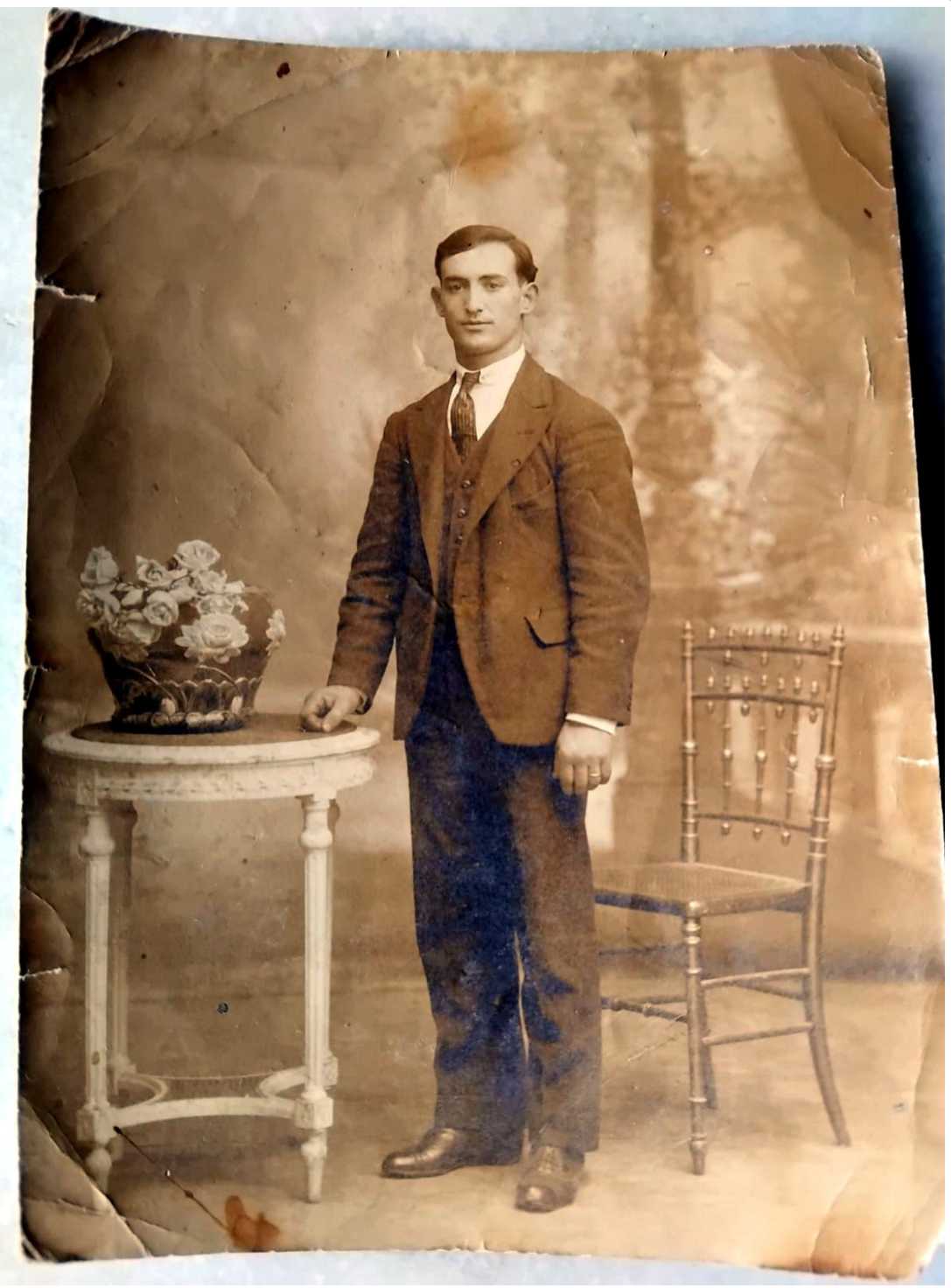
Portrait of Jesús Alonso, c. 1920. Studio photograph from the author's family archive.
When we think of the great European migrations of the late nineteenth and early twentieth centuries, we often picture statistics, maps and crowded ships crossing the Atlantic. Yet behind these vast movements, which transformed entire continents, were millions of individual lives that rarely appear in history books.
Reconstructing those lives is one of the historian's greatest challenges. Paradoxically, many of the answers are found not in national archives but in local ones: parish registers, civil records, cemeteries, electoral rolls, local newspapers and family collections preserved across generations.
For the past several years, I have researched European migration to Argentina and Uruguay between the late nineteenth and early twentieth centuries. What began as a search for my own ancestors gradually evolved into a broader investigation of memory, identity and migration, culminating in my book Roots in the Waters.
One of the first lessons I learned was that no migrant story can be reconstructed from a single document. Every source provides only one piece of a much larger puzzle.
A baptismal register may reveal a place of birth. A marriage certificate identifies new family connections. A passenger list records a departure. A port register confirms a voyage. A census captures a household years later. A family photograph gives faces to forgotten names. A letter explains the reasons behind a decision. Only when these fragments begin to speak to one another does a coherent human story emerge.
Local history plays a central role in this process.
In Galicia, a modest parish register may preserve the only surviving trace of a family that would later build a new life across the Atlantic. Likewise, on the Croatian island of Krk, a civil record can mark the beginning of the journey of an emigrant who eventually worked in the stone quarries of Uruguay and established a family in the Río de la Plata.
The story also illustrates how British enterprise became part of these migration networks. After arriving in South America, the Croatian migrant Marko Grandić found employment in the stone quarries of Conchillas, Uruguay, operated by the British firm Walker & Co. The company supplied stone for major infrastructure projects across the Río de la Plata while employing workers from different parts of Europe. Through enterprises such as Walker & Co., local British commercial initiatives became intertwined with the everyday lives of migrants, creating connections between British local history and the histories of European communities that settled in South America. These links can still be reconstructed today through parish registers, company records, passenger lists and family archives preserved on both sides of the Atlantic.
At first glance, these places seem to belong to separate histories. Yet the archives reveal that they were connected through the same migratory networks linking European villages with South American ports.
This perspective also reshapes the way we understand local history. It is often viewed as the study of a particular town, village or region. In reality, many local communities were profoundly shaped by international migration. Population movements transformed demography, economies, family structures and cultural life, both in places of origin and in destinations overseas.
Small stories also illuminate much larger historical processes. A young Galician learning a trade in Buenos Aires, a Croatian stonemason arriving in Uruguay, a mother preserving letters from Europe for decades, or a family passing memories from one generation to the next are individual experiences that reflect the lives of millions.
This is where microhistory reveals its greatest strength. Rather than narrowing the scope of historical enquiry, it deepens our understanding of major historical processes through the experiences of ordinary people.
But there is another element that is equally important: memory.
Documents provide evidence; memory provides meaning. In many families, it was mothers and grandmothers who preserved photographs, letters, everyday objects and oral traditions. When that chain of transmission was broken by premature death, the passage of time or silence, the documents remained mute until historical research allowed them to be connected once again.
For this reason, I see documentation and memory not as competing sources but as complementary ones. Documents provide evidence; memory helps us ask the right questions. Each confirms, nuances and sometimes even challenges the other.
Historical research therefore becomes an act of reconstruction. It is not simply about gathering information but about restoring context and voice to ordinary people whose lives became scattered across archives, countries and generations.
Perhaps this is one of the greatest lessons of the Atlantic migrations. Political borders never fully contained human lives. Family ties, letters, memories and documents continued to connect communities separated by thousands of miles of ocean.
Today, thanks to the digitisation of local archives and the dedication of historical societies, municipal archives and volunteers, it is possible to reconstruct many of these journeys with a level of precision that would have been unimaginable only a few decades ago.
Every newly discovered certificate, every identified photograph and every recovered letter enriches not only the history of a single family but also our understanding of the shared history of Britain, continental Europe and the Americas. Local archives remind us that even the smallest communities have often been connected by migrations that crossed oceans and transformed lives on both sides of the Atlantic.
In the end, every great historical process is made up of individual lives. More often than not, it is the small local archives that preserve the traces needed to find them once again.
The views and opinions expressed in this blog are those of the author and do not necessarily reflect the official policy or position of the British Association for Local History (BALH). Any content provided by our contributors is of their own opinion and is not intended to malign any individual, group, organisation, or entity.


