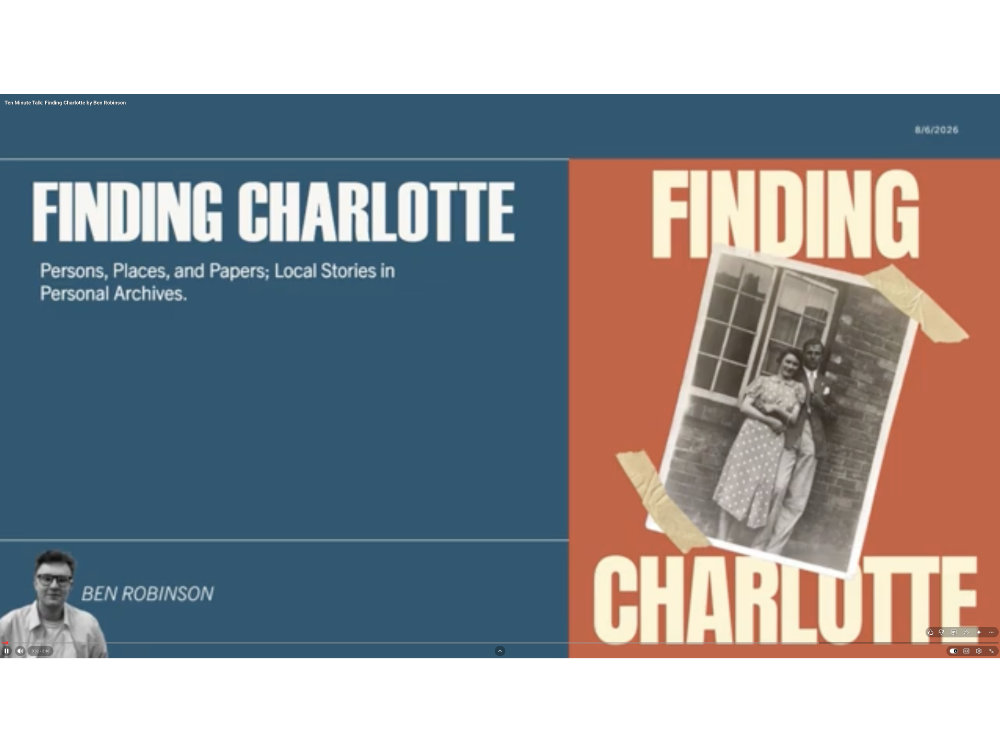
From Plotting Family History to Building Local Histories in Yorkshire
Published: 30th October 2026
When I set out on my own research for my book ‘Finding Charlotte’, I didn’t quite expect a family history project to turn into a process that would uncover several local history stories across Yorkshire. However, the line between family history and local history is particularly thin. Our local history is a combination of not only what exists in public record documents, but also what is locked away in the newspaper archives and family history documents. It is only once these lives are pieced together in a narrative that we can truly understand what local communities were like on a street level.
For me, the key word here is narrative. The intersection of family and local histories allows for these to be deciphered and written as a result of the documents telling stories about people, even through minute details. Simply put, it is easy for us to assume that these isolated family histories exist in pockets that we can uncover. However, once we weave them into a tapestry, we can create a collection of local histories that build one big account of life during a specific time period.
Scarborough at War
Major historical narratives about World War Two often focus on events that take place in cities and important military bases across the UK, or people who played a large role in the war effort. I am currently studying for a master's degree in education history at University College London’s Institute of Education; a recurring theme that my peers and I have noted is that our curriculum hones in on an overarching timeline of the war, forgetting the human aspect of it. But through local histories, our towns and villages can open up street-level stories and histories about WW2 that give us a clearer picture of what was happening in local communities at the time.
As I discovered my own family history, I also discovered a deeper understanding of the War in their hometown of Scarborough. Letters and documents which my great-grandmother kept from the Second World War detailed people and places that assisted me in building a narrative of her life in the town. However, more than this, it opened up addresses and names that I’d never heard of before in prior research.
When I used tools such as the National Archives and FindMyPast, in order to find out more about these people, it began to create a patchwork of lives that gave me context to Scarborough as a whole. One key aspect which acted as a connector of communities in the records was their workplaces.
Waddington’s Pianoforte Factory in Scarborough, where some members of my family worked, acted as a way of grounding my family history in the community. Whilst much was already known about the factory, the lives of its workers were lacking. Once I researched the censuses in the local area, I could build a narrative within the book about the men that worked at this factory. This not only added to the book, but also the historical record.
Building York Through Censuses
Census records became particularly prevalent when it came to expanding this research into York, another setting in which my family lived. The wealth of information I had been offered about Scarborough to include in the book, derived from genealogical research, inspired me to trace backwards to the places that my family resided before Scarborough.
As I trawled through census records to build a contextual image of their lives in the suburb of Clementhorpe in York, the city itself widened. The 1911 census displayed the names of neighbours and their professions, showing widowed wives, families of ten children, men who worked York’s infamous chocolate factories, and these are just to name a few. Making note of all the families, I then researched each of them individually; to build the foundations of the world the book would be set in. What I didn’t realise as I was doing this was that I was also creating a source of information about local lives in the Clementhorpe area of York.
Take the story of Clara Laycock for example, one of my great-grandmother’s neighbours. The census had her down as a widow in her twenties, with two young girls. Upon further research I came to find out that her husband had died in a workplace accident. Clara spent the rest of her life living in that same suburb, and thus a small piece of Clementhorpe’s history could be woven into the tapestry I was building. Clara’s girls were a similar age to my great-grandmother, and it is likely they attended the same school. These interlinks mean that family history becomes larger than just the individual. So, when you research your own family history, I urge you to not only research them, but those who lived nearby. Ensuring these stories are found, told, and preserved in some way or another means that our local histories can be ever-expanding.
The views and opinions expressed in this blog are those of the author and do not necessarily reflect the official policy or position of the British Association for Local History (BALH). Any content provided by our contributors is of their own opinion and is not intended to malign any individual, group, organisation, or entity.