Helping a society as a young person
Published: 6th May 2023

Joe Saunders
BALH Joint Vice-Chair & Head of Outreach
@joe_saunders1
Joe is a familiar face as the host of BALH’s popular monthly webinar series Local History Hour. He is a Trustee of BALH, joint Vice-Chair and head of the Outreach team. Away from BALH, Joe is working towards is PhD, while as a family historian, he undertakes genealogical research and is an Associate of the professional genealogy body AGRA.
Joe Saunders shares his experience of getting involved in BALH and volunteering in a society in his twenties.
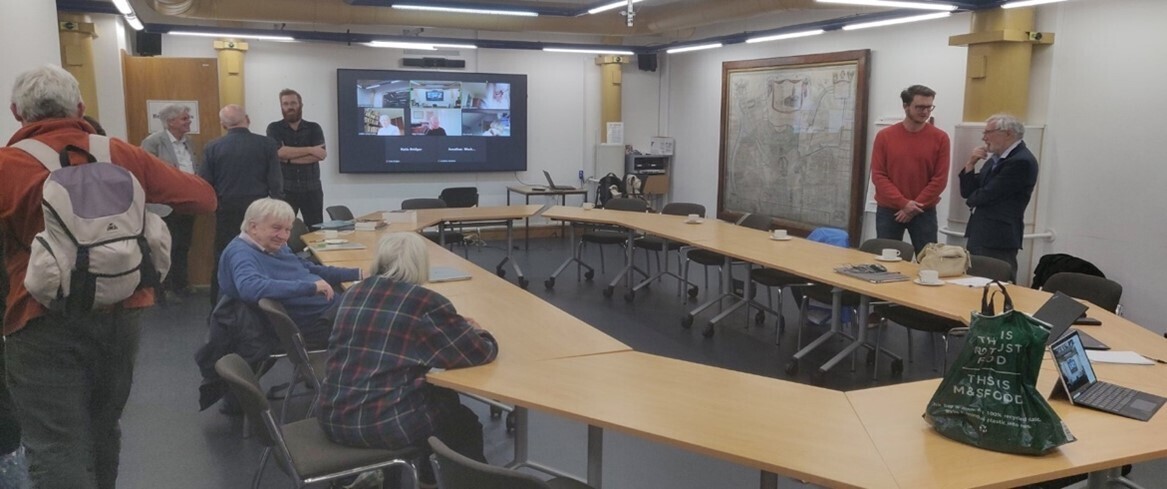
BALH team meeting. Westminster Archives, April 2022.
History societies are run by committed volunteers who give up our time and energy to help groups achieve the things they do. Getting involved with a local history society can incredibly rewarding. In my time with BALH I have met many new and (mostly) interesting people, had experiences I otherwise wouldn’t have had and developed my skills. Being able to help others is incredibly fulfilling. I’ve also found an outlet for my passions and ideas and contributed to at least my own local history knowledge.
While the experience of helping a history society is a somewhat common one, for young people the pros and cons can be compounded. I meet many young people who like the idea of getting involved in a society but are unsure what it actually entails. So, I am sharing some of my own ups and downs for those thinking about helping out.
It can feel incredibly fulfilling to have our enthusiasm and ideas appreciated. This is in the context of a job market where we are so often rejected out of hand in the bitter struggle for work and being at stages of our careers where we are being told what and when to do things. In societies young people can find ourselves encouraged to run with our ideas, to operate with relative freedom and take ownership of our work. In the process we can gain great skills and experience.
Young people also bring important qualities to societies. This is as distinct individuals but also because as the demographic in societies is older we bring inherent value as young people. We bring an energy that many societies need, especially if the same few have been carrying business on for the last few years. Our outlooks on the world, perspectives and technological familiarity all make young people especially useful to societies.
There are things that can be frustrating as a young person joining a society committee, depending on our own situations and personalities. As young people we are masters of the possible but can get bogged down in the reality. Sometimes we must affect changes to attitudes or processes before we can action our plans. Older people in societies should be conscious to channel the enthusiasm of young people, rather than damper or extinguish.
For everyone in a society it can be frustrating to make timings work between many different schedules. For a society to include young people it must be understood that we are often bound by working patterns which keep us away from daytime meetings and events. For younger people it can be hard to find mutually suitable times with outside people organisations you are working with, who may only be able to meet or correspond during ‘usual’ working hours which are also our own. Time can also be frustrating as it moves much more quickly for us than older people and we are so often time-poor with our competing commitments. As young people we are also likely to be undergoing life changes with more regularity than our older peers such as jobs, houses and family situations. We may have to change our levels of commitment to societies with some frequency. For all of us good communication and patience is key.
We must also be careful to ensure that we do not let ourselves get sucked in beyond our capacities. In an exciting world where we can gain control and responsibility it can feel excited to say yes to too much. Conversely, we may only be able to give less than other members of the committee who have more time. This is something that is easily overcome through clear communication, but it can be hard to feel you are slowing things down.
There may also be a clash of outlooks as a young person on a committee with our priorities sometimes at odds with older colleagues. Likewise, we may find ourselves frustrated at the ways things are done, or not done, and must judge how much time is spend pushing particular issues and explaining possibilities. This can all be done with time, especially as we gain trust within a committee. Finding our voice may take as long as it does for others to begin to listen to us.
Overall, there are many reasons why it can be hard to join in with the running of a local history society as a young person. These are outlined here in more detail than the benefits not because they outweigh them but because it is important we are frank about them and discuss how they might be overcome.
I end here with a call. Please do volunteer to help with societies. Problems there are yes, but overall, the cost more than outweighs the reward. Be patient, preserve some of your energy, communicate and be confident in your value. Play to your strengths and carve out a role that works for you. Any and all help is appreciated and important. Societies need young people to survive and to thrive. We really can make a difference. There are so many practical benefits but knowing I have helped progress some history knowledge, fuelled a passion or enabled a person or project is rewarding beyond words.
The views and opinions expressed in this blog are those of the author and do not necessarily reflect the official policy or position of the British Association for Local History (BALH). Any content provided by our contributors is of their own opinion and is not intended to malign any individual, group, organisation, or entity.