Little pearls of local history
Published: 6th May 2023

Simon Fowler
Simon Fowler is vice-chair of Richmond Local History Society and runs their talks programme. He has also written a number of books on the area’s history. A long-time member of BALH Simon is a part of the Outreach Team. By trade he is a professional researcher specialising in records of the 19th and 20th centuries.
Simon Fowler explains how he has been researching and writing articles for a local online newspaper.

Eel pie. By kind permission of Arments Pie & Mash. https://armentspieandmash.com/arments-recreate-eel-pie-british-pie-week/
At the beginning of Lockdown I started writing for a local online newspaper – the Twickenham and Richmond Tribune. Some 130 issues on 130 separate subjects. Each piece consisted of about 460 words or put another way writing about 60,000 words or the length of a book. I had hoped that readers might suggest topics to be covered or least there might be some feedback. But, depressingly, there was almost none. Meeting readers, I was often told how much they enjoyed the pieces though.
The London Borough of Richmond upon Thames has more than its fair share of history – three royal palaces, a necklace of gorgeous Georgian villas along the river, parks and cemeteries, and not forgetting the famous people who made the area their home. But with imagination and good research skills it should be possible to write similar articles for almost anywhere else.
I tried to shy away from the timeworn stories about the great and the good which have endlessly been recycled in the popular histories of Richmond and Twickenham for two centuries. Inevitably the articles were based on my own interests, so, shamefully, there was almost nothing about the mediaeval or Tudor periods, let alone sport. However, I couldn’t resist including a brilliant account of the first live broadcast of Rugby from Twickenham in January 1927.
There was probably too much about food. The revolting sounding Richmond Pie – basically eels in a white sauce – featured in one piece. This followed an article on the eels of Eel Pie Island, better known today as an iconic music venue in the 1960s, but got its name from the delicacy made from eels which lived in the reeds surrounding the island. It turns out that there were half a dozen similar establishments around London, where freshly caught eels from the local marshes were made into pies.
And inevitably there were many pieces about two world wars – which when time was running short allowed me to recycle material from other projects.
There were a wide range of sources online and at the excellent Local Studies Library as well as at The National Archives. The Borough of Twickenham Local History Society’s newsletters inspired a number of articles as they are all online. But the most important source were newspapers, particularly after the Richmond Herald was included in the British Newspaper Archives in 2021.
British History Online was also useful. From the Calendar of State Papers I included a nice item about Thomas Soane, the Vicar of staunchly Royalist Twickenham, who refused to be dismissed by Parliament in 1643. It took three years for him to be replaced by a local schoolmaster and preacher Thomas Willis, who in turn had to be dismissed after the Restoration for, among other things, thanking God ‘publicly for delivering the country from that bloody family the Stuarts.’
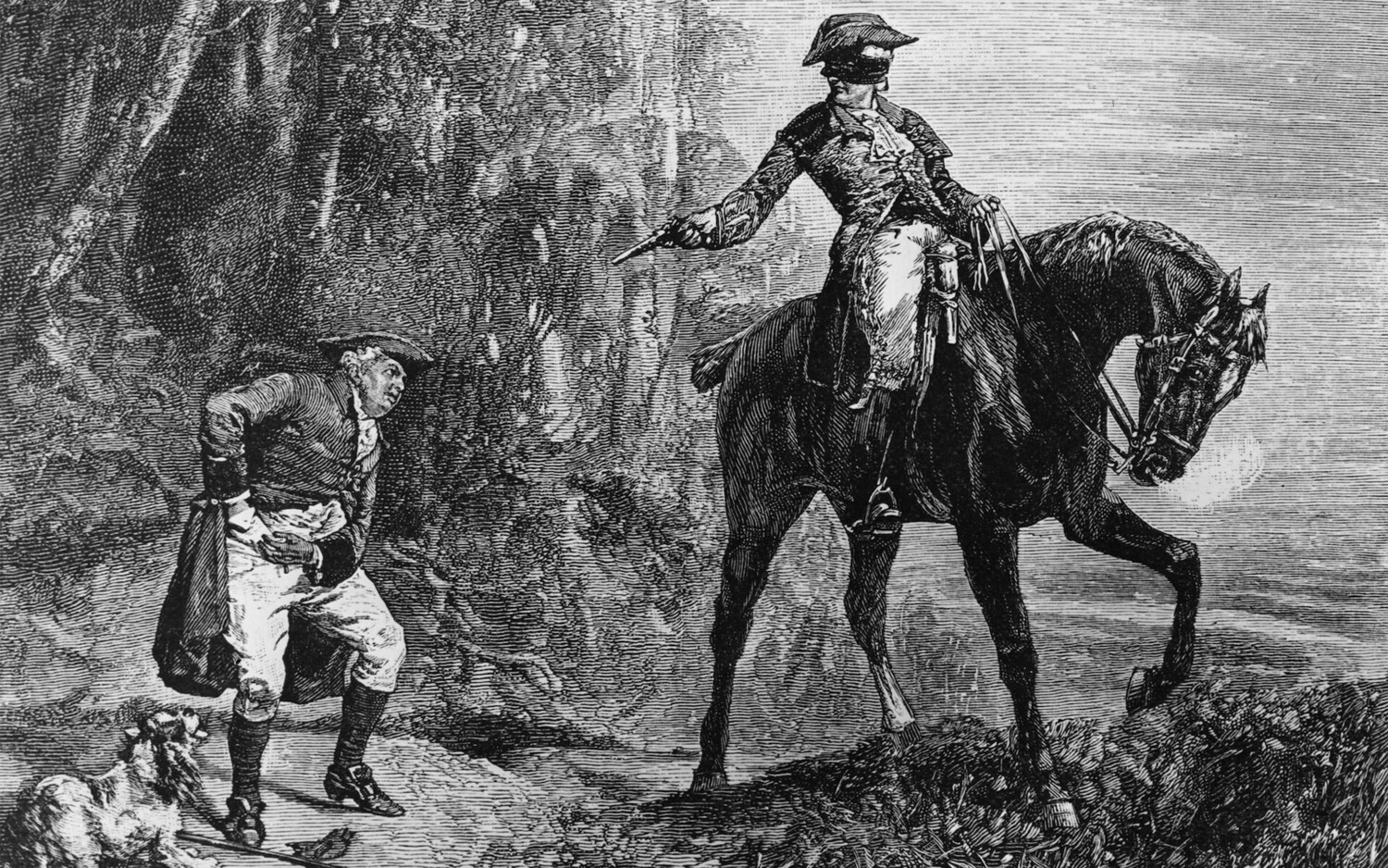
But my favourite source was the letters of the eighteenth-century wit and gossip Horace Walpole, who lived for much of his life at Strawberry Hill. They are full of observations about life in Twickenham. In particular there is a graphic account about being robbed by a highwayman on his way to a dinner party in October 1781. Coincidentally, a few weeks later I found a newspaper account about how a woman sent a highwayman packing while out walking along Kew Road with a group of male friends who cowered as the rogue approached. How readers must have applauded her brave action as these bandits were a menace praying on respectable (and wealthy) travellers.
Highwaymen only disappeared with the introduction of effective policing. Several articles looked at the police. The local beadle made himself scarce during a riot at Barnes Fair in 1801, which was only quelled by a local magistrate Sir Robert Baker, who told the Home Office that after he marched into the crowd they sung ‘“God save the King”’ twice over and thank[ed] me for my conduct.’
Some surprising material also turned up. A Parliamentary inquiry in 1861 looked at the health of the Thames and heard evidence from a number of local fishermen who remembered that salmon and other fish which had once been common had died out almost overnight during the 1820s as the result of sewage flowing downstream from London.
In March 1973, there was an audacious raid on Twickenham’s Crown Post Office, in which nearly half a million pounds were stolen – the third largest mail robbery ever. It would have been more but the gang was disturbed before they could break into the main vault, which the press speculated contained more than £1.5m. There’s a fascinating file at the Royal Mail Archives about the subsequent investigation. Nobody was ever caught nor were the proceeds recovered.
My favourite story is the case of the Reverend William Stukeley and the Kew Gardens druids. As readers will know Stukeley was the preeminent antiquarian of the day. When an Iron Age axe head was found in the grounds of Kew Palace in 1754, he was asked to investigate. Unfortunately, the good doctor had an unhealthy obsession with druids and, without a shred of evidence proclaimed that the axe: ‘a sacrificing knife of the ox-kind.’
How many of these articles could be regarded as serious local history? Afterall there was little rhyme or reason to the articles, except the subjects were those which interested me. And can you really say very much in 460 words?
However, some of the pieces at least looked at subjects which hadn’t been studied by other local historians particular those relating to the environment and economy of the Thames. And, personally, it encouraged me to widen my historical interests.
After 130 different topics it was time to call it a day. Not that I was running out of ideas, but it writing the articles was becoming a chore rather than a pleasure. Providing pieces like this can be hard work, but it can be very rewarding. But more importantly with luck it will encourage readers to take more interest in the past around them, and perhaps take up local history as a serious pursuit.
The views and opinions expressed in this blog are those of the author and do not necessarily reflect the official policy or position of the British Association for Local History (BALH). Any content provided by our contributors is of their own opinion and is not intended to malign any individual, group, organisation, or entity.