Music and Murder under the Midnight Sky: the lives of the assistants and computers of the Royal Observatory at Greenwich
Published: 25th November 2020

Dr Daniel Belteki
Royal Museums Greenwich
@dbelteki
Dr Daniel Belteki is a ROG350 Sackler Research Fellow at the Royal Museums Greenwich. He is researching the lives and scientific contributions of the individuals working at the Royal Observatory, Greenwich during the nineteenth century.
A defining feature of the Greenwich landscape is the Royal Observatory at Greenwich. It is well known for its historic role in defining the International Prime Meridian and for producing Greenwich Time.
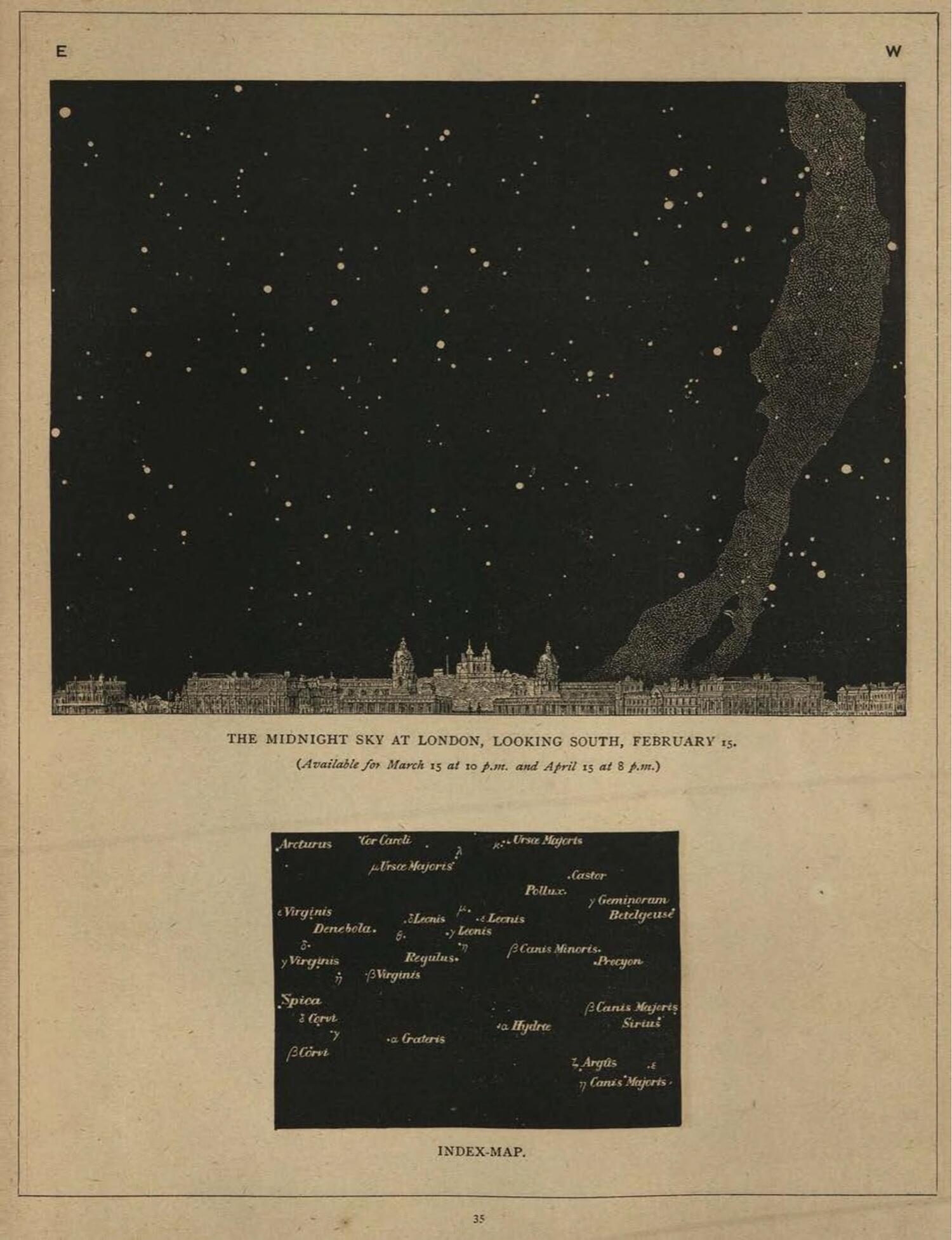
A page from Edwin Dunkin's Midnight Sky (London: The Religious Tract Society, 1891).
Yet, it is easy to forget that the daily work of the Observatory relied on a small community of people who lived in the areas surrounding Greenwich Park. Since historians often focused on the individual “heroes” of science, the lives and contributions of these assistants have often remained forgotten.
During the nineteenth century, the number of assistants and computers (people carrying out mathematical calculations) employed at the Observatory increased rapidly. When John Pond, the sixth Astronomer Royal (and director of the Observatory), arrived in 1811, he found only one assistant working there. By the time the next Astronomer Royal, George Airy, took over in 1835, six assistants were working on site on a daily basis. The number of staff continued to gradually increase with the addition of new departments, instruments, and astronomical projects.
The assistants and the computers almost always lived around the Observatory. To better understand their living situations, I am currently creating a map using the Layers of London platform to show where the assistants lived (the map can be accessed via this link https://www.layersoflondon.org/map/collections/594). For this I am using data compiled by Graham Dolan who runs the website http://www.royalobservatorygreenwich.org/. The map shows that many members of the Observatory staff lived in the vicinity of the Observatory, with assistants often living on the same street. It also shows that they frequently moved as their ranks or personal circumstances changed. Most importantly, it shows that the workforce of the Observatory lived in close proximity to each other, which allows us to examine them as a community.
Many of the assistants developed close friendships. Arthur Bowden remembered fondly about spending his free time with other assistants, such as the Criswick brothers (George and Henry Charles) in their family home: ‘we three young men always found our greatest happiness by the [Criswick] family fireside.’ (Bowden, 1916, p. 171) From Bowden’s recollections we also learn that after George Criswick’s marriage to the musician Elise Tudor Hassall, their new home became ‘the centre of a musical and literary coterie’. (Ibid. p. 172) Music played an important part in the life of Edwin Dunkin too. In his free time, he took singing lessons as part of the Greenwich Madrigal Society and performed with the choir at Exeter Hall. (Dunkin, 1999, p. 84) In his autobiography, he also recalled participating in the activities of the local Greenwich Society for the Acquisition and Diffusion of Useful Knowledge. He was the Honorary Secretary of its Library Sub-Committee in which position he ‘prepared and edited a supplementary catalogue of several thousand books’ that were given to the Society. (Ibid., p. 85)
The assistants did not always live merry lives outside the Observatory. One of the most prominent examples to this was William Richardson. In 1845, the Astronomer Royal received information about Richardson engaging in an incestuous relationship. After the Astronomer Royal investigated the matter, he suspended Richardson from his job. (Astronomer Royal’s Journal, 27 October 1845) On 22 January 1846, a workman was digging a cesspool in Richardson’s garden, when a small coffin was unearthed. Opening it revealed a decomposed body of a child. After the initial investigations, William Richardson and his daughter, Ann Maria, were arrested on charges of concealing the birth of their incest child and murdering their 10 days old baby with arsenic. The case became labelled as the ‘Greenwich Murder’ by newspapers and gained nationwide notoriety. (Rodrick, 2017) Ultimately, William and Ann Maria were acquitted as incest was not yet considered crime at the time, and the evidence for the use of arsenic remained disputed. As a result, they returned to their countryside residence in Pocklington, Yorkshire, where William lived out the rest of his life.
The personal lives of the computing staff affected their work at the Observatory even more. The computers worked in the ‘Great Room’ (today known as the Octagon Room), which was a site of heated conflicts. The person superintending in the Great Room during the late 1830s, John William Thomas, often reported on the misbehaviour of the computers. Through his letters we learn about a computer named Mr Foley calling the Observatory and its working conditions ‘a beastly place, a slavery, and that no one but a half-starved beggar would stop in it’. Foley also actively encouraged others to ‘disrespect’ the Astronomer Royal by finding loopholes in the work regulations. (Thomas to Airy, undated) His complaints were not baseless as the work of the computer lasted 11 hours a day during the early years of Airy’s directorship. Even the superintendent of the Great Room reported that working such long hours made him ‘stupified’. (Hughes, 1999, p. 164)
The next superintendent of the room was Hugh Breen. His reports to the Astronomer Royal described a room governed by calm and quiet focus on work. However, Breen also gained enemies. When he was recommended for the position of Honorary Secretary of the Royal Astronomical Society, an objection was raised against his nomination. The objection was later clarified in a letter sent to the Astronomer Royal by a former assistant of the Observatory, John Russell Hind. Hind wrote that one night he saw ‘Mr. Breen leaning against the wall in such condition, that I could not doubt he was far from sober’, which confirmed to Hind rumours that he had previously attributed to ‘Mr Breen’s unpopularity in the Great Room.’ (Hind to Airy, 1846) Although Airy downplayed the accusations saying that a ‘mere getting drunk once or twice may happen to any body’, (Airy to Hind, 1846) Breen withdrew his candidacy because he thought he would degrade himself as he considered the position no ‘better than the situation of an Upper Servant in a respectable family’. (Breen to Airy, 1846)
The lives of the Observatory staff were filled with action and deserve closer attention. Their strenuous daily labour greatly contributed to achieving the aims of the Observatory. Meanwhile, their personal lives outside the Observatory had a major impact on their employment. As we have seen, excessive drinking, incest, and murder charges were not considered befitting to the character of the Observatory staff. The demanding labour at the Great Room tested the patience of the computers, and created long-lasting enemies who interfered into the careers of their foes. If astronomy is a history of the “heavens”, a working history of an Observatory reminds us about the “earthly” character of astronomical labour.
Social media:
Follow this Twitter account for details of research relating to the Observatory's history: @airyrog
Works cited:
Bowden, Arthur. (1916) ‘George Stickland Criswick - Some Memories’, The Observatory, 50, pp. 168-173. http://articles.adsabs.harvard.edu//full/1916Obs....39..168B/0000168.000.html
Dunkin, Edwin. (1999) A far off vision: A Corhishman at Greenwich Observatory ‘Auto-biographical notes’ (Truro: Royal Institution of Cornwall).
Hughes, R. Elwyn. (1999) ‘Arfonwyson - Uchelgais A Siom’, Llyfrgell Genedlaethol Cymru (National Library of Wales Journal), 31:2, pp. 149-172. https://journals.library.wales/view/1277425/1290993/34
Rodrick, Anne. (2017) ‘Melodrama and Natural Science: Reading the" Greenwich Murder" in the Mid-Century Periodical Press’, Victorian Periodicals Review, 50:1, pp. 66-99.
Documents from the Cambridge University Library, Royal Greenwich Observatory Archives, Papers of George Airy collection (RGO 6):
Entry for 27 October 1845 in the Astronomer Royal’s Journal, 1836-1847, RGO 6/24. Available online at https://cudl.lib.cam.ac.uk/view/MS-RGO-00006-00024/217
Note from John William Thomas to George Airy, undated, RGO 6/525 15.
Letter from John Russell Hind to George Airy, 26 January 1846, RGO 6/229 224-225.
Letter from George Airy to John Russell Hind, 27 January 1846, RGO 6/229 226.
Letter from Hugh Breen to Robert Main, 8 April 1846, RGO 6/229 233.
The views and opinions expressed in this blog are those of the author and do not necessarily reflect the official policy or position of the British Association for Local History (BALH). Any content provided by our contributors is of their own opinion and is not intended to malign any individual, group, organisation, or entity.