
Not all people who lost their lives in the First World War were commemorated on war memorials
Published: 1st March 2022

Linda Hutton
@HuttonCroft
Linda is a PhD student at the University of Wolverhampton, where she is researching aspects of the First World War in her hometown of Barnsley. Originally from Sunderland and Durham, Linda moved to Barnsley from Sheffield nearly 20 years ago. After taking early retirement in 2011, Linda studied her BA in History at the Open University before successfully completing her MA in the History of Britain and the First World War at the University of Wolverhampton. Linda was a volunteer on a project to record all of Barnsley’s war memorials during the First World War Centenary, and this now forms the background to her PhD research.
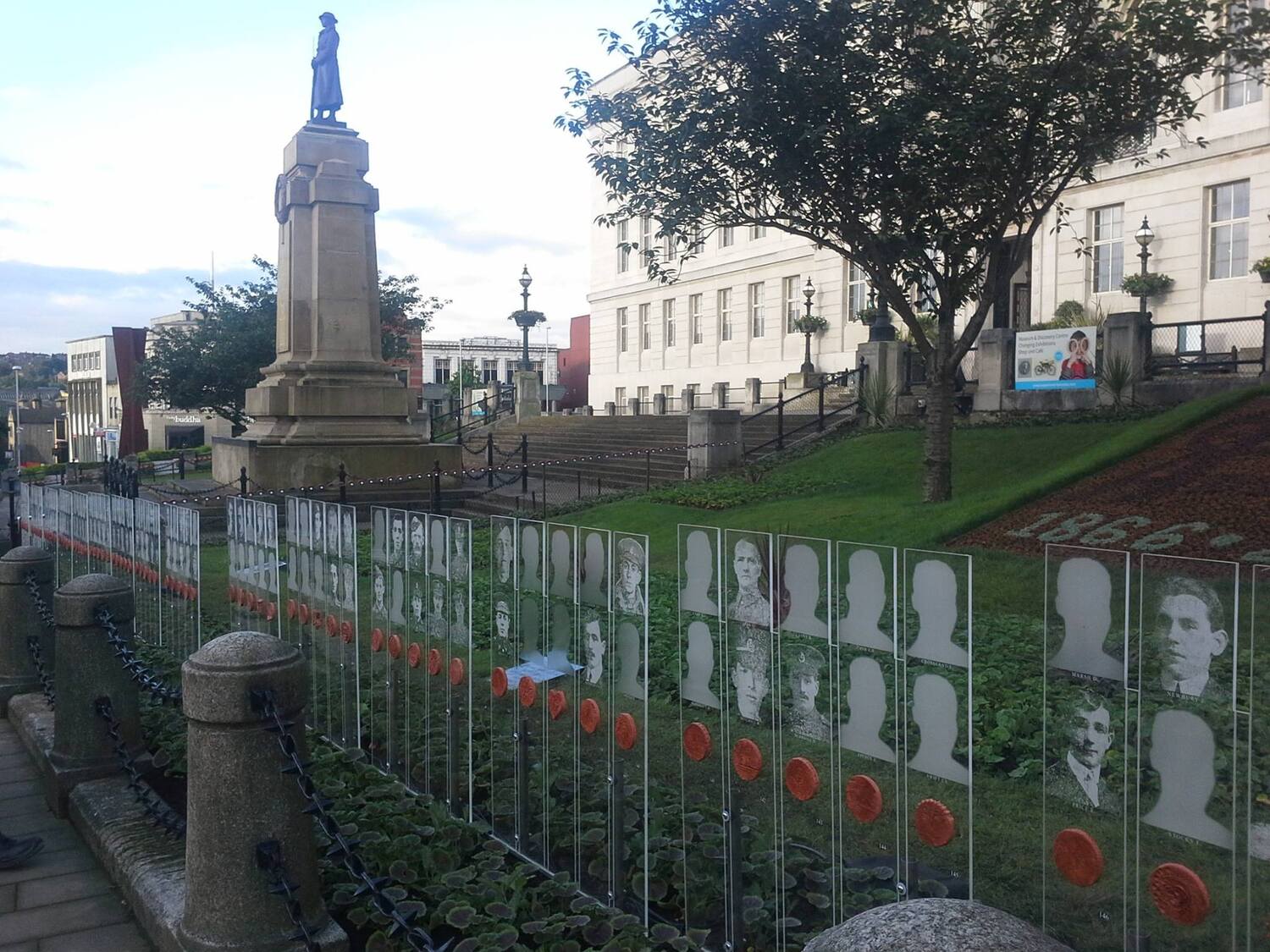
War memorials are a common feature in our towns and villages but as this blog highlights, not all the fallen were commemorated in this way.
The UK War Memorials website was set up and funded by the government during the First World War Centenary.[1] Partners involved in the site included the Imperial War Museum, Civic Voice, Historic England and the War Memorials Trust. One of its ‘Frequently Asked Questions’ suggested a few reasons for names being absent from war memorials.
It is possible that mistakes were made when information was collected and then inscribed. [...] Families may not have wanted to include the name of relatives listed as ‘missing in action’. Individuals may be commemorated on a war memorial where they had no personal connection but where their only surviving family member lived.[2]
Over the next few years, I will be attempting to discover the reasons why more than 600 Barnsley-born men and women who lost their lives due to the First World War were ‘Absent’ from any of the war memorials in the Barnsley Borough in the period 1915-1939.
A voluntary project which ran in Barnsley during the Centenary collated and published a First World War Roll of Honour for the Barnsley Borough.[3] Their research found 3784 men and women who lost their lives who were connected in some way to Barnsley, either by birth, because they lived in the Borough at the time they started their war service or because they are listed on a war memorial in the area. However, of the total, over 700 were NOT commemorated on any war memorial in the area.
I have decided to focus on the Barnsley-born men and women who were not commemorated by any form of tangible memorial during the immediate period following their deaths, from 1915 to 1939. This eliminates people who had come to Barnsley before the war, and still had strong ties to their homes. These incomers can often be found commemorated in their places of birth, or in the places where their parents lived after the war.
Some of the Barnsley-born people who were not commemorated immediately after their deaths have been included in more recent memorials in the Barnsley area or added to existing memorials following community research projects. They were not included in the count of 700+ mentioned above as they are now commemorated somewhere in Barnsley. I have added these people to my sample in order to carry out an inclusive study of the all the people ‘Absent’ from commemoration during my time period, 1915-1939.
My base data is the information used to produce the Barnsley Roll of Honour in 2018. Since the voluntary project was wound up in 2019, I have continued to research Barnsley war memorials and Barnsley connected men and women who were affected by the First World War, in collaboration with another of the former members of the project. The research into the reasons for ‘Absence’ from commemoration is mine and mine alone, although I do share my findings with my colleague.
The UK War Memorials site suggested some reasons for names being absent from memorials, I am finding evidence in the Barnsley area to support their suggestions. I am also finding evidence of other reasons for their absence
One of the main reasons why some Barnsley-born men are not remembered on our memorials is that they can be traced moving to other towns or countries before the war. Some of this information is available using the collection ‘Soldiers Died in the Great War’, originally a series of printed volumes, but now available online at Ancestry and Find My Past.[4] Places of birth, residence and enlistment are amongst the information that was collected for these volumes. Other useful sources include the Commonwealth War Graves Commission website and the Pension Records saved by the Western Front Association.[5] These men can sometimes be found named on war memorials in the places where their widows and children lived after the war
One of the ways in which men who were ‘Absent’ were later remembered was by the addition of a memorial inscription on a family gravestone when the subject is buried elsewhere or has no known grave. The Imperial War Museum includes these ‘Additions to Gravestones’ in their definition of a war memorial.[6] It is difficult to prove exactly when an inscription was added to an existing gravestone, or a completely new gravestone including a memorial inscription was erected, however analysis of the text on the gravestone and research into the family concerned can sometimes indicate that the inscription was made after the deaths of immediate family members such as parents.
This leads me to another question – what evidence is there in Barnsley of the suggestion made by the UK War Memorials website that men who were ‘missing in action’ were omitted from war memorials by choice? Although I have heard anecdotal evidence suggesting that some mothers didn’t want their son’s name to be inscribed on a war memorial because they still hoped the man would return home, I have not found any documentary evidence of this. Is there a correlation between men being remembered on family gravestones after the death of their parents and their status at death of ‘missing presumed dead’? I look forward to investigating this question.
I am currently nearing the end of my second year of part-time PhD study and am excited to have found such an interesting an unusual topic to research. I hope to submit my thesis by May 2026.
All websites referred to were consulted on 9 February 2022.
[1] UK War Memorials, https://www.ukwarmemorials.org/index.html
[2] UK War Memorials, ‘Frequently Asked Questions’, https://www.ukwarmemorials.org/faqs/index.html
[3] Barnsley War Memorials Project, 2014 to 2019. See http://www.barnsleywarmemorials.org.uk/2014/08/about-this-project.html; Barnsley War Memorials Project, Barnsley First World War Roll of Honour (2018).
[4] HMSO, Soldiers Died in the Great War (1921) originally printed in 81 volumes, available on Ancestry.co.uk, https://www.ancestry.co.uk/search/collections/1543/ .
[5] Commonwealth War Graves Commission, https://www.cwgc.org/ ; Western Front Association, ‘Ancestry Pension Records’, https://www.westernfrontassociation.com/ancestry-pension-records/
[6] Imperial War Museum, ‘War Memorials Register Definition of a War Memorial.pdf’, downloadable from https://www.iwm.org.uk/memorials
The views and opinions expressed in this blog are those of the author and do not necessarily reflect the official policy or position of the British Association for Local History (BALH). Any content provided by our contributors is of their own opinion and is not intended to malign any individual, group, organisation, or entity.


