Online resources for local history: the Bibliography of British and Irish History (BBIH)
Published: 14th July 2023

Jenny Lelkes-Rarugal
Jenny joined the Institute of Historical Research (IHR) in 2021 and is the editor for the Bibliography of British and Irish History (BBIH).
Jenny Lelkes-Rarugal, editor for the Bibliography of British and Irish History shares how you can discover what’s already been published in your field.
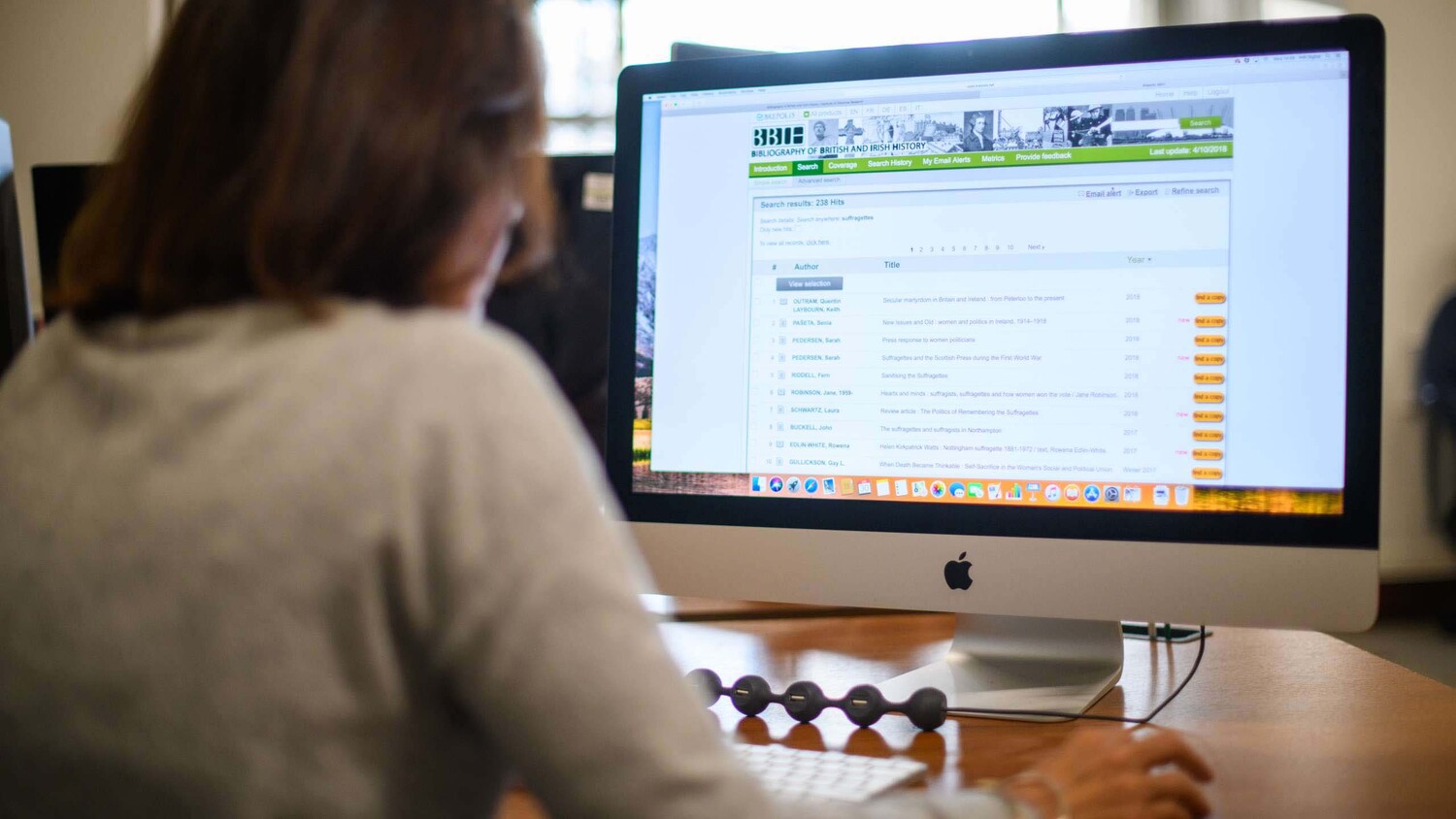
Most people will probably turn to online search engines such as Google. Whilst search engines will certainly provide you with a lot of results, how can you quickly ascertain their usefulness for your study, teaching or research? The problem with Google and other search engines is that they search indiscriminately and do not distinguish between the academic and the non-academic, the relevant and the irrelevant.
This is where the Bibliography of British and Irish History can help you: with targeted searches of literature that has already been evaluated by expert historians to ensure its relevance to your theme.
About the Bibliography of British and Irish History (BBIH)
The Bibliography of British and Irish History is one of the most accurate and comprehensive resources available for studying, teaching and researching the histories of Britain, Ireland, and the British Empire and Commonwealth from 55 BCE to the present day.
BBIH can also be used to study, teach and research a wide range of interdisciplinary historical fields such as the histories of race and ethnicity, migration, gender, disability, the environment, and emotions.
What does BBIH contain?
BBIH provides up-to-date information on over 640,000:
- History books, articles, chapters, edited collections (published from the early 1900s to present).
- History theses (submitted late 1990s to present).
The bibliography is updated three times a year, with c.10,000 new records annually. BBIH editors also regularly check over 800 journals and book series for new content.

Top 5 tips for using BBIH when researching local history
- Subject tree
BBIH’s hierarchical subject tree has been created specifically with historians in mind. It offers you a powerful way of searching by subject because it uses terminology systematically applied to records by BBIH’s editors: your results will not depend on the appearance of words in titles or in keywords provided by authors. You can learn more about the subject tree here.
If you research also involves Irish History in any capacity, it’s recommended to use Irish History Online in conjunction with BBIH so that you don’t miss any important resources for your research.
- Place names tree
BBIH’s place names tree enables you to conduct very granular place-based searches in the UK and Ireland, whether that be by Anglo-Saxon realms, villages, towns or cities. BBIH also enables you to search by international countries, and is particularly strong on former British colonies and Commonwealth countries, as well as mainland Europe.
An additional resource you might find helpful to consult when using BBIH’s place names tree is the Gazetteer of British Place Names.
- Period covered
BBIH records are searchable by a wide range of facets, but one of its unique features is being able to search by historical period. You can specify a precise date or set a chronological range.
- Explore the links in BBIH
When looking at a BBIH record, it is often worth exploring the links as they will often help you with your research:
- Any text in green in the classification details is a link to a new search within BBIH – this is really helpful for finding what else the bibliography holds relating to the theme, place or period of your research project.
- Where available, BBIH editors add external links to reviews, the full text (e.g. via the DOI, journal homepage or databases such as JSTOR or Project Muse), Oxford Dictionary of National Biography and The National Archives (UK) catalogue.

- Accessing materials online or in your library
BBIH is a database of secondary sources. Therefore, once you have found relevant resources for your research, you will need to navigate from BBIH to different library catalogues to consult the materials in print or online.
If you are affiliated with an academic institution, make sure you are logged into BBIH with your institutional library account. This will help with the seamless process of accessing the full-text if your library has a copy.
If your library does not have access the full-text of a resource you’ve found in BBIH, you can navigate from BBIH to Jisc Library Hub Discover or WorldCat (via Google Books) so you can plan to visit another library or request items via interlibrary loan.
Get the most out of using BBIH
The bibliography also offers a range of support such as user guides and videos to aid in your research, as well as themed online reading lists. You can learn more about using BBIH, as well as advice on how to keep up-to-date with the latest published research in your field and manage your reference lists or bibliographies by visiting our help pack.
Subscribe to BBIH
Access to BBIH is via subscription:
- Individual subscriptions. If you are a Friend of the IHR, an individual subscription is available at the discounted price of £35 GBP for 2023. An individual subscription is also available to Royal Historical Society members and Fellows and Historical Association members at a substantially reduced rate.
- Institutional subscriptions. Many UK and international university and research libraries subscribe and provide full access to members. Rates are tailored to the institution.
Keep up-to-date with BBIH
To keep up-to-date with BBIH you can:
- Follow the UK’s Institute of Historical Research (IHR), Royal Historical Society (RHS) and Brepols on Twitter @ihr_history, @RoyalHistSoc and @Brepols
- On history – BBIH publishes regularly in On History, a digital magazine produced by the IHR.
- Brepolis blog – BBIH updates, including themed online reading lists, can also be found here.
Contact BBIH
You can find out more information about contacting BBIH here.
The views and opinions expressed in this blog are those of the author and do not necessarily reflect the official policy or position of the British Association for Local History (BALH). Any content provided by our contributors is of their own opinion and is not intended to malign any individual, group, organisation, or entity.