Remembering the Royal Female Orphanage
Published: 13th June 2022

Dr Philippa Mesiano
@PhilippaMesiano
Philippa is the Activity Plan Coordinator for the National Lottery Heritage Fund Project: ‘Restoring and Celebrating the Arts and Craftsmanship of St Mary’s Church, Beddington’ taking place between July 2021 and June 2023. As part of this role, she is overseeing a group of trained volunteers who are conducting research and oral history interviews linked to the Royal Female Orphanage, located at Carew Manor in Beddington Park from 1866 – 1939.
The Royal Female Orphanage, originally named the ‘Asylum or House of Refuge for Orphans and Other Deserted Girls of the Poor’ was founded in Lambeth in 1758. It was one of a number of charitable institutions (most notably the Foundling Hospital) founded in the mid-eighteenth century to support and care for poor and destitute children, often orphaned or made fatherless as a result of one of the many wars during this century.

The Female Orphan Asylum, Westminster Bridge Road, Lambeth. Coloured engraving by A. McClatchy after T. H. Shepherd, 1828 @ Wellcome Collection.
In 1866 the Orphanage was relocated to a historic manor house in Beddington Park, which had been owned by the Carew family from c.1359 to 1859. In this more rural setting, the girls could benefit from the fresher air and green open spaces.

The orphanage at Beddington was closed at the start of the Second World War in 1939. At this point, the majority of girls returned home to their families or nominated guardian. Fifty-eight girls who remained under the care of the orphanage were evacuated to an estate at Camborne in Cornwall, owned by the Orphanage’s Chairman, Mr Francis Allen. This estate was requisitioned for war use in 1943 and the Orphanage was moved to 743 London Rd in High Wycombe, where it remained until its final closure in 1968.
Foundation
One of the frontrunners behind the orphanage’s foundation was Sir John Fielding, a lawyer and philanthropist with a keen interest in the welfare of women and children, who had gathered donations in support of its creation. Fielding had been blinded in a naval accident at the age of 19, yet he was a notable magistrate and social reformer in eighteenth century London.

Admission
From the beginning, there were certain conditions of entry into the Orphanage. Girls had to be orphaned or fatherless, aged between 9 and 12 and be baptised in the Church of England. No girls of colour were permitted, and all entrants had to be in good mental and physical health.

From 1769 the children had to have either had or been vaccinated against smallpox before they could be admitted.
Mothers and guardians signed an agreement waiving all rights surrounding a girl’s upbringing and education while in the care of the Orphanage as well as her first apprenticeship after leaving the institution.
By the early nineteenth century, it was difficult to acquire a place. Girls received nominations from local respectable people to help them gain entry once there was a vacancy.
Patrons
From Florence Nightingale to Admiral Nelson, the Orphanage had a number of famous patrons over the years, many of whom were members of royalty.
The Orphanage Management Committee were frequently trying to raise funds for staff and upkeep, and to save money where they could. The association with royalty helped bolster the reputation of the institution and bring in more generous donations.
Day to Day at Carew Orphanage (1866 – 1939)
The site at Carew Manor could accommodate up to 150 girls aged between 7 and 16.

Girls started their day at about 6.00am. They got up, stripped their beds, washed themselves, and went to breakfast.
They would eat their meals in the Tudor Great Hall. No talking was permitted during mealtimes.
The food was plain and simple, but it did somewhat improve over the years. Typically, they had porridge for breakfast, meat and vegetables for dinner and bread and cheese for supper.
The building would have been very cold.
Regular church attendance at St Mary’s was an important part of orphanage life. The girls had appointed pews in the St Nicholas Chapel, located in the north aisle of the church, next to the Vestry.

Between 1866 and 1920, the girls were schooled at Carew Manor. They received lessons in reading, writing and arithmetic as well as housework and needlework. From May 1920, they began attending local schools (Beddington Infants and Hackbridge Primary School). However, it was noted that their reading and writing skills were behind those of other girls their age.
There were a variety of disease outbreaks over the years. These outbreaks included: flu, scarlet fever, diphtheria and typhoid fever. This may have been due in part to the cold building, and also the unsanitary condition of the outdoor toilets.
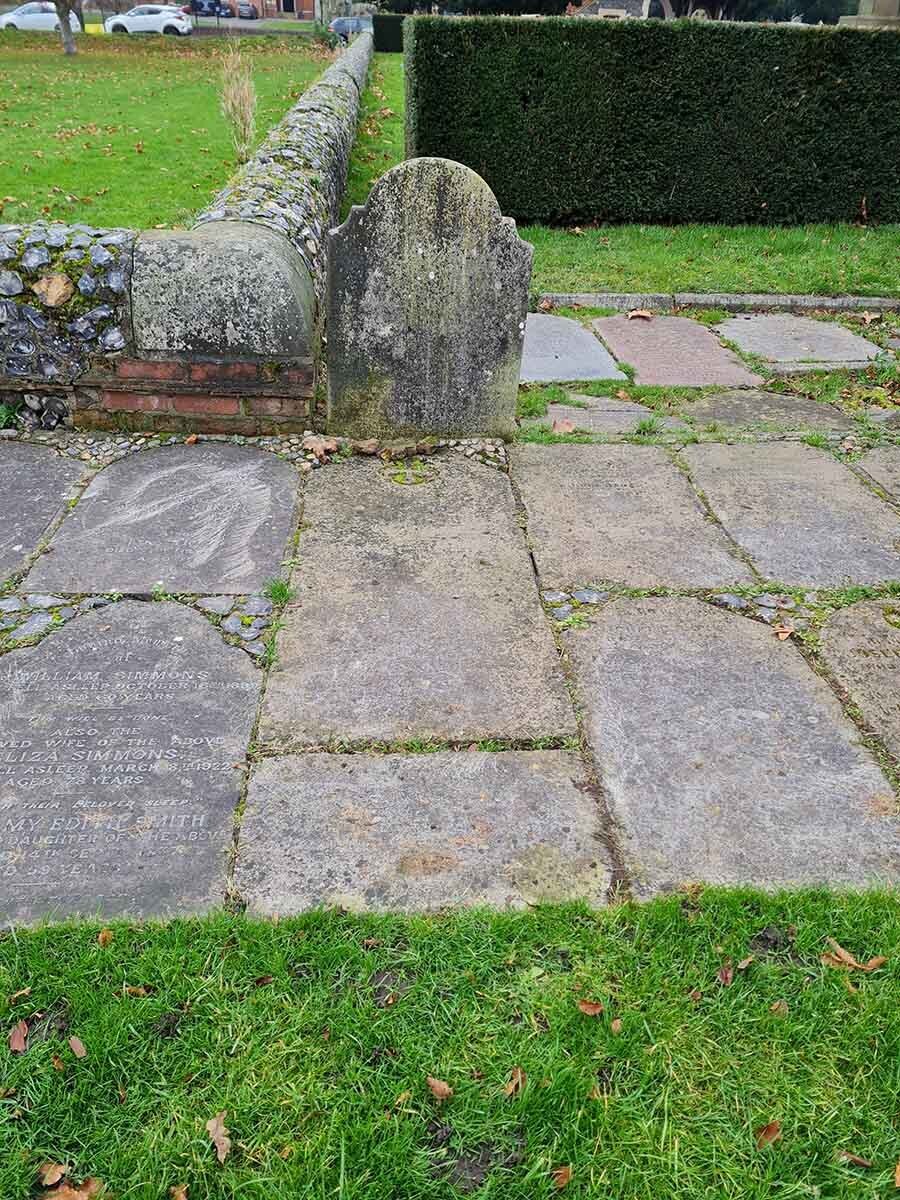
A number of girls died while attending the Orphanage. Their names are recorded on a now fairly weathered memorial stone in St Mary’s churchyard.

After the Orphanage
The majority of girls went onto employment in domestic service roles, often as housemaids, cooks and nannies. Some girls (especially after 1914) went on to be teachers or have jobs in retail, administration, manufacturing, and business. While others became wives and mothers shortly after they left the orphanage.
Girls received 2 guineas from the Committee as reward for remaining in their first appointed post for 2 years.
While a lot of girls stayed living locally, others moved abroad to places such as Australia, Canada and the United States.
Reflections on the Experience
Undoubtedly, it was a hard life – strict and regimented with few luxuries. Yet, the Orphanage Committee and staff acknowledged and upheld their duty of care to these girls, providing what they believed was the best start in life.
The Orphanage was often over-subscribed and there are many letters from mothers of the girls addressed to the Committee and staff, thanking them for this opportunity given to their daughters.

It is important to remember that the Royal Female Orphanage was a product of the society within which it was founded. It developed and improved over time, adapting to new laws and shifting attitudes towards institutional care. Its Committee and staff continuing to provide a practical and moral upbringing for young girls whose families and guardians could not support them.
If you have any memories or information associated with the Royal Female Orphanage which you’d like to share with us, please get in touch:
Email: heritage@stmarysbeddington.org.uk
Phone: 07555144068
The Royal Female Orphanage Exhibition will take place at Honeywood Museum in Carshalton in August 2022 and Sutton Central Library in September 2022.
Follow us on social media for more updates.
Further Reading
London Borough of Sutton: Archives & Local Studies, D2/1–7
Buckinghamshire Archives, A.R.66/82
Asylum for Orphan Girls, An account of the institution and regulations of the guardians of the asylum, or house of refuge (London, 1793).
Thomas Bentham, A History of Beddington (London, 1923)
Beverly Shew, Times Remembered, Times Past: A History of Beddington and Bandon (2012). Available online at: http://cadhas.org.uk/wp-content/uploads/Occ-3-Beddington.pdf
The views and opinions expressed in this blog are those of the author and do not necessarily reflect the official policy or position of the British Association for Local History (BALH). Any content provided by our contributors is of their own opinion and is not intended to malign any individual, group, organisation, or entity.