Report for July’s Local History Hour: Marginalised Lives in Localities
Published: 10th August 2021

Helen Palmer
BALH Outreach
Helen is an archivist and member of the BALH Outreach team.
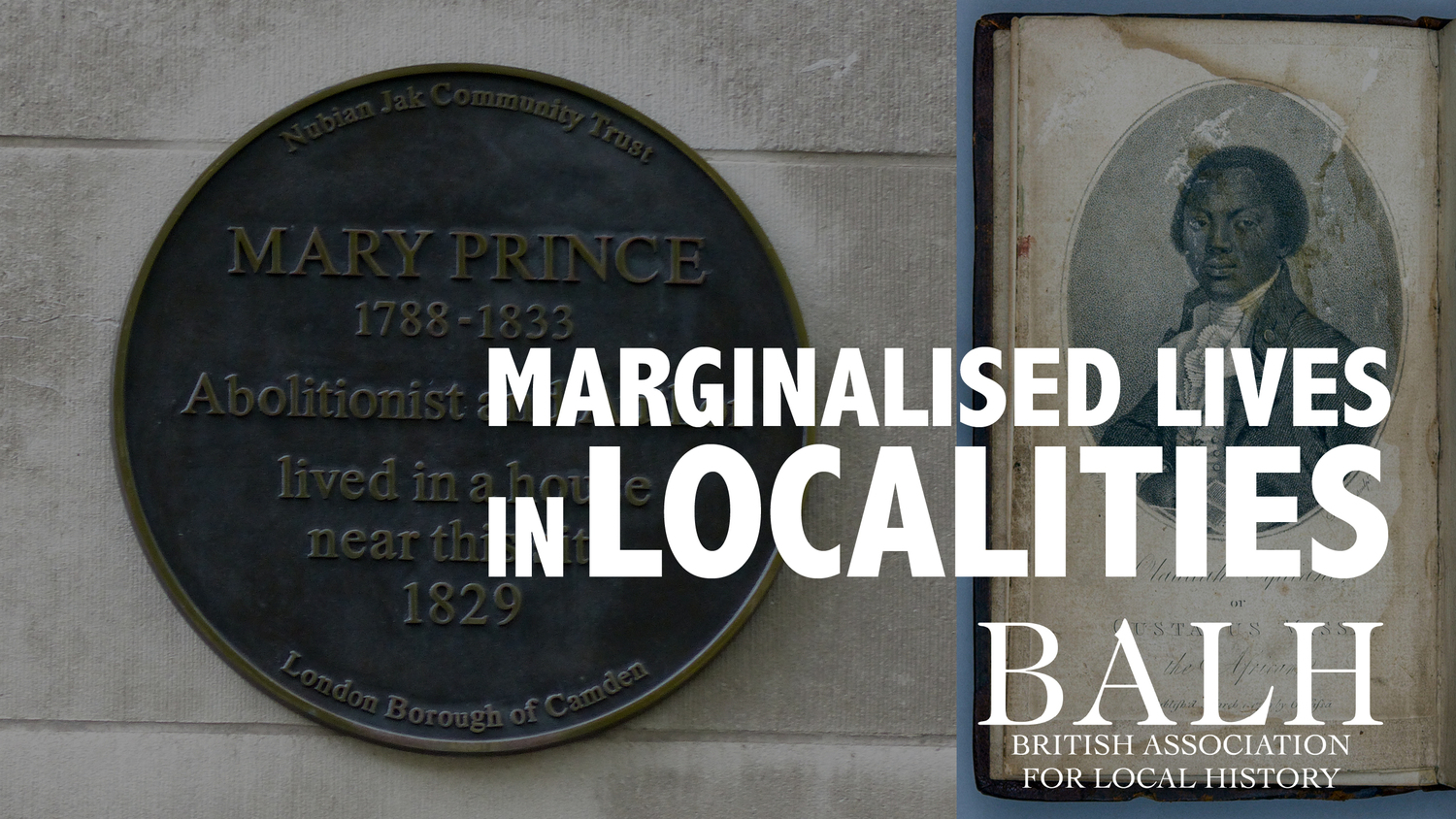
This month’s speakers were Dr Anna Cusack, who recently completed a PhD at Birkbeck, University of London and Emeritus Professor David Killingray.
Even today those who live on the margins of society often leave very few traces, despite the fact that these people have lived and loved and thought and felt as much as any who leave more tangible evidence of their lives. Both speakers produced vivid examples of the “extraordinary lives of ordinary people” using a wide variety of records.
The July talk explored some ways to recover and research marginalised lives in the eighteenth and nineteenth century. Anna Cusack in “Visibility in London through executions c1700-1780” explored records of crime and criminality to reveal some fascinating stories, rich in detail, using as a basis the remarkable Old Bailey Online site which provides transcripts and original images of the proceedings of the law courts at the Old Bailey. Court records provide a marvellous insight into the lives of many marginalised members of society. Anna recounted the story of the stabbing of Captain Joseph Johns, which resulted in the prosecution of Hosea Youell and Jacob Lopez for his murder. You may read the account here : https://www.oldbaileyonline.org/browse.jsp?div=t17471014-13 The narrative gives us the authentic voices of the witnesses recounting the commonplace details that led to the death of a man at the Dolphin Inn in Devonshire Square. Anna used illustrations to great effect including a sketch by Thomas Rowlandson of Rag Fair ( near where Liverpool Street Station now stands ) where the defendant claimed he had bought the sword used in the attack but given it to someone else. Youell gave himself up but hoped to exonerate himself by telling the tale of the mysterious “third man” who made the fatal attack, but was – unfortunately for him – unaware that Captain Johns was still alive and able to identify him as his assailant.
Anna’s second subject was the trial of Charlotte Gardiner, a young black woman who was tried for her involvement in the Gordon Riots. Once again, the witness statements make dramatic reading https://www.oldbaileyonline.org/browse.jsp?div=t17800628-65 Anna used John Roque’s wondrous map of London (1746) to follow the rioter’s progress through the eighteenth century streets.
Both Anna and David provided timely reminders however, that the reader should always interrogate their sources and “use your critical judgement”: we always need to ask ourselves for what purpose a document is created before we come to conclusions about its integrity. And we should also remember that many records about marginalised lives are the opinions of others, not the voices of the people themselves.
David raised this issue in asking Anna about the broadsheets and pamphlets of “last dying speeches” the publications sold as the last words of the condemned. These and “execution ballads” were popular souvenirs. Today they provide opportunities to explore historic ideas of “a good death” (even at the hands of the hangman) and the religious mores of the day, but may not have reflected the actual words of those about the be hanged by the state.
David’s paper “People of African Origin and Descent: Diversifying British Local History” flagged up the wide range of sources which might yield information. Although there were some famous, and celebrated people of colour in eighteenth century Britain, there were also thousands of “ordinary people” whose lives went largely unrecorded, and the fact of whose colour might - but equally might not - feature in any of the minimal records ( such as baptism, marriage and burial registers ) that survive about them.
David discussed the “Runaway Slaves in Britain Project” created by Glasgow University ( https://www.runaways.gla.ac.uk/ ) which holds a database of over 800 newspaper advertisements seeking information on bound and enslaved people of colour who had left the service of their “masters” or “owners” without permission. David pointed out that 14% of the advertisements refer to enslaved people. The remaining percentage reflect the labour laws of the period which gave almost all rights to the employer or “master” over the “bound labourer” regardless of race: it was an offence to flee from an employment contract or apprenticeship especially if one happened to make off whilst wearing clothes which were the property of the employer. These advertisements of the absconding men and (less frequently) women, make compelling if disturbing reading in their vivid descriptions of the individuals concerned. We have the generic drawings of Hogarth and Rowlandson but we do not have many word-pictures of real members of the labouring classes at this period.
African American Phillis Wheatley, whose verse was published in London after it attracted the attention of the Countess of Huntingdon, was cited as a rare example of a well-known black woman and former slave, whose own voice may be heard within her writing. So too the voice of Mary Prince, born enslaved, may be heard in her autobiographical memoir, her narrative written down for her by Thomas Pringle, a British abolitionist.
The incidence of people of African descent in eighteenth and nineteenth century British art helps to broaden our understanding of the diversity within the population at the time. A portrait of Dido Elizabeth Belle - who was raised by her uncle William Murray, First Earl of Mansfield (the same Mansfield who gave judgment in the celebrated anti-slavery Somersett's Case) and was a part of London society in the later eighteenth century was one example, another was the soldier or sailor with raised gun on the bas relief at the bottom of Nelson’s column. Other men of colour appear in David Wilkie’s Chelsea Pensioners reading the Waterloo Dispatch 1815.
By the mid-eighteenth century there may have been as many as 10,000 people of colour in Britain, and a century later there were many more – most particularly in London and the major ports of the country, but increasingly elsewhere too. Although it is not possible to give accurate figures as such data was not collected or officially required until the early 21st century. David mentioned Brian Mackay, the first known incumbent of African descent in the Anglican Church and vicar of Coates in Gloucestershire from 1799-1847, and the writer of this blog brought to mind a man of mixed race educated in the very isolated Ystrad Meurig Grammar School in rural Cardiganshire half a century earlier.
In conclusion David reminded us of the serendipity of research – how the stories of people of African origin and descent might be found anywhere – in an attic where the First World War diaries of Arthur Roberts “Scotland’s Black Tommy” were discovered, on a modest tombstone in any church or chapel grounds, or in a “dusty file” in the Inns of Court. The reminder to the local historian to always keep their eyes open for the ordinary-yet-remarkable was an important and timely one.
BALH thanks Anna and David for presenting their research and offering advice on how to undertake our own research into marginalised lives in localities. In addition to the resources noted above they have suggested some reading below.
BALH’s next Local History Hour will be on National Mapping in the 19th and 20th Centuries with Dr Emma Down and Dave Annal. We look forward to seeing you there.
Further reading:
Jacob Selwood, Diversity and Difference in Early Modern London. (2010)
Frances Crewe (ed.), Letters of the Late Ignatius Sancho, An African. (2005)
Tim Hitchcock and Robert Shoemaker, London Lives: Poverty, Crime and the Making of a Modern City, 1690-1800. (2015) [Open Access Electronic Edition: https://www.londonlives.org/book/index.html]
Mary Prince, The History of Mary Prince: A West Indian Slave. (2000)
The views and opinions expressed in this blog are those of the author and do not necessarily reflect the official policy or position of the British Association for Local History (BALH). Any content provided by our contributors is of their own opinion and is not intended to malign any individual, group, organisation, or entity.