
The origins of the Yorkshire Museum – a Regency story
Published: 23rd October 2024

Steve Barrett
Steve Barrett is a local historian and committee member of York and District Family History Society.
Have you ever wondered why the Grecian style building in York’s Museum Gardens is called the Yorkshire Museum and not the York Museum? This is the story….

YORAG 1959 950. The New Museum, with Part of the Ruins of St. Mary's Abbey York, 1829, N. Whittock, York Museums Trust
If you stray into the Museum gardens you will come across the very impressive Yorkshire Museum a Classical style building that was completed only in 1830 – recent in York terms. A drawing by N. W. Whittock in that year showed a group of elegant Regency folk, with the backdrop of the ruined abbey of St Marys.
How did all this come to be? It seems that a cave, discovered in 1821 in Kirkdale North Yorkshire, was full of the bones of elephants, rhinos, hippos, hyenas, and elks. This was an amazing find in so unlikely a place as North Yorkshire. The cave had been investigated by Professor Buckland of Oxford University. One of the earliest visitors was a York man, Colonel William Salmond an amateur geologist, whose wife was a notable figure in Catherine Cappe’s and Faith Gray’s group of pioneering radical women who made such a difference to the quality of life for the poor of Regency York. It was to be William Salmond who took a noted professional geologist William Smith to Kirkdale to show him the cave, encrusted as it was, in stalactites which had been mixed in with the bones. Salmond then persuaded other York gentlemen to get involved in finding out more. The bones of the animals found were not native to Britain as far as anyone knew. The finds were in short, incredible. Elephants and rhinos roaming the North Yorkshire moors? Incredible, and yet the bones were absolute proof of their presence in Yorkshire.
In those days of the late 18th and early 19th century geologists still sought to ‘harmonise’ two equally authentic accounts of earth’s history – the geology of the stratified rocks found in the cave, and the Holy Bible with its clear origin of the earth’s story. The cave. Professor Buckland deduced, had been a den for hyenas - ‘relics of the deluge’ and the bones were the remains of the animals they had scavenged.
The find had a major impact on intellectual society in York. The proposal to build a museum and ‘school of the arts’ was first suggested by the editor of the short lived Yorkshire Observer. York was dwindling as a centre of business at that time. The industrial revolution had led to the mushrooming of small towns like Leeds Sheffield and Birmingham into large cities and new Societies were springing up all the time. Birmingham notably had its ‘Lunar Society’ headed by James Watt, Matthew Boulton and Joseph Priestley.
The York middle classes felt it was time for them to become a presence too – hence the formation of the Yorkshire Philosophical Society. The first meeting of the YPS took place on December 7th 1822 between William Salmond and two other York men – James Atkinson and Anthony Thorpe, at Atkinson’s house on Lendal or Upper Coney Street. A prospectus was published, and the story began. One thing was evident – that the Society was to be non-exclusive. It was to throw its membership open to all classes. The Society subscription was to be kept as low as possible. William Salmond was the first geologist to explore and map the site of the Kirkdale cave. His colleague Anthony Thorpe was a legal man and a partner to William Gray of Gray’s Court and Jonathan Gray, William’s son, who became the first treasurer of the Society. Other notable members were prominent York Regency figures: Sir William Strickland and the Reverend Charles Wellbeloved who had founded the York Subscription library in 1794. James Atkinson – a surgeon by profession at York County Hospital – even at the age of 80 was a fit and active contributor to the YPS.
A leading light to emerge from the small group of men who formed the Society in 1822 was William Vernon, son of the Archbishop of York. Surprisingly Vernon was not encouraged to join the clergy – in fact he was sent away at the age of 12 to sea, as a midshipman during the Napoleonic Wars. He served much of his time in the West Indies. It was Vernon after his return from war to become the Vicar of Bolton Percy, that he devoted much of his time to chemistry, and the YPS.
In 1823 the home of the YPS was to be in Low Ousegate adjoining the ‘new’ Ouse bridge. It was seen as ‘good cheap and permanent accommodation’ and remained the home of the YPS for seven years. By 1830 the YPS membership exceeded the Leeds and Manchester Societies with more than 500 members. The room in Low Ousegate began to be filled with artefacts donated from all over the country. As the exhibits increased, by March 1824, Vernon was suggesting the possibility of building a new tailor-made home for the exhibitions. There was an amusing anecdote that the rooms in Low Ousegate were so cramped and full of artefacts that visitors often had to lie flat on their backs to look at some of the specimens on display as they had to be positioned anywhere there was space!
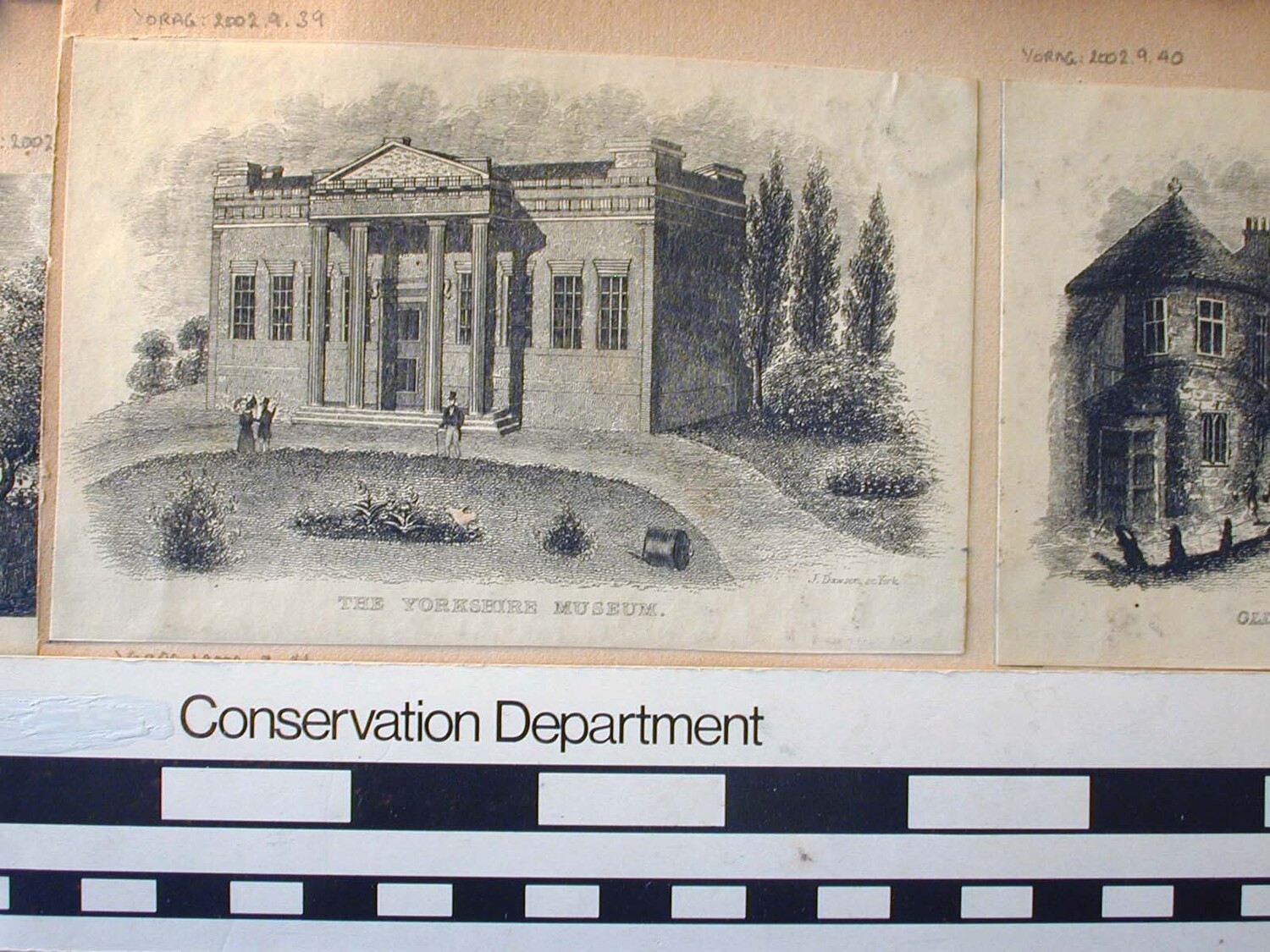
Vernon reckoned that the sum of £3000 should enable the opportunity to ‘raise a building’ to become a lecture hall and museum. A site was chosen called ‘Manor Shore’ close to the river and on land occupied only by St Mary’s Abbey which lay in ruins. John Kenrick, another member, described the area as a ‘most forlorn and desolate’ place – the ruins of the abbey constantly being ransacked for its stones to re-use for building materials. The fundraising exceeded all expectations. £4500 being donated almost immediately by the leading members of York Regency society. A London architect William Wilkins was hired to design it with another York resident architect Richard Hay Sharp supporting. Eventually the ground for the building was approved by the City of York council and the Government – on condition that that the remainder of the purchased land be made into a ‘botanic gardens’ for public use and scientific purposes. The annual rent was one pound and eight old pennies £1/0s/8d. The Archbishop of York, Vernon’s father, laid the foundation stone of the Yorkshire Museum in 1827. And so began the Yorkshire and Museum gardens, which officially opened on the 2nd of February 1830.
Read more:
The best book on early Yorkshire Philosophical Society is A. D. Orange, Philosophers and Provincials 1822-1844.
Also good is The Nature of the World by David Rubinstein and From Cave to Cosmos – a history of the Yorkshire Philosophical Society by Sarah Shields.
All are available in York Explore Reference Library.
The views and opinions expressed in this blog are those of the author and do not necessarily reflect the official policy or position of the British Association for Local History (BALH). Any content provided by our contributors is of their own opinion and is not intended to malign any individual, group, organisation, or entity.


