The Scottish Rates Revaluation of 1985: The Spark that Lit the Poll Tax Fire!
Published: 6th March 2025

Peter Farrelly
Peter Farrelly is a History PhD candidate at Queen’s University Belfast researching ‘The Rise and Fall of Thatcher’s Poll Tax’.
Margaret Thatcher's ‘flagship policy’ the Community Charge, infamously known as the poll tax, remains etched in British history as one of the most contentious policies of her premiership. Introduced in Scotland in 1989 before being rolled-out to both England and Wales in 1990, this flat-rate tax applied Community Charges to almost every adult regardless of income or ability to pay.
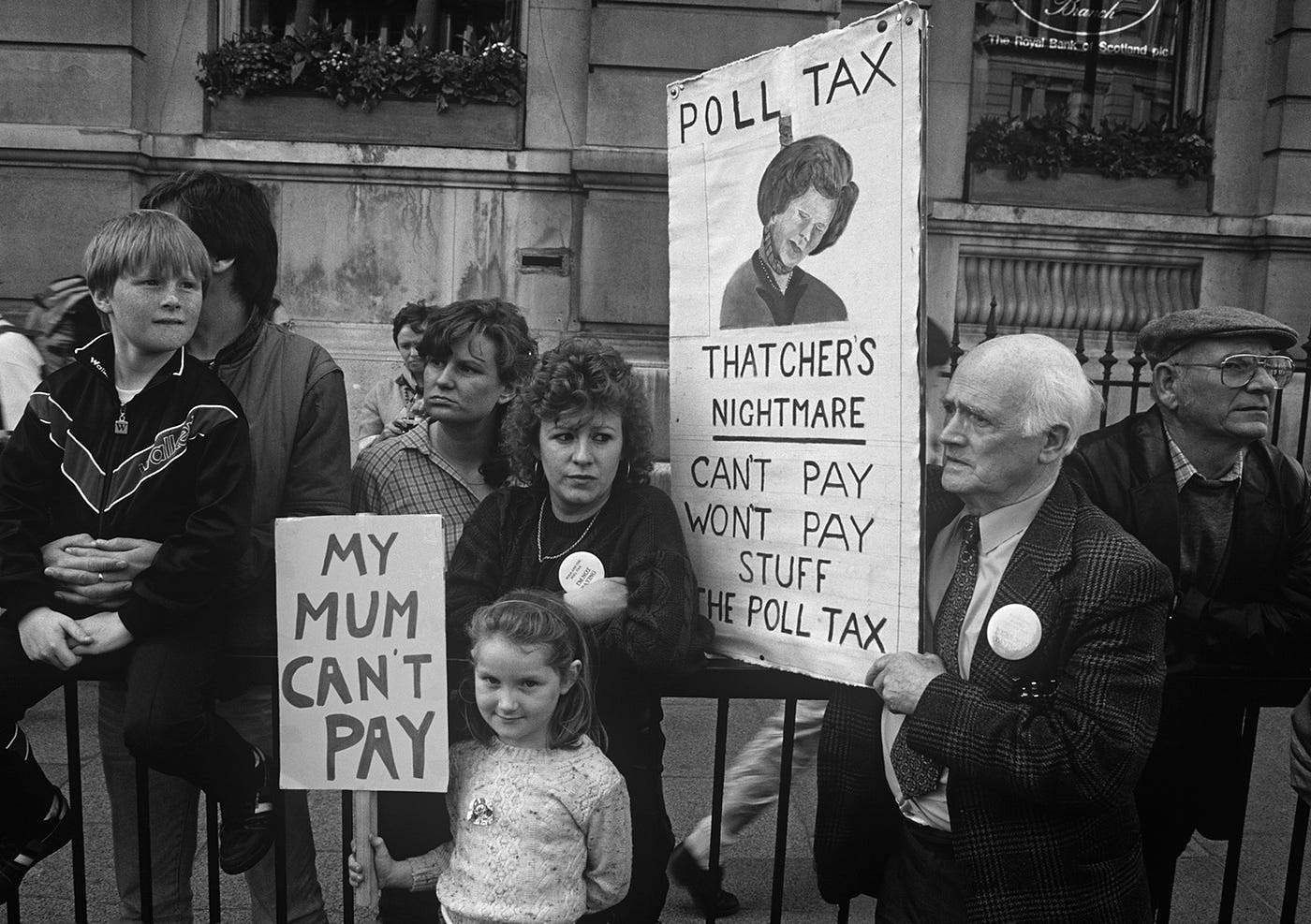
The policy proved so controversial that it faced widespread opposition and protests upon its implementation, ultimately contributing to Thatcher's political decline and toward the end of her premiership in November 1990. As a result, the poll tax persists as a potent symbol of the challenges and complexities associated with local government finance reform, and remains, to this day, a turbulent and significant episode in British and local history.
Significantly, though, historical narratives concerning the poll tax aren’t just focused on the events and carnage that unfolded throughout Britain following its implementation. Researchers and historians are also heavily invested in analysing the complex chain of events and political calculations that led to the implementation of this infamous Thatcherite policy. With this in mind, this article delves into the pivotal role of the 1985 Scottish Rates Revaluation behind the emergence of the poll tax. We'll explore how this seemingly routine revaluation ignited a political firestorm, exposed the flaws of the existing domestic rates system, and created the perfect opportunity for Thatcher's government to push forward their radical alternative. Hence, get ready to uncover the fascinating interplay of political maneuvering, economic realities, and ideological battles that shaped this controversial chapter in British history.
A Political and Economic Earthquake:
The Scottish Rates Revaluation was a process of reassessing the value of properties in Scotland to determine the amount of local property taxes (rates) to be levied. In 1985, this revaluation led to substantial increases in domestic rates for people across Scotland, causing significant political and economic repercussions. The average increase was 24%, but some areas experienced much higher increases, with areas like Perth and Kinross, for instance, witnessing 70% surges in domestic rates. Many businesses were also affected, with shopkeepers in Jedburgh, for example, facing 50% average increases; whilst others in the region experienced rises in rates ranging from 138% to 167%.
These increases had profound political ramifications. Approximately 75% of those people most severely affected resided in areas controlled by Conservative or Independent authorities (i.e., those largely supportive of, or leaning towards supporting, the Thatcher government's neoliberal policies). This fueled feelings of unjust treatment by Thatcher's administration, leading to a dramatic decline in Conservative support in Scotland. As James Goold, Chairman of the Scottish Conservatives, warned Thatcher in early 1985, "the political fallout from the revaluation could devastate Conservative support in Scotland." He emphasized that the Government’s existing local government finance policies, particularly those pertaining to domestic rates, were being perceived as discriminatory toward Scotland, potentially leaving the Party at risk of not controlling a single Scottish local authority and/or region come 1986. A similar concern at this time was also shared by Scottish Secretary George Younger, who predicted severe political damage for the Conservatives unless the revaluation crisis was resolved. The bleakest assessment to these ends, however, came at a Scottish Conservative Council meeting, held on the 25th March 1985, where Mrs. Rosemary Ferrand, a Conservative councillor from Perth and Kinross, warned her peers that she represented an ‘endangered species,’ cautioning that without urgent domestic rate reforms, the Conservative presence in Scotland faced extinction.
Calls for Change and the Rise of the Poll Tax:
Amidst the chaos unfolding, the Scottish Revaluation was occurring whilst a ministerial task force, established in late 1984, were already deliberating over potential alternative solutions to the domestic rates system. This task force, led by junior Environment ministers Kenneth Baker and William Waldegrave, with notable involvement from former banker Victor Rothschild, would ultimately play the pivotal role in shaping the framework that eventually underpinned the Community Charge. The task force advocated for a system that sought to enhance local accountability by connecting voters directly to local household taxes. To achieve this, they proposed nationalizing business rates and simplifying grant allocations, whilst, crucially, giving local authorities full control over the setting of local tax levels. These recommendations effectively endorsed implementation of a poll tax as the optimal solution for funding local government services: and the revaluation provided the necessary impetus for the task force to accelerate its work and solidify support for the poll tax.
The Scottish Revaluation ignited a political firestorm, exposing the precariousness of the domestic rates system, and ultimately fueled an urgent clamor for its replacement. The Adam Smith Institute (ASI), a right-wing think tank, during the revaluation carnage, advocated for a poll tax, highlighting its fairness and efficiency, and even suggested piloting the scheme first in Scotland. Similarly, Michael Forsyth, the Conservative MP for Stirling, published a pamphlet in early 1985 titled The Case for a Poll Tax: an Alternative to Domestic Rates. He argued that the revaluation presented an opportunity for the Conservative Party to abolish the existing rates system, asserting that "a poll tax is clearly feasible, fair, and desirable…all that was needed was the political will to introduce it.”
Consequently, faced with this crisis, Oliver Letwin, a member of Thatcher's Policy Unit, in April, urged Thatcher to support the task force's radical proposals, arguing that the poll tax was the only practical solution to the rates crisis. Subsequently, her government embraced the radical solution, using the Scottish Conservative Conference in May 1985 to publicly announce its commitment to this radical policy shift. Thatcher herself at this Conference acknowledged the "unfairness inherent in the present rating system" and announced a fundamental review of local government finance was already taking place behind the scenes. She emphasized that the new scheme moving forward will be fairer, and would distribute the local financial burden more evenly and ensure that councillors would be much-more accountable to their electors.
Development and implementation of the Community Charge:
Following this commitment to action, between May 1985 and early 1987, the poll tax, which was officially to be known as the Community Charge moving-forward, underwent its policy development. Initially, a dual-running system (with 70% of local government financing coming from a Resident's Charge and 30% from a property-based charge), to be phased out over 10 years, was proposed: with average property charges of £91 per household and average Resident's Charges £106 per person, quoted. These measures were subsequently approved by the Cabinet on January 6, 1986 and formed the basis of the Green Paper "Paying for Local Government," launched on January 28, 1986. The poll tax was now on the Parliamentary pathway to being officially implemented, with the Community Charge eventually placed on the Statute Book by the Secretary of State for the Environment, Nicholas Ridley, on January 15, 1987.
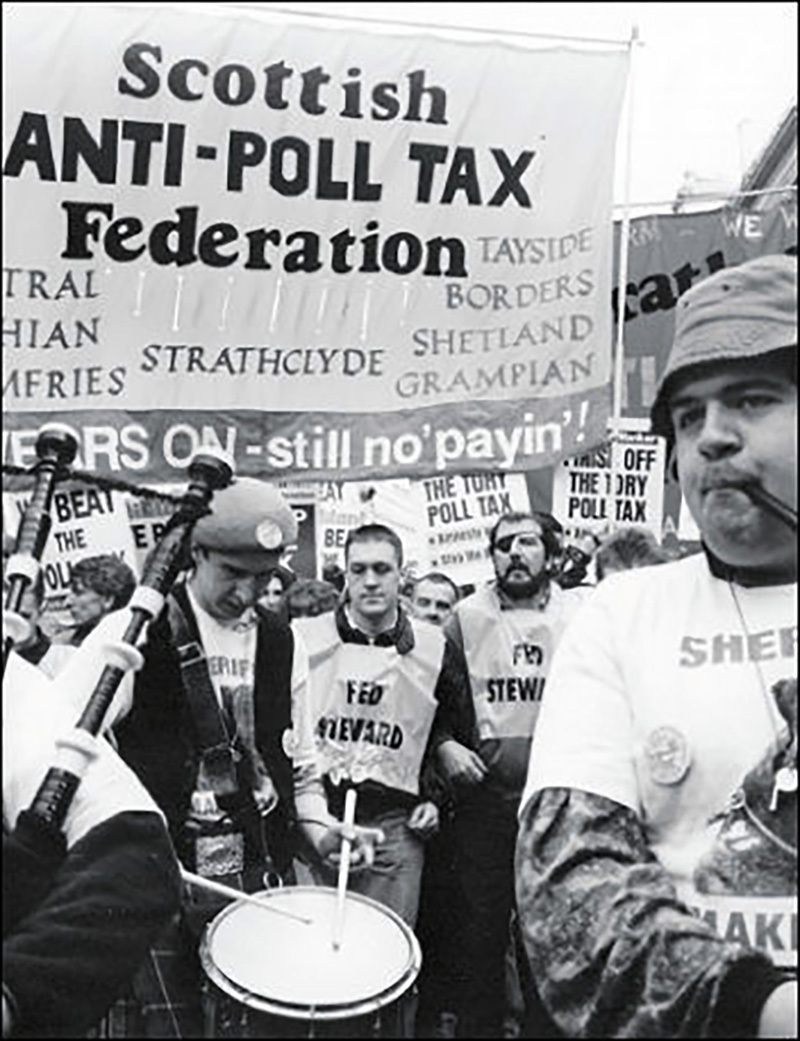
Significantly, a ‘clean break’ amendment, advocating for Scotland to bypass the transitional phase and adopt a ‘full’ Community Charge immediately, was later added in February 1987 after Malcolm Rifkind, who replaced George Younger as Scottish Secretary in January 1986, proposed the move citing financial concerns with the dual-running system. Consequently, this approach meant that Scotland would soon bear the full financial and societal brunt of the poll tax's impact, bypassing any gradual phasing-in period. This decision fueled accusations that Scotland was being used as a 'testing ground' or ‘guinea pig’ for the controversial policy, exacerbating existing resentment and resistance towards the tax, which would ultimately contribute to the poll tax's eventual downfall in subsequent years.
Conclusion:
In conclusion, the 1985 Scottish Rates Revaluation undeniably marked a critical turning point in the history of local government finance in the United Kingdom, setting in motion a chain of events that would have profound and lasting consequences. It not only exposed the inherent flaws and deep-rooted inequalities of the domestic rates system but also precipitated a political crisis for the Conservative government, eroding their support in Scotland and creating a sense of urgency for reform. This crisis, in turn, provided fertile ground for proponents of the poll tax to advance their agenda, ultimately paving the way for the adoption of this controversial policy. The revaluation thus played a pivotal role in shaping the trajectory of local government finance in the UK, highlighting the complex interplay of political pressures, policy debates, and unintended consequences.
Peter Farrelly is a History PhD candidate at Queen’s University Belfast researching ‘The Rise and Fall of Thatcher’s Poll Tax’.
The views and opinions expressed in this blog are those of the author and do not necessarily reflect the official policy or position of the British Association for Local History (BALH). Any content provided by our contributors is of their own opinion and is not intended to malign any individual, group, organisation, or entity.