A local historian walks into a joke…
Published: 22nd January 2023

Joe Saunders
BALH Joint Vice-Chair & Head of Outreach
@joe_saunders1
Joe is a familiar face as the host of BALH’s popular monthly webinar series Local History Hour. He is a Trustee of BALH, joint Vice-Chair and head of the Outreach team. Away from BALH, Joe is working towards is PhD, while as a family historian, he undertakes genealogical research and is an Associate of the professional genealogy body AGRA.
Like many of us, I really appreciate a good joke.
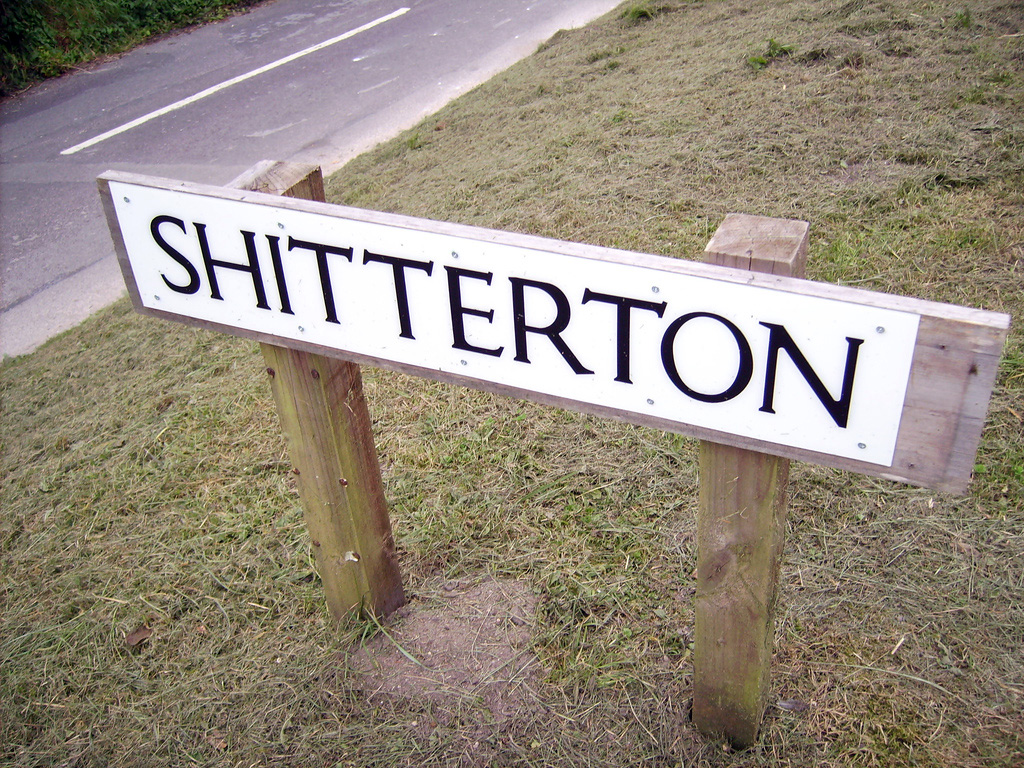
A sign for the village of Shitterton, Dorset. Public Domain.
I especially enjoyed in Helen Palmer’s blog Nonconformity: Report on January’s Local History Hour an old joke she shared about a man of non-conformist persuasion stranded on a desert island:
After many years a rescue party discovered him and found that he had built himself a rudimentary dwelling, and two simple chapels. “Why two?” they naturally enquired. “Ah” he replied, “that one there is the chapel I don’t attend.”
Humour is of course one of the great joys of life. It is often said that the British fondness for dry humour is a defining characteristic. A lot of that humour can be quite morbid. I recently heard a story of a Cumbrian man who after falling sick was being driven by his brother to A&E. According the brother, the man, feeling increasingly out-of-sorts, apparently uttered as he slipped out of consciousness ‘you better not be taking me to f—ing Lancaster’ (the closest A&E department). The story, which I heard told as a joke may have been true, but of course may have been embellished, plays on the local Cumbrian disdain for Lancashire. A joke therefore with quite specific regional appreciation.
Many jokes have this local rivalry element. I lived for years in Glasgow and a man once told me about the marketing slogan the city used in the 80s as it tried to improve its (then poor) reputation. ‘Glasgow’s miles better’ was decided upon and it proved incredibly popular. As we know in recent decades the city has become of the cultural capitals of Britain (it really is, visit). The man told me that following hot on this success, Edinburgh, feeling left out, contacted the same marketing man. The head of the City Council asked him to name his fee, they wanted a slogan of their own. The marketing man asked for a cool few million and when received he responded with a one-line note. It simply read, ‘Glasgow’s miles away’.
There is also the story (supposedly based on true events) that toward the end of the last century people were surveyed to see what they thought was England’s second city. In Manchester they said Manchester. In Birmingham they said Birmingham and in Liverpool they said London.
Of course, alongside poking fun at our neighbours local in-jokes often mean a good laugh inwards at local people and institutions. Growing up in Witham in Essex our local paper was the Braintree & Witham Times which was commonly known as the ‘Brainless and Witless’. Though I’m sure the editorial standards are now much improved.
For the local historian there can be much humour in placenames. In real life I was asked recently if I knew where the Pink Panther came from. ‘No’, I said, ‘where?’. ‘Dur-ham’ came the response. The evergreen popularity of rude placenames which make their way onto coffee-table books and internet click-pieces is testament to the appeal of a silly-sounding word, and our tongue-in-cheek sense of fun.
Some of the oldest jokes in Britain may not be peculiar to a locality but have occurred in innumerable iterations across the land over the years. My neighbour’s recent death was received with sadness by his many friends. He was a large man however and when the family went to organise a coffin, they had to order one in specially made (think Henry VIII). When the family went to plan the funeral their mutual friend the churchwarden laughed and said, in hindsight, he should have charged for a plot-and-a-half. It feels like a joke that mostly appeals to churchwardens. I wonder how many have made that joke over the centuries.
Conversely, there is an importance of specialist local knowledge in order to fully appreciate or even understand a joke. One of the earliest examples of a bar joke is supposedly Sumerian (c.4,500-1900 BC). ‘A dog walked into a tavern and said, ‘’I can’t see a thing. I’ll open this one’’.’ There must be something in it related to the Sumer way of life, however the meaning has been lost, even though the words remain.
I’m coming to think that a good local history joke is like good local history research and writing. You either need an excellent sense of the particular local conditions and the appeal is deeply provincial. Or it is framed in such a way as to be universally funny, speaking to shared sentiments. In any regard, jokes are an important part of our local history which we should look for and record. While we treat history as a serious subject of study, I think it is sometimes forgotten that people have always lived lives filled with light-heartedness and humour as we do today. Jokes are a good reminder of this for our wider appreciation of the past.
The views and opinions expressed in this blog are those of the author and do not necessarily reflect the official policy or position of the British Association for Local History (BALH). Any content provided by our contributors is of their own opinion and is not intended to malign any individual, group, organisation, or entity.