A newcomer’s experience of archives – four projects, and counting…
Published: 6th November 2024

Carol Brinson
Carol Brinson is a Committee member of West Sussex Archives Society, Volunteer in the Weald & Downland Museum's Library, member of Midhust u3a Local History Group.
The joy of local history research was confirmed for me when I joined Midhurst u3a’s Local History Group in January 2022. Each member researches a topic of their own choosing and then presents it to the group, with much discussion and exchange of information ensuing.
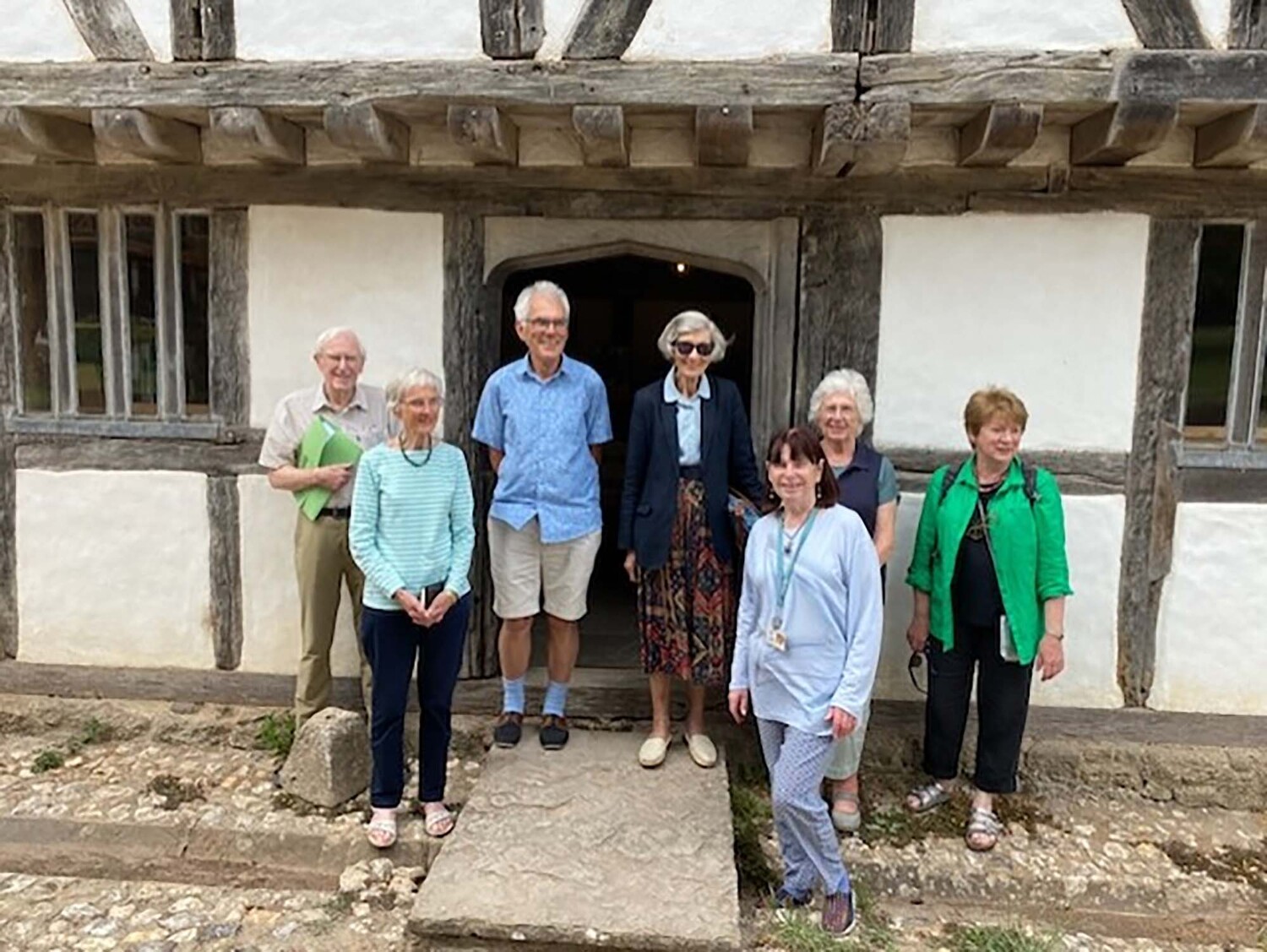
Midhurst u3a Local History Group at the Weald & Downland Museum's Library
My first project was to try and find out who built the terrace of houses where I live in Midhurst. I didn’t have much to go on, except the initials J.D. and the date 1877 on the end wall.
My introduction to West Sussex Record Office (WSRO), for this research, was a revelation, with the staff being so helpful to a novice. A map of Midhurst Parish in 1846 and an Apportionment of the Rent Charge in Lieu of Tithes were quickly found and immensely useful. J.D.? It seems this may have been John Dolloway but I haven’t, so far, been able to confirm it.
Then there was a huge fire in the centre of Midhurst in March 2023. The Angel Hotel and adjoining buildings were destroyed. It soon became apparent that not much information had been gathered in one place about these old buildings and their history. My next absorbing project began...
One of the earliest finds in the WSRO catalogue was from 1790: an invitation addressed to Mr Charman written on the back of a printed card by which ‘Susan Baker respectfully acquaints the Ladies and Gentlemen of Midhurst, and its Vicinity, that the Assembly will be held at her House [Angel Inn, Midhurst], on [blank] the [blank] of [blank] 179-. Admittance 3s.6d. each Person. Coffee, Tea, & Musick included’.
Quarter Session Rolls revealed that the hotel was regularly used as a court of law, auction catalogues show that property sales were often held, newspaper cuttings describe several happy-sounding social gatherings and celebrations, and publicity material has colourful descriptions of the hotel’s offerings including a booklet of which I was allowed a photocopy. It contained some lovely drawings of the hotel exterior and rooms by Thomas William Armes from the 1930s. WSRO PH/29080:
Although the “Victims of Fire” research could be never-ending, I did reach a sensible stopping point, having on the way had a lot of fun and another learning curve in the setting out of my findings as a document, a copy of which I gave to Midhurst Museum.
What next? A walk in Graylingwell Park in Chichester reminded me of the plight of the original farmhouse, in a derelic state and clad in scaffolding and white sheeting. Its main claim to fame seemed to be that Anna Sewell, author of one of my favourite books, Black Beauty lived there, albeit briefly. A-ha! A possible project!
I discovered that the farmhouse has a rich history of distinguished occupants, with strong links to New Zealand and Australia, and to the Chichester Quakers. Once again, WSRO had plenty of information, including research findings by a group of staff and day out-patients at The Farm House Community in 1985. West Sussex Archives Society’s own journal West Sussex History was also very helpful. My findings are in a document The Chequered Life of a Farmhouse and its Inhabitants - An exploration of the history of Graylingwell Farmhouse, Chichester, a copy of which is in Graylingwell Park’s Chapel where the Chichester Community Development Trust have a collection of items about the former Graylingwell Hospital site. Research can continue into the history of the farmhouse, for which the plan now, I understand, is restoration for residential use once more.
My most recent project is the life of a lady many Chichester people will have known simply as Mrs Shoesmith. This colourful character was a teacher who was head/proprietor of Summersdale School (which I attended briefly) then of Northgate House School. There is a great deal of information about her (Winifred Emilie Shoesmith, MBE, nee North) which was donated to WSRO shortly after her death in 2008.
It can be seen that for all four of these projects I am indebted to WSRO and the helpful staff for their patience. Of course, other sources led me forward on the trails such as libraries, including the Weald & Downland Museum’s, and West Sussex County Council’s at Midhurst – with free access to Findmypast and Ancestry and several local interest books. Internet seaches also were absorbing, involving much browsing, red herrings, diversions and distractions, as well as posts on facebook pages and emailing and my own books and friends. However, it was the huge resource of WSRO which has provided most of the solid information which was needed.
I am now involved in research on two other Chichester women – Lizzie Cutten (1869-1920 - another teacher and a leading light in the suffrage movement) and Elizabeth Johnston (1788-1861 -philanthropist). This is in connection with the newly-formed Chichester Women’s History Group. I have gleaned some information at WSRO but more will be welcome.
Article originally included in The Researcher – October 2024 – newsletter of the West Sussex Archives Society and reproduced here with its editor’s blessing.
The views and opinions expressed in this blog are those of the author and do not necessarily reflect the official policy or position of the British Association for Local History (BALH). Any content provided by our contributors is of their own opinion and is not intended to malign any individual, group, organisation, or entity.