Adam of Newmarket and the Jews
Published: 26th May 2021

Dean Irwin
@medievaljews
I completed my PhD at Canterbury Christ Church University (2017-21) and specialise in the records of medieval England. I am currently working on a reappraisal of Simon de Montfort's relations with the Jews.
Adam of Newmarket (c.1226 – c.1291) was a Lincolnshire knight and, during the baronial revolt of the 1260s, a leading supporter of Simon de Montfort.
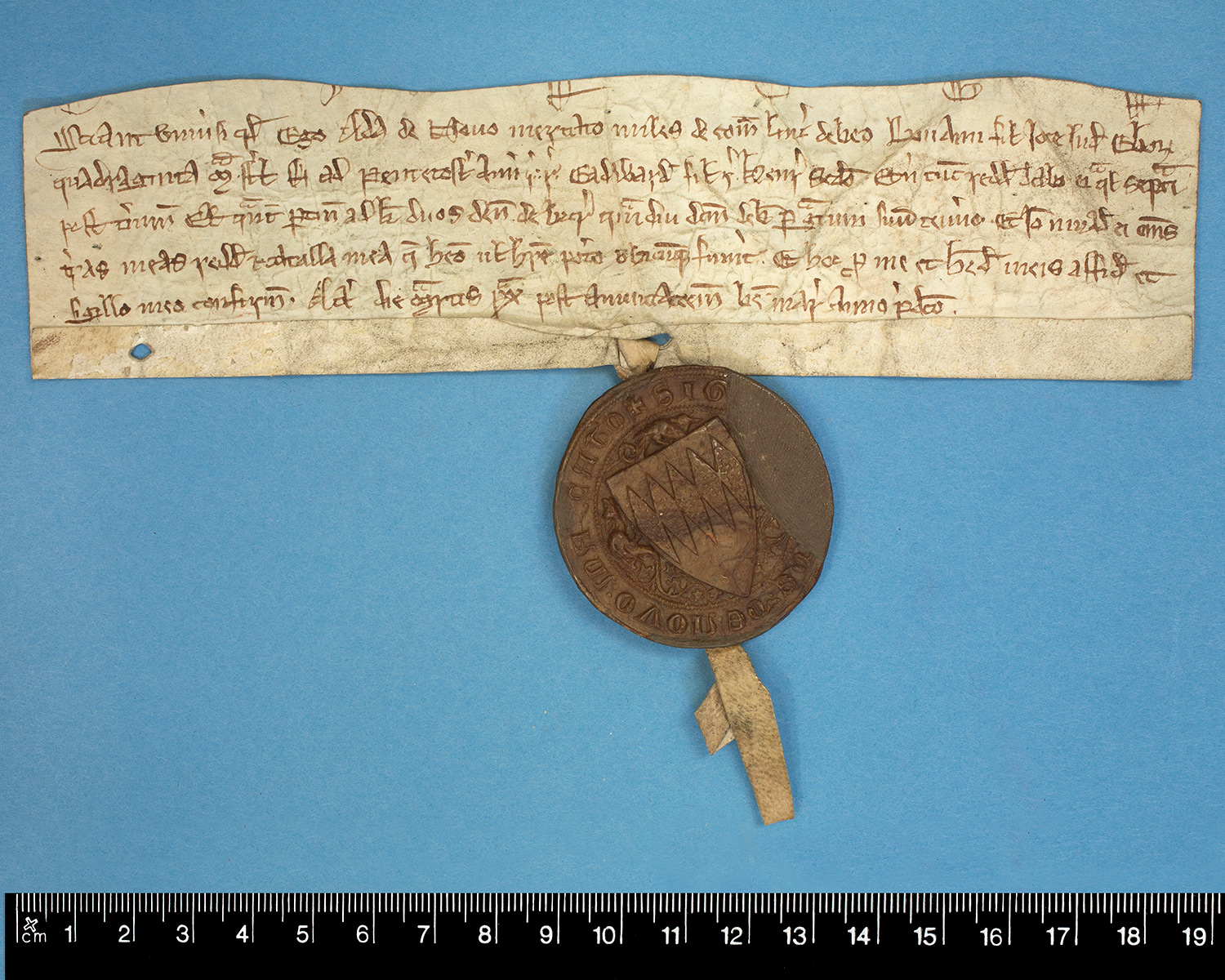
WAM 9014. ©Dean and Chapter of Westminster
At the end of 1263, Adam travelled to Amiens, as a representative of the barons, to treat with Louis IX in the hopes of securing his support. Although his mission was ultimately unsuccessful, Adam was catapulted into the heart of government following the victory of Montfort at the battle of Lewes (14 May 1264). This was a decisive victory which saw the capture of most of the leading royalists, including Henry III through whom Montfort governed for the next fifteen months. Adam took no part in the fighting itself, having been captured by the royalists at Northampton six weeks previously, but he did reap the rewards of victory. After Northampton his lands were declared forfeit to the Crown, an act which was quickly reversed by the new Montfortian regime, as well as appointing him to keep of Lincoln castle and, from July, as the steward of the royal household. In this role, he authorised and witnessed many of the documents which were issued by the captive Henry III.
The political landscape changed once more following the battle of Evesham (4 August 1265) which was as decisive as it was disastrous for the Montfortians. On the battlefield, Montfort and many of his leading supporters were killed and Henry III was released from his captivity. Such was the extent of the Montfortian defeat that news of the battle did not reach Simon’s widow, the Countess Eleanor, at Dover until a week later. Fortunately for Adam, he was absent from this battle also, having been captured at Kenilworth by the Lord Edward shortly before, which probably saved his life, albeit at great cost. With his government and power restored, Henry III was in no mood to forgive those who had transgressed against his kingship. Instead, their lands were forfeited to the Crown and he used Jewish debts to great effect in punishing the rebels. Not only did he restore the debts which had been cancelled by Montfort but he also ensured that Jewish creditors would encounter no difficulties in pursuing their claims against the Disinherited. When a settlement was finally reached, in the form of the dictum of Kenilworth in 1267, the king allowed he former enemies to reclaim their lands in return for massive fines, which forced many, including Adam, further into debt to the Jews.
The extent to which such individuals were forced into indebtedness to the Jews can be seen with Adam of Newmarket. In the early 1270s alone, there is evidence that he borrowed well in excess of £1,000 from Jewish creditors. One such record survives in the Westminster Abbey Muniments room (see figure 1). This acknowledgement of debt records that Adam had borrowed £26 13s 4d (40 marks) from Bonami son of Josce, a Jew of York. By law, every transaction in which a Jew lent money to a Christian had to be recorded upon the instrument of a tripartite chirograph. Figure 1 is that instrument, which was drawn up at Lincoln on 27 March 1274, probably by a clerk named William the Foreigner. In order to, quite literally, seal the deal, Adam had to apply his seal to the foot of this document. This is a particularly important survival because while a substantial number of documents have survived, relatively few of the seals have been preserved. This is a particularly fine example, depicting five lozenges on a seal with a dragon on each edge, with Adam identified as the owner in the inscription. Undoubtedly, this is one of many which he would have been forced to apply his seal to in the decades after Evesham in order to retain his lands.
What such evidence illustrates, as much as anything, is the exceptionalism of the (formerly) disinherited debtors. Although much has been written on Jewish moneylending in medieval England, the point which has rarely been made in the scholarship is that much of the surviving evidence suggests that, in the main, debtors borrowed commensurate with their ability to repay. The notable exceptions to this are people like Adam of Newmarket who had to borrow far in excess of the value of their lands, properties and goods in order to satisfy the price which was exacted for their disloyalty. Therein lies the point. Through the Dictum of Kenilworth, Henry III and his government reached a political accommodation which allowed individuals to reclaim their lands and some of them were, eventually, brought back into the fold. While they may not have suffered the same fate as their colleagues who fell at Evesham, the king still exacted a substantial price for their allegiance in 1263-5 and it was paid in cold, hard, cash (and lots of it), much of it borrowed from the Jews.
The views and opinions expressed in this blog are those of the author and do not necessarily reflect the official policy or position of the British Association for Local History (BALH). Any content provided by our contributors is of their own opinion and is not intended to malign any individual, group, organisation, or entity.