David Dymond Memorial Winter Lecture 2022
Published: 27th December 2022

Paul Dryburgh
chair@balh.org.uk
@pablodiablo74
Paul Dryburgh is the Chair of BALH. He is an archivist and historian who specialises in government and society in the British Isles in the 13th and 14th centuries. His current role is Principal Records Specialist (Medieval) at The National Archives. Paul is also Honorary President of the Mortimer History Society and Honorary Fellow at Centre for Medieval and Early Studies, University of Kent.
In the annual BALH lecture, Briony McDonagh, Professor of Environmental Humanities at the University of Hull spoke on the theme of Landscape, Environment and Learning Histories.
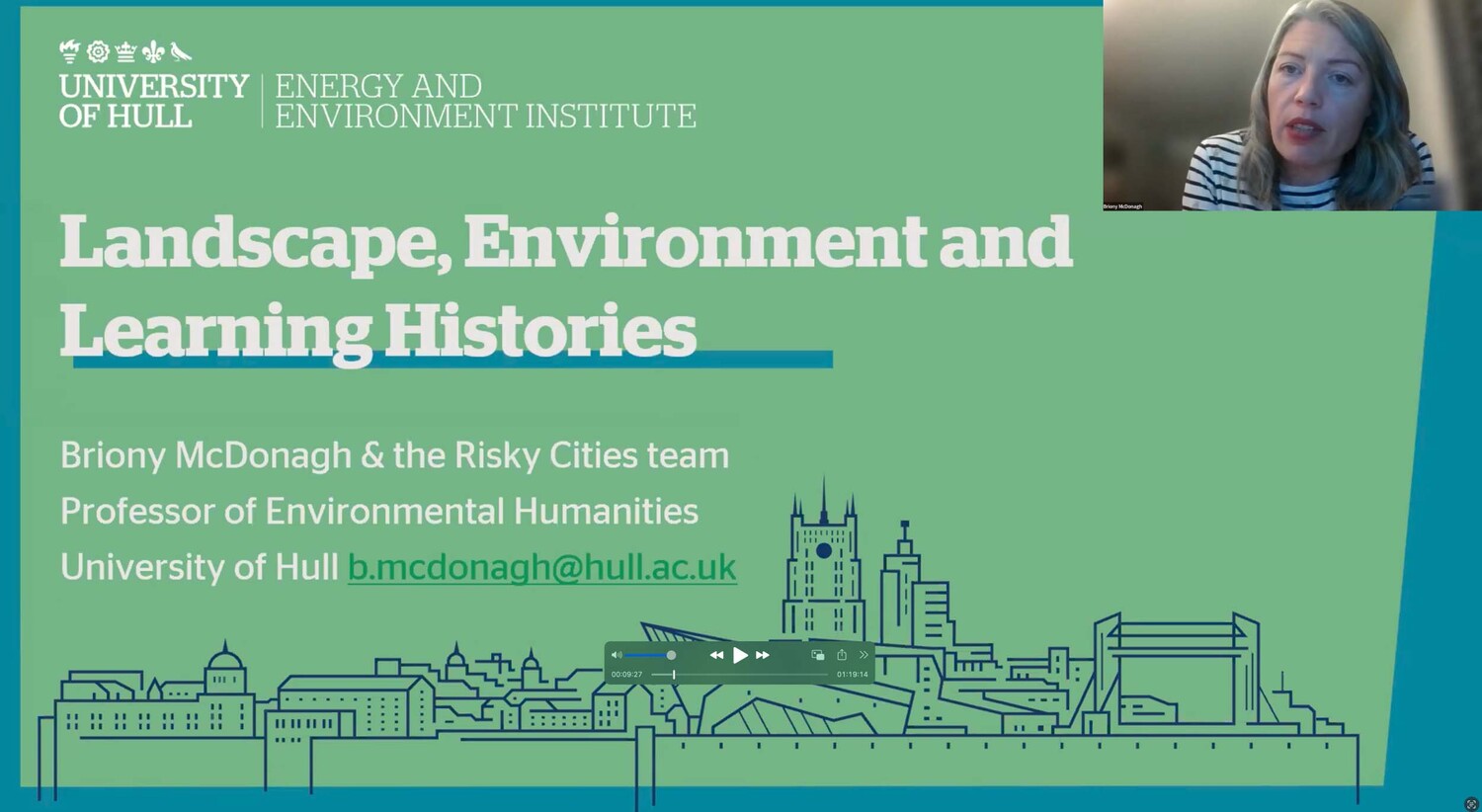
Humanity’s fluid and fluctuating relationship with water has become one of the key factors in discussion of our global present and futures. Many of the narratives around and strategies for tackling and managing change are global. However, coming to terms with increased drought and major, increasingly destructive flood events and driving behavioural change is reliant on positive dialogue around climate change and making that relevant and comprehensible to communities at the local level. One strategy to achieve this and so drive demonstrable change is to connect communities with their local history (and historical geography) and tell and retell stories of resilience, risk management and the changing environment over many centuries in creative new ways. Delegates to the Association’s second annual David Dymond Memorial Winter Lecture on 8 December received a superb insight into the power of coupling place-based scholarship and arts-led engagement to build more inclusive cultures around water and the environment as a response to structural, social issues and the local (not to say personal) effects of human-induced climate change.
In a stimulating presentation not dampened by a heavy cold, Briony McDonagh, Professor of Environmental Humanities at the University of Hull, introduced the Risky Cities: Living with Water in an Uncertain Environment project (https://riskycities.hull.ac.uk/). A three-year multi-disciplinary, multi-partner research collaboration funded by the Arts and Humanities Research Council, the Natural England Research Council and the UK Climate Resilience Programme, Risky Cities looks both forward and back to examine the influence and impact of water over eight centuries in and around the East Yorkshire estuarine city of Hull, and the histories of water management and how communities in the past learned to live with their watery environment. It harnesses what Professor McDonagh terms a ‘green/blue humanities approach’ to provide pegs on which to hang meaningful engagement with the local community, one of the most at-risk urban areas outside London (90% of Hull lies below the tidal watermark) yet least responsive in terms of taking pro-active measures to live better with water and flood risk – only 6% of Hull’s population of 300,000 has signed up to Environment Agency flood alerts, for example. This is all the more pressing since Hull, situated on the north bank of the Humber at its confluence with the River Hull, suffered very severe floods in 2007 and a storm surge in 2013.
The project has several partners, national and local, academic, arts and cultural heritage sectors and local government. It has three main areas of focus: 1) Living with uncertain waters, which seeks to understand how communities have interacted with water and responded to dramatic climate events from the medieval and early modern past to the present, adapting their knowledge systems to develop resilience; 2) Fictions of flooding, which examines how fictions in poetry, prose, drama and newspapers (all of which are increasingly playing a role in reframing and retelling stories locally) arose and developed alongside more archivally rooted histories, and which, by creating artistic recordings, are being used to evaluate the community’s resilience; and 3) Learning from the past for an uncertain future, which employs place-based stories about the past to work with local communities to build climate change awareness and flood resilience. Not unnaturally for the Association’s audience, the primary focus of Professor McDonagh’s lecture was on community interaction with water in the past. The approach taken within Risky Cities allows Professor McDonagh as Principal Investigator and her postdoctoral researchers to delve deep into local and national archives. Archival research has enabled the team to address how communities have experienced, responded to and learned to live with water over eight centuries, how they have managed and governed water and how they have adapted and whether this has helped or hindered the development of community resilience and improved local knowledge systems.
While the research has broader import for many urban, coastal communities around the UK and beyond, Hull presents a unique case study. It is a community formed of flood: before the mid thirteenth century settlement on an appreciable scale had been hindered by the saturated environment on the north bank of the Humber. Only from the 1260s when the abbot of Meaux, a house of Cistercian monks whose capacity for transforming local landscapes and systems of land and water management is well known, laid out the town did mass settlement become viable. So much so, that Edward I, appreciating its location for trade and supplying his military machine, founded a new town – Kingston upon Hull – in the 1290s. The project has brought together diverse evidence for a repeated history of flood events over the next four centuries, most notably the bench books of the city of Hull, the returns of the commissioners of sewers, the town chronicle and the monastic chronicle of the nearby abbey of Meaux, as well as the Chancery patent rolls. This demonstrates that flood events were largely tidal surges but could also be compound events of heavy rainfall, high river levels and the like. Generally, in a developing coastal community such as Hull, we can characterise flooding either as overtopping, a rather more short-term and less destructive episode, or as total ingress where ditches and banks are breached and significant, longer-term damage caused. In 1349, for example, a community already ravaged by plague witnessed the destruction of banks and dykes by “the impetuosity of the river”; in the 1390s the town was almost destroyed by flood and the overflow of the Humber. The severity and character of each episode conditioned recovery from them.
A re-examination of the archival heritage, both in printed edition and in the original, permits a piecemeal reconstruction of community response to flood. The accounts of the medieval and early modern corporation reveal a long history of works on ditches and banks, which were often in disrepair. Contemporary mapping and archaeological evidence belies networks of drainage ditches and sluices to prevent tidal waters ingressing and allowing riverine waters out into the Humber Estuary. The corporation patently understood the value of maintenance and continual repair; references to flood events are often made in the context of expenditure on water management such as the cutting and clearing of drains and gutters. Nonetheless, the sea’s erosive force could be permanently difficult. Saline intrusion ruined wells and bore holes. The Hull citizens attempted to dress this by cutting an open ditch from Anlaby, around 5km from the urban centre. In the 1460s they even tried the ingenious measure of laying lead pipes to bring drinking water, but the expense of the enterprise bankrupted the corporation! The reliance on manmade management systems, conversely, inevitably made them vulnerable to sabotage, as in the Civil War or as part of local disputes where banks might be deliberately broken to flood land within the catchment area.
Generally though, the stories which have emerged from the archive are largely about surviving and thriving in an estuarine environment. There is evidence of goods and crops being warehoused on the first floor of buildings and stone floors being raised as part of an urban flood resilience strategy. The story of Hull’s relationship with water has, in fact, been less about cataclysm and more about premodern adaptation. Indeed, what emerges most strongly was an ongoing need to manage water infrastructure and mitigate flood risk. This, Professor McDonagh argued, created a stronger sense of responsibility and stewardship for the green-blue home in premodern Hull.
Such a strong narrative of resilience, adaptation and stewardship has been harnessed by Risky Cities in its more innovative, arts collaborations. A strand of the project – “Melt” – has worked with the National Youth Theatre to develop creative responses to climate change especially in coastal communities. “On the Edge” premiered at the COP26 conference in Glasgow in 2021 and explored the anxieties of young people and their responses to climate change. Within Hull itself, the project has targeted engagement in areas that had not engaged with the 2017 City of Culture through a programme of creative writing and textile workshops. As we go to press, a zine will be distributed to around 10,000 households. Finally, “Floodlights” created three multimedia light and sound installations in 2022 to explore living with water in Hull, past, present and future, including a strand in a Hull secondary school that examine the city’s seafaring history. While the project’s research and evaluation is ongoing, they can point to evidence of change in attitudes in Hull, not to mention a pride in the town’s coastal and water-bound identity.
The David Dymond Memorial Winter Lecture pays tribute to one of this country’s pre-eminent local historian, who died in 2021. During a remarkable career which began as an inspector for the Royal Commission on Historical Monuments in and around York, including the Hull area, Professor Dymond remained a scholar, teacher, editor and writer of over fifty publications, mostly focussed on Suffolk. A former Vice President and Vice Chair of the Association, David raised the profile of local history immensely, perhaps most notably with Researching and Writing history, a Guide for Local Historians which is now in its fourth edition. The vision of the influence and impact of local history espoused by David could perhaps never have stretched to the kind of co-created artistic interventions developed by Professor McDonagh and the Risky Cities project team. What is undoubtedly true of David, and I am sure shared by anyone who reads this report, is the belief that historically informed, place-based engagement can and does drive cognitive change and enriches lives. Equally, finding new ways of exploring and retelling stories, making the global local and vice versa, are key dynamics of local history. The Risky Cities project provides a wonderful role model.
The views and opinions expressed in this blog are those of the author and do not necessarily reflect the official policy or position of the British Association for Local History (BALH). Any content provided by our contributors is of their own opinion and is not intended to malign any individual, group, organisation, or entity.