“Eu henwau’n perarogli sydd”: Welsh epitaphs of the First World War
Published: 3rd September 2021
Jenny Turner
@jennyturner_
Jenny is a PhD student at the University of Kent, researching First World War commemoration in Wales from 1914 to 1939. She is particularly interested in the differences in tone between English- and Welsh-language commemoration, and how it reveals differing priorities and narratives even within the same communities.

Tyne Cot. Photo: M. Kelleher
Visiting a Commonwealth War Graves site is at once an overwhelming and profoundly intimate experience. Even in the largest cemeteries, a shared surname, the badge of a local regiment, or a familiar address in the register prompt a jolt of recognition and a feeling of connection.
For me, it is the sight of personal inscriptions in Welsh that cause me to pause at a particular headstone. It is always moving to read the personal inscriptions; more so, I feel, in a language that most visitors are not able to understand—the epitaphs in Welsh seem more private, somehow, and it is a privilege to be able to read these last communications from the bereaved to their loved ones.
The Imperial War Graves Commission (IWGC) decided in February 1918 that “relatives should be allowed at their own cost to add a short inscription of the nature of a text or prayer”.[1] The Commission capped the inscriptions at sixty-six characters, and charged three and a half pence per letter. As well as the length restriction, and the charges involved, the IWGC determined that the inscriptions should not use derogatory language, nor express feelings of revenge or hostility that might cause pain to others.[2] But apart from these conditions, the Commission were surprisingly open-minded, and tens of thousands of separate inscriptions were accepted.
Even a brief look at some of the epitaphs shows their sheer diversity. Many are drawn from conventional texts, such as Bible verses, hymns, and poems; others quote letters, or the casualty’s last words. Some include an address, reclaiming the casualty from their military identity and burial setting. Personal inscriptions speak about, to, and on behalf of the war dead, and were inscribed in an array of languages, including English, Gaelic, Irish, Welsh, Manx, Latin, and French, and various regional dialects.
With lockdown restrictions gradually easing, many of us will be thinking of heading back to the former battlefields, or exploring our local areas for war graves and memorials. While of course the scars of the conflict, the trenches and mine craters, and the grand monuments, are the most obvious sites to visit, do take some time to stop at the headstones and read the personal inscriptions.
You may come across some Welsh epitaphs—here is a selection to look out for.
There are over seven hundred separate Welsh-language inscriptions from the First World War. They can be found in cemeteries in every theatre of war. The majority are taken from religious verses or hymns, but others come from poems or patriotic sayings. A few are explicitly anti-war in tone. Many are unique, such as the four-line englynion bedd (literally, ‘grave elegies’), stanzas written to a strict and complex metre, a distinctive aspect of Welsh culture.
One of the most popular inscriptions is
HYN A ALLODD HWN EFE A’I GWNAETH
adapted from Mark 14:8 in the New Testament and translated as
HE HATH DONE WHAT HE COULD.
The verse appears on forty-four headstones, with some spelling variation, including those of Sergeant Gwilym John Harries, of Llwynhendy in Carmarthenshire, who is buried in Bailleul Communal Cemetery Extension; Second Lieutenant James Thomas Jones, from Aberaeron in Ceredigion, who is buried in Lijssenthoek Military Cemetery; and Private Owen Williams, buried in Llanbeblig Churchyard in his hometown of Caernarfon.
It also appears in its original form
HYN A ALLODD HON HI A’I GWNAETH
meaning
SHE HATH DONE WHAT SHE COULD
on the headstone of Nurse Jennie Williams of the Voluntary Aid Detachment, from Llanberis, who is buried in Ste Marie Cemetery in France.[3]
Another popular inscription is taken from the hymn Gorffwys yn y Bedd, written by the bard Ieuan Glan Geirionydd (Evan Evans). The line reads
EU HENWAU’N PERAROGLI SYDD A’U HUN MOR DAWEL YW
which can be translated as
THEIR NAMES ARE PRESERVED FOREVER, AND THEIR SLEEP IS SO PEACEFUL.
You will also see it in the singular form, as
EI ENW’N PERAROGLI SYDD A’I HUN MOR DAWEL YW
meaning
HIS NAME IS PRESERVED FOREVER, AND HIS SLEEP IS SO PEACEFUL.
Twenty-seven families chose this line for their loved ones’ headstones, including those of Private William Parry, buried in his hometown of Llanystumdwy, near Criccieth; Private Goronwy Owen Davies, whose grave is in Tyne Cot Cemetery; and Private Llewelyn Evans, buried in Martinsart British Cemetery.
Themes of everlasting remembrance are also found in other personal inscriptions. Twenty-six headstones, in cemeteries across France, Belgium, Italy, and Wales, are inscribed with lines from the poem Nid â’n Ango, an englyn written by Welsh bard Hedd Wyn (Ellis Evans, himself killed in action on 31 July 1917), in memory of his friend Tommy Morris, who was killed in France in May 1916.
Ei aberth nid â heibio — ei wyneb
Annwyl nid â’n ango,
Er i’r Almaen ystaenio
Ei ddwrn dur yn ei waed o.
The translation is
His sacrifice will not be cast aside —
his dear face will not be forgotten,
although Germany has stained
her steel fist in his blood.
If you are visiting Dickebusch New Military Cemetery in Belgium, look out for the headstone of Gunner Evan Evans of Bangor. His mother Ellen chose the first two lines of this englyn and signed it ‘Mam’. Or, if you are in northern France, stop by St Mary’s ADS Cemetery and find the grave of Second Lieutenant Iorwerth Glyndwr John. His family chose the same lines, though substituting ‘wyneb’ (‘face’) for ‘enw’ (‘name’), but preceded it with
UN O FEIBION HOFFUSAF CYMRU
meaning
ONE OF THE BELOVED SONS OF WALES.
You may also see some simpler inscriptions, such as
HUNED MEWN HEDD
or
GORFFWYS MEWN HEDD
both meaning
REST IN PEACE.
The phrase
HEDDWCH I’W LWCH
literally means
PEACE TO HIS DUST
but carries the same sentiment as ‘Rest in peace’.
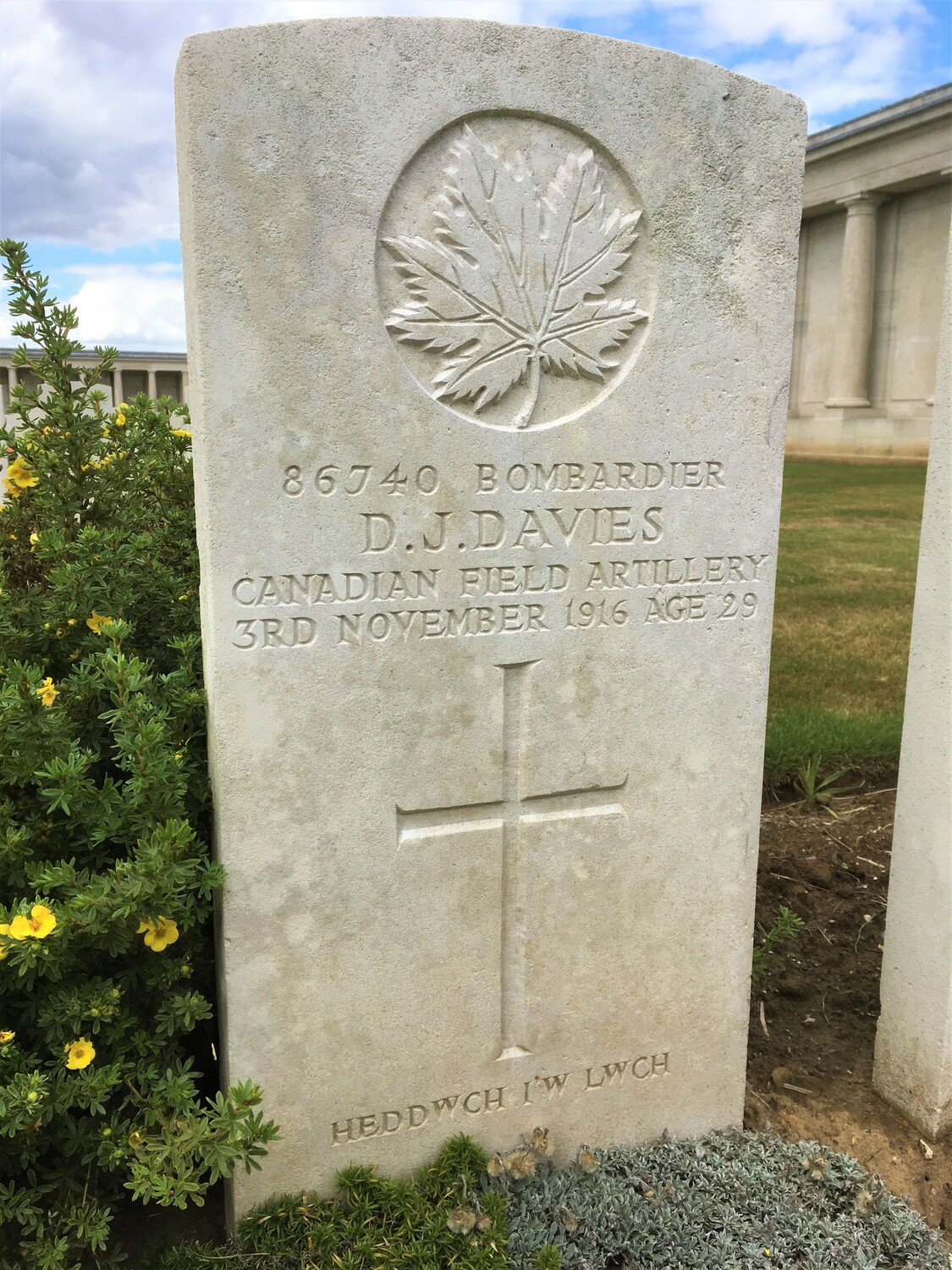
Individualised inscriptions also have interesting tales to tell. A consistent theme is the distance between home and the country in which the soldier is buried. A good example is the following cwpled (couplet):
ER MARW YMA MEWN GWLAD BELL
CAWN GWRDDYD ETO
MEWN GWLAD WELL
translated as
ALTHOUGH HE DIED HERE IN A FAR-OFF COUNTRY
WE WILL MEET AGAIN IN A BETTER LAND.
These words can be found on the headstone of Gunner Owen Arthur Beddoe in Salonika (Lembet Road) Military Cemetery. His parents, Henry and Mary Ann, living at the time in Pontlotyn, expressed their grief that their son died and was buried so far from home, but also their certainty that the family would reunite in the afterlife.
For other families, their sorrow was all-encompassing, and the personal inscriptions they submitted are absent of any sense of pride or hope. An epitaph I consider one of the most poignant is inscribed on the headstone of Private Evan David Davies of the Rhondda.
GOLEU O’N TEULU
DDIFLANODD
Y LLAIS A GAREM
SYDD FUD
It means
THE LIGHT OF OUR FAMILY HAS DISAPPEARED. THE VOICE WE LOVED IS SILENT.
If you are visiting Abbeville Communal Cemetery, take a moment to stop at his grave. The casualty figures from the conflict are, at times, incomprehensible, but behind every name is a story. Here, it is that Evan and Margaret Davies wanted those who passed the headstone to know that their son was loved, and that their family would be forever changed by his death. What more important lesson can we learn from the loss of life in the First World War?
[1] Commonwealth War Graves Commission Archive, WG 61: Minutes of the Second Meeting of the Imperial War Graves Commission, 18 February 1918.
[2] See CWGC Archive, WG 1562: Minutes of the Twenty-Ninth Meeting of the Imperial War Graves Commission, 18 January 1921; WG 1722: Minutes of the Forty-Second Meeting of the Imperial War Graves Commission, 21 February 1922.
[3] See also: https://www.merchedchwarel.org/jennie-williams-llanberis
The views and opinions expressed in this blog are those of the author and do not necessarily reflect the official policy or position of the British Association for Local History (BALH). Any content provided by our contributors is of their own opinion and is not intended to malign any individual, group, organisation, or entity.