Fun Facts about Black British History
Published: 27th October 2020

Dr Daniella Gonzalez
BALH Outreach
@BALHNews
As BALH’s Social Media Fellow, I’ve been planning some fun ways of engaging people interested in local history and one of the ways that I’ve done this is through #FunFactFriday, which is all about sharing friendly and enjoyable local history facts with our followers.
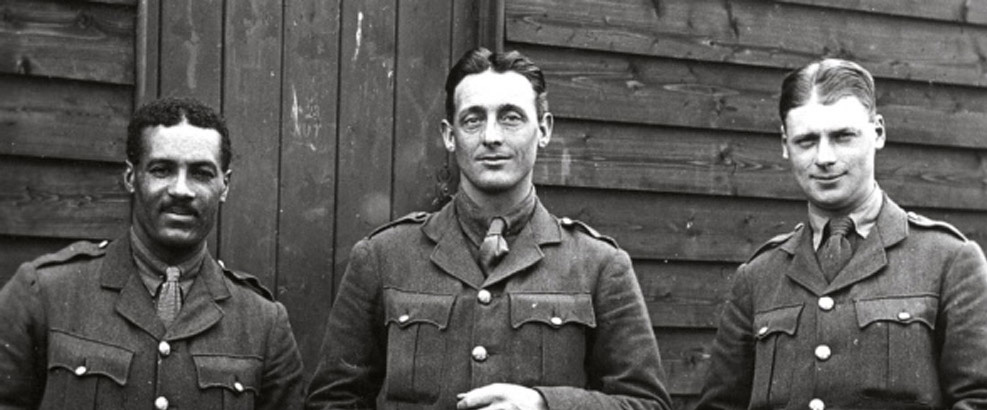
Walter Tull with his fellow officers (Unknown author, Public domain, via Wikimedia Commons)
The idea behind this initiative is to engage audiences and continue promoting the study of local history, both of which are key aims of BALH. This has really kicked off during the last few weeks and I’ve been posting lots of fascinating fun facts on BALH’s social media platforms. This month I’ve been highlighting the fantastic stories of prominent Black British historical figures and events, as well as situating these within their local history context.
Black British History has a richly vivid and longstanding history, harking back to Roman Britain, and it tells us the story of the relationship between Britain, Africa and the Caribbean; this is as much a global history as it is a local one. This is a history that should be celebrated beyond Black History Month and that forms a key part of Britain’s story. It is for these reasons that within this piece, I want to spend some time expanding on these histories and celebrating the study of Black British History, as well as placing these figures and events within their broader history.
The histories that I have included on BALH’s social media platforms explore the stories of Roman Britain, the First World War and Race Relations from a local history perspective and through the lens of Black British History. For the purposes of this piece, I’ll go through each of these chronologically, starting with the Beachy Head Lady.
Discovered in 1953, the Beachy Head Lady was one of 12 skeletons found in the coastal town of Eastbourne, in East Sussex, between the nineteenth century and 1990s. It was reassessed and examined in 2012 by local archaeologists. When found, her skeleton was almost complete and was determined to be that of a young woman, possibly in her early twenties. When she was originally uncovered by twentieth-century archaeologists there was little evidence that showed when this woman had lived, yet having undergone more extensive tests, such as radioisotope analysis and radiocarbon dating, we now know that she was of Afro-Roman descent, potentially born locally or brought over in her youth from Africa, and that she lived at some point between AD 125 and AD 245. This examination also showed evidence of a nourishing diet in her youth – testing on her teeth (which were in very good condition) showed that she ate fish and vegetables. Her placement in her grave also gives some clues about her status in the local community, where she would likely not have held a lowly position.
She is (possibly) one of many Afro-Romans that arrived in Britain from Africa during the 3rd century, when Britain was in the hands of the Roman Empire. These developments in archaeology and forensic science are ways in which we delve further into examining and learning about people of African descent in Britain, how they lived and formed part of local communities.
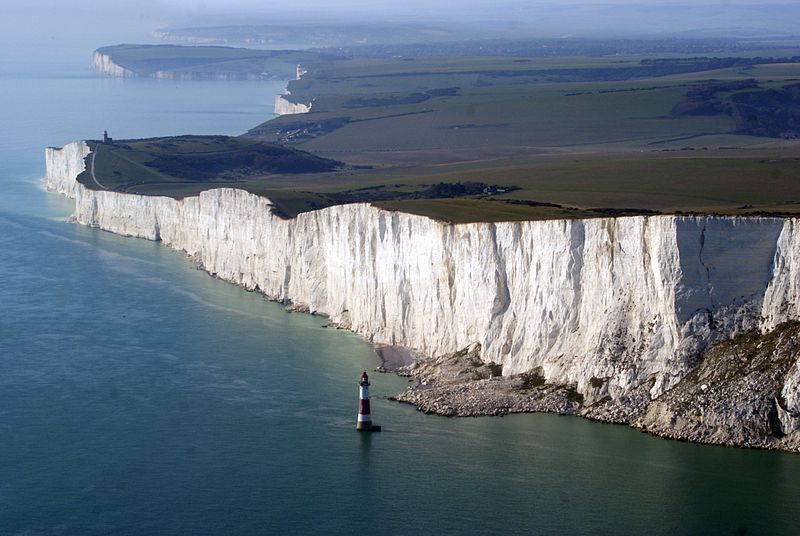
Beachy Head, East Sussex – photo: Ian Stannard
My next example fast-forwards us through quite a few centuries but explores a key event in Britain’s past, and one in which we see Black Britons, as well as soldiers from the West Indies and Africa, take a prominent role in the events that unfolded. This event is none other than the First World War, lasting between 1914 and 1918, and a time in which we see, to borrow from David Olusoga, that ‘[f]or black people in Britain and many other parts of the empire, the First World War changed their understanding of the empire and their place within it’.
While people were vocal about their opposition to the recruitment of black soldiers, there were black men who fought on the Western Front and who hold a vital place in British history. A fantastic example is Walter Tull, one of the most notable Black Britons who fought in WW1.
Born in Folkestone, Kent in 1888, Tull was of Afro-Caribbean descent and the grandson of a slave (linking back to the plantations in Barbados). When war broke out in 1914, Tull was a professional footballer, playing midfield for Northampton Town F.C and was considering a transfer to play for Glasgow Rangers. Nevertheless, on 14th December 1914, Tull went to the army recruiting office in Holborn, London and enlisted, joining the Middlesex Regiment. Having been a footballer, Tull’s unit was the 1st Footballers’ Battalion, which was made up of other footballers and football fans (for example, his commanding officer, Major Frank Buckley, had been a footballer for Manchester United).
Having been a footballer, Tull was well known and he was just as successful in his military career, rising through the ranks and very quickly being made a sergeant, as well as continuing to play football across the country for his club. He was then sent to France in November 1915 and by 1916 was one of several British men to be treated for ‘acute mania’ (what we now know as post-traumatic stress disorder).
After a brief stint in England recuperating from ‘acute mania’, Tull was sent back to the front later in 1916 and fought in various battles, including the Battle of the Somme. Tull’s circumstances, however, changed in February 1917, for he then spent time in Scotland training to become an officer. This would not normally have been allowed as the 1914 Manual of Military Law did not allow ‘alien soldiers’ to have power or authority. Similarly, in 1912 HM Stationery Office published the Short Guide to Obtaining a Commission in the Special Reserve of Officers. This text stated that all army recruits needed to ‘be of pure European descent’, thereby creating a racial barrier for soldiers of colour and ethnic minorities. Despite this, Tull was recommended and, after the horrific losses at the Somme in 1916, the army was encouraged to relinquish some of its rules about the race of officers. By May 1917, Tull had become a second lieutenant and was now to lead white British soldiers into battle. He was later recommended for the Military Cross.
He died in March 1918, near the French village of Favreuil. He is one of thousands listed as missing, with his name engraved into the Arras Memorial in Nord-Pas-de-Calais. Tull is one of many black men who selflessly laid down their lives in the fields of Northern Europe. They are an ingrained part of Britain’s story that should not and cannot be ignored.
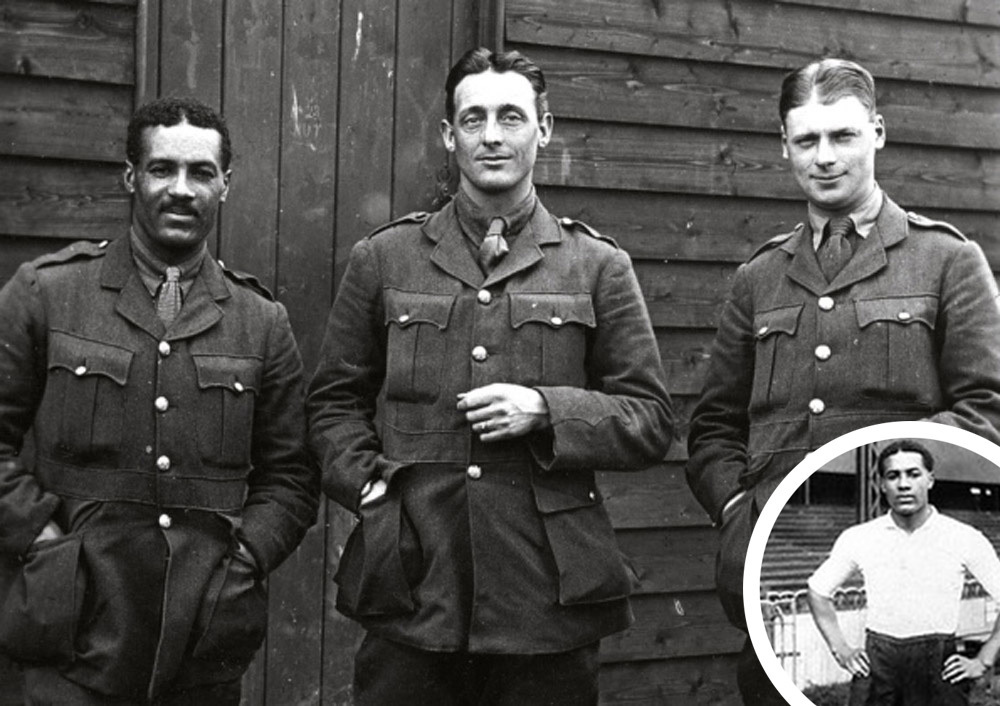
Walter Tull with his fellow officers (Unknown author, Public domain, via Wikimedia Commons)
Inset image - Paul Campbell’s picture of Walter Daniel Tull, 17th Middlesex Regiment by Diego Sideburns
Racial tensions, nevertheless, remained following the war and continued well into the twentieth century. The last of these examples thus takes us all the way to the city of Bristol in the 1960s, where we see both racial injustice and discrimination yet also see progress made in the UK’s anti-racial discrimination legislation. This particular story focuses on the Bristol Bus Boycott of 1963, a major event of the Black Civil Rights movement in Britain.
Parallel to the rest of the nation, racial discrimination was widespread throughout Bristol and at this moment in time there were several thousand residents of West Indian origin living within this city (many of these individuals had done military service during the Second World War, whilst others had emigrated to Britain more recently). During this period, these individuals suffered violence and faced inequality when it came to housing and employment. These are the circumstances from which the West Indian Association arose.
The reason I have chosen the Bristol Bus Boycott of 1963 is because it gives us an excellent insight into this reality and the change that arose following this historic event. The boycott happened because of the refusal by the Bristol Omnibus Company to take on Black and Asian bus crews – the company was happy to allow these customers on their buses but they would not employ them. This was a grievance highlighted by the West Indian Association, who brought attention to bear on the fact that the Bristol Omnibus Company had imposed a colour bar. Whilst there were some concerns among bus workers regarding competition in terms of labour, racial discrimination was at the heart of this issue.
As a result, four West Indian men – Roy Hackett, Owen Henry, Audley Evans, and Prince Brown – formed a group, later called the West Indian Development Council, to face this injustice head on. Paul Stephenson later joined and he was to be their spokesman. He demonstrated that the Bristol Omnibus Company had set a colour bar following an interview he set up between the Bus Company and Guy Bailey – when the Bus Company was told that Bailey was of West Indian origin, the Company cancelled the interview. This, and Rosa Parks’ refusal to give up her seat on the bus in the US, inspired these men to boycott the Bristol Omnibus Company.
These activists received widespread support for their actions, with students from Bristol University showing their solidarity by organising a protest march to both the bus station and to the Transport and General Workers’ Union’s (TGWU) headquarters on 1st May 1963. Politicians, like Tony Benn, Fenner Brockway, and Learie Constantine also criticised the actions of the Bus Company, with the latter publicly speaking out against this racial injustice and outwardly showing his support for this campaign. It was only at the end of August that there was an overall agreement amongst bus works to end the colour bar. The result of this was a promise by Ian Patey, the general manager of the bus company, on 19th August 1963 that there would be no more racial discrimination when it came down to employing people from Black and ethnic minority backgrounds. This was seen through the employment of Raghbir Singh on 17th September, 1963 – he was the Company’s first ever non-white bus conductor.
This was a significant event in the history of race relations in Britain, resulting in the Race Relations Act of 1965, which made it unlawful to discriminate on the basis of race within public places, and 1968, which extended the former to employment and housing –these were now offences.
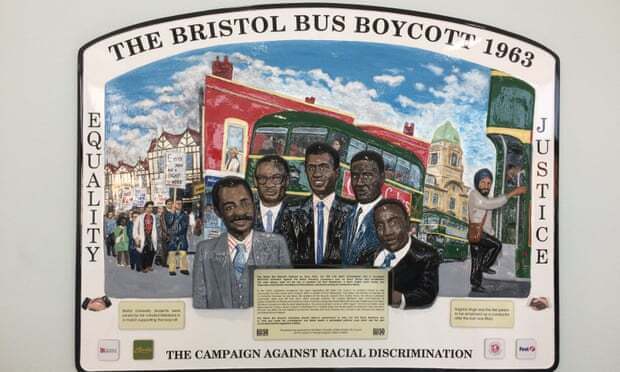
Bristol Boycott plaque. Photo: Historic England
These are just three snippets into what the study of Black British History can tell us about British local history. There are several other important figures that tell the tale of local Black British History, as well as Black British History more widely –individuals to look out for include: the Ivory Bangle Lady, the Tudor trumpeter John Blanke, Ignatius Sancho, Olaudah Equiano, Sarah Forbes Bonetta, and Mary Seacole (they are just some of several Black figures that form part of Britain’s all-encompassing history). By looking at certain events and figures belonging to a particular British location, therefore, a story starts to emerge about the communities that are part of Britain’s past and the links that the British Isles had with Africa and the Caribbean.
If you’re interested in learning more about Black British History, I’ve compiled a list of ‘Further Reading’, which you can see below – happy reading!
Further reading:
Peter Fryer, Staying Power: The History of Black People in Britain (London: Pluto Press, 1984)
Peter Fryer, Aspects of British Black History (Surrey: Index Books, 1993)
David Olusoga, Black and British: A Forgotten History (London: Pan Books, 2017)
If you’re interested in finding out about in Roman Britain, check out this recent blog post from York Museums Trust ‘Celebrating the Ivory Bangle Lady’
You can also check out the Bibliography of British and Irish History, whose editors have recently compiled a comprehensive list of 412 publications about Black British History as part of Black History Month.
The views and opinions expressed in this blog are those of the author and do not necessarily reflect the official policy or position of the British Association for Local History (BALH). Any content provided by our contributors is of their own opinion and is not intended to malign any individual, group, organisation, or entity.