Medical Officer Reports – A Mine of local information
Published: 31st August 2021

Paul Diggett
Paul is a mature PGR at Manchester Metropolitan University, where his working title for his PhD is " The Residuum: Life and Death in Manchester between 1868 and 1914, with reference to Angel Meadow and Ancoats." What started out as a local social history project, is now also encompassing environmental history, and how it affected the lives in the poorest areas. Using the Medical Officer of Health reports, which are often overlooked, which contain a wealth of information, of social and environmental importance.
One of the most overlooked sources of information from the nineteenth century are the Medical Officer Reports.
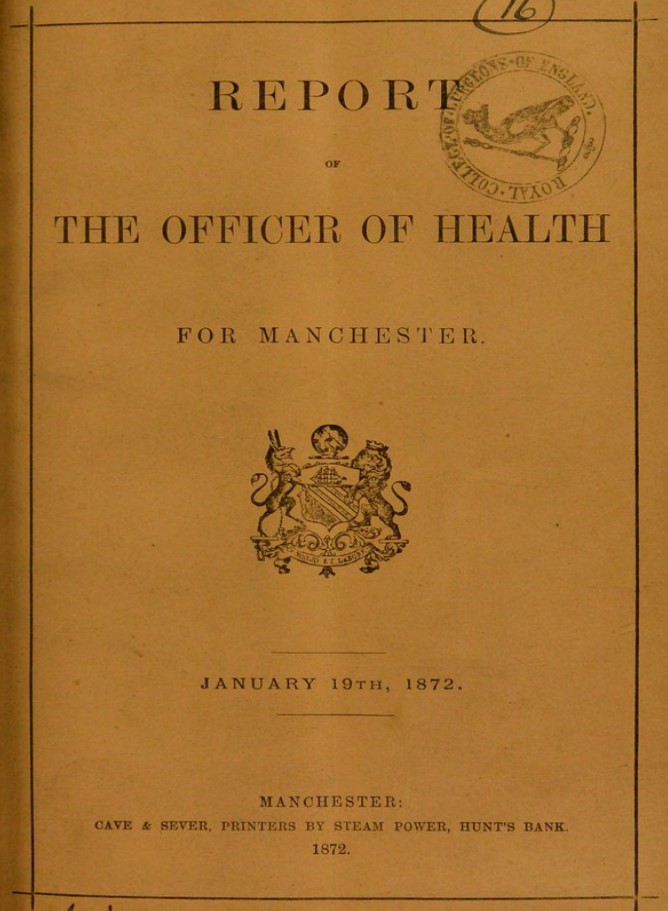
These reports contain a mass of data, from infant mortality figures and standard mortality figures. Investigations into housing, sanitation and food are often gone through in detail, as are births, the appointment of midwives and their work. The first place in England to appoint a medical officer of health was Liverpool in 1848, quickly followed by the Corporation of London a few months later. Under the Public Health Act of 1872, every incorporated borough or county had to appoint a Medical Officer, and report to the Council Body and send a report through to the Registrar General in London.
Manchester did not appoint a Medical Officer until 1868, under pressure from the neighbouring Council in Salford, and a forthcoming visit from the Rivers Pollution Commission. The work of the Medical Officer was concerned with sanitation, housing, maternity, and child welfare and with new legislation food protection laws.
The Medical Officers compiled statistics relating to births and deaths, and in a City such as Manchester was concerned in the high infant mortality rates. The Medical Officer produced statistics for every infectious disease for adults and children. In the Medical Officer’s report for Manchester in 1868, the Officer stated that “Manchester has had a long unenviable reputation as one of the most unhealthy towns in the kingdom.”[i]
In 1904 the Medical Officer explained with the use of tables that the average deathrate for diarrhoeal deaths of infants in Manchester stood at 35.5 per 1000 births.[ii] The Medical Officer then breaks them down into each electoral council ward, so that those reading the reports can see which areas are a cause for concern and need work. Manchester’s Medical Officers would do this break down for every infectious disease.
This enables modern researchers to find which diseases killed the most infants. Summer diarrhoea, as opposed to Cholera, was one of the largest killers of infants in Manchester. As a result, we are able to read the Medical Officer’s summary of the infection, how it was spread and what preventative steps could be taken.
It was during the late Victorian period that the Medical Officer’s reports really illuminated the health of the City. Most Medical Officers investigated the poorer and slum areas, such as Ancoats and Angel Meadow in Manchester, in depth and provided those in their reports. It is through these reports that once can understand why Back-to-Back housing, and why Manchester was the first place in the country to outlaw the building of them in 1848.
Between 1900 and 1906 there was a national smallpox epidemic, and the Medical Officer reports across the country investigated these. They looked at how smallpox was being spread, what their area was doing in response, and also what the local medical attendants reported to them. It was during this period Manchester had a smallpox hospital, which other councils bought beds for their residents to be “removed” to. The information the local medical officer gathered was also shared with the Registrar General who would report the national figures to the Local Government Board.

In the context of Manchester, and specifically Angel Meadow and Ancoats, the local environment and disease environment impacted on infant mortality. Manchester’s Medical Officer’s Report for 1868, stated that “dirt and the causes of dirt and the consequences of dirt” were at the forefront of the Medical Officer’s thoughts.[iii] Though he did link a large amount of the disease and dirt to the “intemperate habits of the people.”[iv] Which was very much addressing the concerns and beliefs of the middle-class councillors and aldermen of the Council.
It is these insights that we get from the Medical Officer’s reports which explains some of the attitudes of the council, as the Medical Officer was a senior officer of the Council. We also see that in Manchester, the reports were often mentioned in depth in the local media and especially in The Manchester Guardian. It is through these reports that we see the priorities of the Council, and how for example, Manchester did not do anything that would upset the ratepayers. This meant, the slums in Manchester did not receive running water until the twentieth century, but the suburbs received the water at the earliest possible date.
Manchester’s Medical Officers would often discuss the state of the privy middens, often referred to as “Dolly Vardens” (after the music hall performer). It is through the reports that we learn that water closets would not be required for the slums, they would have to suffer the dry conservancy privy and the nightsoil collection. It was only in 1890, after the Third Reform Act that the midden system was abandoned, and they began to convert them to water closets. The Medical Officer reported that in 1920, Manchester still had 1,326 pail closets and 48 privy middens in use.[v]
If you want to read your local Medical Officer’s reports most Local Archive Centres will have copies, either loose or bound. But if you would like to look at a large variety of these reports than I would recommend The Wellcome Collection and their online library https://wellcomecollection.org/works and see why these are a mine of information which uncovers some of the social history of your area.
[i] Medical Officers report for 1868, p3.
[ii] Medical Officers report for 1904, p177.
[iii] MoH 1868, p3-4.
[iv] MoH 1868, p3.
[v] MoH report 1920, p47.
The views and opinions expressed in this blog are those of the author and do not necessarily reflect the official policy or position of the British Association for Local History (BALH). Any content provided by our contributors is of their own opinion and is not intended to malign any individual, group, organisation, or entity.