
Medieval Graffiti in Canterbury Cathedral: A Local Experience of Becket’s Cult
Published: 23rd December 2020

Dr Philippa Mesiano
@PhilippaMesiano
Philippa is the Activity Plan Coordinator for the National Lottery Heritage Fund Project: ‘Restoring and Celebrating the Arts and Craftsmanship of St Mary’s Church, Beddington’ taking place between July 2021 and June 2023. As part of this role, she is overseeing a group of trained volunteers who are conducting research and oral history interviews linked to the Royal Female Orphanage, located at Carew Manor in Beddington Park from 1866 – 1939.
In 2018 / 2019, a group of trained volunteers, led by the Collections Manager, Sarah Turner, and Collections Intern and Assistant, Philippa Mesiano, systematically recorded a large portion of the graffiti in the Eastern Crypt of Canterbury Cathedral. During their survey, they noted a significant amount of medieval graffiti in both the Eastern and Western Crypts.

Graffiti is a fairly modern term, coined in the mid-nineteenth century to describe the informal carvings recorded at ancient Roman sites such as Pompeii. Today, it holds a lot of negative connotations, and yet, in the Middle Ages the act of carving marks into the walls and surfaces of churches and cathedrals was an acceptable practice (Champion, 2015, p. 5).
Medieval graffiti can be found in churches and cathedrals across the UK. Canterbury Cathedral is no exception, and its Crypt, famously the location of St Thomas Becket’s original tomb following his martyrdom on 29th December 1170, is particularly rich with medieval graffiti.

An exploration of some of the medieval marks in this space can offer a unique insight into the local community’s relationship with the Cathedral and the saint, particularly in the early days of the cult.
Understanding the Crypt space will really help illuminate this discussion on the creation and purpose of these marks. Canterbury Cathedral’s Crypt is divided into two sections: the Western Crypt built in the late eleventh century under Archbishop Anselm (r.1093–1109) and Prior Ernulf (r.1096–1107) in the Romanesque style; and the Eastern Crypt built in 1180–1181 by William the Englishman, the later of the two architects employed by the Cathedral to rebuild its Eastern arm after the 1174 fire. Becket’s tomb was originally located in the most Eastern part of what is now the Western Crypt, then, as part of the rebuilding programme it was relocated to the centre of the Eastern Crypt (until his remains were moved to a new shrine in the Trinity Chapel on 7 July 1220.)
In the first few years following Becket’s martyrdom, some 700 miracles were reported. This accounted for the vast majority of all miracles reported in relation to the saint. Many of these miracles have been attributed to people from the region of Canterbury and Dover – locals who had flocked to the Cathedral’s Crypt to see and experience the healing powers of the new martyr. At the Cathedral, they would have engaged in active worship: physically interacting with the space to demonstrate their devotion, sometimes going as far as to stick their heads into the tomb to get a closer look! Some members of the community would have shown their devotion by carving crosses and other religious marks into the fabric of the building, particularly in the Crypt – the space closest to Becket.
The cult of Becket was one rich in material culture. Immediately following his death, we know that people took pieces of cloth soaked in the martyr’s blood. Shortly afterwards, pilgrims visiting the Cathedral could purchase ampullae (small lead phials of Holy water, allegedly mixed with the blood and brains of Becket), and also pilgrim badges (small lead-alloy pin badges depicting different images linked to the saint, his life and death). These were items which pilgrims could take away to commemorate their experience. Many also left votive gifts at Becket’s tomb, and later at the shrine, in a further display of devotion. Graffiti marks were a kind of votive, another way for people to leave something behind and ‘preserve an intimate relationship’ with the saint after they had departed the space (Owen, 2010, p. 43).
Unsurprisingly therefore, much of the medieval graffiti in the Crypt is religious in nature. Crosses, Christograms, devotional text and figurative scenes illustrating biblical or other religious iconography are amongst some of the most commonly depicted types in this space. Indeed, the Christ in Majesty graffiti in the Eastern Crypt is the largest piece in the Cathedral (Philippa Mesiano and Ellen Meade have recently engaged in new interpretation of this graffiti).
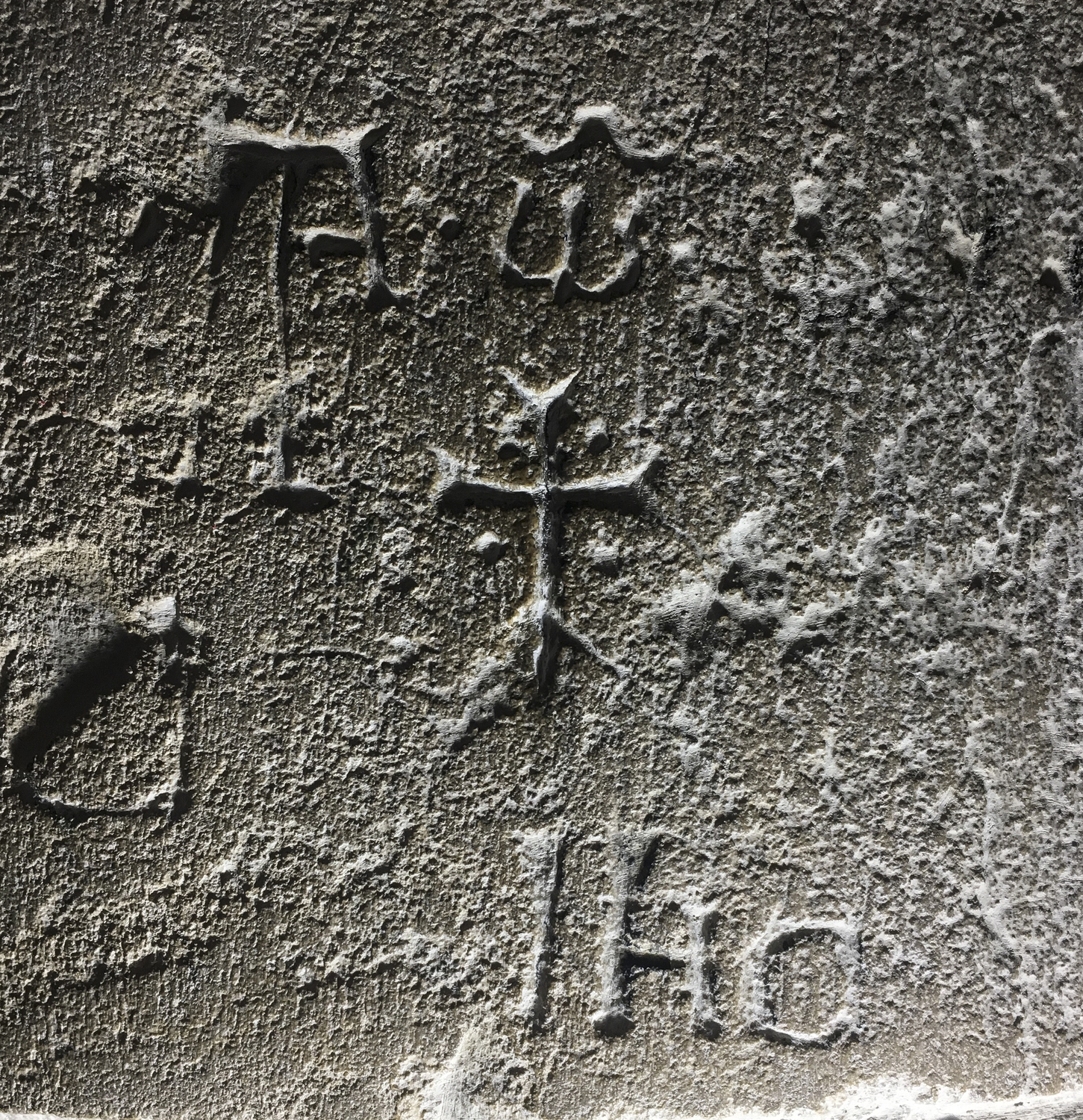
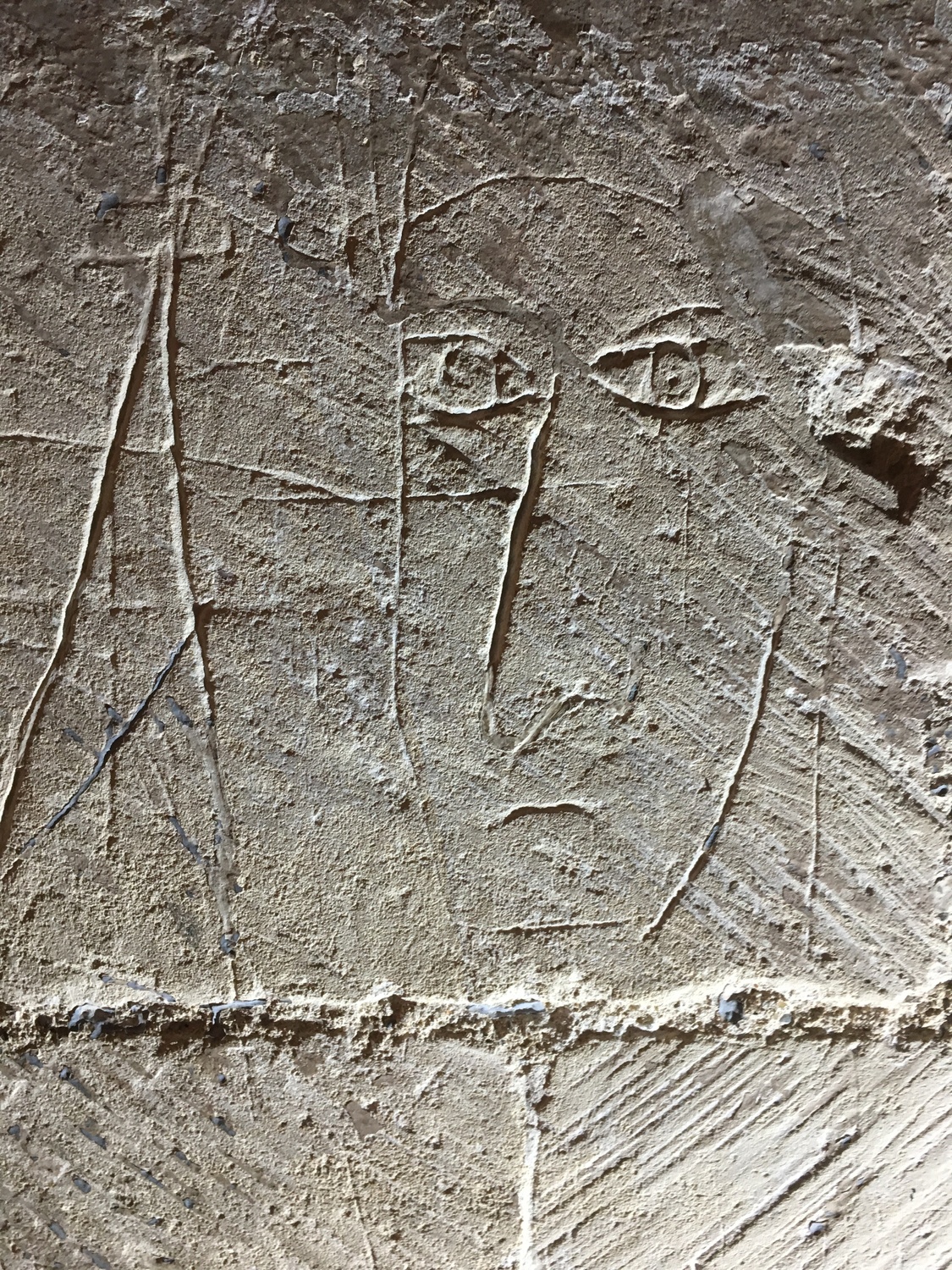
Amongst the graffiti in the Crypt, there are hundreds of crosses. They range from the most basic cross, consisting of two simple lines, to some which are very ornate and detailed. Some were lightly scratched while others have been deeply etched into the building’s fabric. These crosses are clearly devotional – literal prayers cut into the building: the occurrence of which was sometimes connected with other pieces of devotional graffiti. For example, there might be a single cross next to a Christogram, or a cluster of crosses next to a figurative scene depicting a significant biblical scene. Undoubtedly, a number of these crosses would have been carved by local people visiting the tomb.
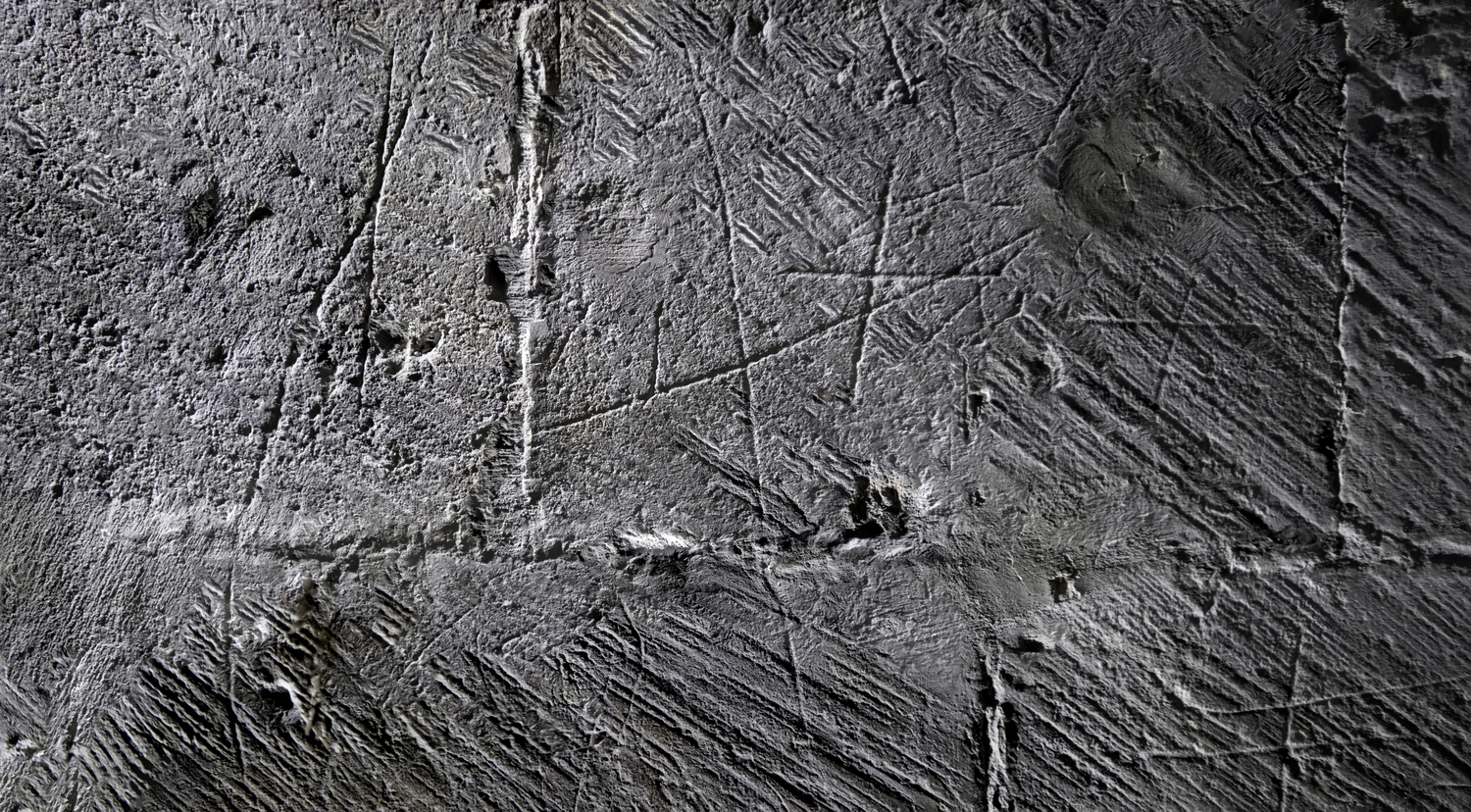

This act of carving devotional marks was not reserved for local residents, it was something which all pilgrims could engage in; however, in the early years of the cult locals would have represented the majority of people entering the Crypt to sneak a glimpse at Becket’s relics.
Following his martyrdom, Becket quickly became an internationally recognised and revered saint (canonised in 1173), and yet, from the very early days of the cult he held a deep significance for the local community, his memory forever etched into their hearts and minds (and in this case, the very walls of the Cathedral…)
You can learn more about the Canterbury Cathedral Graffiti Project here: https://www.canterbury-cathedral.org/heritage/the-canterbury-journey/volunteer-opportunities/graffiti-project/
Philippa Mesiano and Ellen Meade will be sharing new interpretation of the Christ in Majesty graffiti at the Becket conference in April 2021: https://becket2020.com/
Further Reading:
Blick, Sarah, ‘Votives, Images, Interaction and Pilgrimage to the Tomb and Shrine of St. Thomas Becket, Canterbury Cathedral’, in Push Me, Pull You: Imaginative, Emotional, Physical and Spatial Interaction in Late Medieval and Renaissance Art, ed. S. Blick and L. Gelfand, 2 vols (Leiden, 2011), ii., pp. 21–58
Champion, Matthew, Medieval Graffiti: The Lost Voices of England’s Churches (London, 2015)
Koopmans, Rachel, Wonderful to Relate: Miracle Stories and Miracle Collecting in High Medieval England (Philadelphia, PA, 2010)
Jenkins, John, ‘Modelling the Cult of Thomas Becket in Canterbury Cathedral’, Journal of The British Archaeological Association, 173 (2020), pp. 100–123
Owen, Kirsty, ‘Traces of Presence and Pleading: Approaches to the Study of Graffiti at Tewkesbury Abbey’, in Wild Signs: Graffiti in Archaeology and History, ed. J. Oliver (Oxford, 2010), pp. 35–46
Pritchard, Violet, English Medieval Graffiti (Cambridge, 1967)
The views and opinions expressed in this blog are those of the author and do not necessarily reflect the official policy or position of the British Association for Local History (BALH). Any content provided by our contributors is of their own opinion and is not intended to malign any individual, group, organisation, or entity.


