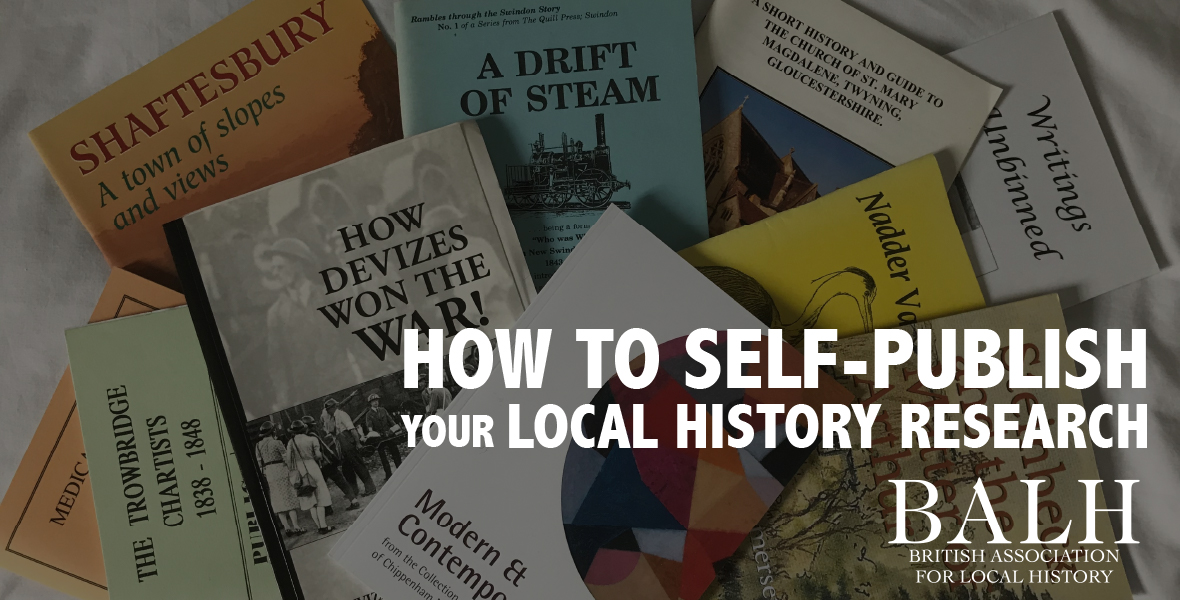
Notes from our Digital Webinar: How To Self-publish Your Local History Research
Published: 14th May 2021

John Chandler
BALH Chair of Publishing
john@hobnobpress.co.uk
John is the Chair of the BALH Publishing team. Besotted by books and local history from an early age, he attained a doctorate in ancient history, before working as a librarian and local historian in Wiltshire. That love of books and publishing led to him taking over Hobnob Press in 2001, since when he has produced nearly 250 books both for Hobnob and others. John has also worked for Victoria County History in Wiltshire, Herefordshire and Gloucestershire.
Fresh from our webinar on self-publishing, John Chandler offers some further thoughts and useful information.
I think that we were all amazed at the take-up for our self-publishing webinar, over 230 attendees, and I was astonished that almost everyone stuck with us to the end. Sitting talking to oneself in front of a computer it really doesn’t make any difference whether 6 or 600 people are listening – but of course it does. If one can be said to receive empathy back from a remote audience the feeling was of a community of kindred spirits. So thank you for your attention and participation (and thank you, Paul and the BALH digital team, for making it happen).
As well as offering you our thanks, this blog pursues some of the points raised in questions which we failed to address. I was conscious that, because I have no experience of the printers other than those I regularly use, I was unable to advise on the range of print-on-demand suppliers out there; and because I do my own typesetting and design I have no idea how much to expect to pay for professional help. It was gratifying therefore to discover that a BALH member, Andrew Chapman, who attended the webinar, runs a company which specialises in helping people to self-publish, Prepare to Publish (https://preparetopublish.com/), and he is well able to advise on such matters. Heather mentioned a printer that she has used and several people asked for details: it is Print 2 Demand (https://print2demand.co.uk/). Because we were speaking on behalf of BALH I was trying not to recommend particular companies, nor to push my own little outfit, nor for that matter to slag off a well-known chain bookseller. So please don’t take any of this as official BALH policy.
Several questions concerned ISBNs, how much they cost and whether you need them. To buy just one currently costs £89, ten cost £164, 100 cost £369, and (if you are really ambitious) 1,000 cost £949. You do not have to have an ISBN but there are advantages. I suggest you look at the Nielsen website (https://nielsenbook.co.uk/isbn-agency/) and perhaps this site too (https://ukbookpublishing.com/do-i-need-an-isbn-for-my-book/). Incidentally, journals and magazines should carry an ISSN (International Standard Serial Number) – these are free and issued through the British Library. Each issue of the serial carries the same number. The British Library is also the recipient of legal deposit copies of monographs (standalone books) and serials, as explained here: https://www.bl.uk/legal-deposit.
Copyright is always a worry and a confusion. The BL’s website has a useful summary (https://www.bl.uk/business-and-ip-centre/articles/what-is-copyright). See as well the Government’s site (https://www.gov.uk/topic/intellectual-property/copyright) – this also explains about ‘fair dealing’ (short quotation for criticism or review). For most of our purposes copyright continues for 70 years after the creator’s death, or 70 years after first publication if that is later. So the specific example raised of a postcard published c.1925 will only be copyright if whoever took it was still alive in 1950. On a different copyright issue, the question of publishing a revised version of one’s own university thesis should not be a problem, though out of courtesy (as with most such matters) it does no harm to clear it with whoever may have an interest. Frequently small publishers face demands for large copyright or reproduction fees, out of all proportion to the financial scale of the publication. The National Trust recently refused me permission to publish the author’s own photograph taken of one of its properties, claiming copyright because she was standing in their grounds. (I resist using an exclamation mark.) If negotiation is not successful (try offering a few free copies of the book) the only recourse is to walk away and find a different, copyright-free, alternative. When you publish a book you should include a copyright statement (usually vesting copyright in the author) and perhaps some kind of disclaimer or prohibition – copy the wording from a mainstream publisher’s book.
Adobe Creative Cloud, as it is now called (https://www.adobe.com/uk/creativecloud.html), which includes Indesign for typesetting, Photoshop for image manipulation, and many other tools (most of which you probably won’t need) is in widespread use – like Microsoft Office you pay for it now by a monthly subscription, though I still use an old version that I purchased outright. There are freeware and shareware programs out there which you might consider as alternatives, such as Faststone Image Viewer (https://www.faststone.org/), Scribus (https://www.scribus.net/) and – for indexing – Index Generator (https://www.openviewdesign.com/). There are comparison websites describing similar programs, so search Google. As before, do not take these as BALH recommendations – you must check them out for yourself. But, as I suggested in my talk, you may consider, if you use Word all the time, just exploring the additional tools and tweaks available in it that can improve the appearance of your text.
Several questions raised specific stylistic issues. These may have been the tip concealing the iceberg beneath, so it’s probably best to refer you to the two books which sit on most editors’ shelves, Copy-Editing by Judith Butcher (the Cambridge handbook) and the Oxford Manual of Style (full references to these and others at https://en.wikipedia.org/wiki/List_of_style_guides#United_Kingdom). A Google search on ‘Style Guides’ throws up plenty of free downloads. I expressed my prejudice against using Times as the typeface of choice. Personal favourites are Garamond, Baskerville, Bembo, Minion, and Caslon, as well as the more obscure Scala and Chaparral. I sometimes use Doves Type, partly for the story behind it (check it out). Of course, most of these are not free, although there is a multitude of quite acceptable typefaces (referred to – wrongly – as fonts) free to download. Typography can become an enthusiasm (aka obsession) – to indulge it get hold of Simon Garfield’s Just my Type (Profile, 2010).
Finally, two deeper considerations about what we do and why. Someone asked about the potential crossover between writing for a local history audience and a much wider readership. One of the missions of the local historian, it seems to me, is to enthuse people in general about their neighbourhood so that they will become interested in it and care for it. Writing engaging books of local history for the ‘general’ reader which are attractive and produced to professional standards is therefore a laudable aim, in fact it is our duty. We all know about ‘creative writing’, but there is also its opposite, ‘destructive writing’ – the ability by one’s ineptitude and incompetence to dampen any enthusiasm the reader thought they had for our subject. The second consideration about local publishing is that it is part of a continuum – knowledge about the past is stored in archives and libraries – historians mine these resources to undertake their research – they write up and publish their research – they deposit copies in archives and libraries – they have added to the resource for the next researcher. Just a thought.
Thank you, on behalf of the BALH, for taking part in what I hope you feel can become a constructive dialogue.
John Chandler
The views and opinions expressed in this blog are those of the author and do not necessarily reflect the official policy or position of the British Association for Local History (BALH). Any content provided by our contributors is of their own opinion and is not intended to malign any individual, group, organisation, or entity.