Opening up our research to others: from department store to model colliery village
Published: 24th February 2021
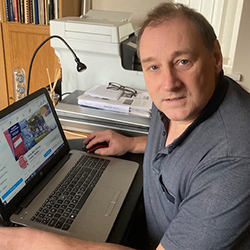
Philip Cousins
@philip_cousins
Philip Cousins is a volunteer, publicity officer and vice-chairman of the Derbyshire Victoria County History Trust (a registered charity). He has been interested in local history since his early teens. An electrician by trade, he has recently retired after nearly 40 years working with the NHS, latterly as a contract manager.
At Derbyshire Victoria County History Trust we’ve decided to open up our research to people who might not have heard of us or our studies. In truth we’ve not been as good at this as we should.

New Bolsover was created by the Bolsover Colliery Company for its workers in the 1890s. The company’s managing director, Emmerson Muschamp Bainbridge (junior), is credited with having an enlightened attitude to his workers. His father also enhanced working conditions at what is reputed to be the first ever department store – Bainbridge’s – in Newcastle-upon-Tyne. This is just one of the subjects being highlighted via the Derbyshire VCH Trust’s new Facebook page.
For some years we’ve had a website – which was part of a Heritage Lottery Funded ‘England’s Past for Everyone’ (EPE) project. For Derbyshire this covered Bolsover, Hardwick (Hall) and adjacent areas. Two popular paperback books were published. Outside of the EPE project we completed and published one of the traditional VCH ‘big red books’ – the first since the early years of the last century. We have a county page on the main VCH website.
We’ve decided that our reach needs to be improved, known wider and that we can perhaps correct some historical misconceptions. To assist in this, we have set-up a simple Facebook page – hardly earth-shattering it has to be said – but never-the-less something we have not tried before. We plan to post something of our research about once a week. If necessary, we’re revisiting some of this research and populating a new website, which can handle much more data than a simple Facebook post. Some of this revisiting has been due to comments posted in response. Some will be new information, or things we can’t cover within our big red books.
What do we mean by the latter? The Bolsover Colliery Company was a leader in enlightened provision for its workers. This included, from the 1890s, construction of ‘model’ villages in areas such as New Bolsover and Creswell. The company’s managing director, Emmerson Muschamp Bainbridge, is credited with this enlightened attitude. There’s an interesting link revealed in his surname. That name – Bainbridge – may still be well-known to people in Newcastle-Upon-Tyne. Here was, ultimately, a large a department store, which for many years traded under the Bainbridge name. This is reputed to be the first ever department store, tracing its roots back to the late 1830s. It was founded by another Emmerson Muschamp Bainbridge. He was actually the father of our Bolsover Colliery Company’s Bainbridge – they both had exactly the same names. The store still trades, but under the John Lewis Partnership. Since 1974 it has been situated at Newcastle’s Eldon Square shopping centre.
Our Bolsover Bainbridge was presumably heavily influenced by his father. Amongst other innovations, Emmerson senior provided a hostel for his workers near the original department store premises in Newcastle. Emmerson junior made sure that his model villages had access to shops, recreational facilities, schools and institutes. There was even a company orphanage at New Bolsover.
We didn’t have the space in our books to explore this interesting link. So, we will be putting this right in posts on our new website.
We’re also righting some wrongs. In a spin-off to our research for VCH big red books on Chesterfield, in 2019 we published ‘Chesterfield Streets and Houses’. This book shows how the layout of the town centre developed and the history of individual houses. It highlights some misconceptions about the history of some buildings in the town. These include a fine ‘Georgian’ terrace which actually dates from the early years of Victoria’s reign, a pub said to have belonged to the Knight’s Templars (which it didn’t) and a bowling green which dated back to the 13th century – it is old but not that old! We’ll be highlighting these and others in posts to our Facebook page.
Illustrations are important on Facebook. For example, there is an Old Chesterfield Pics group, which regularly attracts hundreds of views and posts. Where we can we’ve included historic illustrations in our posts on Chesterfield. This has enabled us to repost on the old pics Facebook page, widening our reach. We’ve also used our contacts with others for old photographs such as Bolsover Civic Society. This strengthens relationships with the local history world.
Facebook is, of course, something of a conversation; it’s not just about posting. We’ve used posted comments on our page to reassess some previous research. This has included architect PB Houfton’s involvement with the Bolsover Colliery Company’s housing, leading to further posts and information on our new website currently under development, using WordPress. We’ll also be asking questions where our knowledge has gaps. We’ve already had a ‘guest’ contribution from one of our other volunteers and there’s plenty more to cover. Hopefully when our volunteer research group is able to reconvene, we’ll be able to keep our ‘followers’ and others informed about our latest discoveries.
But this does require some commitment. At present I operate most of the posting to Facebook and monitor the site. As most of the information for the initial post has already been written, it is fairy easy to extract this from our existing sources. Overall, it’s certainly given me something interesting and productive to do, particularly as someone who is newly retired in a lock-down!
Finally, my general tips:
- Use Facebook to improve your reach.
- Get to know your intended audience.
- Use examples from your existing research, but prepare to be challenged. See this as part of the conversation.
- Monitor comments and be prepared to answer these, but don’t think you have to answer every point.
- Repost to other applicable groups. Frame your original post so it’s attractive to these groups and don’t forget to abide by their rules.
- People like photographs and old maps. Use these in your posts.
- Build up a good and trusted relationship with others in your organisation. For me that’s principally with our county editor and our Trust officers. Check with them if you need to.
- Remember that you are representing your organisation. Be courteous in all you write.
Where can you find us:
Our Facebook page: www.facebook.com/DerbyshireVCH
Our Explore website: www.victoriacountyhistory.ac.uk/explore/county/derbyshire
Our old county new VCH website: www.history.ac.uk/research/victoria-county-history/county-histories-progress/derbyshire
Our new site, in development using WordPress: http://derbyshirevch.org
The views and opinions expressed in this blog are those of the author and do not necessarily reflect the official policy or position of the British Association for Local History (BALH). Any content provided by our contributors is of their own opinion and is not intended to malign any individual, group, organisation, or entity.