Outlaws and Fugitives - A glimpse of some lesser-known Carlisle carvings
Published: 22nd May 2023
Jon Tait
Jon Tait is a member of the Rothbury & Coquetdale History Society and has written a number of local history books with a particular focus on football.
The Keep at Carlisle castle underwent a large-scale restoration and conservation project last year.
A specialist cleaning team removed sediment and water damage from the famous 14th century ‘prisoner carvings’ etched into the red sandstone on the second floor of the building as part of the works.
The carvings are a bit of a puzzle to decipher with work including dolphins, mythical creatures, a fox preaching to chickens and faces chipped into the soft facings. Others, such as a white rose of the Yorkists and the crescent and manacles of the Percy family, are less cryptic.
However, much less famously and without the wide celebrity of their counterparts, there is a real tangible link to the Border Reiver past of the city cut into the stone by a window off the Great Hall on the floor below.
Dating to the time of the ‘Pacification of the Border’ when King James ascended to the English throne on the death of Queen Elizabeth in 1603, the graffiti carved in that quiet corner of the castle was put there by men who were seeing their whole way of life turned upside down.
The reivers were well described by Robert Ferrer, the prior of St. Oswald’s, in a letter to Cromwell in 1539 where he wrote that around the Borders there was ‘as a sort of petty gentlemen, who have no right to that name by ancestry, lands, or the like, who oppress the poor by extortion, robbery, forgery, false promises, and arrests.’
The churchman – who was burned at the stake in 1555 - understood the collusion that went on at Truce Days, the corruption between officials, the petty power squabbles between the families and the violence that they employed to add to and maintain their wealth. The reivers of the Anglo-Scottish border were simply a mafia.
Arthur Graham of Mote was deported to Ireland on the 22nd April 1607 on a second boatload of Grahams to be removed from Cumberland by order of the Border Commissioners.
The first attempt to remove the notorious Grahams saw 100 ordered to go to fight in the Netherlands in July 1605. Only 72 turned up, and so many of those had deserted and returned home that in September 1606 a first boatload of the Grahams, numbering 114 people, were sent to Ireland from Workington. A third boatload were sent away over the water in September 1607.
Arthur’s name is etched forever into the wall alongside that of T. Graham, with his nickname ‘The Stone’ – possibly Thomas Graham of Logan, who was sent away on the third ship.
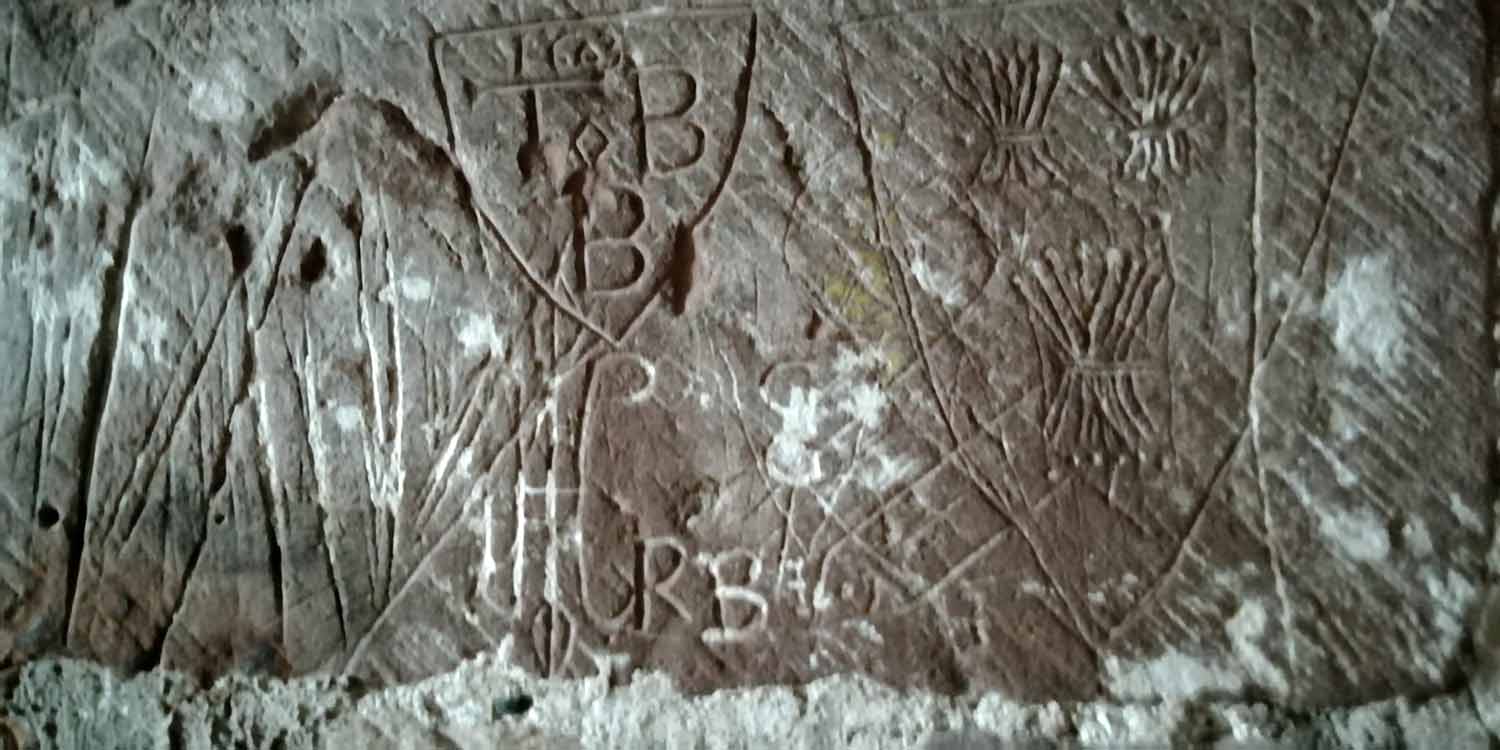
On the front facing side there is a crest featuring three sheaves of wheat belonging to the Blenkinsop family and the initials ‘T.B.B’ and the date 1603 in a shield motif. Other initials nearby include C.B., C.R.B. and G.G. in a similar shield – most likely one of the many George Grahams in the area.
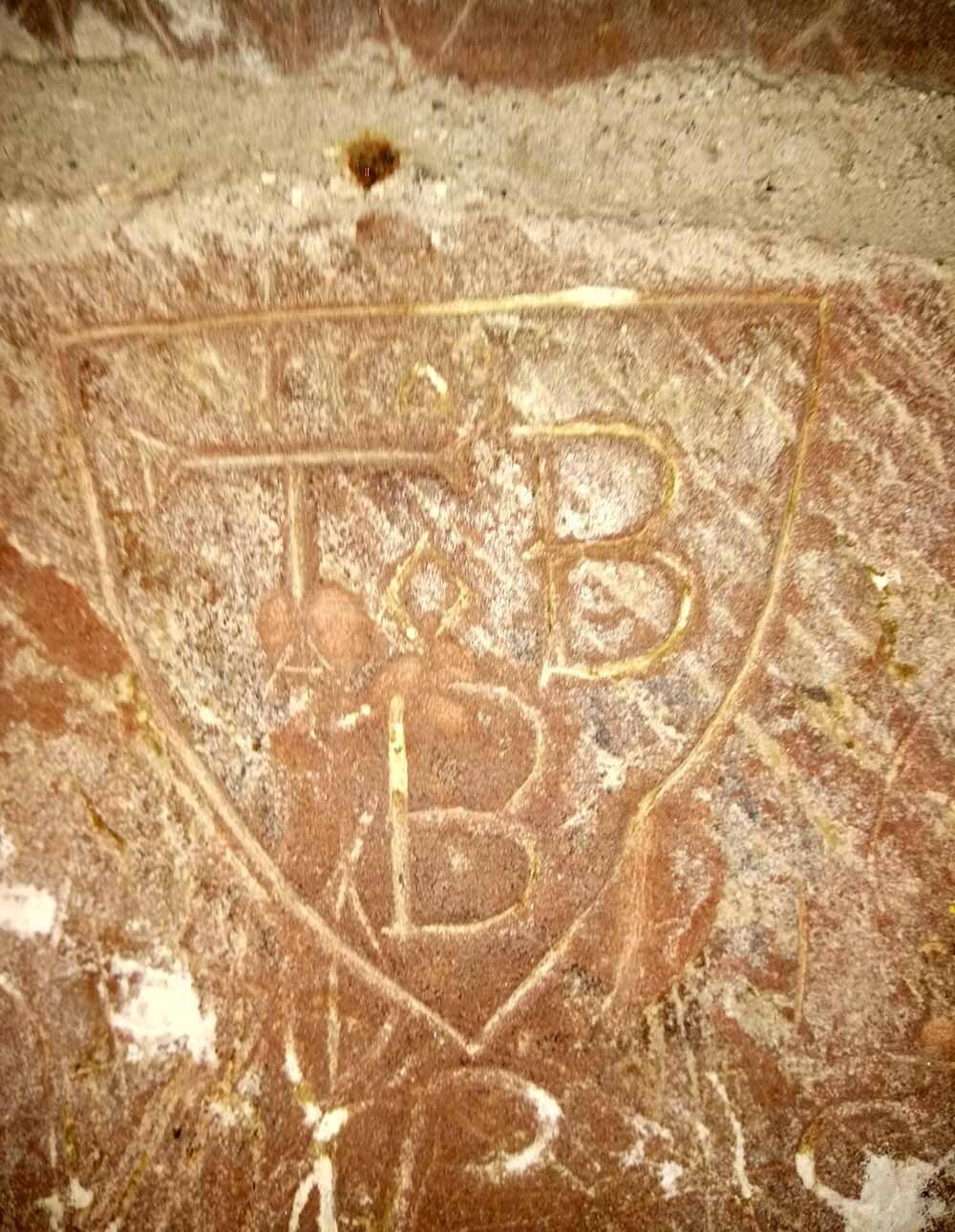
Thomas Blenkinsopp of Bellister, near Haltwhistle in Northumberland, was named as one of numerous fugitives and outlaws in August 1605 wanted by the Commissioners, who were hanging, drowning and branding their way through the old charge sheets.
Thomas was wanted, along with Edward and John Blenkinsopp, for burglary and felony; they were ‘thieves, spoilers and burners,’ and had rode ‘with banners displayed in open day foray since the King’s Proclamation, for which they stand many times indicted at Carlisle.’
In the March of 1603 Edward and John Blenkinsopp of Bellister had, with Tristram Blenkinsopp of Darlees, Francis and Richard Irwin and the Cumbrian Alexander Armstrong of the Mill, burned down the houses and barns of Alexander Liddall and Humphrey Crowe at Town Green.
Tristram of Darlees had also been charged a year earlier with breaking into and burgling a spinster called Isabella Waugh of 30 shillings at Redpath with Nicholas Blenkinsopp of Dryburn Haugh.

John Blenkinsopp of Bellister stole eight cattle from Thomas Sparke in west Allendale with Cuthbert Milburn of Dunstead and the Scottish reiver Thomas Frissell of Overton in 1605. It’s possible that the J.B. and E.B. initials on the door lintel opposite belong to John and Edward.
The Blenkinsopps weren’t just petty criminals when you look at the calibre of Gilsland reivers that they were being listed alongside; Anton’s Edward Armstrong was wanted for 12 murders and was deported to Ireland on the third boat of Grahams. His family and gang weren’t as lucky as him – Tom and Jock ‘Stowlugs’ Armstrong, Christopher Irwin, and others including George and Will Bell were all executed by Lord William Howard.
There was a breakout from the Sheriff’s jail at Carlisle in October 1605 when the jailer’s servants left a door open as they brought in the prisoner’s supper and five ‘notable offenders’ escaped. It was the third such escape from the castle since Sir Henry Leigh had been Provost Marshall of Carlisle but he wanted to be blameless as he ‘kept the Castle, not the gaol.’
The intriguing marks that the reivers have left chiselled into the stone with their own hands provide tantalising glimpses back to the end of their criminal reign and the imposition of order on the Marches.
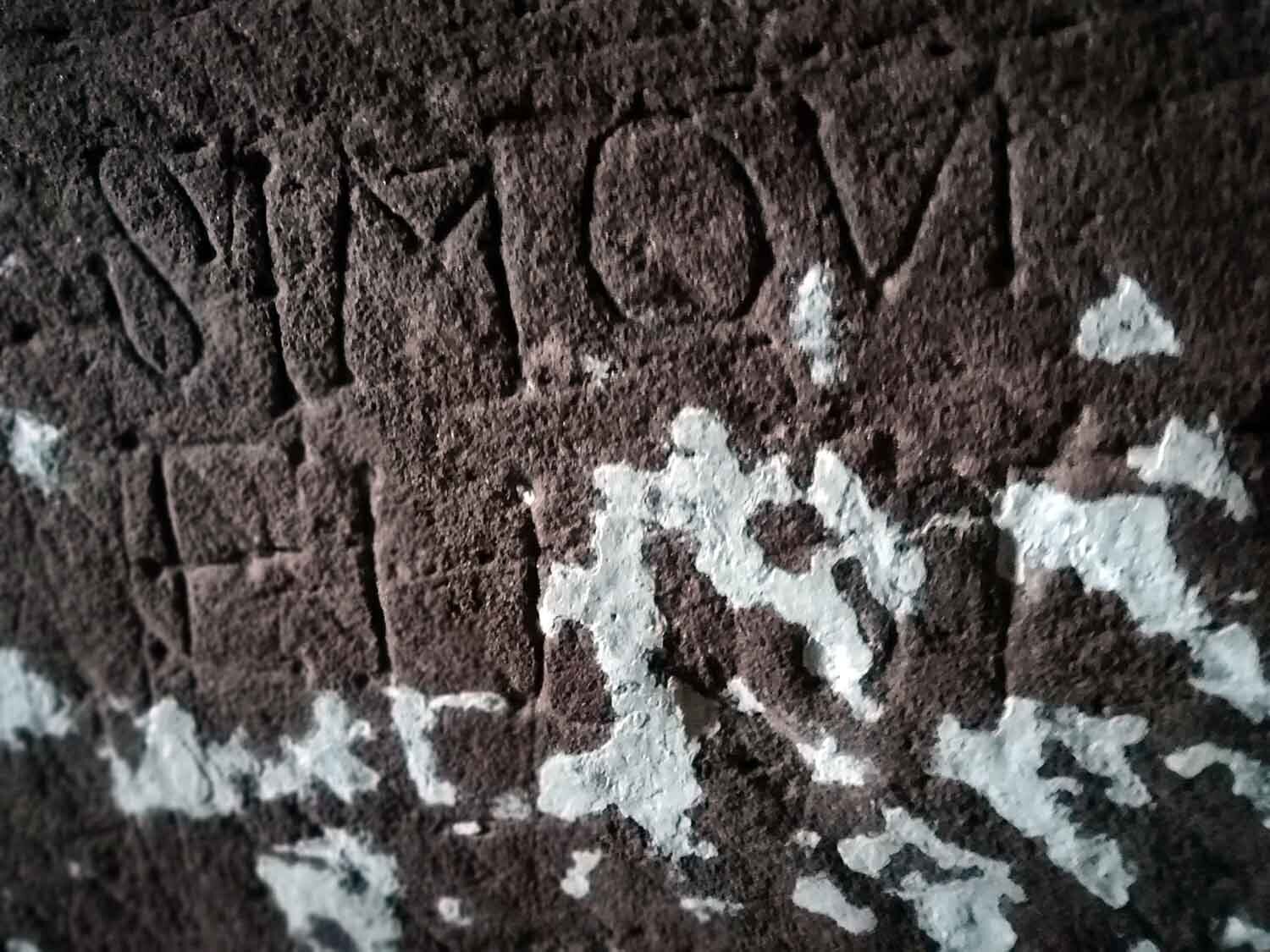
One has to wonder if Simon Elliott whose name is forever on the red sandstone nearby was the Liddesdaler Sim Elliot who, along with Robin Elliot of the Park, Clemmie Croser, Gawen’s Jock and others who took Tom Routledge prisoner when they stole 60 cattle and a horse from Todhills in Cumbria in 1581.


Sim and Robin also met with Thomas Musgrave, the captain of Bewcastle, to plan a football match between the Armstrongs and the Bewcastle men in 1599 which predicably ended in violence.
To see such intimate echoes of the past at close quarters are a real rarity and special little-known attraction of the great Border city fortress.
References
Northumberland Quarter Sessions at the National Archives.
The Manuscripts of the Earl of Westmorland, Captain Stewart, Lord Stafford, Lord Muncaster, and Others, Volume 30, Royal Commission on Historical Manuscripts, 1885.
British History Online. Letters and Papers, Foreign and Domestic, Henry VIII, Volume 14 Part 2, August-December 1539.
The Calendar of Border Papers, Vol 2, Joseph Bain, 1894.
The views and opinions expressed in this blog are those of the author and do not necessarily reflect the official policy or position of the British Association for Local History (BALH). Any content provided by our contributors is of their own opinion and is not intended to malign any individual, group, organisation, or entity.