Parish Loyalties on the eve of the Civil War in Somerset
Published: 11th February 2023
Occasionally records that relate to multiple parishes escape the careful eye of the local historian. One such source for over 200 parishes in Somerset is a petition in support of Episcopacy on the eve of the Civil War of 1642-1646.
The names in the petition, some 14,350, were gathered in 1641 and presented to Parliament in December that year (referred to hereafter as the December Petition). It was a repost to the “Root and Branch” petitioners from the county of November 1640. A recent study of this important source has been brought into print by the authors, details of which are at the end of this blog.
Why is it important for local historians? There are three main reasons. First, it contains the names of thousands of adult men living in 1641 who are not included in the Somerset Protestation Returns, published by the late Dr Thomas Laity Stoate. The Protestation Returns for Somerset are not complete, thus making this petition a very valuable source. Secondly, the men who appear in the petition are thought to have been Royalist supporters, whereas those in the Protestation Returns cannot be distinguished as universally supporting one side or the other, or even neither! The third, but more contentious reason, relates not only to the absence from the petition of some entire parishes, but also to the absence of some of the men listed in the Protestation returns from parishes that are included in the petition of December 1641.
Now this important source is in print it is possible to compare the names against other sources and in some cases address the third issue (above). Good examples to study are Taunton and Wrington. It is well known that during the Civil War Taunton was vehemently for Parliament. So why are there so many names from Taunton supporting the King’s love of his bishops? Similarly there is a part for Wrington where the resident clergyman, Samuel Crook, was a defiant opponent of King and bishop alike. The answer lies in some measure in the simple fact that so many parishes in the county were in fact divided in their loyalties.
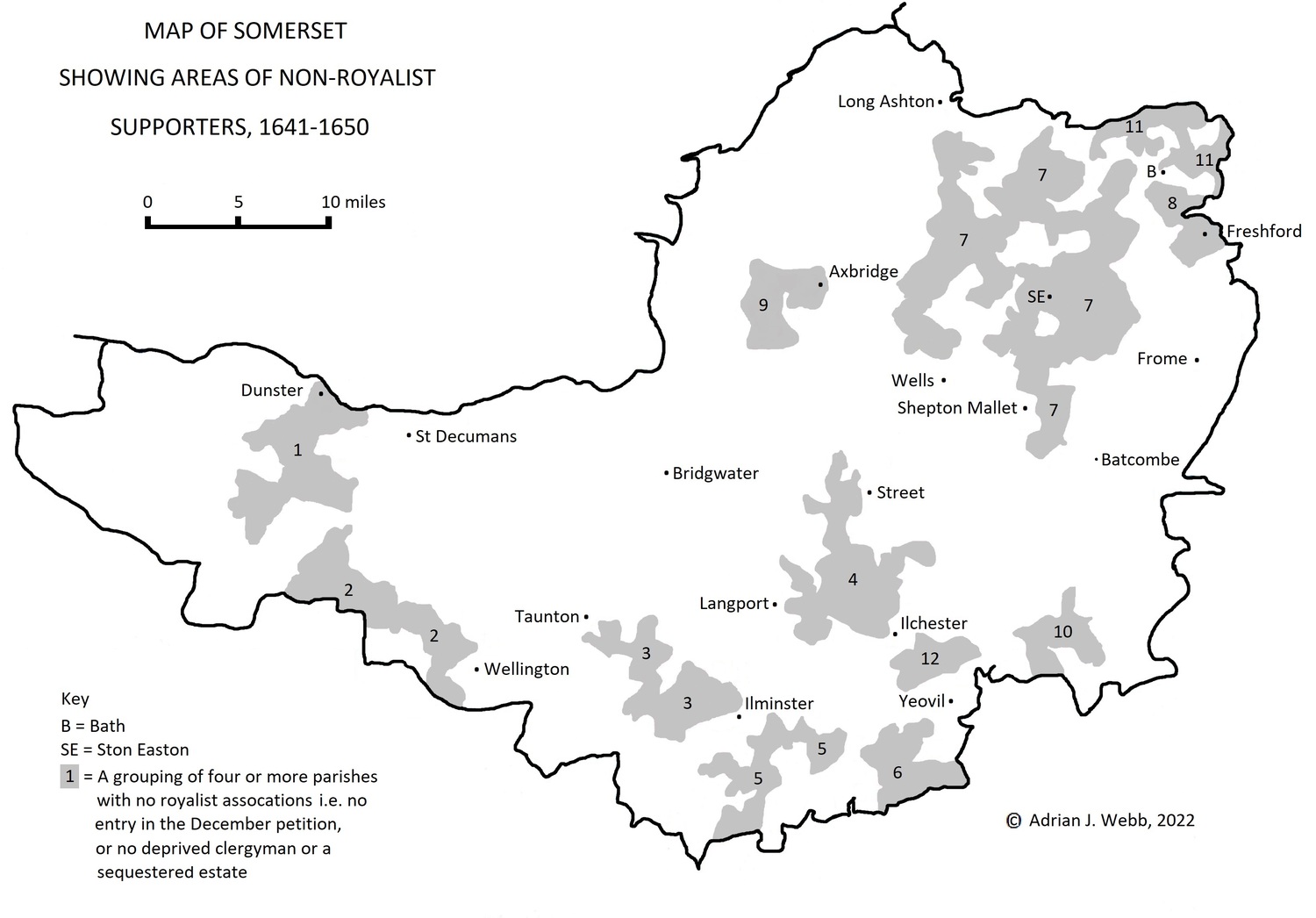
Does this mean that those parishes that are not represented in the petition did not support Episcopacy? With so much evidence for the division of loyalties within the county it is difficult to make a blanket statement that a parish not in the petition was totally for Parliament. It may have been the case that the parish clergyman simply did not bother contributing to the petition. Thus his lack of organisation meant that Royalist supporters, if they wanted to support the petition, had to go to a parish where names were being collected. There is some evidence for this, as there are many examples of more than one parish combining together. A map showing the parishes that are absent from the petition is shown below.
In reply to the December petition there was a tit for tat exchange of similar documents, all of which are transcribed in our book. The attempts by the learned elite in the county to avoid a war eventually all came to nothing. However, their petitions provide a fascinating insight into the arguments both sides were using, as well as the names of their supporters. It is possible to match some of the Royalist supporters in these petitions with the names in the December petition. Whereas Parliamentarian supporters, such as the Blakes, Strodes and Hippisleys who were behind those petitions cannot be found in the December petition.
One of the themes in the later petitions was the problems in Ireland, at the same time the county was busy collecting money for distressed Protestants. Although only a handful of parish collections for Somerset were identified some years ago, the authors have unearthed several more that are included in our volume. Complementing this involvement with Ireland are the accounts for the sale of lands in Ireland that were confiscated from the “rebels”. The man who was predominantly concerned in Somerset was the county’s sheriff, Martin Sanford. The documents reveal an interesting cabal of Parliamentarian investors, predominantly based in the Bath area, the Mendips, Taunton and Chard.
All of the themes and documents referred to above are explained in five chapters. Each chapter is based upon research into original first-hand primary sources. Subsequently there are other events concerning the vicar of Pitminster, Christmas at Barrington, the Bishops Wars, strange preachers at Chew Stoke, cuckoo pipes at Bruton, militiamen, fighting clergy, Ship Money, the bishop’s registrar, communion tables, petitioners from Beckington, investors in Ireland, MPs, coded petitions, riots at Neroche, Royalists and Roundheads, Assize courts, poor clergymen, protestations, silver-tongued Sydenham, church courts, Scotland, musters and much more.
Please email somersethistorian@gmail.com to order a copy at 20% off for BALH members. Payment can be made by BACS, or cheque. Copies can be ordered at full price through Ebay.
The views and opinions expressed in this blog are those of the author and do not necessarily reflect the official policy or position of the British Association for Local History (BALH). Any content provided by our contributors is of their own opinion and is not intended to malign any individual, group, organisation, or entity.