Report from Local History Hour ‘Women's Lives in Early Modern Documents’, 29th April
Published: 8th May 2021


Joe Saunders
BALH Joint Vice-Chair & Head of Outreach
@joe_saunders1
Joe is a familiar face as the host of BALH’s popular monthly webinar series Local History Hour. He is a Trustee of BALH, joint Vice-Chair and head of the Outreach team. Away from BALH, Joe is working towards is PhD, while as a family historian, he undertakes genealogical research and is an Associate of the professional genealogy body AGRA.
April’s Local History Hour was a beautifully blended joint lecture on the lives of early modern women in the south west of England presented by Sarah-Jayne Ainsworth and Imogene Dudley. They explored the various types of ‘transactional’ texts that can be used to explore the lives of women from different social groups, which also tell stories of local gentry families and the people who worked for them. We were very pleased to welcome 141 listeners.
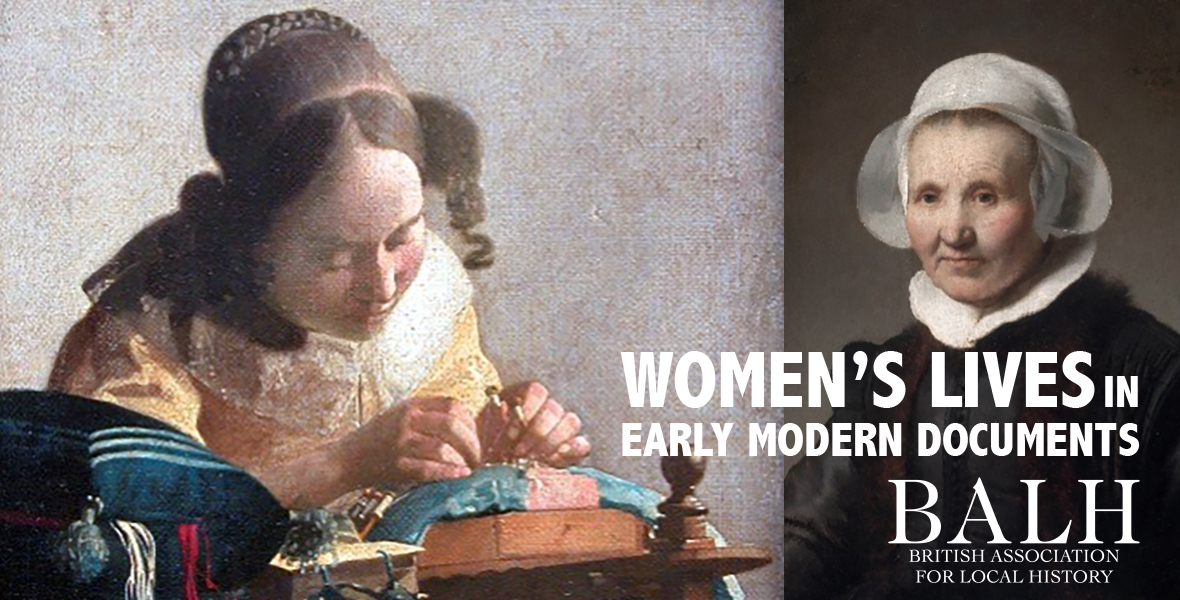
Sarah-Jayne introduced us to Lady Lucy Reynell of Ford (1577-1652), who lived in Forde House in Wolborough near Newton Abbot, Devon. As a gentry woman she had significant control over transactional texts to leave her mark in history. We were given a tour of written texts, including a hagiography of her by her nephew Edward Reynell, and the Reynell Account Book. Lucy also left a will, which Sarah-Jayne argues was written by Lucy so all details of charitable bequests, relationships and book ownership came from her desire to leave a record of herself. This is reinforced by a plaque marking her establishment of a local clergy widows’ house. We were also shown how she made a record of herself and her family in Wolborough Church, having commissioned and overseen the Reynell Memorial. Mention must also be made of her portrait as a symbol of her status, and her image of piety and virtue.
In contrast, Imogene explored how similar sources can be used to explore the lives of much lower status women. Household account books can reveal the lives of household servants, such as Hannah Jarman who worked at Leyhill in Payhembury, Devon. She worked at the farm intermittently, and parish records show she married a local man. So by piecing together records, lives of working women can still be found in the records. They may not have made wills, but they could feature in the wills of their employer, for example. As Imogene discussed, though, unlike gentry women they had no control over the content of records of their lives. A startling example was the record of Ann Ralph, a female servant at Leyhill in the 1640s, who was recorded in a letter written by her male employer’s son-in-law – it was a very negative character assassination! But without even this negative record she would otherwise have just been a line in an account book.
This was fantastic a whistle stop tour of a wide variety of sources that can be used to explore the lives of women in their localities. Questions from the audience included how do we access the documents? Of course, right now we are relying on digital documents but as archives open up we can get our hands on original documents. Using both digital and original were extolled for their different virtues, and each way of accessing gives something different to the researcher – original documents can be appreciated for their physicality which gives a lot of clues that a transcription or a photograph may not give away. But a photograph can be zoomed into or shared on social media if help is needed!
Another question, which is always fascinating, is how Sarah-Jayne and Imogen came to their research subjects? Sarah-Jayne explained how she started with wills – a man’s will made her want to find out what a woman’s will was like, which then led her to people she wanted to pursue. Imogen said she started with the documents and allowed herself to be led by them.
We also put to our speakers four of the questions we couldn’t answer on the night:
Q: What do you lose by seeing a will in electronic form (e.g. on Ancestry) as opposed to in the original form (at the registry)?
There are some obvious things, like the challenges of digitisation which mean that the photos can be difficult to read, but the main thing is the connection to the actual document. In physical form, you can see what it was written on, you can see where the scribe’s ink had to be replenished - I even found a thumb print at the precise point where the scribe would have held the document to read it to the witnesses on one will. And then there are things like seals which are better seen in real life.
Q: How "personal" is the language you found in wills? Is the vocabulary distinctive? Are there "jokes" or asides? Can you "hear" the voice of the author?
Much of the language is formulaic, as you’d expect from a legal document. However, there are examples of the testatrix’s voice which come through. In places, there are direct addresses to the witnesses and there are examples of women basically telling their children to play nicely together and not get involved in legal disputes. And objects are often given family names - pans, for example - or sometimes animals such as cows, which makes them more personal. If you’re interested in voices in wills, have a look at my recent blog post on a site where there are lots of other great posts of relevance. https://manyheadedmonster.com/2021/04/27/not-so-silent-witnesses-hearing-voices-in-early-modern-wills/.
Q: I am interested in where the money came from and where it went to when the individual died, for those involved in businesses / farming etc. Is that something you have examined?
I have to admit that my work is not really concerned with following the money. Some women leave huge amounts of property or leases on property, but this is not something that I’ve followed, as my focus is more on wills as particular types of test.
Q: Fascinating talk – thank you both so much! Sarah-Jayne mentioned Lucy reiterating bequests made by her husband (e.g. her property to their daughter). Have either of you ever come across any examples when the will of the widow might contradict that of her deceased husband?
I’m intrigued to know if the women had the power to do that (in the event, for example, of a feud between the woman and her children after the death of her husband etc.). I don’t think they necessarily contradicted them, although sometimes there are references to bequests which had been made by her husband and only partially fulfilled that then get redirected. Generally, though, men and women covered different things in their wills.
In the words of two great historians, Mendelson and Crawford, ‘the legacy of women's lived experiences in past ages is not easily recovered’. Sarah-Jayne and Imogene have shown that with work and more than a little luck recovering the lives of early modern women can be a hugely rewarding experience. We hope everyone who tuned-in took away information and inspiration to do the same. We’ve also put together a short list of resources and reading to help.
BALH continue to bring local history into your homes and we encourage you all to join our next Local History Hour on May 27th. We move forward in time to consider Burberry- Local Draper to International Fashion Brand with Dr Mike Winstanley introducing textile making and the drapery trade in the 19th century and Dr Barry Shurlock presenting a detailed study of life and work of Thomas Burberry in Basingstoke. We look forward to seeing you there.
Resources:
As well as the https://manyheadedmonster.com blog Sarah-Jayne also recommend the Power of Petitioning in Seventeenth-Century England project which has loads of great petitions and blogs which might be of interest to people looking at women’s history. https://petitioning.history.ac.uk/blog/
For those of you wanting to try your hand at reading these documents but are a bit daunted by seventeenth century handwriting then check out our report on March’s Local History Hour which contains a list of learning resources including BALH’s publication, Mark Forrest, Reading Early Handwriting, 1500-1700. https://www.balh.org.uk/blog-report-from-local-history-hour-the-english-civil-war-in-the-localities-2021-04-19
Further reading:
Alice Clark, Working Life of Women in the Seventeenth Century.
Sara Mendelson and Patricia Crawford, Women in Early Modern England 1550-1720.
Lucinda M. Becker, Death and the Early Modern Englishwoman.
Susan E. James, Women’s Voices in Tudor wills, 1485-1603: Authority, Influence and Material Culture.
Karen Grannum and Nigel Taylor, Wills & Probate Records: A Guide for Family Historians.
Tom Arkell, Nesta Evans and Nigel Goose (eds.), When Death Do Us Part: Understanding and Interpreting the Probate Records of Early Modern England.
Jeremy Gibson and Else Churchill, Probate Jurisdictions: Where to look for wills.
The views and opinions expressed in this blog are those of the author and do not necessarily reflect the official policy or position of the British Association for Local History (BALH). Any content provided by our contributors is of their own opinion and is not intended to malign any individual, group, organisation, or entity.