The Future of Local History Events
Published: 9th May 2021

Paul Carter
BALH Digital Manager
digitalmanager@balh.org.uk
@pac404
Paul Carter is founder and Managing Director of Beachshore, a web development agency working with a number of organisations in the local and family history world. He is also the creator of Name & Place, a dedicated software solution local history projects including one-name (surname) studies, one-place studies and house histories, which is used by both individual researchers and societies. He is also the BALH Digital Manager, responsible for the Digital Team and coordinating our online output.
As the BALH Web Manager, I am frequently asked for advice in running talks and events online. As we tentatively return to the outside world, what does the future look like for local history organisations, their meetings and events?

This article started as a standard email response, to BALH society members seeking guidance, but this is a wider issue, something which affects us all. This is based upon the questions I am being asked, what I’ve witnessed first-hand, and my technical understanding of the issues and requirements involved. Circumstances are of course changing, and none of us can say for certain what would be allowed, or what would be acceptable to participants in the near or more distant future. This is my thinking at the time of writing, in early-May 2021.
Type of organisation
Firstly, there’s no one answer to cover all types of society or organisation. If you are a small community group, with a membership entirely made up of local people, you are more likely to want to, and be able to, return to physical meetings. If you have a wider audience or membership, or indeed a larger membership, you will need to consider both the logistics of hosting events and the wishes of your non-local audience. We will be announcing the initial findings of our all-encompassing local history survey at Local History Day next month, but what is noticeable is most respondents were open to virtual meetings continuing and being less likely to want to travel beyond their immediate area. Now some of that view is going to have been swayed by the situation at the time they responded, but it is still a telling statement of acceptance of the technology imposed on us all.
Type of event
We should also distinguish between regular meetings, i.e., the traditional monthly church hall meetings, and more ad-hoc events or conferences. The latter will typically attract a wider audience and may require a special venue to accommodate the numbers etc. These larger events are candidates for being made hybrid, i.e., welcoming both physical and virtual attendees. However, those events do have challenges and things to consider, which I cover below.
What have you done in the past year?
This is also a key consideration. I am aware of some organisations who have done nothing, shut up shop, in some cases sadly, not to reopen. Others have adapted and evolved, taking to running online meetings, creating busy programmes of virtual talks, exploiting the opportunity to attract both speakers and attendees no matter where they are based. Essentially if you’ve done little or nothing different since early last year, and can restart, you have two options:
- Plan for physical meetings as before, in line with official guidance
- Exploit the experience of other organisations and adapt to a hybrid or virtual setup. It’s not too late!
For those organisations where you have thrived over the past year, increasing awareness, membership, and events, you naturally have the tougher decision. Do you turn your back on those positive advancements or accept your organisation has changed forever? I am aware of some societies, who despite increasing their membership online, are advocating returns to their church halls, which I find both a simplistic and short-sighted view. These are the same societies who were struggling and worried for the future with their declining numbers at church hall meetings on a cold November night. My view is you plan to accommodate both, because while I am a technologist by profession, I am also human and understand the need for social contact. So, I would suggest you look at returning to physical meetings, whether at the previous frequency (i.e., monthly) or less frequently (i.e., bi-monthly / quarterly), and retain a programme of online events. Not only will this enable you to retain your new online membership / audience but enable you to grow it.
Also consider your speakers. I give talks, and I know many other speakers and a common thread is they don’t imagine spending two hours driving round the M25 on a Tuesday night just to give a talk to a church hall audience of 30. For many, those days have gone. But use that to your advantage – attract a wider range of speakers to give more varied talks online.
Rethinking membership packages
Within BALH, we decided to offer most of our events as free member benefits, while charging a small fee to non-members. Not only that but we took the opportunity to pilot a new scheme to try to address a problem we’ve had for years – how to offer benefit to the membership of our member societies. That’s where the Society Discount Code comes in. Now what we have noticed is only about half of our virtual event audience are BALH members, meaning we do receive some unplanned income from our events. That more than covers the costs of our Zoom software (we pay a higher rate for Zoom Webinar, see below), and can be considered a model for local societies. The more regular events you run; you have the opportunity to generate some revenue while still being able to pay for speakers if you wish. The key here is your audience is potentially global, so try to exploit it.
In the short term, during the pandemic, these virtual events have been charged on an ad-hoc basis, but if you are going to continue running them, consider a new online or ‘e-membership’ package. That could for example include PDF versions of your publications, access to your online events and the like. Not all societies have been giving their online talks for free to members, especially if there’s a speaker’s fee involved. So, there’s no one answer to encompass all, but you could either enhance your current membership packages, or perhaps, to avoid rocking the boat, add a supplementary level or indeed a bolt-on “virtual” package charged as a supplement to regular membership. The key is to be attractive to both your traditional physical membership while being equally attractive to your new or potential online membership.
Don’t forget, this isn’t just about how your thinking or understanding has evolved over the past year, your audience has too. I have spoken to plenty of people who I’d never have been able to entice to a video call before last year, let alone an online talk. In fact, one person I have in mind tried and failed in 2019 to convince me to spend seven hours travelling for a one-hour meeting because “video chat is too difficult”. That same person I see at least monthly in video meetings now…
The challenges of physical events
While these are the events we’re most familiar with, the key difficulties now are:
- Inability to see into the future, therefore the risk of whether to hold them or the decision being taken out of the organisers’ hands
- The willingness of attendees to both travel and take part
- The willingness of speakers to both travel and take part
- The ability of venues, who most likely will have to adapt for some time to come, to our needs
I cannot give specific advice, because your circumstances will vary, but these are the factors you will need to base your decision on. For BALH, it was simple. June is too early for us to consider a physical or hybrid event, so Local History Day will be online. That decision was made easier by the survey feedback reflecting that view.
The challenges of hybrid events
I define a hybrid event as a traditional physical event but able to accommodate visitors attending online. These have existed for some time, certainly before 2020, so I’ve had some experience of both what it takes to consider organising them and indeed some of the pitfalls to avoid. There will be a growth in this type of event in the future. We at BALH have been discussing how we’d do this, and the types of events it would suit.
Potentially hybrid events can help you run a physical event, because if you have to limit numbers, for example, diluting your physical audience with a (paying) online audience could make all the difference. A hybrid event will need:
- A venue which can accommodate it.
Primarily you will need a strong and reliable internet connection because you are going to be broadcasting out. If you’re unaware, there’s two internet speeds; downstream is the content coming to you – you viewing a video, downloading files, browsing emails. That is faster than upstream, which is you sending files, broadcasting video etc. That’s why it can often (rightly) feel slower uploading a file rather than downloading it. So, your venue needs to have a good upstream speed and connection, generally a business-grade one rather than a cheap home Wi-Fi. - Dedicated technical support.
Either within your group (if you’re lucky enough) or provided by the venue. I foresee a growth in this type of service in future. This technical help will not only be able to ensure you have the right computer and broadcast equipment but also manage it throughout the event, which is why it needs to be dedicated. If you need to purchase this as a separate service, it’s another cost you will need to factor in to the feasibility in running the event, and equally the ticket prices. - Ticket pricing
Normally cheaper than the physical ticket price, but you need to strike the balance between the costs of running a hybrid setup, the potential reduction of physical attendees, at the same time as making the online ticket cost attractive. Can you give away freebies or event offers as part of an online ticket sale? - Recognition from speakers that the audience is not just in the room.
Technically this will require microphones, but also the ability to make online attendees feel part of the event as opposed to looking from the outside. This has been a common problem with early attempts I’ve witnessed. - Additional content for the online attendees.
There’s nothing worse than breaks, for coffee or lunch, when the camera is left running, and online attendees can eavesdrop on conversations taking place near the microphones! Instead, plan additional content, such as asking your speakers to do a short interview or Q&A online during the breaks. Even run a video during this time. - Have a virtual “Host”
To help bridge the gap between online and physical audiences, plan for a host, someone who is at the physical event, but their job is to engage with the online audience, check that they can see and hear okay and answer general questions. Even just explaining what the venue is like, adding some colour to the experience for those watching from home. Likewise, make provision for questions to be answered or points raised from the online audience as well as the physical audience. Your virtual host can help with this, as well as helping fill the content in breaks. - Recording talks or the whole event?
This is a thorny issue, as while many organisations have jumped straight to offering recordings, at BALH we don’t. This is for several reasons, not least respecting our speakers’ wishes. Many can ‘sell’ their talks many times over, and recordings of their content, freely available, remove that opportunity. We also like the concept of an ‘event’, while having recordings available to watch any time diminishes that impact of a live broadcast. When events are ticketed, you also need to bear in mind who sees recordings, and how long for. So that’s why we don’t offer recordings, but you may wish to. Primarily, ensure your speakers are happy with this, and are clear who the audience will be, and how long for. - Post-event
Survey your online participants, to understand how the experience was for them, what they enjoyed, what could be better. This is important because they are not there with you and their views could easily be missed.
The technical equipment required will vary but in general terms, you will need:
- Good quality internet connection, as described above
- Dedicated computer for broadcasting, ideally with a second for your virtual host
- If your speaker is using slides, don’t rely on the camera picking up the screen in the room, plan for a copy of the slides to be broadcast, just as you’ll be familiar with in any online talk you’ve attended in the past.
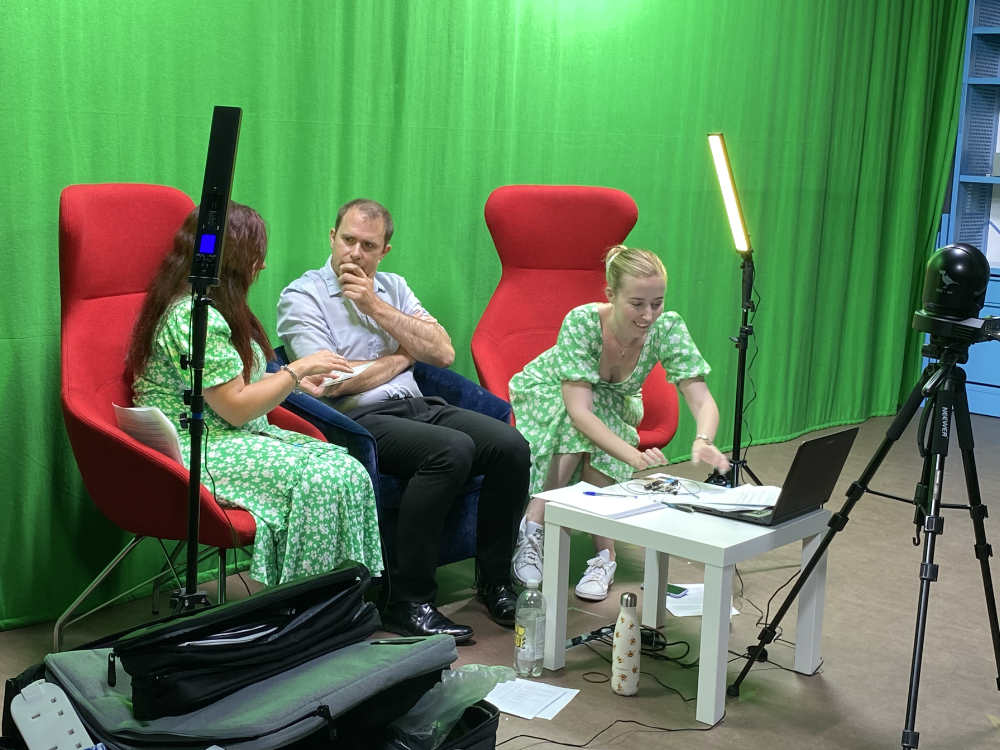
- Video camera. This could be as simple as a web cam, but you will get better results from a dedicated camera. Regardless, don’t rely on the built-in cameras of a laptop. An external camera gives you more flexibility for positioning to best effect. More advanced setups could involve multiple cameras.
- Microphone. In many ways more important than the camera. Ensure your speakers can be heard! This requires dedicated microphones, either lapel mics or directional mics, so the speakers are clear while background noise from the room is minimised.
- Testing! Test in advance. Ensure it is all working well before the event starts.
- Plan for redundancy – have backup equipment available in case something fails.
As you will see from these requirements, I don’t anticipate hybrid meetings to be feasible for the regular monthly “church hall” meetings, but you could record them…
Record not broadcast
By eliminating the “live” element, you can simplify the technical requirements, and could make physical talks available later to your online membership. Again, this would need to be agreed with your speakers, but you could use a regular video camera to record the session, again ensure the microphone is good enough quality, then publish the video later for your wider membership.
As an aside, it’s easy to publish video content to YouTube, simply set up a free account and you have a video channel. While you can set videos to ‘private’, anyone with the link can access it, so it’s not particularly secure. We use Vimeo, which for £6 per month, gives you the option to only allow videos to be viewed under specific circumstances, i.e., from your own website. It does better protect video content, that you wish to restrict to a specific audience.
Copyright considerations
The issues surrounding copyright can be complex and confusing, and unsurprisingly I am asked about this more than anything else. Actually the issue covers not only the copyright of any content used in a talk (document images, photographs or maps) but also the speaker's own copyright of the talk. The speaker should always ensure they have the appropriate permission to reproduce any copyrighted material used for their talk, and this permission may vary based on the content and the audience. Copyright covers content irrespective of whether the talk is given to a small church hall audience, via a live online broadcast or as a recording of a live presentation.
Agree the plan for a talk's use with your speaker and don't necessarily expect all speakers to have the same view. I'm frequently exasperated by people who complain when we don't make recordings of our talks available or even provide copies of the slides! What happened to just making notes? Significant time and effort is invested in producing a talk and while some speakers may be willing for this content to be made available as a recording, don't expect this to be the case. Remember too that the speaker may derive income from giving the same talk to different organisations, and they will wish to protect that.
If your organisation broadcasts a talk or makes a recording available, you technically become responsible for the content, so should be aware of your obligation before publishing a recording straight onto your website or YouTube. The details of UK copyright law is beyond the scope of this article but a good starting point is the British Library Business and IP Centre, which includes some excellent articles on the topic, including fair use, YouTube videos and the avoidance of copyright infringement.
The challenges of online events – are they worth it?
I have been an exhibitor, a speaker, and an attendee at online events over the past few years. This year my web agency was hired to develop a dedicated online platform for a major event, supporting speakers, exhibitors, and workshops, which gave me another perspective.
Organising and running online shows is hard work. It should not be underestimated or considered an easier solution than physical events. It is still early days for the online show market, and there’s a lot to learn for both exhibitors and attendees. I do have a lot of insight, so if it is something you are considering running, I will be happy to share my thoughts with you, but it is beyond the scope of this article.
Conversely online single / dual speaker events are easy! This has been part of regular BALH life over the past year! One piece of advice – invest in a Zoom Webinar licence if possible. If you’re likely to attract more than 30 – 40 to your event, it makes management so much easier. Zoom Meeting can be likened to a room full of people all able to talk over each other. Zoom Webinar is much more a speaker and audience structure. However, again, there’s a cost consideration, but what you can do is pay for Zoom licences monthly, so if you have a quiet period, you don’t need to pay for an upgrade you’re not using during that time.
I wish you the best of luck with your plans for the remainder of 2021, and beyond. Do let us know how you find events working for you, your successes, and even failures. We're all still finding our way in this new world, so let's share experiences for the mutual benefit of the wider local and family history world.
The views and opinions expressed in this blog are those of the author and do not necessarily reflect the official policy or position of the British Association for Local History (BALH). Any content provided by our contributors is of their own opinion and is not intended to malign any individual, group, organisation, or entity.