The Magic of Chancery: Report on March’s Local History Hour
Published: 18th April 2022

Catherine Warr
BALH Engagement Fellow
engagement@balh.org.uk
@HiddenYorkshire
Catherine is the BALH Engagement Fellow, focusing on ways to both develop and support local history, and looking for ways for BALH to help. She runs the highly successful YouTube channel Yorkshire’s Hidden History and was recognised by YouTube in their autumn 2021 campaign, showcasing British creators in a number of national newspaper and billboard adverts.
BALH’s highly popular monthly informal lecture series, Local History Hour, returned in March to discuss ‘The Magic of Chancery Records’.
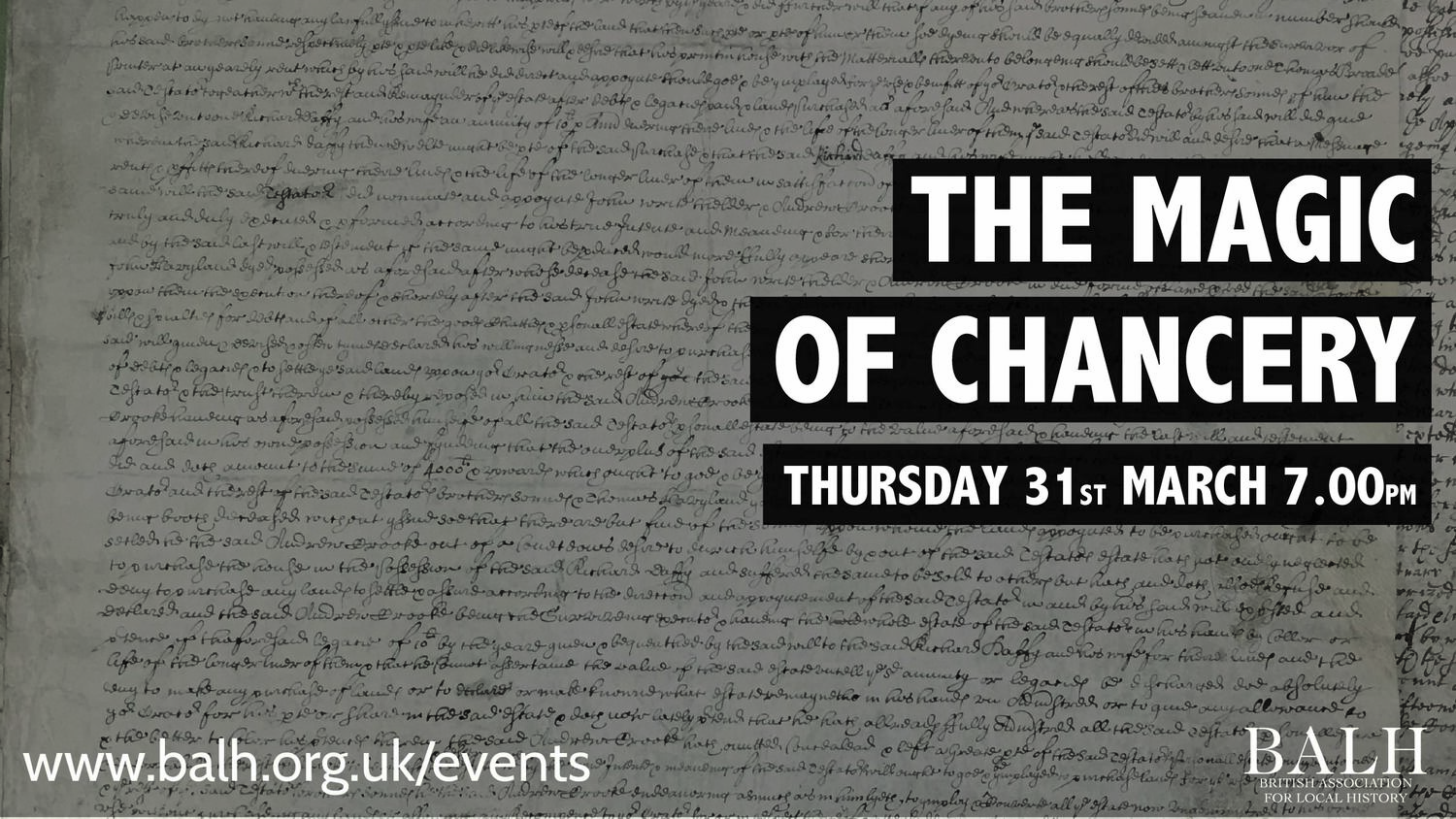
Chancery Records are, essentially, the records of civil cases and lawsuits brought by people against each other. They were distinct from the criminal courts, as there was no jury and no cross-examination, and so the dramas which unfold from the records can be seen as somewhat akin to an episode of Judge Judy, with accusations and defences unravelling to form an enthralling drama.
Sue Swalwell and Susan Moore, both experienced researchers with an ability to navigate the sometimes complex and daunting world of archives, took the packed audience through an introduction to what Chancery records are, what they can tell us, and how one may go about finding them.
These records can be very useful to local historians and genealogists in a number of ways. For a start, a considerable number of them have survived, and as demonstrated by Susan, even a cursory search using the right tools can produce helpful and interesting documents. There are an estimated ten miles of documents in the National Archives, and so the chances of finding at least something relevant to your area of research may be higher than initially expected!
In addition, the format of the documents themselves can help in establishing or confirming details of genealogies; many documents begin with family details and personal histories, often with the complainant establishing the case grievance by going back through time, “In the time of X, when my great-grand-father Y”, etc. Similarly, the documents can record a collective memory; many of the witnesses called in to testify at disputes were community elders with considerable knowledge of the families and goings-on of the area, and so not only do we get an insight ‘from the ground’, so to speak, but we can see how information was remembered and communicated in communities orally, at a time before the ability to read and write was commonplace among the public. Likewise, the documents do not just record the disputes of the wealthy gentry; collected within them are the personal details and testimonies of people from all stratas and positions in society, lending a valuable voice to people who were often excluded from documents from the period or the ability to tell their own story.
Finally, the documents themselves reveal many details about land ownership, debts, merchants, monetary values, and essentially anything which could be involved in a personal dispute. Detailed inventories reveal a fascinating glimpse into how people lived, the furniture they owned, the clothes they wore, and the food that they ate.
Drawing all of these elements together, Sue Swalwell took the audience on a fascinating journey through one woman’s life to illustrate how these records can be used to help build up a picture of someone’s life. The woman in question was Elizabeth Swalwell, who lived in a number of villages in North Yorkshire throughout her life in the 18th century. The Chancery records from 1752-3 document an almost labyrinthine personal story with many twists and turns. She was taken to court by family members, including her own son, in a conflict centred around land ownership. Documents reveal multiple marriages, debts, and an almost nomadic life as she moved to various villages across Yorkshire, and an eventually tragic financial decline.
Despite their usefulness, however, these documents can also be difficult to grapple with. The nature of the cases – consisting, essentially, of just an accusation, the defendant's response, and perhaps a few periphery documents, with no cross-examination by lawyers to resolve conflicting stories or inconsistencies – mean it may be difficult to draw out an accurate story or confirm the details in any one person’s testimony. As such, caution is advised when using these records to evidence or confirm claims. Some palaeographical skills may be required to decipher and read documents, although Chancery records tend to be more legible and in better condition than other documents of the period. The documents themselves may also be cumbersome, dirty, and heavy to handle, and so assistance may be required in the retrieval and handling of documents, and one must remember to not wear white clothes on the day! Nevertheless, these factors should not dissuade any intrepid researcher from venturing into the archives to see what secrets may be discovered; as Sue Swalwell rather pithily summarised, these documents are not "just a cupboard full of dusty old legal documents...but a cupboard that can transport you to another time, another place....another world."
In closing, March’s Local History Hour was a fantastic opportunity for members to learn about a topic which, on the surface, may appear to be rather dry, but is actually rather fascinating and immensely useful for those interested in local and family history.
For more information Susan’s book is the definitive guide to these records:
Susan T. Moore, Tracing your Ancestors through the Equity Courts: A Guide for Family and Local Historians (2017)
We are immensely grateful for the contribution of Susan and Sue, and you can find out more about their work at www.susanmooreresearch.co.uk and https://swalwell.one-name.net/.
If you have found this report interesting and want to join in the next Local History Hour, please keep an eye out on upcoming events at www.balh.org.uk/events.
The views and opinions expressed in this blog are those of the author and do not necessarily reflect the official policy or position of the British Association for Local History (BALH). Any content provided by our contributors is of their own opinion and is not intended to malign any individual, group, organisation, or entity.