Tudor and Stuart handwriting and Lionel Munby's legacy
Published: 20th August 2023

Anthea Jones
Anthea Jones came to Gloucestershire in 1976 to take up an appointment as head of history at Cheltenham Ladies’ College, later also becoming Director of Studies. She is the author of a number of books on local history and a contributor to The Local Historian. Her recent book, Johannes Kip: the Gloucestershire Engravings, was published by Hobob Press in 2021. To appear shortly will be Thomas Baskerville: journeys in industrious England, and writings personal and topographical, also to be published by Hobnob Press.
Heather Falvey's review in the Summer 2023 Local History News of 'Datchworth and Tewin in Tudor and Stuart Times' triggered an unexpected and happy memory of attending one of Lionel Munby's Hertfordshire classes.
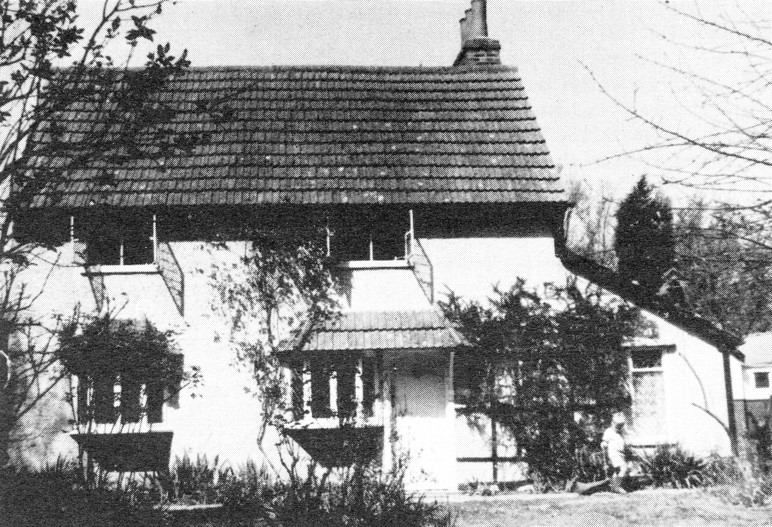
Ninnings Wood Cottage in 1967
Was it in Knebworth? I don't remember the venue but I have a vivid recollection of Lionel arriving on the first evening with a sheaf of photocopies (remember those?). 'I have been persuaded', he said, 'by Fred Emmison, the Essex County Archivist, at a recent conference that people can be taught to read sixteenth and seventeenth century handwriting, whether or not they have any historical background'. It seems that this may have been one of his earliest such classes.
Accordingly everyone was given some photocopies and set about transcribing them, after an initial lesson in the letters of the alphabet which cause most difficulty. It was such fun, and an eye-opener for one who up to that time had studied history from text books. We were given a copy of the page included in Hilda E.P Grieve's Examples of English Handwriting 1150-1750, drawn from A. Wright's Court Hand Restored. That page has stayed with me ever since and has been given to many other people. Lionel would probably have been gratified to know how many people I too have since helped to read inventories and wills. One very keen group moved on to parish registers and many supporting documents.
The first fruits of those classes were a small resesarch project which I wrote up as 'Has Your House A History?' published in 1971 in a Kent local history magazine and in a Hertfordshire one. I should have copyrighted the title! The article was about a small timber-framed cottage near Knebworth. I hadn't thought about it for over 50 years, but Lionel Munby's classes were certainly the original stimulus.
Some facility with reading older scripts has proved of great value to me personally in pursuing local history. Most recently the handwriting of a minor gentleman of the seventeenth century, Thomas Baskerville, has occupied me over a lot of hours. There are three extensive manuscripts which have survived amongst his papers. Baskerville may have adopted different styles of handwriting at different times, and like most of us probably wrote more neatly for a final draft than when first setting down his ideas. It is also possible that one of his companions sometimes copied up his script, as may also one of the young students at Oxford who helped him compile what appears to have been intended as a guide to the university. Most difficult to read has been his list of London taverns which he possibly wrote while walking the streets of the City, but this may have been one manuscript he asked someone else to compile for him.

Thomas Baskerville married quite late. He was a conscientious caretaker of an estate in Berkshire and also appears to have been a diligent letter-writer, maintaining a careful record of his extensive if distant kinship network. But he also went off every two or three years or so on extended journeys round England on horseback. He was an observant traveller. On the back of a horse, he would have had a better view of the countryside he passed through than we have in cars, on bicycles or even on foot. He was not a standard tourist, but took a particular interest in the daily activites of the people he saw as he rode along. His recorded observations cover a great variety of subjects: men ploughing with horses in Norfolk, cultivating saffron in Cambridgeshire, the design of bridges in Yorkshire, the casting of iron implements in Gloucestershire and along the river Wye, practices in growing apples and hops in Herefordshire. He described his personal experience in picking ripe hops and grafted a favoured variety of Herefordshire apple in his Berkshire property. He loved fishing, and fish were an important part of his diet. He travelled specially to Farnham in Surrey to see the market and also to Stourbridge fair.
Baskerville's intention was probably to publish his Oxford manuscript, his record of his family connections, and his accounts of his English journeys, paying attention to the routes followed, but if so it was never carried through. Two selections of his writings were published about 1900; very nearly all will be published this year (2023) by Hobnob Press. His handwriting has often been a challenge, but it has been fascinating to follow him in his excursions, observations and miscellaneous collections of information. Reminding me of those very first lessons in reading early modern handwriting makes me bless Lionel Munby's teaching and enthusiasm.
The views and opinions expressed in this blog are those of the author and do not necessarily reflect the official policy or position of the British Association for Local History (BALH). Any content provided by our contributors is of their own opinion and is not intended to malign any individual, group, organisation, or entity.