‘Heads – you lose!’ Working for the railways in Britain before 1939: BALH Dymond Lecture 2025
Our annual winter lecture returns with Dr Mike Esbester. Explore the hidden human stories behind Britain’s railways, uncovering the lives, risks and accidents of railway workers before 1939, and revealing how the Railway Work, Life & Death project is helping local historians reconnect these people with the places they lived, worked and died.
Thursday 11th December 2025 7:00pm - 8:00pm
Event type: Virtual
Booking for this event is now closed.
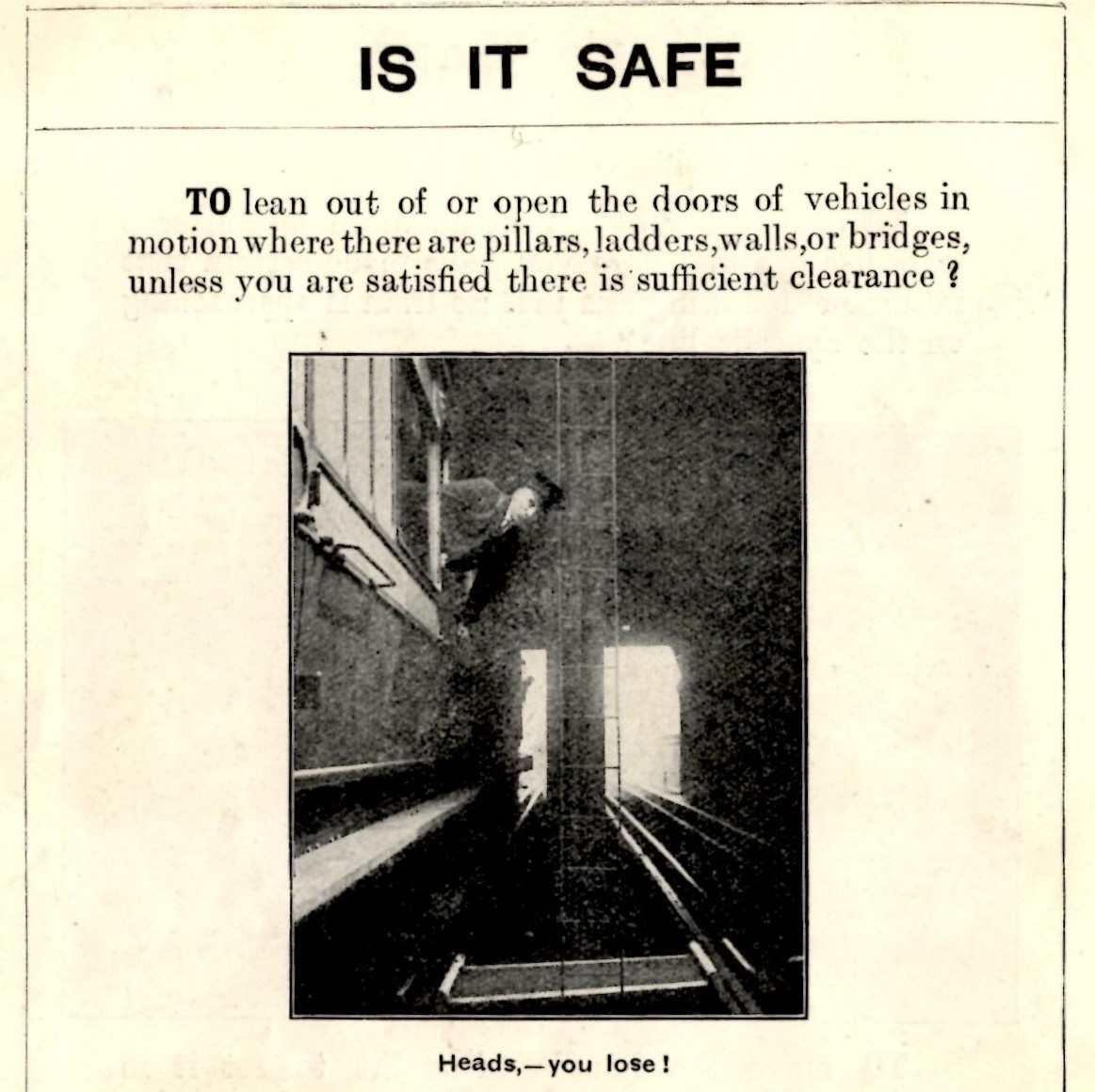
1920s posed railway staff safety image, showing a railwayman leaning out of a carriage, but his head is about to hit a signal post. The caption reads ‘Heads – you lose! Is it safe to lean out of or open the doors of vehicles in motion where there are pillars, ladders, walls or bridges, unless you are satisfied there is sufficient clearance?’
Details:
In 1924, the London, Midland and Scottish Railway published a warning to staff about some of the dangers they faced at work – including ‘heads – you lose!’. Well might they have highlighted the risks of the job: that year alone 263 railway workers were to die on the job, and a staggering 21,098 were injured. But who were those workers, in 1924 and since the advent of the railways? How can we locate past railway employees – and ground them in the places where they lived, worked, and played?
These questions are particularly timely, given 2025 is ‘Railway 200’, marking 200 years since the first steam-hauled passenger journey on the Stockton and Darlington Railway. One of its themes is ‘celebrating railway people’ – but where do we find those people? The very visible infrastructure and engineering achievements of the railways over the past 200 years have left their mark on the landscape and the cultural imagination – but the people needed to make the railways run have left less of a trace.
One way we can access at least some of those staff, and which is the focus of the lecture, is where they left a significant mark in the documentary record: via the accidents they had. These incidents were spread across Britain wherever there were railways – and as we shall discover, in places where there weren’t railways, too. They give us an invaluable insight into ordinary people in their places, offering us rich possibilities for contributing to and understanding local history.
As part of this, I shall introduce the Railway Work, Life & Death project, a collaboration exploring the working lives and accidents of British and Irish railway staff. We will look at how the project can help understand the nature of railway work, as well as contribute to local history via the focus on particular places. I shall highlight some of the local history work the project has been doing, and will warmly encourage you all to explore what the project offers you.
Speaker
Mike Esbester is Senior Lecturer in History at the University of Portsmouth, and a co-lead of the Railway Work, Life & Death project (www.railwayaccidents.port.ac.uk). The project is exploring the working lives of British and Irish railway staff, via the accidents they had and the records they left behind. A collaboration between the University of Portsmouth, the National Railway Museum and the Modern Records Centre, including working with The National Archives of the UK and the RMT Union, dedicated volunteers have been transcribing and researching railway employee accidents. They have produced a database currently standing at over 115,000 individuals, freely available from the project website. The project is active on social media, including Twitter/X, Bluesky and Facebook. Collaboration is at the heart of the project, which welcomes input from anyone interested.
Mike’s wider research focuses on the history of transport and mobility, and on the history of safety, risk and accident prevention in modern Britain. He is an Associate Editor of the Journal of Transport History, and has published widely in academic and more accessible formats. Publications include 'Collaboration in the Archive. The MRC and the Railway Work, Life & Death project' (co-authored and freely available on open access), Health & Safety in Contemporary Britain (Palgrave, 2019; co-authored with Paul Almond) and Governing Risks in Modern Britain. Danger, Safety and Accidents, c.1800-2000 (Palgrave, 2016; co-edited with Tom Crook).
Booking:
Booking for this event is now closed.