‘Daddy, the treehouse is wobbling!’ or Local History in Lockdown.
Published: 16th April 2020
‘History always teaches us that however bad things are, there have always been worse times- and people live through them and record them. This is a kind of therapy in itself’.

These are the words of Matt Haig, journalist and author, born 1975, who read English and History at the University of Hull, in ‘Tiger King and a bloody mary: Hilary Mantel, Simon Armitage and other writers on lockdown life’ The Guardian, 6 April 2020 https://www.theguardian.com/books/2020/apr/03/corona-crisis-tiger-king-lockdown-life-hilary-mantel-simon-armitage-julian-barnes-anne-enright-jeannette-winterson-diane-evans
Well, Matt Haig challenges his readers to record bad times, and that includes local historians, as BALH’s Chairman has also pointed out on this website and in Local History News (no. 135, Spring 2020, Supplement, page 1).
So how might local historians do this? Here are a few of our suggestions:
Journals – paper, online or photographic
Perhaps we might start by keeping a journal, with a retrospective introduction on how much has already changed. The technology perhaps doesn’t matter, whether paper or computer, but photos and audio recordings would be good too.
Recording how the street scene has changed, whether you are in a village, city or town, and this might perhaps be done week by week. Which shops, businesses and leisure facilities had to shut down at the start of the pandemic, and which fell in the categories allowed to stay open? Then at the end of lockdown, there will be material to review which businesses and shops have survived to be able to re-open.
Audio recordings
An Interview, by the usual distant technical means, with a shop owner, for example, would be good. I am wondering how the chocolate shop which my friend owns is doing at what would normally be one of the busiest periods of the year. Some owners might be willing to say what use the various government schemes have been for their finances and ability to survive. Recordings could be made of the sounds of nature which are usually drowned out by traffic, aircraft, trains or school playtime or home time. I’m only sorry I didn’t happen to be able to record some children a couple of gardens away shouting, ‘Daddy, the treehouse is wobbling!’ So now I know what the sounds of woodwork and machinery had been for the previous three days, clearly a lockdown project.
Photos and videos
What communal (or individual) projects have been started up in your locality? Did some streets take up Thursday clapping and do you have some photos, and were there individual musical efforts as well such as the West Hampstead (front garden) blues?
Local newspapers
If you are lucky enough to have a local newspaper, analyse one week’s reporting of communal and individual activities. In one April week, my local paper had 24 such activities reported, from the ongoing need for, and success of, the local food bank, advice from the local Citizens Advice Bureau on claiming universal credit, local villages carrying out litter-picking more safely on the now-quiet streets, and an animal rescue charity losing £2000 a week from the closure of its two shops, tea rooms and Easter Fair. More positively, that Fair will be online, along with various garden tours, while there were photos of a local riverside beauty spot empty of the families who normally enjoy themselves there in good weather.
Ephemera
Keep copies of ephemera prompted by the lockdown which arrives through your door. So far I have only received two items, one being the council’s quarterly puff which could only be read with an ironic smile (‘Hop Along for FREE, Easter family fun’, etc) although a ‘Coronavirus Update’ had been inserted at the last moment. For more advice on what ephemera to collect and how it will be used in the future, see Dr Jane Howells’ talk ‘Don’t Throw that Away! The delights of Ephemera’ on https://www.balh.org.uk/education-conference-presentation-material.
Appeals for information
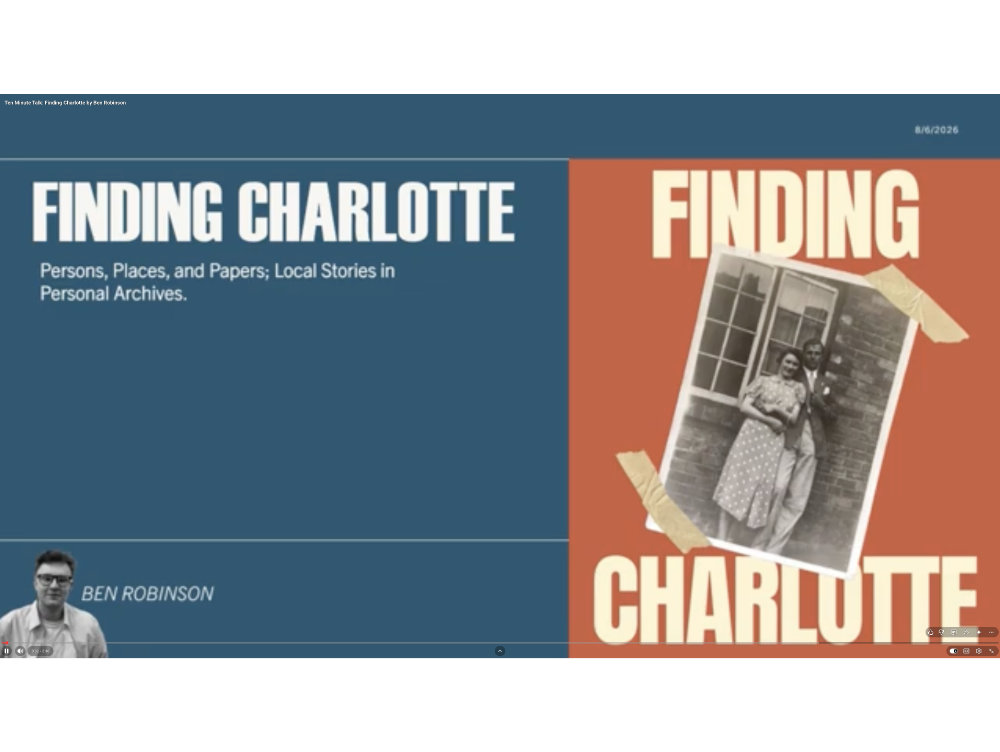
You or your local history society might make a collection of such material from throughout the lockdown to keep it the society’s archive or present to your local studies library (having used it to write an article first, of course!). Some local archives are making online appeals for collecting such material, such as the Mass Observation Archive (@MassObsArchive), the Borthwick Institute at the University of York (@UoYBorthwick), Leicestershire Record Office (@RecordOffice) and Sutton's Museum and Heritage Service (@SuttonHeritage, with the hashtag #TheLocalsDiaries)' Or you could put ten of your photos and some commentary (up to 1500 words) into a PowerPoint presentation for consideration by BALH as a ‘Ten- Minute Talk’. Email me if you would like to know more.
Keeping in touch
What technical skills have you, your family and friends learned, to stay in touch? And how has your local history society, or any national society you belong to, put these to use? Has everything just shut down or are new ways of ‘meeting’ being found and enjoyed? From my area, I give the example of the Knole (NT) research groups, some of which are starting to meet by Zoom and ‘share’ cake (photos of), talks and discussion. You can see how the Lamorbey and Sidcup Local History Society is pointing its members and others not just to the cancellation of meetings but also to their recent and forthcoming research via the BALH website https://www.balh.org.uk/news-an-update-from-lamorbey-and-sidcup-local-history-society-2020-04-06. All local history societies are invited to do the same, an important part of recording this period.
Finally, if you find times on your hands, BALH is making more and new material available on its website at this time, as are many other organisations such as British History Online. As BHO notes, ‘from 30 March, all transcribed content on BHO is now freely available to individual users, and will remain so until 31 July 2020’. Among the most important for local history, are the Calendar of Close Rolls, covering the reigns of Henry III to Henry VII (covering 1244 to 1509). So in your spare moments, you could seize your chance to search their indexes for place names in your locality while you don’t need a premium subscription to BHO. For some guidance see https://www.british-history.ac.uk/using-bho/local-guide.
Gill Draper, Events and Development Officer, BALH, development@balh.org.uk