
The Amateur Historian Volume 2 Number 3 December January 1955
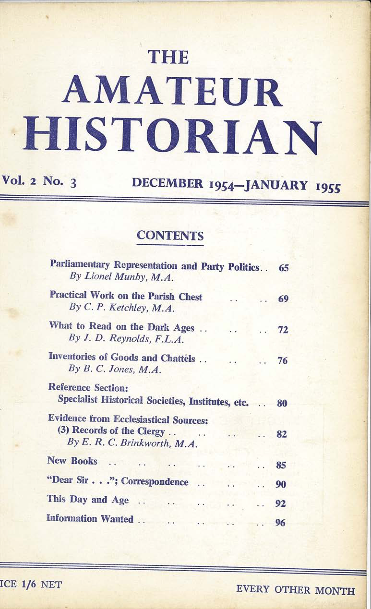
Contents
Parliamentary representation and party politics Show more
By Munby, Lionel M.
pp 65-68
After noting that the work on the History of Parliament volumes continues, Munby suggests that conventional views of the party system imply that it 'sprang fully grown from Restoration politics'. The article considers the radical rethinking of the subject which began in the late 1920s and Munby considers that this has an important bearing on a neglected subject, namely the importance of local party political issues. The arguments about the nature of party politics and the development of the system are summarised and key works on the subject are noted. An important element in these analyses is that local factors (such as family, estate and territory, and influence) assume a more prominent place in the thinking of historians as they undoubtedly did in the events and processes of the time.
Practical work on the parish chest Show more
By Ketchley, C.P.
pp 69-71
Brief account of the types of material likely to be found in 'the parish chest': parish registers; overseers' records; churchwardens' accounts; vestry records; waywardens' books; miscellaneous administrative records; terriers, surveys and other poor law material. A few short explanatory notes take the form of a brief glossary of terms and there are suggestions for further reading.
What to read on the Dark Ages Show more
By Reynolds, J.D.
pp 72-75
Bibliographical guide to reading and research on the period between 'the departure of the Romans from these islands' and 'the arrival of the Normans'. Recommends various general introductory texts covering the whole period and a few more detailed local studies; also notes with approval several historical novels which are held to give a flavour of the times; some biographies of prominent individuals; examples of literary texts such as 'Beowulf'; and a range of books on Anglo-Saxon art.
Inventories of good and chattels Show more
By Jones, B.C.
pp 76-79
Discussion of the value of probate inventories for the local historian, beginning with an explanation of the purpose and rationale of the making of inventories and their basic structure, the possibility of omissions or questionable valuations being noted. The article then considers the main categories of information which inventories may provide, including household goods, furnishings, debts and credits, house structures, tradesmen's stock and equipment, and ready money.
Records of the clergy Show more
By Brinkworth, E.R.C.
pp 82-86
In his third article on 'Evidence from ecclesiastical sources' Brinkworth discusses the range of records which relate to the activities of incumbents. The main categories described are: i) bishops' registers, to find out details of the clergy themselves and to trace their careers; ii) certificates of institutions to benefices; iii) local parish records; iv) presentation deeds, mandates for induction, resignation and sequestration bonds; v) visitation books; vi) manorial records as they relate to the advowson; vii) a range of sources giving the history of the benefice; viii) gazetteers and directories; ix) tithe records; x) glebe terriers; and xi) biographies and lists of Oxford and Cambridge alumni. Most of these types of records are explained in some detail and their form and purpose are clearly stated. There are also suggestions as to where some of the major sources may be found and a short note lists some books for further reading (see also 02 01 19-22; 02 02 50-53)
[Hide]

Hugo Javier Freitas


Laura Yeoman


