
The Amateur Historian Volume 4 Number 6 Winter 1959-60
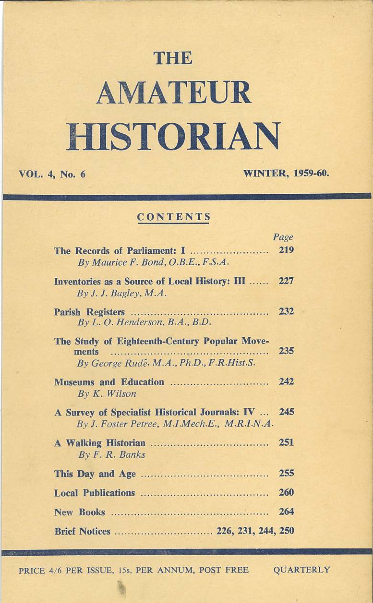
Contents
The records of parliament - 1. Acts of Parliament Show more
By Bond, Maurice
pp 219-226
Description (first article of a series) of the types of records which are kept at the Houses of Parliament, looking specifically at Acts of Parliament. The author, who was archivist at the House of Lords Record Office, describes how researchers may access and search the Acts, there being no formal index, and details the format of the documents. He also explains the nature, purpose and format of the numerous ancillary documents associated with Acts of Parliament, including proceedings, bills and petitions (see also 04 07 267-274; 04 08 307-314; 04 08 354-358).
Inventories as a source for local history: 3 Textile and other industries Show more
By Bagley, J.J.
pp 227-231
The author shows how intensive study of inventories can reveal detail about economic activities, not always apparent at first sight, of individuals and households. Thus, south-west Lancashire was an intensive spinning and weaving region in the 16th and 17th centuries, but there is little direct evidence of who did this work. Close examination of inventories shows, however, that although individuals were described by conventional labels such as 'husbandman', the goods which they owned indicated dual occupations or suggested that other trades, such as weaving, were practised. Similarly, some of those described as 'merchants' are shown to have been farmers in some way, with varying levels of wealth and with agriculture a significant source of income (see also 04 04 157-161; 04 05 186-195; 04 08 320-324).
Parish registers Show more
By Henderson, L.O.
Description of the development of parish registers, from the inception of the system of parish registration of baptisms, marriages and burials in 1538 at the order of Thomas Cromwell. The author comments on the modifications made to the system subsequently, and highlights some of the more detailed evidence which might be found in a register, as well as discussing some of the problems in interpreting incomplete volumes where there are gaps in coverage.
The study of eighteenth century popular movements Show more
By Rudé, George
pp 235-241
Important article by a leading social and economic historian, which considers the widespread social disturbances of the 18th century and asks whether they were part of a more general social trend towards protest and voicing of social and other concerns and grievances. The author suggests a number of sources for researchers: contemporary histories and journals, Home Office reports, judicial records and parish records. He points out the weaknesses of many of these sources, particularly when it comes to identifying the participants, and uses examples to show the difficulties encountered in finding the occupations of one 'mob'. The author also suggests that researchers should closely look at the target of the rioters' anger, as motive is too easily dismissed. He demonstrates how close examination of the rioters' motives may well suggest a quite different view of the disturbance or protest itself.
Museums and education Show more
By Wilson, Kenneth
pp 242-244
Brief account of the possible education role of museums and the way in which practical work can be undertaken to enhance this function.
A survey of specialist historical journals - IV Show more
By Petree, J. Foster
pp 245-250
Article, part of a series on the contents of specialist historical journals, which reviews the Transactions of the Newcomen Society, with discussion of its scope and format and potential use as a source for the local historian.
A walking historian Show more
By Banks, F.R.
pp 251-254
Biographical account of the topographer William Hutton, who was born in Derby in 1723 and became a journeyman stocking-maker. He then became a bookbinder and poet and in 1749 walked to London, taking three days for the 125-mile journey. In 1754 he moved to Birmingham, trading as a bookseller, and made a success of this, opening the town's first circulating library and in 1782 publishing his own History of Birmingham. In later life he wrote other histories, but his most celebrated achievements were at the age of 76, when he undertook and wrote about a walking tour of Wales, and at 78 when he explored Hadrian's Wall, walking from Birmingham via Liverpool and Preston in the company of his daughter, Catherine. He covered the whole length of the wall and the entire return journey, via Carlisle to Birmingham, the entire tour taking 35 days. He died aged 92 in 1815, having achieved his last walking tour, in Yorkshire, at the age of 88.
[Hide]

Hugo Javier Freitas


Laura Yeoman


