Ways to Get Involved in BALH's Work
Published: 7th November 2022

Megan Kelleher
BALH Digital Strategy Coordinator
socialmedia@balh.org.uk
@MeganEKelleher
Megan is the BALH Digital Strategy Coordinator and a PhD student at the University of Kent. Her thesis, provisionally titled ‘The Commemoration and Care of First World War Dead Buried in the United Kingdom’, is focused on highlighting the presence of First World War graves in the United Kingdom and how these sites of memory conform to and contrast with the cemeteries and memorials found along the former battlefields.
At BALH, we are always interested in sharing the broad range of local history work being done across the British Isles. Whether you are just starting out, or you are a seasoned local historian with decades of experience, we’d love to hear from you! Below, we will explain some of the ways you can share your local history research with BALH.

Blog Posts and News Articles
The website news and blog is designed to fit alongside our print publications, Local History News and the Local Historian, as well as our short presentations, the Ten-Minute Talks. On a monthly basis, we will be publishing articles of around 750-1000 words. In addition to being published on the BALH website, your article will also be promoted through our social media channels and e-newsletter.
Blog Guidelines and Advice
- You should aim to have 750-1000 words, in a plain text or Microsoft Word format, to easily copy and paste.
- Choose a topic relating to local history that interests you – this could be a location, well-known historic figures or groups, or an item/building.
- Your title should be informative, and capture the attention of your readers.
- When conducting your research, make sure that the facts you include are accurate. Please make sure to submit your blog post prior to submission.
- If you are using specific terminology, make sure to explain these ideas in a concise and clear way. Where citing the works of others, make sure to reference their work.
- Submit your blog post along with at least one clear, copyright-free JPG image (or one taken by yourself you’re happy for us to use).
- The primary image should be landscape format (wider than tall, miniumum 1500px width). Other images should also be JPG format and can be in landscape or portrait format.
- Make sure to include a short biography of yourself (including social media handles or an email, if you’d like) along with a clear profile photograph of yourself.
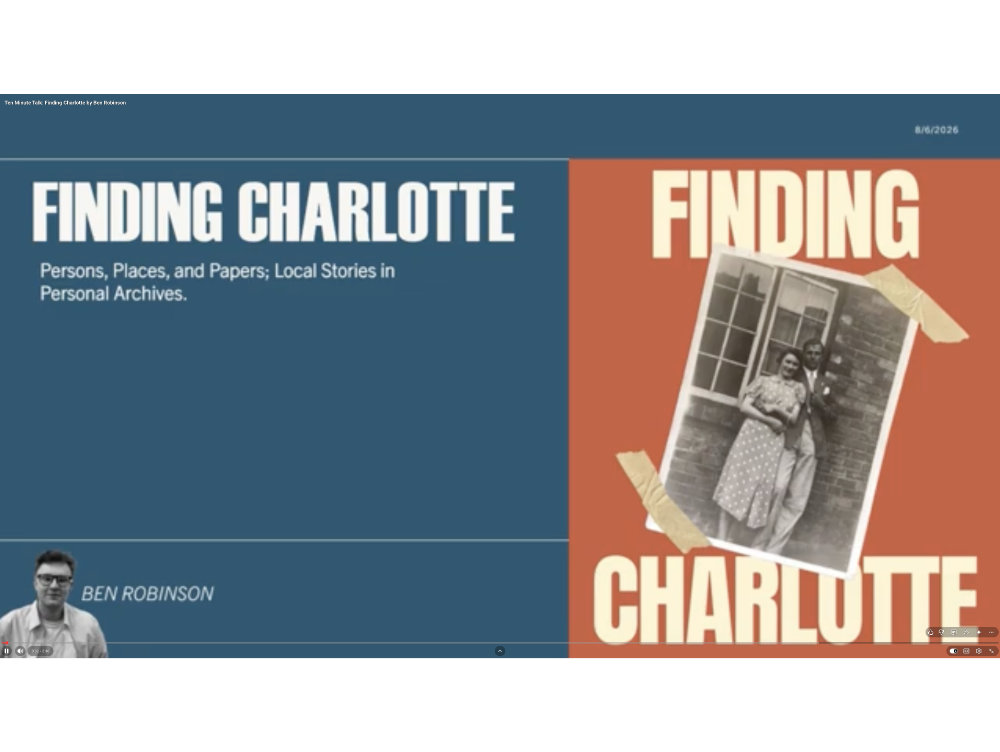
Ten-Minute Talks
Do you want to share some of your research, but are not sure you have enough to create a full webinar or Local History Hour? Ten-Minute Talks are perfect for exploring new ideas in a concise way! Ten-Minute Talks take the format of a PowerPoint-type presentation, with supporting notes. Optionally you may record a video too of the talk. As the name implies, these are intended to be short talks, something which takes no more than ten minutes to read or watch.
Ten-Minute Talk Guidelines and Advice
- Considering the length of the talk, select a topic to focus on, and up to ten copyright-free images, photos or quotations to illustrate your theme.
- Using PowerPoint or an equivalent PDF-format presentation file, create some slides, just as you would if giving a physical version of this talk. Keep the slides visual, with minimal wording.
- Make sure that your PowerPoint presentation is clear and does not have too much text.
- We're also open to non-PowerPoint presentations, where you speak to camera, perhaps while on location. However this needs to be done well, with good video and audio, to be considered for publication.
- Keep your talk as close to 10 minutes as possible!
- Using facilities such as Zoom, Microsoft Teams or other recording platforms, record your presentation.
- Please record in a room where there are few distractions and minimum background noise.
- Use a microphone and headphones for better quality sound and to minimise feedback from laptop/PC speakers.
- If possible, please neatly edit the start and end of your video (using QuickTime Player or similar).
- Remember to speak clearly and to look up from your notes at the webcam to aid viewer engagement.
- Remember to render you video file as a universal format: MPEG-4 is the most common and popular format. This format works well with video hosting websites, including YouTube.
Podcasts
The BALH has a popular podcast, ‘Local History Matters,’ where we share information about the type of work BALH and its members do. This includes chatting with experts about their own research and learning more about what local history means to them. If you’ve got a topic that you know lots about, but don’t want to share it in a video-based format, this option may be for you!
We record all of our podcast episodes remotely, so you will be interviewed via Zoom in the comfort of your own home. These recordings will take no more than an hour, with questions shared with you and agreed in advance, and then the recording shall be edited before publication.
Podcast Guidelines and Advice
- Submit an abstract on your chosen topic (no more than 200 words) to our Digital Team, who will be in touch.
- Make sure to look at the proposed questions and make notes around points you want to make during recording, if this is helpful.
- Please record in a room where there are few distractions and minimum background noise.
- Use a microphone and headphones for better quality sound and to minimise feedback from laptop/PC speakers.
- Make sure that your internet is working, and is strong enough to be able to correspond without “glitches.”
If you are interested in sharing some of your research in any of the above formats, we’d love to hear from you! The Digital Team may be contacted at digitalteam@balh.org.uk.
The views and opinions expressed in this blog are those of the author and do not necessarily reflect the official policy or position of the British Association for Local History (BALH). Any content provided by our contributors is of their own opinion and is not intended to malign any individual, group, organisation, or entity.