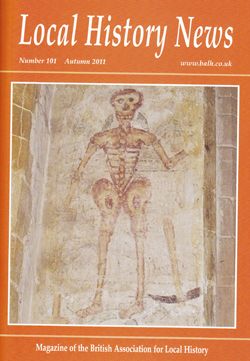
Local History News Number 101 Autumn 2011
Contents
Anglo-irish Convention Show more
In Ireland in September I at last met ‘our Irish correspondent’, James Scannell. We’ve been corresponding, exchanging emails, and swapping books and history magazines and journals for years, but until then had never actually met. I was delighted to have the opportunity—I was staying at Saggart, on the south-west side of the Dublin, and James made the long but interesting journey by the Red Line of LUAS, the city’s superb new light rail system, with its sleek silvery-pink trams that glide out along two routes from the centre to the edge of the metropolis.
We had dinner in the CityWest hotel, a mammoth complex which has an astonishing 750 bedrooms, together with more spas, golf courses, health and beauty treatment parlours, conference facilities and entertainment venues than many a sizeable town in the Home Counties. It’s a potent symbol of Ireland’s boom years, edged by the traffic-thronged motorway which heads south-west towards Cork, Limerick and Waterford, and surrounded on the other three sides by sprawling new housing estates. Tucked away, almost buried, just to the south is the old village of Saggart, a homely place of cottages and inter-war semis that is now drowned by the flood-tide of development which spilled out from Dublin since the mid-1980s.
The CityWest complex itself is built round an 18th century country house – 250 years ago Saggart was far out of the city, where the lower foothills of the Wicklow Mountains meet the plains of Kildare. A couple of miles away, at Tallaght, the death of the Celtic Tiger is evident in a series of tall half-built tower blocks, boarded up and edged with security fencing, lining the north side of the N81. But the demise of that mythical beast was not apparent at CityWest. On the night I stayed there was an extravagantly over-the-top wedding with 300 guests, a spectacular event which must have cost hundreds of thousands of euros, while the exuberant red-kitted Cork ladies’ football team (who were playing the next day in the all-Ireland Gaelic football final) made a dramatic entrance, filling the lobby with kitbags and supporters. It was bedlam!
I enjoyed talking to James about local history in the Republic. There are now many local history societies, not just in the towns and the counties but increasingly in the villages too, and there’s a really strong and growing interest in heritage, history, archaeology and conservation. One consequence of the boom years, and the almost demented rush for development, has been damage to the landscape and environment (those supporting the proposals for our own ‘relaxed’ planning system would be wise to take note) but another consequence has been growing anxiety about the loss of the past, a concern reflected in an upsurge in interest in local history. Irish local history societies seem (and this is inevitably a subjective observation) to be especially active in campaigning for conservation and heritage issues.
James is a leading light in the Old Dublin Society, which recently celebrated its 75th anniversary, and talking to him made me appreciate how close the links can be between such societies and the county and city library and archive services. In Britain these relationships can be more patchy, but certainly in the Dublin area (now divided into the city and three county councils) there is a vigorous and active co-operation. I’m also impressed by the ability of Irish societies to attract the attention of politicians. Perhaps it’s a function of the comparative smallness of a country with 4½ million people: politicians are closer to communities and constituents? But what a tribute to the power of local history it is that in February this year, when the Bray Cualann Historical Society in County Wicklow published a special edition of its journal to commemorate the centenary of the birth in the town of Cearbhall Ó Dálaigh, president of Ireland 1974-1976, a meeting of the Society was attended by the current President of the Republic, Mary McAleese. That is impressive!
BALH Awards 2011 Show more
The editor spreads the word
Arthur Bantoft was given the scroll marking his receipt of a BALH Award for Personal Achievement 2011 by the Association’s Chair Helen Good in September at a meeting of his local group, Barwick-in-Elmet Historical Society. Sadly his health did not permit Arthur to travel to London to join us at Local History Day in June, but a suitable occasion was arranged locally and his friends and colleagues attended the presentation in large numbers.
The Barwick-in-Elmet Historical Society was founded in 1984 and Mr Bantoft joined a year later when the membership was ‘a handful of enthusiasts’ of about twelve people. It is now a thriving society of some 60 members. One of his referees recalls he had an immediate impact on the scale of activity of the society. An early development was the publication of a journal of which Arthur agreed to be editor. He continued in that role until 2007. Many readers will recognise the process during the early years: the Editorial Committee met once or twice a month, usually in Arthur’s house, copy was submitted in long hand and a member of the committee typed it up, they discussed content and layout. Arthur took it personally to the printer in Leeds, collected the finished product, arranged distribution to local shops and posted copies to members throughout the world. It is said that Arthur was The Barwicker. He made the journal both readable and academically acceptable through encouraging contributions from society members and from academics with an interest in matters that concerned the parish of Barwick-in-Elmet. This stimulated interest in the history of this large parish and drew in people who would otherwise not have become involved.
Professionally Arthur was a chemistry teacher, becoming head of department at Tadcaster Grammar School. He enjoyed fell-walking, and was involved with fund-raising for the Royal National Institute for the Blind. He first became interested in family history when his father died and he realised that he knew very little about his predecessors. From there followed a natural progression to local history (just what we like to hear at BALH!). Arthur joined the Tadcaster Historical Society where he was living at the time. He recalled that if he had not become involved with historical research ‘he would not have met so many different interesting people or travelled to interesting places’.
Arthur’s own meticulous research was carried out locally at the West Yorkshire Archives in Leeds and Leeds Local Studies Unit, as well as further afield. In additional to his numerous articles for The Barwicker (both signed and written under a pseudonym when he modestly felt he was contributing too much) he wrote two books for the society A Greater Wonder: a history of Methodism in the village and Barwick School: Education in a Yorkshire village. Another special interest was the history of workhouses and their management.
For his tireless commitment to promoting the history of Barwick-in-Elmet for a quarter century, Arthur Bantoft was nominated by his successor as editor to the society for a BALH Award . In writing to accept the award he commented that the work has been ‘a source of great pleasure’ and that recognition should also go to his fellow members whose efforts contributed to bringing alive the history of the local villages in the parish.
Black Heritage Trail In The West Midlands Show more
In the spring 2011 issue of Local History News was an article promoting the work of SCAWDI (Sparkbrook Caribbean and African Women’s Development Initiative) in researching the experiences of early Black migrants to the West Midlands. We were also calling for local and family historians to pass on any information they came across during the course of their own research relating to this topic. We have received some excellent leads as a result and our thanks go out to those who have been able to help.
The article also made mention of our upcoming project, working with local volunteers to create a heritage trail, informing readers of the diverse locations in this region that have links with the early Black experience. The result, called A Day in the Life… has been published in a booklet, available through SCAWDI and abstracted into leaflets which will be available in tourist and information offices throughout the West Midlands. Locations include stately homes, pubs, parish churches, museums, theatres and many more, with information on the Black histories hidden within and details on how to find them.
Although the project is now officially complete we hope that as people visit the locations for themselves, they will contribute their own insights to the project. We will have an online feedback form available via our website (below) by the end of the year or you can email comments directly to us. The idea is not only to provide thoughts on the specified location, but also your own advice to later visitors on what else in the area you would visit and why. The end result we hope will be an appreciation of the diversity of our local heritage and also, a wider knowledge of those hidden gems within our cities and countryside which should be appreciated.
For more information on how to get involved or to order a copy of the trail booklet please contact:
David Callaghan – SCAWDI
The Friends Institute
220 Moseley Road
Birmingham
B12 0DG
david@scawdi.co.uk
www.scawdi.co.uk
A Day in the Life… booklets cost £5.00 + £1.00 p&p. Abstracted leaflets are free of charge. A list of where they can be found will be on the SCAWDI website by October 2011.
Warwick Network For Parish Research Show more
The ‘Warwick Network for Parish Research’ was established in 2003 to facilitate the study of British and European parishes c. 1300-1800. It supports a wide range of works on religious, social, political and cultural aspects as well as interdisciplinary and comparative perspectives.
In preindustrial times effectively all Europeans were expected to attend their parish church. Parishes thus offer ideal opportunities for comparative investigations into late medieval and early modern culture. Current debates on religious change, political life and local identities underline the wide range of approaches to the subject and the benefits of scholarly exchange.
The Network consists of an informal association of researchers, with an institutional base at Warwick’s Department of History, where several early modernists pursue interests in the field. Chronologically, the focus lies on the period from the establishment of the parish network in the High Middle Ages to the dawn of the modern period in the nineteenth century.Geographically, the network’s range extends over the whole of the European Continent, with a particular emphasis on Central and North-Western Europe. Thematically, we cover the entire spectrum of parish scholarship, from local studies and micro-histories via social and demographic approaches right through to theological issues and investigations into music, art and literary works. Past activities have included specialized workshops, public lectures and support for the writing of parish histories. Our two main initiatives, however, are the provision of an online information platform and the organization of an annual symposium.
The Network Website (http://go.warwick.ac.uk/parishnetwork) offers details on current research projects, a large bibliography (of works in English as well as other European languages), a calendar of events, advice on how to start a new investigation, extensive links to audio-visual digital resources and a selection of recent articles in the field. If you have information on research projects, primary sources, literature and / or web links you would like to publicise on the site, please send WORD documents (up to 200 words per item) as e-mail attachments tob.kumin@warwick.ac.uk. The same address can be used if you would like to be added to the Network’s mailing list.
The Warwick Symposium on Parish Research, inaugurated in 2003 and supported by Warwick’s ‘Humanities Research Centre’, addresses specific issues, usually by means of presentations from an international range of scholars, a comment by a distinguished specialist and extensive general discussion Past themes have included: ‘Parish Records and Parish Culture’, ‘Parish Clergy and Parish Community’, ‘Rituals and the Parish’, ‘Challenges to the Parish’, ‘Parishes on the Margins’ and – most recently – ‘Parish Material Cultures in Perspective’. Details of programmes, abstracts of papers, symposium reports, visual impressions and a podcast can be found on the Symposium Website (http://go.warwick.ac.uk/parishsymposium).
For the tenth anniversary meeting on the theme of ‘Parish Studies Today’, to be held on 25-26 May 2012 at the University of Warwick, we have joined forces with the ‘British Association for Local History’ and the ‘Centre for the Study of Christianity and Culture’ (University of York) to present a panorama of the entire spectrum of work going on in the field (please see the separate call for participation in this issue).
We would be delighted to welcome you there!
Parish Studies Today
CALL FOR PARTICIPATION
The ‘Warwick Network for Parish Research’ has been running an annual symposium highlighting new work on late medieval and early modern parishes since 2003. While mainly an academic initiative, the events have also attracted interest from a wider public. Further information on all previous meetings can be found on our website:http://go.warwick.ac.uk/parishsymposium.
In 2012 we will celebrate the 10th anniversary meeting and would like to mark it by involving a wide range of groups and societies interested in parish history. Under the theme of ‘Parish Studies Today’, the overall aim is to showcase the large variety of work currently pursued in the field. Ideally, this could help to forge closer ties between researchers and facilitate the exchange of ideas. At present, university historians are often unaware of the many projects undertaken by community groups, while the latter may find it difficult to access specialized research. This event – organized in conjunction with the ‘British Association for Local History’ and the ‘Centre for the Study of Christianity and Culture’ at the University of York – hopes to bridge this divide.
The Symposium will take place over the weekend of 25-26 May 2012 (1-3 days depending on response) on Warwick’s Central Campus. Activities might include project presentations, panel discussions, poster displays, publication stalls, video presentations, lectures, methodical workshops etc. There will also be plenary lectures by leading scholars on topics ranging from the Middle Ages to the present day. So, we would like to ask whether you / your organization / society can take part. Symposium delegates would be interested to hear about local histories, community websites, churchyard projects, 3-D modelling of church interiors, art historical / stained glass research, early music networks, church conservation and restoration work, design of teaching materials / research tools, transcriptions of records and many further initiatives.
One-page proposals (with an indication of the topic, content, format and, if applicable, audiovisual elements of your contributions) should be sent to the contact email below by 15 December 2011. The generous support by the Humanities Research Centre of the University of Warwick and the co-organizers will help to keep conference costs to a minimum. Please circulate this information to any other bodies or societies with interests in parish history.
Warwick Network for Parish Research Contact: Beat Kümin (b.kumin@warwick.ac.uk)
Internet Sites For Local Historians Show more
Jacquelené Fillmore
To the delight of readers, a second edition of the Internet Directory for Local Historians is due to be published shortly. This edition includes an updated version of the previous edition, articles written since publication, and some new websites for you to peruse. The Directory is in the same format as the first, is indexed and cross-referenced.
Putting the Directory together is a time-consuming job. Website addresses are compiled throughout the year both for the Directory and The Local Historian articles, and the few weeks before publication all websites are checked so that information is as up-to-date as it can be for our readers.
Finding the websites, checking on their purpose, discovering whether they will appeal to local historians and family historians, finding an eclectic mix, and deciding which sites to review takes time, and I am sure there are some websites that you would like to see included that have not been so far. So I have a plea:
Amongst our readers there are a lot of people not only searching but also browsing the internet. As we while away an hour or two going from link to link, I am sure many of us have come across websites which are interesting if not for our own research then worthy of mention to those who might be researching that particular topic. To make the TLH articles and the Directory more diverse, I would like to invite readers to send me the addresses of any websites they have come across and have either used in their own research or feel might be useful to others. I would also like to hear the type of subjects our readers are interested in. It has been pointed out that many military/war sites are included in the listings, and it would be interesting to include subjects which our readers would like to see. Of course we cannot guarantee that web sites exist on any particular interest, but we will do our best.
Another problem also arises with subscription sites. Where it is obvious that information has to be paid for on a website then mention is made, but without taking out subscriptions or buying vouchers it is not possible to ascertain what is beyond the free part of the site. If you have paid a subscription or bought vouchers etc. and have been able to see beyond the ‘free view’ I would like to hear from you. If you could write the website address and a small description of the site that would be even better, and I will endeavour to include them in the next articles.
To send your response to this article either now or in the future, please contact me at J.D.Fillmore.01@cantab.net
Discovering Long Lost Singers Show more
As a folk song enthusiast, I was fascinated to read Simon Fowler’s piece on folksong and local history, Seventeen come Sunday and The Cordwainer’s song by Martin Bashforth.
It occurred to me that local historians, many of whom spend a lot of their time browsing through local newspapers, are ideally placed to make discoveries about folksongs – and folk singers, from the pages of their local papers. Very few of us, I imagine, will have the good fortune of Mr Bashforth, to discover a folksong – and to hear it still being sung in convivial surroundings! But some of us may be able to discover the names of long dead folk singers, and may be able to learn a little about where and how those songs were sung. Browsing through the Stratford-upon-Avon Herald for 29 January 1892, I was struck by a piece entitled ‘Entertainment at the workhouse.’ The reader was given a detailed description of what was (even in a workhouse) clearly an enjoyable entertainment. I was fascinating to discover that there was, admidst the recitations and comic or sentimental songs, a folksong – ‘The Farmer’s Boy’, and I was even more fascinated to discover that the name of the singer – he was ‘one of the veterans of the house,’ seventy-three year old Edward Guoite.
The early folksong collectors recognised that England’s workhouses contained singers, many of whom had a rich repertoire of folksongs, which could not be allowed to disappear, and these collectors visited the workhouses and collected these songs and, luckily for us, preserved not just the songs and their tunes, but the names of the singers. The English Folk Dance and Song Society ‘Take Six’ archive contains many of the songs collected on these visits to workhouse, together with the names of their singers. But they could not visit all workhouses and in Edward Guoite, it would appear that we have a singer who would, but for the chance mention in the Herald,would have remained hidden from history.
I may have written somewhat dismissively of the comic songs and recitations which made up the larger part of the programme of the New Year’s entertainment at Stratford. But in fact, to a folksong enthusiast, it is particularly interesting to discover the context in which folksongs were performed. In the early days of collecting, folksong collectors tended to be purists; they were thrilled to discover singers who had in their repertoire ‘real folksongs,’ passed down from other singers; and there was often a kind of hierarchy of folksongs; the Child ballads, like Mary Hamilton or Edward, Edward, were given a higher status than ‘ordinary’ songs, like The Farmer’s Boy. Collectors tended to ignore the inconvenient fact that many of the singers made no distinction between folksongs and music hall songs.
Alas, we know so little about many of the old singers; anything we can learn is invaluable. It would appear that Guoite, as one of the veterans of the house (he was seventy-three) was well-respected; not only was he asked to sing his ‘harvest home song,’ but he was asked to give the formal vote of thanks to the organisers. Also, it would seem that he was a good singer – he was asked for an encore and obliged! I love hearing recordings of old folk singers, but sadly, by the time they came to be recorded, many of them were, as performers, past their best. How I wish I had been present at the New Year’s celebration in 1892, and had had the chance to ask Mr Guoite for more songs!
I am sure local historians will be able to discover more ‘lost’ folk singers, and to learn more about their lives, as well as their songs; and it is to be hoped that they will be able to share their findings with scholars of folk music – and with those who simply love folksongs!
rosemaryshall@yahoo.co.uk
Behind The VCH Bookshelf Show more
A dozen years ago I was in the Gloucestershire Record Office, as it then was, examining for a planning enquiry the Tidenham tithe map. (Tidenham, incidentally, is the English parish on the other side of the old Severn Bridge, arriving at which most people think they are in Wales.) A genial gentleman sidled up and glanced at the map, as I often do at other people’s maps in record offices. He politely asked what I was doing and then suggested that, as the VCH had covered the parish, I might look at the archived notes compiled in the course of researching it. In fact, as I recall, he even offered to enter the accession number on a slip for me. He was, of course, the county editor (now retired) for the Gloucestershire VCH, and he himself had researched the parish.
A dozen years later, as I prepare to step gingerly into his shoes as Gloucestershire editor, I am returning to those VCH notes, so painstakingly referenced and organised. My status, on a fixed part-time contract, is less exalted than his, though it carries the same title, and I have been given an office in Gloucestershire Archives, as it now is, and a very friendly welcome. I am examining the VCH notes because, in my inadequate way, my task is to emulate them for the parishes I am about to research. Anyway, enough of my problems.
But my point is this. Most local history research is question-based. We want to discover how something or someone came into existence, prospered and declined, and left a mark on our locality – so we search for the appropriate historical sources, wrestle with them, wring them out, use a bit of lateral thinking, and come up with an explanation and a narrative. VCH ‘red book’ editors also wrestle with historical questions, but the underlying research is conducted in a different way. Because the aim is to cover many (some might say ‘all’) aspects of parish history, the garnering of information is systematic, wide-ranging (based on Herculean checklists) and methodical. As a result far more is collected, transcribed or summarised than appears in the published red book accounts.
Once the book is out the notes can be archived. In many cases they have been deposited in the appropriate local record office, university or library, and may be available to researchers. Some, previously lodged centrally, have now been distributed in this way. Thanks to our commendable urge to embrace new technologies the VCH continues to stand foursquare at the centre of local history research (and please do immerse yourselves in our wonderful new website). But in the process it would be wrong to disregard those old pencilled jottings on slips of paper.
At their best these accumulations of notes offer an extended VCH. Imagine that you are beginning to write a popular history of Tidenham. You have the VCH article, with its panoply of footnotes pointing you to the sources you must use. Some are printed in readily available books, others are documents in the local archives, but many are in national or distant repositories. Coyly, some footnotes merely say ‘Local information’ or ‘Personal observation’. But before you set off questing a reference to Aberystwyth or Lambeth Palace, or from Wiltshire to Alnwick Castle (yes I once did – most enjoyably too), it is well worth taking the trouble, as my predecessor advised, to ascertain whether the relevant VCH notes are accessible. You may find that the obscure and unpublished source (in illegible Latin, to boot) has already been transcribed for you, or the map has been copied, or the dubious ‘local information’ turns out to be a rambling but priceless letter from an indiscreet and now deceased village eccentric. The VCH just may give you more than you bargained for.
Ahead In The Clouds Show more
In a letter to the diocesan registrar in March 1690 James Garth, rector of Hilperton, described that he was ‘now labouring under several of the infirmitys of old age (being 71 years) as the stranguary, the stone, the wind, the scurvey etc & whatnot’.
He had been presented by a pretended churchwarden ‘(tho no Christian) for pulling away a wire over one of the windows placed there to make a ball court’. There were commonly about 30 ‘rude persons young & old playing there every Lords day, the whole day’.
The attention of John Wyndham of Salisbury in the 1740’s to his bodily functions, as indicator of his wellbeing, led him to keep a daily record of his bowel movements often (on good days!) with the delightfully euphemistic, or an obscure vernacular, phrase, ‘shoals of seals’.
A collection of over 2000 vouchers and bills for household and estate expenditure between 1797 and 1831 of the Pyke family, farmers in the Pewsey Vale, represents a remarkable collection of material that provides a detailed picture of daily life of ordinary people in the early 19th century.
Survivals such as these in the Wiltshire and Swindon History Centre illustrate the vast quantities of archives in repositories, public and private throughout Britain, and support the assertion of archivists and historians that the lives our ancestors are far better documented than those of the present generation. Letters and receipted bills of the past have been replaced by the telephone, text messages and credit card receipts of the present, leaving at best the thinnest of paper trails. Furthermore the centralisation of government, and the resulting dependency on computers with the consequent decline in the generation of detailed local records, has had a drastic effect on the nature of the archives of the previous fifty years and probably those of the next fifty. The plethora of statistical surveys, evidence of the average man in the street as opposed to particular records of individual, mean that there is a danger of losing sense of real people in history. There is a serious danger of casting ourselves into archival oblivion.
However, new technologies offer some hope for archives of the future; archives but perhaps not as we know them. The emergence of Cloud computing, whereby data can be accessed via the Internet is opening up the possibility for individuals to create digital archives, an interesting development that is not just restricted to writers, poets, artist and other creative people. Emails, despite their bland uniformity and unromantic appearance have one considerable advantage of this over most collections of personal letters in that both sides of the correspondence are preserved, thus providing the reader with a fuller and more balanced record of the communication. The disadvantage is the lack of association with place; how many emails give the place or address of sender? This development brings a number of issues of authentication (the argument that without a signature authenticity is compromised, although the writer’s email address is as safe from hackers as the writer’s signature is from forgers). Preservation raises the problem of the storage of machine readable information with speed that hard drives are obsolete; and the particular issue of passwords and ensuring that they outlive the creator and so enable his archive to be accessed. For me though the fundamental issue is if these become the main source for the history of individual lives the historian will be dependant to a far greater degree than before on sources of a self-conscious nature; losing the immediacy and, to a degree, more impartial nature of material created in other ways.
Many viewing this with some alarm feel that a disk will not have the same appeal as a manuscript. Historians and literary critics in the future will not be able to afford such scruples. Archivists, faced with the challenges of preserving digital records must resist such fears and must stress the complete opposite of Marshall McLuhan’s aphorism ‘The medium is the message’. After all James Garths probably believed that he was communicating digitally in 1690; by holding his pen between his fingers.
Out Of Darkness Show more
Margaret O’Sullivan
The ‘darkness’ traditionally associated with the centuries immediately before the Norman Conquest is largely the result of the relative lack of evidence – archaeological and archival – for the Anglo-Saxon era. Moreover, documents which do survive are difficult to use for local history. It’s not just that royal charters are standardised, because this is true at all periods. Boundary clauses are hard to interpret and often little is known of individuals beyond their names.
An exciting new exhibition at Staffordshire Record Office aimed to dispel these shadows and illuminate the county’s past. Timed to coincide with tours of selected items from the Staffordshire Hoard discovered in 2009, a remarkable selection of original Anglo-Saxon archives from the Record Office’s collections were on special display.
The key document was the will of Wulfric Spot, founder of Burton Abbey in Staffordshire, the most northerly Benedictine abbey of the time apart from Durham. Wulfric, called ‘Spot’ because of a distinguishing spot or lump, is thought to be the son of the Wulfrun from whom Wolverhampton derives its name. Wulfric owned a great deal of property, principally, though not exclusively, in Mercia, and his will, dated to between 1002 and 1004, contains bequests not only to the new abbey, but also to the king and to Wulfric’s family. For example, his brother Aelfhelm and his grandson Wulfheah were to inherit all Wulfric’s lands ‘between the Ribble and Mersey and on the Wirral on condition that when it is the shad [herring'>more... season, each of them shall pay three thousand shad to the monastery at Burton’. Wulfric had no male heir and he describes his daughter as ‘wretched’, possibly because she was disabled and not expected to produce a child. Other lands bequeathed in the will included estates in Derbyshire, Warwickshire and Northumbria, as well as Staffordshire, and the signatories to the royal confirmation grant were headed by King Aethelred, followed by two Archbishops, ten Bishops, twelve Abbots, four ‘Duces’ and twenty-one ‘Ministri’ (thegns).
When Burton Abbey was dissolved, its estates passed to the Tudor diplomat Sir William Paget (1506-63) and its surviving archives, including Wulfric Spot’s will, descended to his successor, the Marquess of Anglesey, whose family papers are now in Staffordshire Record Office. In the display, the will was complemented by seven other late 9th or very early 10th century charters, an exceptional number to be found outside major national or university collections. Of especial interest was another item, an 11th century document purporting to be a copy of a 9thcentury charter, itself recording land grants back to the 670s. This fascinating example of medieval invention testified to the crucial importance attached to documentary proof by the monks of the time who felt justified in using their scribal skills retrospectively to legitimatise their ownership of land.
What was most effective in this exhibition was the placing of the charters in their local context and the mapping of place name elements on to present day plans. Antedating Domesday Book by a century or more, references in these documents contribute significantly to understanding the development and growth of towns and villages and the characteristics of the tenth century landscape in Staffordshire. Many place names remain unchanged and, even where features have diminished in importance over time, the survival of the name first recorded in these early charters reminds us of the crucial importance of investigating archival sources for local topography. For instance, Filley Brook might look a modern name, but it is mentioned more than a thousand years ago in a charter of 958 relating to lands at Darlaston near Stone and it remains both a boundary stream and the name of a small settlement nearby.
These Anglo-Saxon charters are rare survivals, subject to many vicissitudes. A grant relating to Ogley Hay in 994 was found in the wall of the monastery at Wolverhampton in 1560. Transcribed by William Dugdale in 1640 and published in his Monasticon Anglicanum, the original was then lost and its fate is still unknown.
What happened to Wulfric Spot himself? The date of his death is not known for certain but is likely to have been before Christmas 1004 when the charter containing a copy of his will was confirmed, even though a local tradition claimed he died on 22 October 1010 fighting the Danes at Ipswich. The monks reported he was buried at Burton beside his wife Ealhswith. By 1066 only fourteen of the fifty-two estates mentioned in his will were still extant. He had no surviving son and his principal heir, his brother Aelfhelm, an ealdorman of Northumbria, died in 1006. Political machinations further reduced Wulfric’s bequests. However, his memory lived on and as late as the eighteenth century he was commemorated in a fanciful but evocative portrait in the windows of Hall Hill in Abbots Bromley.
There were further opportunities to see the archive exhibition (with facsimile documents) when it travelled to Lichfield and Tamworth after Stafford. The display, which has been commended by scholars such as Professor Christopher Dyer, had already attracted large audiences. For the non-specialist, it genuinely opened a door into the past and will enable local historians to explore with more confidence previously little known archives.
There are some interesting possibilities: the location where the Staffordshire Hoard was found is in the area described in the Ogley Hay charter and one of the later place names in the immediate vicinity is Knaves’ Heath, explained as a high point from which travellers were watched as they passed along the road. The route is on the borders of ancient forest land, but the burial there of the Staffordshire Hoard remains an enigma awaiting further research. Will local sources such as these charters help to lighten the darkness?
Good Local History In Schools Show more
Whilst BALH believe that there is a fair amount of effective local history in schools, it is often not possible to know where this is taking place. The traditional means to elicit this information are fast disappearing. Occasionally such knowledge comes to light, for example, from Ofsted findings or through articles in the educational press. We are convinced, however, that this omits much of the best practice.
BALH would like to increase its awareness of the best local practice in schools. We would thus welcome any feedback from members about the whereabouts of good local history teaching and learning. This is a request not just for those such as teachers but for any member who may be aware of the whereabouts of any such practice in their locality. It may, for instance, be based on some information picked up from a local newspaper.
We do not necessarily want details about the nature of the local history. It would be enough to know the names of schools or colleges where good local history might exist. It can involve any type of school or age of pupil from age 4 to 19. In short, any information would be welcome even a name.
The purpose of gathering this information is twofold. Firstly, we believe that BALH, as a national organisation with a strong educational remit, should be collating such information. Secondly, we want to disseminate such knowledge by providing case studies, resources and teaching ideas on our website. This means that we might want to follow up examples to find out more information and determine how and why local history is so successful in these institutions.
If you have any information that we might be able to follow up, therefore, could you kindly email us at mail@balh.co.uk (with local history in schools as the subject line) or write to the BALH PO Box address putting the same subject on the envelope.
I K Brunel And Water Show more
The review of the latest book about Isambard Kingdom Brunel [Isambard Kingdom Brunel Through Time; John Christopher - Local History News Number 97 Autumn 2010'>more... has prompted me to revisit a lecture I gave over 30 years ago: Unwritten Chapters of the Biography of IKB. In this I pointed out that he was much more than ships and railways and the GWR in particular. Indeed, I have since realised there is a particular omission from railway histories in general. Not one mentions the provision of water at termini or at stations along routes. C. R. Clinker in his three-volumeHistory of the GWR is one such culprit, a point he acknowledged later when negotiating the deposit of his papers as a special collection at Brunel University where I worked at the time. In a not so recent lecture on the history of Paddington station given in the London Museum the provision of water was not mentioned. Where would a steam train have gone without it in the 19th century? For Local Historians in particular there is more.
Just before the end of the last century London Metropolitan Archives received the historic records of London water companies held by Thames Water. That archive (now ACC 2558) was the largest ever received and weighed a staggering 7.5 tons. There are over 1000 ‘company-years’ of directors’ minutes to 1904 when the Metropolitan Water Board took control of the eight existing water companies. There are letter books containing all incoming mail, those of the Grand Junction Waterworks are brought into the LMA reading room each on their own trolley they are so big. There are copies of works plans including an original plan for the filtering reservoir at Paddington which included charcoal as the purifying agent. In the event, carbon was not actually used until a century later, but John Rennie, the consulting engineer to the company specified it in 1812. There are also copies of Parliamentary briefs for the lawyers representing the company in the House of Commons Select Committee on the Waterworks Bill. In the West Middlesex papers there is a record of their Counsel’s speech in the Commons Select Committee where he described the Bill as a fraud on the legislature, such was the opposition aroused in the other London waterworks companies. The M.P.s who were shareholders of the Grand Junction Canal Company in the Commons saw the Waterworks bill through! Thus the canal company divested itself of it rights to supply water from the dead end of the Paddington arm of the GJC acquired in their 1798 Act.
The LMA archive is a treasure trove of incredible detail about the streets along which all sorts of pipes were laid, about the people who worked for the companies and about the people who bought the water, and so much more. In 1812 Rennie started laying the first part of his ‘Grand Main’ along Oxford street. It consisted of nine foot lengths of 30 inch diameter cast iron pipe, it doubled the immediate and local storage capacity of water to the company and gave an extra element of safety in case of fire. It was built over a number of years. It survived the Blitz, and I understand it was still operational in 1975.
Due to the sheer volume of material in this archive (the index of which is available on the LMA’s web site) any researcher will take some time to time to get to grips with it, but the local information to be derived will repay handsomely the necessary efforts, as will be seen by reference to IKB below. Anyone who has not read the verbatim record of a House of Lords or Commons select committee most of which have survived will be staggered by the (local) detail quoted by witnesses in the early handwritten records. Whereas counsel for the opponents of the Stockton to Darlington railway made fun of George Stephenson on his first attempt as a witness for that bill, IKB was treated with kid gloves after his first ever such Select Committee question. Referring specifically to IKB and the GWR, correspondence, in 1839, survives between IKB and the William Clay, M.P., the Chairman of the Grand Junction Waterworks. An 1839 letter book contains IKB’s first letter requesting a discussion about a water supply to the station. Others follow and there is more … The volume of water supplied to the station was reported at each Directors’ meeting for the following ten years. The GWR act that enabled the terminus to be rebuilt further into London contains clauses designed to protect the interests of the Water Company’s works which were then adjacent to and on a higher level than the station site. The Parliamentary Archives (formerly known as the House of Lords Record Office) holds holds the verbatim record of the Select Committee proceedings on the Paddington Extension bill where IKB himself gave evidence. The following example illustrates the usefulness to local historians of records in the Parliamentary Archives. When, in the autumn of 1859, Lord Ebury the owner of Moor Park proposed a railway from Watford junction to Rickmansworth his local solicitor assembled information about the amount of various commodities which were carried annually into Rickmansworth and this was reported to the Select Committee by the carriers in person. The figure of 15,000 tons of coal mainly from Watford junction and Bushey indicates the volume of the traffic which could be taken off the rudimentary roads and brought in by rail and in the process reduce the local cost of coal by 50%. We also obtained information about all the local carriers ... It was not surprising that Herbert Ingram, the proprietor of the Illustrated London News, a local resident, a local papermill owner and a director of Lord Ebury’s railway wanted to add a siding from the station to his works at Scots Bridge Mill a year later.
In respect of water supply records away from London, what is there for the local historian? Reverting to the GWR and IKB, out in the country the railway lines passed by and through towns. No engine could carry enough water in its tender for the whole journey from London, for example, to Bristol; accordingly several town and city fathers, such as those at Bath and Gloucester, called on IKB to establish a town waterworks as the lines were built nearby. For the local historian this represents a bonanza: again each required an Act of Parliament with the accompanying detailed Parliamentary record; local newspapers tended to report such proceedings; the new local waterworks created its own records which I found for Bristol Waterworks, are available for researchers. .
At Bristol the Merchant Venturers Society commissioned a waterworks from IKB for their estate on Clifton Down the works for which were sited in the Avon gorge. This brought the City Fathers into collision with the Merchants when the former commissioned James Simpson, consulting engineer to the Chelsea Waterworks to devise a plan to provide a supply for the whole city. The subsequent Parliamentary Select Committee on the City Waterworks bill advised that only one works was necessary and eventually a satisfactory compromise was reached between the two engineers in the Select Committee on Simpson’s bill. The Merchants Venturers, as Lords of the Manor of Clifton did not need a parliamentary act to enable them to purchase land compulsorily since they already owned it, thus in the absence of any parliamentary records, it is their own records that provide their side of the story.
Furthermore these two examples of IKB and the provision of local water supplies hide the fact that his letter books and note books are held in a special Bristol University Library collection. These contain material about the first treatment introduced by James Simpson at the Chelsea works about 1827, the slow sand filter, without which the London cholera outbreaks would have been even more devastating than they were. IKB was catholic in his search for potentially useful ideas in the field of civil engineering. In the 1850s his waterworks consultations included the Glasgow works on Loch Katrine (1855), the slippage problems of the giant main supplying Manchester from the Longdendale valley (1852) as well as at the Sydenham site of the Crystal Palace (1854) where towers, topped by a huge iron water tank, were being constructed to provide the pressure needed for the fountains to flow adequately. The actual problem at both Sydenham and Manchester was geological. There were dipping clay strata underlying the foundations and wet weather revealed the difficulties. The quality of the concrete used at Sydenham was also suspect. IKB had also been one of the engineering experts involved in the construction of the original palace in Hyde Park.
In respect of sewage and sewerage, the Court of Common Council, the governing body of the City of London, became very worried about the state their sewers in 1848. The Courtrecommended their engineer to consult ‘eminent engineers’about the City’s sewers as insurance against the possible inexperience of their own man. James Walker, Thomas Cubitt and IKB were called in and briefed. They then set about the task of considering the 49 miles of the City’s sewers, the existing sewers, the connections to the neighbouring Parishes’sewers, and the effects of these on each other. (Some neighbouring Parish sewers were square in cross-section, some egg shaped, and naturally met at parish boundaries!) The three called in a major contractor, and the four principals walked some of the sewers. The contractor was given his orders with respect of the 46 miles which the 3 did not walk, the points to be observed, e.g. the shapes of the connecting sewers(!) and a report was awaited … It came, was printed by the City, bound in red calf, IKB asked for 50 copies! IKB declined an invitation to become a member of a Royal Commission concerning sewage, he was building the great ship at the time.
IKB’s contribution to the war effort in the Crimea was to design a unit hospital for manufacture in this country and erection on the coast at Renkioi. Responding to a request received through a family connection at the War Office and within a short while he had specified a design, found a contractor to manufacture and have erected a sample unit on the concourse of Paddington station. In the Bristol University letter books details are to be found of his instructions to his engineer for site works etc. When the first hospital had been manufactured in its entirety, one of his engineering staff was given about three days notice to sail with the parts and copious directions for the erection of the building.
When an attempt was made to form a Society of Railway Engineers IKB declined to become involved. He regarded it as essential for there to be one forum for engineers. He was a Vice-President of the Civil Engineers Society who would have eventually have become President had he not died at the relatively early age of 59. The breadth of his work remains to be fully recognised.
Geoff Saul worked at Brunel University in the Industrial Chemistry Dept. Whilst preparing a course of lectures on the rise of the chemical industry he observed the John Leach cartoon of ‘a drop of London water’ in Punch 1849. The combination of the cartoon and the small print sparked an interest in both the local history of water and its use in industry both of which were incorporated into the course! The invitation to give the lecture mentioned above came in 1979. The University may still have the video in its archives.
Following early retirement in 1982 and the knowledge that Thames Water had an enormous archive he received permission to read as he would. The realisation of the difficulty in covering the overall subject adequately and an invitation to create and edit a Newsletter for the local historical society in 1987 led away from London water history and the development of a local history data resource for the production of the newsletter. The local waterworks has been subjected to detailed scrutiny from its creation by act in 1884 until its take over as a ‘cash cow’ late in the last century.
A recent health hiatus gave considerable, inactive, leisure time for reflection. The resulting slow but actual physical recovery without apparent ‘loss of marbles’ (the current Society Chairman‘s words not mine!) has led to the final production of this paper.
I am grateful to Dr Heather Falvey for reading the draft of the paper and offering valuable advice. However any errors incorporated are entirely my responsibility.
Finding The Fosters Show more
Diane Richardson
Sometime in the 1920s or 1930s a young Londoner migrated to Australia, circumstances still unknown. The youngest of his five children, in early 2011 I decided to find out what I could about the family he left behind. With details from his Birth Certificate and a few uncertain family stories, I subscribed to Ancestry.com and the adventure began.
My siblings and I grew up in the outback mining town of Broken Hill in far western New South Wales. Although hot, dusty and isolated it was prosperous and had a very healthy sporting and cultural life as well as a turbulent political history. After serving in the Australian Infantry Forces in both the Middle East and New Guinea in WWII, my father, Eric George Foster (known to us as George Eric) and his wife, Elizabeth Margaret (a former Broken Hill girl) along with their eldest daughter, Helen, travelled to Broken Hill to begin a new life. George was employed as a painter/sign writer by the Zinc Corporation Mine and stayed with them until retirement. He was also a talented artist and gardener. He died in Broken Hill, two years after his wife, in 1991. Although I knew my father came from London, I always thought of us as a ‘Broken Hill family’. I discovered that the family he left behind was very much a ‘London family’.
My Grandfather, George Henry Foster, was a railway porter then gardener and married Fanny Elizabeth Kemp, who had been a school teacher, in 1895. George Henry is recorded as being ‘deaf from childhood’ in the 1881 census and this is a genetic characteristic passed down the generations. Soon after marriage they moved from London to Clacton where they had five children, losing one at age 2. Sometime after 1911 the family moved back into London and resided at 4a Darwin Road, Ealing, where my father was born in 1915. Using the invaluable England Census records I was able to research the family to the late/mid 1700s, following many of them from birth to death through all the trials and tribulations of life at that time.
The records whisked me back through the family, revealing along the way two staunchly working class families living in the very heart of London and employed in the printing industry on his father’s side and as farrier/blacksmiths on his mother’s side. The addresses for both families showed that they lived very close to the river and probably suffered from all its moods. From the records available of the flooding of the Thames, I would assume they were affected by them and probably by the ‘big stink’. It appears that both direct lines of ancestors were able to make a life despite the hardships of early widow- and widower-hood and loss of children. Changes of address were quite frequent.
However, I discovered that in the 1700s the Fosters were a family of artisans, working as jewellers, hilt makers and cutlers in and around Fetter Lane, City of London. The Librarian at Goldsmiths’ Company, London was able to direct me to two books listing the family and provided me with a photocopy of two pages of one of them. Many thanks to him. There appears to have been three with the first name of John; the first one born about 1740; the second about 1762 and the third one about 1789. Two of them may have been married to a Rebecca. This complicated things somewhat, especially trying to sort it out sitting at a computer in my lounge room in the lovely Clare Valley of South Australia. Help was needed. Initially, I emailed the British Association of Local History. They kindly passed me on to the Local History News who had Dr Andrea Tanner contact me. She proved willing to embark on some research for me for which I am most grateful. This will take some time.
The third John Foster, was listed on the 1814 Birth Certificate of William Sir Foster (his son) as a Jeweller living in Fetter Lane. By 1841 John was working as a Law Writer and living in Chichester Street and by 1845 he was employed as a Clerk in the Record Office and residing with his family in Hatfield Street, the other side of the river. The change of occupation and residence had occurred. Working backwards, the areas they lived in include Ealing, Kennington, Lambeth, Camberwell, Holborn, and City of London. And yes, that was a ‘Sir’ you read but it is a name not a title and appears for a few people in the tree, including the second John. It is very clear on the originals as Sir but caused problems for the Index transcribers.
Meanwhile, using the research tools on the internet I have discovered old maps showing all the addresses in London (from the 1600s to today), old photographs of local areas with commercial buildings and housing and one absolute gem. It is a photograph of an Officer’s Oval Shoulder Belt Plate with the mark of John Foster (II) London, 1791. It was auctioned by Christie’s in March 2011 and sold for 3,000 pounds. There are many articles on life in London through the ages and they are invaluable for setting the scene for my ancestor’s lives. My experience when contacting other organizations by email was always positive. As well as the contacts already mentioned, I contacted the Child Migrant Trust in England and the National Archives in Canberra. Unfortunately neither of the last two organizations was able to provide me with any record of my father’s migration to Australia. Sometimes, records are just not available even when you search in all the right places.
But back to the present! When I first started the research on Ancestry.com I was amazed and disappointed to discover that no-one else was researching that line of the Fosters. However, it has meant that 95% of the information now available, I have uncovered and that thrills me inordinately. Luckily, two cousins, Wayne Brooks then Jane Sandwith entered the few details they had, contact was made and I now have three new cousins at least. Jane and Mary, her sister, are granddaughters of my father’s only brother, Edward. Wayne is the grandson of an older sister, Dorothy. One lives in London and two within an hour of London. With the help of the North Mackay Local History Group of Queensland I was able to establish that another older sister Ethel Violet, who also came to Australia, died in 1981 having outlived her husband and only child. That leaves one more sister, the eldest, Ellen Elizabeth to discover.
The mystery remains, however. Why did my father lose touch with all of his family? He was a late last child of older parents. Was he sent out with one of those Child Migrant Schemes or did he come out to join his sister, Ethel, who he did have contact with for some time in the 1930s here in Australia? I doubt we will ever know as I have left it a too late to start my search. Most of the stories have gone to the grave with their owners.
My cousin Jane has family in Adelaide and is visiting them in December 2011 and making an overnight trip up to Clare so we can meet. It is so exciting – this will be the first person of my Father’s bloodline that I will know besides my siblings. Two of my sisters will travel from Broken Hill to meet her. Even more exciting, I have booked my plane flight to London for late March, 2012.
Although the Foster Family Tree makes up three volumes when printed out, all we really know is facts. I have no way of knowing how my father would have reacted had I been able show him this research but I have done it in his honour, to honour his ancestors and to leave a legacy for all the descendents of his line. It is a gift to my extended family and I believe a precious one.
Irish News Show more
Investigating the 1920 burning of Cork City
In mid-December 2010 events were held in Cork to mark the 90th anniversary of the burning of the city by Crown forces in reprisal for acts committed against them. The Irish War of Independence (1919–1921) was in its second year and in Cork city attacks by the Irish Volunteers were answered with bitter reprisals. The streets of the city became the battleground of a bloody war of attrition. Two lord mayors died: Tomás MacCurtain, the first republican to hold this office, was shot on 20 March 1920 by a band of armed men (RIC District Inspector Swanzy, believed to have been responsible, was transferred to Lisburn, Co. Antrim, and there murdered in reprisal in August); and Terence McSwiney, who succeeded MacCurtain, died on 25 October after 74 days on hunger strike in Brixton prison. On the night of 11 December 20 Auxiliaries were ambushed in the suburb of Dillon’s Cross, and the 55-strong contingent of K Company then set fire to the city centre. This was generally regarded as a spontaneous reprisal for the ambush, but detailed research by Gerry White and Brendan O’Shea (published in 2006) revealed that members of K Company had already prepared explosive and incendiary devices and had identified target buildings. Some 5 acres of the city centre was destroyed, with damage amounting to £2 million and the loss of 2000 jobs. The identity of the individual who organised this action remained a mystery but in his research on the Auxiliaries and Black and Tans in Ireland, historian Jim O’Herlihy has uncovered a letter written by a Charlie Schulze to his mother in Selkirk and to his girlfriend in which he claims that he led the operation, telling his girlfriend that ‘we took sweet revenge’. He has also found a letter written by Major General Bernard Montgomery to his father, confirming the involvement of K Company in the burning of Cork.
Centenary of the Irish Countrywomen’s Association
In 2010 the Irish Countrywomen’s Association (ICA), the largest women’s organisation in Ireland with over 15,000 members, celebrated its centenary. Established in Bree, Co. Wexford by a group of mainly Protestant women, and then known as The Society of United Irishwomen, its aim was to improve the lives of the women of rural Ireland at a time when poverty, emigration and agricultural stagnation were endemic. From the outset it was argued that promoting a better quality of life for women would have wider benefits for the entire country. In 1935 the organisation chose a new name, the Irish Countrywomen’s Association, but continued to campaign for improving conditions for women, with emphasis on family health and education as well as fulfilling a social role and promoting the Irish language and Irish culture. Its UK equivalent is the WI. The ICA has branches (known as guilds) in numerous towns and villages throughout Ireland including, nowadays, city neighbourhoods.
Looting of U-Boat wreck
The British archaeological press carries frequent reports concerning the looting of underwater sites, and particularly the wrecks of vessels of all periods. The same problem is apparent in Ireland. Off Cork there has been looting of a recently discovered German submarine and war grave: the UC-42 lies in 27 metres of water off Roches Point in Cork Harbour, where it sank with a crew of 27 in September 1917 while engaged in a mine laying operation. The Criminal Investigation Antique Branch ofAn Garda Síochána, the national police force, was alerted after reports from divers about the desecration of the wreck site through the removal of crew members’ effects as well as military artefacts. The unit also received reports that divers had damaged the structure of the wreck in an attempt to remove parts of it. The assistance of the Irish Underwater Council, the body representing diving clubs in Ireland, in raising awareness of this activity has been sought. The Council’s code of conduct prohibits members from interfering with wrecks or sea life and requires them to respect all wreck sites. The German embassy in Dublin has also indicated a particular sensitivity since this is a relatively recent loss in which most of the crew, who are known by name, have close living relatives. As the wreck of UC-42 is of particular significance to both Irish and German maritime history, a ministerial underwater heritage order may be placed on it (as was done in the 1990s for the RMS Lusitania) which restricts access and places it under the protection of the National Monuments Acts.
Titanic 100 Festival
The loss of the Titanic, which sank on its maiden voyage in April 1912 after colliding with an iceberg in the North Atlantic, is marked every year in Belfast, the city where it was designed and built. This year Titanic 100 Festival (which ran from March to May) was on a much larger scale, and included the dramatic moment on Tuesday 31 May at 12.13 pm, when a single flare was fired above the city’s docklands to signify the exact time that the liner rolled down the slipway and entered the water. All the boats in around the Harland and Wolff shipyards, where the liner was built, sounded their foghorns at the same time. The guests at the Queen’s Island shipway commemoration, which focussed on liner’s launch rather than its ultimate fate, included representatives from four places linked to the Titanic story: Liverpool and Southampton, Cherbourg and Cobh (in 1911 known as Queenstown). Meanwhile, a longitudinal sectioned plan of the Titanic, used at the inquiry into the liner’s loss in 1912, has been sold at auction to a private collector for more than £225,000. Drawn in Indian ink and hand coloured on paper mounted on linen, the plan headed ‘S.S. Titanic Profile’ has red and green chalk markings indicating where it was believed that ice had penetrated five watertight compartments.
Search for aircraft landing and radio station sites
The bog at Derrytgimlagh near Clifden, Co. Galway, has two claims to fame: close to as one of the most westerly points in Europe it was the site where Alcock and Brown crash-landed in 1919 after making the first west-to-east Atlantic crossing by aircraft, and it was also the location of Marconi’s first transatlantic wireless station. The exact locations of both are, however, unclear. The 1959 memorial to Alcock and Brown in the form of an aircraft tailfin at Errislanan Hill, is not in the correct place, as the original crash site was not marked at the time. The Marconi wireless station unknown was burned down in 1921 during the War of Independence: it had been in operation since 1907 and one of those who served there was Jack Phillips, Chief Radio Officer on the Titanic. Now a team with archaeological, engineering, geophysical and historical research skills is trying to identify these two locations, on behalf of the Clifden and Connemara Heritage Society with the supported of the National Parks and Wildlife Service. It will use modern technology and also more traditional methods of archaeological and historical research. Further help is being provided by the Bodleian Library, Oxford, which holds the Marconi Company archive, and by the Royal Navy.
Preserving historic buildings
The Irish Heritage Council has announced that grants of up to £18,000 will available to farmers to preserve old farm buildings and farm yards, as part of the fourth Rural Environmental Protection Scheme under the Traditional Farm Buildings Grant Scheme for 2011–2012. Under the scheme grants will be available for approved conservation works to farm out buildings as well as associated structures. But meanwhile in Dublin, An Taisce (the Irish equivalent of the National Trust) and a number of other conservation organisations have expressed their deep concern about of the rising levels of damage sustained to Georgian and other heritage buildings across the city, stating that the problem is on a scale not seen since the early 1980s. Buildings in important streets such as Hume Street, Parnell Square and Portland Row are subject to sustained attacks in which copper and lead are being stripped, and fireplaces, brass letterboxes and door handles, and stained glass removed. One building, Belcamp College, was largely destroyed in an arson attack in April 2011. The house stood in a 200-acre estate and was designed by James Hoban, the architect of the White House in Washington DC. In 2004 it was bought for €105 million by a property developer, but was soon attacked by thieves and vandals: six sets of stained glass panels were officially removed from the property with the assistance of the Heritage Office of Fingal County Council and are now being held for safekeeping in the storehouse of the National Museum, but marble fireplaces, oak floorboards and lead from the roof had already been stolen.
Heritage Council of Ireland
The Heritage Council of Ireland, which proposes policies and priorities for the identification, protection, preservation and enhancement of the national heritage, has recently been transferred to the new Department of Arts, Heritage and Gaeltacht. According to the minister, Jimmy Deenihan, he will have two over-arching objectives in the area of heritage during his term of office. The first is promoting the role of heritage in making Ireland an attractive destination for sustainable tourism and inward investment, and the second is strengthening the conservation and protection of Ireland’s heritage through improved compliance with national and EU law. He believes that the appreciation of those elements of the built heritage which are unique or distinct to Ireland must be enhanced, as through its heritage the Irish people will experience the history of Ireland itself, and understand more clearly how Ireland has developed as a nation. Resources are limited and he emphasised the need for all those involved to work together more creatively, saying that he intended to work closely with key partner bodies such as the Office of Public Works, the Heritage Council, the Irish Heritage Trust, and the Landmark Trust
Protected Structures index available on-line
The Heritage Council of Ireland has estimated that there are 38,171 protected (listed) structures in Ireland and has now published on its website an index to the records of protected structures which are held by each planning authority (visit www.heritagecouncil.ie). Since 1999 the 87 planning authorities (county, city and town councils) have been responsible for protecting architectural heritage by listing buildings of special architectural, artistic, archaeological, cultural, scientific, historic, social or technical interest in their development plans. Details of most of these plans are available on planning authority websites and a spreadsheet of these, with web links to the pages, has also been published on the Heritage Council’s website. The Heritage Council intends to update the lists annually.
Federation of Local History Societies AGM 2011
The ancient town of Kilmallock, Co. Limerick was the location for the 2011 AGM of the Federation of Local History Societies (the equivalent in the Republic of the British Association for Local History). This was the 30th anniversary of the founding of the Federation and it was decided to make it a weekend event, 27-29 May. On the Friday evening Liam Irwin, senior lecturer at the Mary Immaculate College in Limerick, spoke on the history of the town, in advance of the following day’s historical walk of Kilmallock. The official business of the AGM was speedily dispatched on the Saturday morning and was followed by ‘Society Speak’, in which delegates of local history societies spoke on their activities during the past year.
In the afternoon there was a walking tour of Kilmallock visiting the impressive Friars Gate Theatre, the small local museum and the enormous Dominican friary which is the pride of the town. Other sites included the College, the King’s Castle, and the remaining town gates. Later on, members of the Kilmallock re-enactment group, in medieval warrior costumes, displayed medieval weapons, shields and mailed armour, providing a very impressive talk and demonstration and showed a wide knowledge of medieval uniform and weaponry. On the Sunday morning the delegates travelled to one of Ireland’s most important archaeological sites, Lough Gur, where they were met by retired garda (police officer) George Finch, led delegates through the Lough Gur Archaeological Site with a commentary which was fascinating in its delivery and detail.
Publications Awards 2011 Show more
The British Association for Local History Publications Awards for 2011 were presented during Local History Day in June. As usual, the awards were given for articles which had appeared in journals, newsletters and magazines published by local history societies up and down the country. A shortlist of eight was whittled down to five award-winners. In joint first place were Chris Hall, for his detailed and vivid account of the sanitary question in the Oxfordshire town of Witney in the late Victorian and Edwardian period, and David Holmes for a magisterial paper on the development of the boot and shoe industry in Leicester during the nineteenth century. The first of these is on a perennially-popular subject, for public health, sanitation and epidemic disease have long been a favoured topic for local historians. But in more recent years attention has increasingly turned away from the great cities towards consideration of the circumstances of small towns. Chris Hall’s article is a valuable contribution to the widening knowledge of the sanitary question in all its dimensions. David Holmes’s article takes a great industry, one which became fundamental to the economic well-being of a major city, and analyses its development and the impact which it had upon the area.
Another winner, John Wright, chose a challenging topic. Many local historians are hesitant about using sources from the sixteenth century and earlier, but John tackled the military survey of 1522, using the records relating to the Glaven valley of North Norfolk (the area around Blakeney, Wiveton and Cley next the Sea) and in doing so produced a very good analysis which sets the local evidence in a wider context, notes the inconsistencies and potential problems in the data which the source provides, and draws conclusions about the local circumstances. An edited version of his article will be published in The Local Historian for February 2012. Another East Anglian paper looked at a topic which is often overlooked by local historians, yet was of crucial importance to Victorian towns – the production of town gas, and the building of gasworks. Tony Broster considered the history of the gas industry in Suffolk, paying particular attention to the small market town of Framlingham. Finally, David Butler chose to look at one of the less familiar buildings in the spectacular city of Durham, focusing not on the cathedral or castle or colleges, but on the town hall, built in 1848-1851 and perhaps provocatively described by a contemporary as ‘the chief ornament’ of the city.
We also make an award for a short article, for all those noted above are substantial (in the first two cases, too long to be reproduced in The Local Historian!) but many journals published by local history societies have shorter contributions. An outstandingly good one was ‘Do it with Pride’, by Edna Blake and Erica Statham, which investigated the lives of the shopworkers at Joseph Johnson’s department store in Leicester, using oral history interviews to reconstruct the conditions of employment and the feelings of the workers towards the firm which employed them.
Chris Hall, ‘”Class distinction, democracy and proper drains” – how Witney was civilised, 1894-1904’ (Oxfordshire Local History vol.8 no.4, autumn 2009, pp.22-95)
David Holmes, ‘Development of the boot and shoe industry in Leicester during the nineteenth century’ (Transactions of the Leicestershire Archaeological and Historical Society vol.83, 2009, pp.175-218)
John Wright, ‘The Military Survey of 1522’ (The Glaven Historian: Journal of the Blakeney Area Historical Societyno.12, 2010, pp.3-18)
Tony Broster, ‘An investigation of gas production in the nineteenth century, with particular reference to East Suffolk’ (Fram: The Journal of the Framlingham and District Local History and Preservation Society 5th series no.15, April 2010, pp.9-24)
David Butler, ‘”The Chief Ornament of his Native City”: William Henderson and the building of Durham’s Town Hall, 1848-1851’ (Durham County Local History Society Journal no.75, February 2010, pp.38-72)
Edna Blake and Erica Statham, ‘”Do it with Pride”: working lives at Joseph Johnson’s Department Store’(Leicestershire Historian no.45, 2009, pp.18-26)
Guided Visit To Houses Of Parliament Show more
In early August a party of sixteen BALH members and friends assembled in Westminster Hall for a morning tour of the Houses of Parliament. Westminster Hall is the oldest surviving part of the Palace of Westminster and the scene of Lying in State of Kings and Queens and in earlier times was a Court of Law and prior to that saw the trial of King Charles I and the impeachment of Warren Hastings. From there the party were taken through various chambers following a path of the manner in which our democracy works and the several processes by which our laws are enacted. From the Central Lobby we were taken into the House of Commons and shown the Government and Opposition green benches, the Speaker’s Chair, and had the working procedures outlined to us. From there we went to the Division Lobbies where the Members are counted through in the event of a vote. We then went to the Queen’s Robing Room where Her Majesty prepares prior to giving the Queen’s Speech on the opening of Parliament for another Session. Finally we came to the House of Lords with their red benches and where the Lord Speaker sits on the Woolsack in front of the Queen’s Throne. On either side were the Government and Opposition benches and at the far end the ’Crossbenchers’ for those Lords with no political party allegiance, and to one side the benches for the Bishops. It was interesting to absorb all the paintings, statues and busts in the corridors which spanned many governments and famous personalities which made the tour so worthy together with our thanks to the Guide for his enlightenment.
In the afternoon the party visited the Victoria Tower which is located at the far end of the Palace away from ‘Big Ben’. Here are housed the Parliamentary Archives where all the records of the workings of both Houses are kept. Sadly few of the records of the Commons exist before 1834 having not survived the disastrous fire of the Old Palace of Westminster on the 16th October that year.
The party were shown around the humidity/air conditioned and fire protected storage rooms where they could observe the original parchment documents in rolls and stacked from floor to ceiling. Remarkably the Victoria Tower has some six miles of shelving. We were then given a fascinating talk by the Assistant Keeper of the Records who recounted many interesting facts. The first Act of Parliament still existing is from 1497 and was an ’Act for taking Apprentices to make Worsteds in County Norfolk’. Among the many iconic documents held in the collection are the Death Warrant of Charles I, the Stamp Act and the Great Reform Act. There are even a collection of artefacts such as a Suffragette banner and a war time bicycle lamp.
The Archives, as a unit, was established in 1946 and is now called the Parliamentary Archives to both Houses. Its function is the acquisition and collection of all relevant documents relating to the Houses and their care and preservation. They are also charged with the duty of public access, outreach and promotion to the wider public which is serviced by the online catalogue ‘Portcullis’. Their holdings are extensive and as well as Bills and Acts of Parliament they keep the Journals of both Houses together with Plans, Committee records, Appeals cases, Peerage claims and of course the well known printed and sessional papers called ‘Hansard’ .
There is also a collection of personal political papers, including those of Lloyd George, Bonar Law and Lord Beaverbrook, but these are now no longer collected. For local and family historians there are local Enclosure Acts and plans, Protestation Returns, Returns of Papists, and many maps and plans of canals and railways. A programme of digitisation is now underway and among the several projects is a Private Bill Witness database, a schedule of House of Commons Parliamentary Papers back to the eighteenth century, and historic ‘Hansard’ prototypes back to 1803.
In conclusion the party were shown the facilities of the Research Room (by appointment) where they expressed their thanks to the Parliamentary Archivists for their magnificent work.
Book Review: Cricket And Local History Show more
Thomas Disney, Cricket Lyrics: The Man and his Poetry, The Black Country Society, 2011, 77p. £6.99
At the centre of this small book are the 17 cricket lyrics of Thomas Disney (1854-1921), schoolmaster and headmaster of Halesowen Grammar School between 1883 and 1904. The poems were published by Disney himself but then disappeared from view. They were re-discovered by James Morgan, the Chairman of the Black Country Society, among the papers of Jack Haden, a local journalist and historian.
Although most of the cricket lyrics would be more happily classified as verse than as poetry, they are interesting in themselves and some are rather better than the word 'interesting' often implies. However, they add up to only 23 pages and so are here buttressed by four essays, written by different authors, providing helpful background.
Perhaps the best of these essays is that on the poems themselves. This analyses the poems in terms of both technique and content as well as commenting on cricket verse in general. Although he is rather harsh in his judgement of cricket verse in general, he is right that some of Thomas Disney's verse compares favourably with much of it.
Two essays taking entirely different approaches seek to make the most of the relatively small amount known about Thomas Disney. The first of these gives us basic information about Disney's upbringing, education and early career as a teacher but concentrates on the 21 years as Headmaster of Halesowen Grammar School. The essay is enjoyable and informative. It gives a very favourable view of Disney as an educator and organizer and as a person but ends with an unexpected comment mentioning 'critics, both actual and literary'. He dismisses their criticism but we are left not knowing who these critics might have been. We discover the identity of one literary critic in the final essay, which deals with a character, seemingly based upon Disney, in two novels by the Halesowen novelist, Francis Brett Young*. This is a worthwhile exercise although it is hard to weigh up the unfavourable picture of the character against the positive view we have been given earlier. We are also left wondering if Francis Brett Young was the only literary critic of Disney and who the 'actual critics' were.
The only disappointing essay is that dealing with cricket. Here we are given pen pictures of two Halesowen Grammar School pupils who went on to play cricket for England. Both of these attended the school long after Disney's time at the school and it is a little far-fetched to see their success as a product of the headmaster's encouragement of cricket during his time there. After all, the elder of the two, Eric Hollies, was born eight years after Disney left the school. A chapter on the cricket clubs in the area at the time Thomas Disney was playing and watching cricket would have been more valuable.
Despite this, we have here a pleasing little book, worth reading both for the verse itself and for the supporting essays.
Keith Bain
* Stan Hill points out that there is much local history material in Francis Brett Young's early 20th century novels. For example, reviewing The House under WaterBirmingham's Water Engineer wrote that the historical and technical details in the book (about the city's water supply from the Elan Valley in Wales) were accurate in every respect.
Launch Of New Directions ... Show more
NEW DIRECTIONS IN LOCAL HISTORY SINCE HOSKINS:LAUNCH AT CENTRE FOR WEST MIDLAND STUDIES, UNIVERSITY OF BIRMINGHAM
The end of September saw the launch of this publication of selected essays from the ‘After Hoskins’ Conference held in 2009 and sponsored jointly by BALH and the Centre for Local History at the University of Leicester. The conference was a great success and New Directions provides a permanent record of the range and quality of papers presented there.
Malcolm Dick, Director of the Centre for West Midland History, introduced the two speakers at the launch. Professor David Hey, President of BALH, gave an entertaining and informative talk about his long relationship with W G Hoskins, first as examiner for his MA, then as supervisor for his PhD thesis on Myddle in Shropshire and subsequently as colleague in the 1980s when Professor Hey came to edit and update the third edition of Local History in England. Hoskins was living in retirement in the West Country at this time, but, though frail, his spirit was as strong as ever. He retained his interest in current affairs by hoping daily for the demise of Margaret Thatcher. Quite apart from David Hey’s outstanding qualifications as an editor, he earned Hoskins’ further approbation when he revealed that he had an ancestor who had lived in Devon. This made David ‘a good man’ – a true distinction and a proper starting point for a respected local and family historian.
Professor Christopher Dyer recalled his opinions as a young man of Provincial England and the departure it represented from traditional approaches to local history. He continued by outlining how New Directions was primarily practical, Aimed at a wide audience, the fifteen papers in the book show ‘how to do’ local history, rather than how to theorise about it. It had been difficult to select from the wide range of topics covered at the Conference, but the final choice reflects contemporary work in many fields and using a variety of methodologies. It is a good, well written and skilfully edited publication which celebrates local history as it practised today. With thanks to his fellow editors (Andrew Hopper, Evelyn Lord and Nigel Tringham), Professor Dyer drew attention to the fine colour photographs in the publication and explained the unusual way in which they had been financed. When tree lopping and shredding outside the meeting room disrupted one of the presentations at the conference, Professor Dyer sought to protest to the organisers, only to find none was on site. This failure in administration led to a partial refund of costs – enough to pay for colour illustrations.
Published by the University of Hertfordshire Press, New Directions in Local History costs £16.99. The launch event was filmed and will appear on the website for the Centre for West Midlands History.
Margaret O’Sullivan
The Wrong End Of The Stick Show more
Twice this year I have visited one of the most remarkable monastic ruins in these islands, the glorious Augustinian priory at Kells, ten miles south of Kilkenny (not the Kells of book fame, for that is in County Meath) The priory lies in a lush green valley, beside the lovely Abhainn Rí (King’s River) just east of Kells village. In the medieval period there was a thriving Anglo-Norman borough, but that has vanished and only a sleepy dusty hamlet with a fine medieval bridge remain. The first sight of the priory ruins is breathtaking (a much overused word but in this instance the case – I gasped in astonishment). Down in the valley are five great fortified towers linked by a high curtain wall, pierced with regularly-spaced arrowslots: I was reminded not of a monastery but of the fortified hill villages of Tuscany and Umbria. Beyond a high central wall, also with towers, lies the inner precinct, the tall remains of the great priory church, another massive fortified tower built onto the south wall of the chancel, and a large complex of ruined domestic and claustral buildings.
The priory was founded at the end of the twelfth century, a generation after the Anglo-Norman conquest of South East Ireland, and flourished under the protection of the barons of Kells (founders of the town and nearby castle) in the relatively peaceful and prosperous thirteenth century. In 1316, though, it burned. The circumstances may seem extraordinary. The Scots under Robert the Bruce, taking advantage of English weakness after the victory at Bannockburn in 1314, invaded Ulster, swept down into Meath and Kildare, attached Dublin, and ravaged Kilkenny and Carlow. Kells Priory went up in flames. I knew that in 1322 Bruce invaded northern England and burned my town, Preston, but that he had reached almost to the south coast of Ireland was a revelation. And only a decade later, as rebuilding work was under way at Kells, the monastic buildings were burned again, in the baronial wars that followed the deposition of Edward II.
In the resulting sense of deep insecurity, the magnificent fortifications were constructed, encircling an area of several acres, now grass-covered and empty but with the bumpy hummocks of foundations still evident. The monastery survived until the 1540s, when it became a farmhouse, and in the nineteenth century was abandoned altogether. In the 1970s there was some limited archaeological excavation (the results have just been published in a beautiful volume) but the site, though in state care, has never been tidied up, labelled, ‘heritaged’, interpreted, given the ‘pay at the entrance’ treatment. It is therefore hugely evocative, allowing the imagination full and free rein. There is no access charge and no guidebook, and you come and go as you please, crossing the sheep pastures to the gatehouse. The Office of Public Works, which owns the site, is slowly undertaking meticulous conservation and stabilisation work on the buildings, so some of the walls have a little scaffolding, but that does not impinge.
There in June, on a warm sunny afternoon, I was quite alone. The absolute silence was broken only by the bleating of sheep in the pastures, the cawing of rooks, and the breeze rustling the willows along the river. It was a magical experience, unmissable and unforgettable. I sat for a long time, thinking and gazing around, with not another soul in sight … until an English couple appeared, picking their way fastidiously over the tumbled masonry. They came towards me and, greeting them, I asked ‘Isn’t this a wonderful place’. The man sniffed, looked angry, and said that it was outrageous. ‘What?’, I asked, greatly puzzled. ‘Wrecking the place’, he replied. I said that it was ruined four and a half centuries ago. He looked at me as though I was stupid, shook his head, and pointed to the OPW scaffolding. ‘What in God’s name do they think they’re doing, pulling down the buildings like that? It wouldn’t be allowed in England’.
Do You Remember Sheffield In The 1980s? Show more
The University of Sheffield's Department of History is appealing to the public to share their memories of Sheffield in the 1980s.
The new project, entitled Witness, is led by students from the department with Dr Andrew Heath and Dr Charles West. Each year a group of students, trained by the Oral History Society, will collaborate with interviewees from Sheffield to research a particular aspect of the city’s past. A sample of interviews, together with an accompanying historical report, will then be posted online for free public access.
Dr West explained: “There’s a proverb that says, ‘when an old man dies, a library burns to the ground.' History isn’t just books in the library, it’s also people’s lives and experiences, at home and at work. That’s the starting point of the Witness project.
Witness will explore a different period of Sheffield's history each year. This year, the students have decided to focus on Sheffield in the 1980s. David Holland, 47, a mature undergraduate History student, said: ‘I'm coming to higher education quite late and, as I'm in my forties, I can remember Sheffield in the 1980s very well. Anyone who lived in Sheffield in the 1980s will remember the huge changes to the city's industry and economy wrought by both recession and government policy, and the massive impact on life they had with the closure of much of the steel industry, the Miners' Strike, mass unemployment and the shadow of the Cold War.The music scene was world renowned and clubs such as the Leadmill and the Limit were booming. The buses were incredibly cheap and frequent too. Long-gone bits of civic architecture such as the Hole in the Road, the Wedding Cake and the Egg Box made up an important part of Sheffield's skyline, as did the massive housing developments of Park Hill and Hyde Park. For me, it is people's experience of such events and buildings that help give a three-dimensional picture of them. I think our role is to help add this human dimension to what has often been reduced to a dry list of 'historic' events, where the people who actually experienced them and felt their effects have been written out of the story.
Dr West added: “The 1980’s seemed suitable as a starting point partly because it gives us a very wide pool of memories to draw upon, and partly because there may be some parallels with the Sheffield of today - job cuts, recession, tension between local government and national government.”
“We're very grateful to the Oral History Society for training our students and providing ongoing support. We're also thankful to other projects in the Faculty of Arts and Humanities at the University of Sheffield for their significant help, including Storying Sheffield and Philosophy in the City.”
The students will interview the public using state of the art audio equipment, to produce MP3 files which will then be available online. A jointly authored written report, bringing together the various interviews, will be available freely online via the website, http://www.witness.group.shef.ac.uk/.
Dr West continued: “One of the common problems with oral history projects is that once the interviews are collected, no one does any work with them. We are very keen to avoid this! We are also planning to have an exhibition next October to showcase our findings, to which of course the interviewees will be invited, as well as other interested members of the public.”
If you would like to help the Witness project and share your memories of Sheffield in the 1980s, get in touch by emailingwitness@sheffield.ac.uk or telephone the Department of History on 0114 222 2555.
Notes News Issues Show more
Local History Day
In the centre pages of this issue you will find further details of Local History Day 2012. On Saturday 16 June we will be assembling at Friends Meeting House in Manchester. The morning session will be presented by Dr Paul Carter who was project director for TNA ‘Living the Poor Life’ project, and co-author of BALH’s latest publication which is a guide to those wonderfully rich sources that constitute the correspondence between Poor Law guardians around the country and the central authorities (see Supplement p 4 for details of how you can obtain a copy). The BALH annual lecture will be given by Karen Hunt, Professor of Modern British History, Keele University. Prof Hunt will be discussing a fascinating topic that is relevant throughout the country, the impact of women voters on local politics between the wars. Book your tickets now!
Bibliography of British and Irish History
Members who subscribed to BBIH, that invaluable source of reference, last year will have received an email inviting them to renew their subscription for 2012. Enclosed with this mailing is an offer to encourage more people to join in. Respond quickly to get the best value deal, and tell your friends and colleagues about this attractive extra benefit to BALH individual membership.
Who Do You Think You Are Live!
BALH will again be taking a stall at Olympia for 24-26 February 2012. As well as selling our two new publications, answering ‘local history’ questions, and encouraging family historians to develop their involvement with local history, there will be four BALH presentations in the SoG workshops programme. Helen Good, Gill Draper, Paul Carter and Jane Howells will be speaking about their specialist topics, and building bridges between the two areas of interest.
Gill Draper gave a talk based on the ‘Living the Poor Life’ material at the West Surrey Family History Society Open Day early in November (see photo above). It was a pleasure to receive the article published on p X of this issue; another example of the way local and family history becomes intertwined.
Local history in the news
An eye-catching sub-heading in the i newspaper on 13 October read ‘Local history provides an exhilarating form of membership’, under the headline ‘How to keep the past alive and parents out of trouble’. Author Amol Rajan relates how his parents, following retirement, have become ‘fanatical about the history of south London’, that local history has provided ‘satisfaction and belonging’. But he goes on to say someting with which we would enthusiastically agree: ‘these feelings ought not to be reserved for the elderly’.
Local history is for people of all ages.
News From Archives Show more
Community Archives & Heritage Group (previously known at the Community Archives Development Group) aims to support and promote community archives in the UK. It is a special interest group of the Archives & Records Association UK & Ireland. They bring together bodies and organisations concerned with community archives and provide a forum for the regular exchange of views and information. Amongst the resources on their website is a very useful set of Cataloguing Guidelines that can be downloaded. www.communityarchives.org.uk
Volunteering Roadshows. The Archives & Records Association PSQG sub-committee on Volunteering is running a series of FREE roadshows to celebrate European Year of Volunteering. These roadshows are aimed at *Raising awareness of some of the opportunities and challenges of working with volunteers in an archive setting and *Providing an opportunity to share experiences. It is also hoped that the roadshows will help to identify future training needs in this area. Participants: The roadshows are targeted at anyone working with volunteers within the archive sector. This means both those who manage or co-ordinate volunteer work and those who work alongside volunteers (e.g. para-professionals, archive assistants). Please note that these events are not designed to provide training for volunteers themselves. The first roadshows took place on 18th November 2011in London and 21 November in the Midlands. Look on the website for future dates elsewhere. www.archives.org.uk/events/events/training.
A consortium of local heritage and community groups, led by the Diaper Heritage Association, has been awarded £49,000 by the Heritage Lottery Fund to work together to raise the profile of Southampton’s history during the time of the Tudors. ‘From Records to Revels’ is designed to highlight the superb original records in the town’s archives and how they, with archaeological remains, can be used to interpret Southampton’s past and bring it alive to a wider audience. The project will engage new volunteers, hold a Michaelmas Fair in September 2012, and build a website hosting a ‘virtual Tudor Southampton’ that will include a database of all known inhabitants between 1485 and 1603. Amongst the partner organisations are Southampton Records Series, the University of Southampton, Friends of Southampton Museums and Galleries, and Bitterne Local History Society.
Top of many local historians’ wish-lists would be an index to their historic local newspapers. A team of volunteers atWhitehaven Archive and Local Studies Centres, Cumbria, has just completed transferring the information on over 100,000 index cards to a database. This now contains the partial surname and subject index of theCumberland Pacquet 1775-c1850. Now available for staff use on the internal network, the eventual aim is to make it accessible to Archive Centre visitors. Friends of Cumbria Archives www.focas1991.co.uk
Shropshire Archives has recently held an exhibition of watercolours that formed part of the Shropshire Olympian Festival. This celebrates William Penny Brooke’s championing of Olympic ideals, and Shropshire’s role in founding the modern Olympic movement. The arts as well as sport were an integral part of his vision.www.shropshirearchives.co.uk
The Wakefield and North of England Tulip Society, in collaboration with the Borthwick Institute, University of York, will create both an online and an actual archive for the benefit of local historians and schools as well as gardeners. A Heritage Lottery Grant of £10,900 will ensure the archives of the last remaining tulip society in England are preserved for generations to come. The grant will be used to provide training for volunteers in conservation and preservation techniques, plus materials for displays and talks. The original documents will be deposited at the Borthwick. To mark the end of the project a Tulip Heritage Day is planned for Wakefield in May 2013. www.tulipsociety.co.uk
News From Libraries Show more
The current exhibition at The Women’s Library is entitled ‘All Work and Low Pay: the story of women and work’. It shows the extraordinary range of jobs done by women in the past 150 years, and highlights the campaigns for equal pay and fair working conditions led by pioneering activists and supported by trade unions. There will be guided tours throughout until the Spring. On Saturday 28 January 2012 a Study Day ‘Opening the Cage Door’ will examine some of the most prominent strikes of the 19thand 20th centuries when working women protested against low wages and poor working conditions. There will be contributions from historians, unionists, and women who took part in these actions.www.thewomenslibrary.ac.uk
News From Museums Show more
‘Remembering Star Wars: a social history of cinema in Enfield’ is the new exhibition at Enfield Museum that will run until the beginning of May 2012. It will explore how the cinema experience has changed over the last 30 years, and look at the impact of the classic Star Wars films on life in the 1970s and 80s, with Star Wars memorabilia from a local collection. Part of the exhibition goes further back to look at the changing fortunes of cinemas in Enfield from the 1890s when the first films were shown in venues such as Edmonton Town Hall. Dugdale Centre, Thomas Hardy House, 39 London Rd, Enfield EN2 6DS www.enfield.gov.uk/museum
Poole Museum has launched its new website Poole History Online that can be used by anyone interested in Poole’s heritage. Thousands of photographs, documents and maps have been compiled and digitised by volunteers working in Poole History Centre over the years since it was founded in 2000. http://www.poolehistory.org.uk
The Winter 2011 newsletter from Chester Community History and Heritage announces two new exhibitions for the new year, running from January to March. ‘Lunatics, Lovers, Poets and More’ will look at some of the characters in Chester’s past, heroes and villains, saints and sinners, and some just plain eccentric who have lived, worked or visited the city. ‘Walking through the stalls, a glimpse of Chester Market’ is the foyer exhibition. The first market was held in 1139, and since then has held a central role in the business and cultural life of the city. These photographs come from the main collection, but if anyone has their own pictures of the market they are willing to lend, please get in touch. Emailchh@cheshirewestandchester.gov.uk
The British Postal Museum and Archive Newsletter September 2011 has, as usual, much of interest. Their resources play an important part in the work that goes into ensuring accurate historical reconstructions featuring the Post Office. For the recent dramatization of Lark Risethey supplied interior photographs, descriptions of uniforms and advised on plausible plotlines. A new series will be broadcast shortly on BBC Radio 4 ‘The People’s Post: a narrative history of the Post Office’ which used advice and material from BPMA. On very different note, the Director Adrian Steel reports on an amendment to the recent Postal Services Act permitting full privatisation of the Royal Mail that creates a transparent framework in which Britain’s postal heritage can be preserved, giving BPMA recognition in law. www.postalheritage.org.uk
Colne Valley Museum is 40 years old. In 1971 a small group of enthusiasts decided to preserve a weaver’s cottage in the Pennine township of Golcar, to recreate the way of life of a handloom weaving community of the 19th century. Despite initial doubts, it soon became successful and has grown and diversified. It won first prize in the BBC Chronicle industrial Archaeology competition in 1972, was one of the first independent museums to become Registered, and has achieved the Learning Outside the Classroom badge. School visits are an important source of income. And one of its explicit purposes is to preserve and teach traditional skills, so there is a programme of learning weekends, including bread-making, rag-rugging, corn-plaiting and clog-making. The museum now occupies a row of four cottages, and is still run entirely by volunteers. www.colnevalleymuseum.org.uk www. aim-museums.co.uk
‘England was the home of the Industrial Revolution, but its heritage is at risk of neglect and decay. If we don’t use it, we lose it’. So begins the first essay by Sir Neil Cossons in English Heritage’s Conservation BulletinSaving the Age of Industry (Autumn 2011). EH’s Industrial Heritage at Risk website draws attention to this danger, but much of the rest of the publication is positive and constructive, discussing projects and activities where, in different ways, the industrial past has a bright future. www. english-heritage.org.uk
[Hide]

Hugo Javier Freitas


Laura Yeoman