Local History News Number 139 Spring 2021

Contents
Half-crowns, shillings and farthings Show more
By Alan Crosby
Monday 15th February 2021 marked the 50th anniversary of the introduction of decimal currency in the United Kingdom. I consider myself fortunate to be well old enough to remember the old system and its operation – and there can be few other compensations for advancing antiquity!
The anniversary reminded me of how much pounds, shillings and pence are embedded in my personal ‘folk memory’, from handing over sixpence for my bus fare to the grammar school sports field and receiving a threepenny bit as change, to visiting uncles giving me a half-crown, shop window displays (“Now only 19/11”), the sixpence in the Christmas pudding, and all those TV adverts (“1001 Cleans A Big Big Carpet For Less Than Half A Crown”).
Then there are the phrases – ‘turns on a sixpence’, ‘bob a job week’, ‘take the queen’s shilling’, ‘only nineteen and six in the pound’ – and the antiquated maths textbooks at junior school which referred to farthings (abolished in my infancy, but fondly remembered by older folk because of the perky little wren on the reverse). A set of new phrases appeared immediately after 15 February 1971. “What’s that in real money”? “HOW MUCH? That’s five shillings. Daylight robbery”. But they were complaining and querulous, the sort of thing that grandma would mutter at the shop. They weren’t based on a thousand years of currency.
Of course, the new arithmetic was easier, but I never had any problem with the old currency, and that invaluable skill that has stayed with me. Think of it and be amazed … I can add up the values in a probate inventory in my head, a true wonder in one who suffers from acute maths-phobia. And the figures 240, 480 and 960 really mean something even now.
I loved the inherent strangeness of it all, a quality best summed up in those captivating tables of values, weights and measures on the back cover of school’s Surrey County Council standard issue exercise books. Magically mysterious words …. pennyweight, rod, pole, perch, furlong, avoirdupois, chain. And I was always puzzled by those other seemingly eccentric but very frequently encountered values. Why, I would speculate, is it 6/8 or 13/4 or 3/4?
Now of course I know, and I can delight in the fact that in my own lifetimes those subdivisions of the mark, that splendid medieval denomination, still survived. Those arithmetic tests that had a boy buying a quantity of apples for 3s 4d were a sort of oral heritage. I never saw a sovereign, but guineas were everywhere and not only intriguingly odd but also unashamedly high class. “Oh, it was really quite a bargain, only five guineas” is so much more nuance-laden than the prosaic “Five pounds five shillings”.
All very well, and having first-hand knowledge of pounds, shillings and pence stood me in very good stead when I embarked upon historical research. However, the time came when I was teaching 17th century social history at the University of Central Lancashire, to a class of (mostly) 19 year olds. We were going to use transcripts of inventories, and it was necessary to explain about values. Some of the young people had never even heard of shillings. Imagine that! So, time was set aside for an explanation … and then the trouble started. Their expressions of incredulity, their slow head-shaking, their broad smiles made it obvious that to them this was simply bizarre. And when I got to explaining the mark, a unit of account for which there were no coins, some audibly laughed.
At the end I asked whether there were any questions. Evidently, dumbstruck by the sophisticated complexities of what they had just learned, they sat in a silence which eventually broken by a young man with the courage to put into words what were clearly the thoughts of all of his colleagues. He sighed deeply, shook his head, and said “You must all have been bloody bonkers”.
Six decades on the stage of local history Show more
By Jane Howells
In the 1960s and 70s you might have seen Brian Austin appearing in TV dramas including ‘Steptoe and Son’ under his professional name of Simon Cord. After being forced to retire from acting through illness he became a successful playwright, winning the Taylor Award for the ‘best original one-act play in Great Britain’ in 1984.
At the same time Brian’s interest and expertise in local and family history was growing. His first major project documented the history of his native town of Weston-super-Mare in Somerset, and he reconstructed the genealogies of all the main local families. Over the following 60 years he has published numerous reports and articles, and made many appearances on TV and radio talking about local history. His thorough research is deposited with Somerset Archives and Local Studies in Taunton. This includes not only his detailed notes, transcriptions and indexes, but also major discoveries such as wills and petty sessions records. He saved 189 volumes of 19th century Town Commissioner Record Books from a flooded cellar.
Two periods of part-time teaching gave many others the benefit of Brian’s enthusiasm and skills. Through the 1980s he worked at the then Weston Technical College, and in the following decade for the University of Bristol, encouraging others to learn about ‘Sources for Local and Family History Research’. When some of his students wanted to continue beyond the end of their course Brian formed with them the Weston-super-Mare Family History Society which continues to flourish.
In 1992, to celebrate 150 years since Weston became a town, Brian was commissioned to write a musical play ‘Weston our Weston’. This was performed to great acclaim, with a cast of 72 playing the actual characters of early 19th century Weston, and demonstrating his belied that it is the people who are important in the history of a town.
Amongst the other special projects Brian has undertaken is researching the lives of 400 Victorian cricketers for the Association of Cricket Statisticians, and writing the histories of four local cricket clubs.
Brian’s encyclopaedic knowledge is freely shared, and his meticulous systems are fool-proof, enabling him to locate information without hesitation. As he began his research before the days of computers he is devoted to the importance of personally consulting original documents, and maintains careful hard-copy files. In the days when face-to-face contact was possible Brian held regular free consultancy sessions at Weston Museum and at the Central Library in Bristol. A total of over 300 columns for the Bristol Evening Post called ‘Talking History’ and for the Weston Mercury called ‘Weston Tails’ gave even more people access to Brian’s take on local history.
A particularly worthwhile contribution has been supporting other groups to develop their local history. Worle is now a suburb of Weston but is a village that appears in Domesday Book and has its own interesting past. Brian attended the initial meeting when a small group of villagers decided to set up a history society, and gave them invaluable advice. They have since published more than ten books, numerous pamphlets and articles and established their own archive. Brian has is own page on their website giving access to Worle material in his collections.
As the nomination form states: ‘it is hard to imagine anyone else matching Brian’s prolific contribution across so many aspects of local history’. As Brian himself emphasises, all this would not be possible without the support of his wife, award-winning poet Annmarie Austin, whose seventh volume for Bloodaxe Books Shall We Go? will appear this year.
With thanks to Brian Austin, Adrian Webb, Pat Hase and Raye Green.
www.brianaustinhistory.yolasite.com
From the programme of ‘Weston our Weston’
‘a town is not only what it is now but is also the sum of its past, and if you don’t know the history you don’t really know the town’.
While out walking: Westmorland Show more
By Joe Saunders
Westmorland is known primarily for two things, sheep and rain. As seen here in the Upper Eden Valley both have combined to offer a sight of medieval a rigg (as ridges are called in these parts) and furrow system. A link to our medieval past such as this is one the best sights in the British landscape, a striking reminder of the generations of labour that have shaped the world around us. These marks often survive on high ground where arable land was turned over for sheep and has not been ploughed out by modern methods. They can be most visible when the sun is low or after a snowfall. In this instance they could be seen as our unusually heavy February snow was being washed away by the native rain. Even though cold and wet I was glad to catch a glimpse before they melted away. The sheep, much smarter than I, were nowhere to be found.
Gateshead Archive: The People’s Archive Show more
By Don Watson
Gateshead Local Studies Collection is an important and unique heritage resource that documents the history of the borough. It is housed in the Central Library, the nearest library site to some of the most deprived neighbourhoods in the area. The collection includes around 50,000 items including maps, photographs, newspapers and books. Over 15 years ago these were removed from public access and since then the collection has become under-used and undervalued by the public, with a heavy reliance on staff to search for material. To create public access to this collection, Gateshead Central Library are currently delivering a new project – Gateshead Archive: The People’s Archive, funded by the Heritage Lottery Fund.
This project is in the process of developing an exciting new heritage space that engages a wide range of audiences through interactive digital displays and provide dedicated research areas for visiting groups and individuals. The building renovations have been completed and The People’s Archive was formally opened in December 2019. In the period from opening until mid-February 2020 almost 41,000 visits were made to the Archive, compared to around 20,000 for the whole of the previous year. Instead of being tucked away at the back of the building the information and resources about the area’s history are now centre stage.
The Archive houses over 8,000 volumes - nearly 6,000 of these are on open shelves for people to browse and read freely, and they are accessible without the need to be a library member. New bespoke Special Collections cabinets house around 2,000 of the most valuable items from the collections - the cabinets feature locked glass fronts, allowing visitors to browse the most important items but ensuring their security, with only library members having access to these by completing the relevant request forms. 20 new study desks provide space for researchers and laptop users while 15 public computers stations are available. A communal table seating 12 people is there for use by visiting community groups. Archive workshops such as house history or ancestry tracing for beginners have been held, as have class visits from local primary schools about Gateshead heritage. University study groups use the Collections as part of their courses.
The Archive has new map cabinets with clear signage to house the historic ordnance survey maps; the tops of the cabinets are covered in map graphics which attract people towards them to explore the collections inside. Two digital interactive display kiosks showcasing the collections have been installed and these have created interest in Gateshead’s history by using items within the collection to illustrate 100 'stories’, each plotted on a map to make them easy to browse.
The core of the project has been supported by trained local volunteers organised through the Friends of Gateshead Archives; 150 members are active out of a mailing list of some 250. The Living Memory Project involves volunteers interviewing local residents and recording memories of Gateshead life in the post-war years. This will include LGBT residents and their stories. In another strand volunteers are researching the history of selected shops, commercial buildings and other key sites in Gateshead with the aim of establishing a local Heritage Trail. 17 Information boards have been completed so far and 10 of them distributed to different venues.
An on-line programme of history talks and courses is available for people to improve their knowledge and skills relating to ancestry and Gateshead history research. It is intended to host an annual Local History Conference at which ideas and current research can be presented and discussed.
Volunteers are also helping with the indexing and cataloguing of the library’s Gateshead collections and are being trained to digitise material. An important strand is the Digital Heritage volunteer programme which involves volunteer training in image processing, audio processing, summarising oral history recordings and transcribing collection material as well as preparing materials for digitisation. Alongside this staff are working to digitise the 50 volumes of local newspapers, hand-written burgess rolls, and the donated collections of local historians. This will make items in the collections much easier for readers to identify and use.
The restrictions required to contain the Covid-19 virus have obviously curtailed many activities and postponed others, including a major Gateshead Local History Festival. Nevertheless, volunteers are still able to continue some research work from home and as much material as possible is being made available through regular podcasts and a YouTube channel, for example a Black History Research Guide. Funding has been extended, and some of this will be used to employ a Diverse History Researcher to highlight stories from the different communities of Gateshead over the past 300 years. The Local History Conference organised but postponed in 2020 will be rebooked in 2021 and held online if necessary.
While out Walking: Cheltenham Pigeons Show more
By John Chandler
Unless you are a pigeon fancier you probably wouldn’t notice this sign fastened to a lamppost by the churchyard path outside Cheltenham Minster. But look more closely and you may see that lower down there is a pigeon (two in fact), actually portrayed in the metal casting of the post itself. This is because the borough’s coat of arms incorporates two ‘pigeons in chief’ (as a herald would say) with another one, ‘a pigeon all proper’, as the crest on top.
Pigeons, like Romulus and Remus at Rome, or King Lear at Leicester, are Cheltenham’s foundation myth. Flocks of them were said to have gathered to peck salty deposits from a spring on the site later occupied by the Ladies’ College, and were noticed by a canny entrepreneur who exploited the spring waters as a spa. One thing led to another and so a small one-street country town grew rapidly to become the major educational and cultural centre of today – with pigeons on its insignia.
Calling something a myth suggests that it is not true, but in its purest and original sense it only means a tradition passed down by hearsay to explain something. In Cheltenham’s case the myth is probably true, since the pigeon episode is supposed to have occurred around 1718, and is recorded in print in 1740 and again in 1742, well within living memory of the writers’ informants.
So, yes, pigeons are vermin, and a problem and all that, but it does seem rather ungenerous of so civilised a place as Cheltenham to deny its founders a share in the prosperity for which they were partly responsible. A few ready-salted crisps perhaps.
Behind A Great Woman…: Selina Bracebridge Show more
By Margaret O’Sullivan
Cancellation of events in 2020 to celebrate the bicentenary of the birth of Florence Nightingale (1820–1910) meant that others in her immediate circle also missed out on publicity. One of these was Selina Bracebridge née Mills (1797–1874), whom the nursing pioneer regarded as her ‘spiritual mother’. Selina’s influence on the self-doubting and insecure Florence was considerable and without her support Florence would have been a far less effective campaigner. She learnt from the older woman determination and perseverance, together with practical skills in fundraising and networking. Born in Bisterne near Ringwood in Hampshire, Selina married Charles Holte Bracebridge, from a wealthy north Warwickshire family, and their home was Atherstone Hall, in the centre of Atherstone. The couple were cosmopolitan and knew Europe well. They had a particular affection for Greece, living in Athens for much of the 1830s and where Selina was active in supporting educational and community initiatives. Her published works include her panoramic drawings of Athens, one in 1836 and one ‘taken May 1839’ with descriptive notes, both produced to raise funds for an Anglican church in the city. Now called St. Paul’s, this was consecrated in 1843 as one of the earliest foreign churches in the Greek capital and is still active today (2021). Likewise in Athens, Selina and her associates supported a mission school, whilst in England she was a long-serving member of the Committee of the London Benevolent Repository, a charity for those suffering 'reversals of fortune', and solicited aid in 1859 for the Coventry (Warws.) Industrial Home for Girls.
It was the support of the Bracebridges that rescued Florence from depression in her twenties, notably when they persuaded her parents to let her travel with them to Rome in 1847–8 and to Egypt, Greece and Eastern Europe in 1849–50. After the news in September 1854 of the Battle of Alma in the Crimean War, when Florence decided to investigate the state of the wounded, Charles and Selina accompanied her to Scutari (now Uskudar) near Constantinople in November of that year. Charles Bracebridge is said to have helped finance Florence’s journeys and both he and Selina appear in the 1857 painting by Jerry Barrett, now in the National Portrait Gallery, of Florence tending the sick at Scutari. In correspondence with Henrietta, countess of Carnarvon, Selina referred to her own work in the military hospital there; later, this was said to have left her prostrate with exhaustion. During her travels, Selina (who was said to have been a favourite pupil of the artist Samuel Prout) made many landscape drawings, often with a specific charitable purpose. Her Eastern European sketches helped raise public awareness of conditions abroad, particularly during the Crimea campaigns. This was appreciated not only by Florence Nightingale, but by local people in Atherstone who on 20 August 1855 presented Charles and Selina with a scroll commemorating their ‘mission of mercy’. Selina did also paint for pleasure and when she stayed with Florence at the Nightingale family’s midlands home, Lea Hurst near Cromford (Derbys.), she produced views in and around the Derwent and Wye Valleys. Moreover, Selina was friendly with Florence’s older sister, Parthenope (1819–90), who married into the Verney family, owners of lands in Derbyshire at Pleasley. In 1906 the estate was inherited by Parthenope’s stepson, Frederick Verney MP (1846–1913), whose wife Maude painted evocative watercolours of what by then was a pit village.
The archive of Henrietta Molyneux Howard, countess of Carnarvon (1804–76), wife of Henry John George Herbert, 3rd earl of Carnarvon (1800–49) includes letters from Selina, especially about current social issues. The earl was a well-known writer, traveller and politician and Highclere Castle – television’s ‘Downton Abbey’ – was not far from the Mills’ family home in Hampshire. Selina was one of the earl’s local circle and this link continued after the 3rd earl’s son, Henry Howard Molyneux Herbert (1831–90), inherited the title and estate in 1849. Selina found him useful because of his political influence as a Conservative politician who was eventually to become both Secretary of State for the Colonies and Lord Lieutenant of Ireland. Possessed of an active social conscience, Selina used all her skills, artistic as well as personal, to further her objective of improving the lives and prospects of the disadvantaged. Although conventional in her attitudes, Selina was influential locally, nationally and internationally. It was her positive encouragement and direct example that helped Florence Nightingale overcome her personal and practical difficulties and thereby realise her ambitions.
Covid-19 Archives Fund Show more
Last Month The National Archives announced the successful applicants who have received funding from the COVID-19 Archives Fund. 25 archives from across England, Scotland, Wales and Northern Ireland have each received up to £50,000 from the fund. The fund was open to both recognised collecting institutions and other archival custodians and will help them safeguard their vital records or re-home other vulnerable collections. The government grants will offset some of the practical costs of the planned interventions, such as storage, conservation, transport and expertise.
Grants were made to the following, and further details of the specific projects supported can be found by following the link below:
Wirral Archive Service, City of Westminster Archives, Tower Museum Derry, Spetchley Park Gardens Charitable Trust, The Keep, East Sussex, Royal Society of Sculptors, Archives and Records Council, Wales, Lancashire Archives, West Dumbartonshire Archives, Worcestershire Archives and Archaeology Service, Northamptonshire County Council, Alfred Gillett Trust, Wheal Martyn Trust, London Metropolitan University, University of Bristol Theatre Collection, Hackney Archives, West Yorkshire Archive Service, Centre for Policy on Aging, Loughborough Bell Foundry Trust, Midlothian Council, Brent Museums and Archives, East London Mosque and Royal Institute of British Architects.
https://www.nationalarchives.gov.uk/about/news/covid-19-archives-fund-grants-awarded/
Here are three examples to illustrate the variety of material supported:
Wirral Council has found two long abandoned basement rooms in the Treasury Buildings, Birkenhead. Amongst mouldy financial records of no value they found 52 Rate Books and 11 Superannuation Registers which are archival records and of interest to those researching house history and family history.
The grant to Worcestershire will help secure and protect the archives of Worcestershire County Cricket Club.
Spretchly Park Gardens Charitable Trust willreserve recently discovered material from the archive of renowned horticulturalist, photographer, writer, musician, collector and proto-feminist Ellen Ann Willmott (1858-1934).
Local Authority Records find their place to shine Show more
By Julie Davis
The Wiltshire & Swindon History Centre will become the first archive to work with the online journal provider JSTOR for its new pilot project ‘Open Communities’. The project aims to deliver primary sources to online audiences and WSHC’s material will be fully searchable with over 200 digital images free to access https://about.jstor.org/open-community-collections/
The History Centre has chosen its local authority archives as its first collection, an interesting but much underused resource. The dataset will contain a sample of the whole to help researchers understand more about local authority material and what it contains. The focus will be on material created and kept by Wiltshire’s district, borough and county councils during the period 1938-1946.
Local authority records are key to county archives; the 1958 Public Records Act enshrines the right of public to view the records of local government and thus obliges local authorities (City or County Councils) to keep these records safe and secure, whilst also providing access for the public to these records, making archives an ‘essential service’.
Archives relating to local authorities contain the day-to-day workings of the councils, from minutes of meetings, accounts ledgers, plans, correspondence and more. Each department creates its own records which are transferred to what was called the ‘County Record Office’; more often called a history, heritage centre or archive in recent times. This process continues today, although of course many of the records we receive are now ‘born digital’. This description, however, does not fully explain the richness of the sources; you would not be alone in thinking that the workings of the council must be pretty tedious and boring, but this is not actually the case. Yes, it has its share of uninteresting goings on, but dig a little deeper and you can soon find some gems!
WWII material is a case in point. Many letters from Wiltshire residents and organisations are contained within the files. There are worries over the state of houses and complaints about the state of the roads due to military traffic. The difficulties faced by councils billeting evacuees becomes apparent, as does the problem of a sudden increase in population into a rural county. I particularly enjoy the Clerk’s Correspondence files; the to-ing and fro-ing of letters, the issues that were raised over many topics including the requisition of land and property, planning and more. You get a real sense of the personalities of the various clerks, their dedication to their roles and the job of trying to provide a sense of stability in a time of turmoil.
There are also revelations to be found. It is widely known that the planned 1938 evacuation (cancelled due to the signing of the Munich Agreement) was due to take place to counties near London, but the Wiltshire County Council files make it clear that evacuees were to travel as far as Wiltshire, and plans were being hastily put into place to facilitate this.
It was also exciting to find copies of items discussed in academic books, for example the Home Office’s statement regarding the treatment of US black troops in Britain which led to Eisenhower’s staff moving to counter it, not to mention Wiltshire Constabulary’s joint police teams in action…
The Wiltshire and Swindon History Centre’s WWII collection will be available to view on the Open Communities site at the end of the month.
If you would like to find out more about the local authority material at the Wiltshire & Swindon History Centre please contact us at Archives@wiltshire.gov.uk or visit www.wshc.org.uk
Julie Davis is County Local Studies Librarian
Wiltshire & Swindon History Centre
A Local History Perspective on the ‘Black Lives Matter’ Movement Show more
By Janet Owen
Police Officer Derek Chauvin’s trial for second degree murder and manslaughter, which started in March this year, brought back vivid memories of events in Minneapolis, USA, on 25th May, 2020. This was when officers of the Minnesota Police Department arrested 46 year-old African American George Floyd for allegedly using forged currency. They handcuffed him and forced him to lie down on the ground while Officer Chauvin knelt on his neck for seven/eight minutes, long after it was obvious that Floyd was dead. The world-wide condemnation of this brutal and totally irresponsible act ignited the ‘Black Lives Matter’ movement.
The main aim of Hornsey Historical Society (HHS) in North London is to promote local history studies within the ancient parish of Hornsey and in Wood Green which lie in the west of Haringey, a large and highly diverse borough. Our Society supports the ‘Black Lives Matter’ movement totally and we are committed to educating Haringey’s residents with a balanced view of the past and developing their ability to ask questions and to think through issues, particularly around cultural attitudes. Thirty eight percent of borough residents are from black, Asian and minority ethnic groups (BAME) backgrounds and 26% identify themselves as ‘white other’. Deprivation levels, particularly in the northeast of Haringey, are high and over 180 languages are spoken. Haringey Council’s swift response as part of the ‘Black Lives Matter’ movement was a ‘Review on Monuments, Building, Place and Street Names in Haringey’. Led by the Leader of the Council, Joe Ejiofor, councillors were keen to ensure that names in the borough reflect the values, culture and diversity of which Haringey is proud.
When introducing the Review in June 2020, Cllr. Ejiofor commented, ‘If we were naming roads today, we would never choose Rhodes Avenue which is named after Thomas Rhodes – great uncle to Cecil Rhodes, an imperialist, colonialist, and white supremacist’. The road to which he referred is in Wood Green. Cllr. Ejiofor’s comment and the growing number of Haringey residents supporting a name change for this street prompted HHS to respond to the Review with a letter to the Leader of the Council.
In this letter HHS explained that Rhodes Avenue and Rhodes Avenue School are built on the site of Tottenham Wood Farm, lived in by landowner Thomas Rhodes until his death in June 1856[1]. Not only was Cecil Rhodes born just three years before the 93-year-old Thomas Rhodes died but Rhodes is not an uncommon surname all over the country, particularly in the North of England. The 1856 Death Register for the second quarter lists three men with the name Thomas Rhodes and 48 individuals in total with that surname. HHS commented that the link with Cecil Rhodes was at best tenuous, would incite confusion, possibly ridicule, and the comment that the sins of the great-nephew were being visited upon the great-uncle!
In the letter’s conclusion, our local history society warned of the dangers of sweeping generalisations and erroneous assumptions. HHS pointed out that the past is continually being reassessed through the lens of the changing moral and social values of succeeding ages and this is, naturally, happening today. Much that is positive for present and future generations can result. But sensitivity and subtlety are essential. Hornsey Historical Society wants everybody’s energies focused on changing the present unsatisfactory situation for people of colour and ensuring equality is a reality in the present and in the future.
HHS received the standard Review acknowledgement to its letter from the Leader of the Council’s Office. So far one street and a park have been renamed - Black Boy Lane in Tottenham, changed to La Rose Lane after John La Rose, a former resident, publisher, essayist and poet, who was born in Trinidad, and Albert Road Recreation Ground (next to Rhodes Avenue) which has been renamed O.R.Tambo Recreation Ground after South African-born Oliver Tambo, anti-apartheid campaigner, long-time president of the African National Congress and close friend of Nelson Mandela, who lived in exile in Muswell Hill for over 20 years. No consultation over a change of name for Rhodes Avenue is planned by Haringey Council.
Janet Owen, HHS Publications Officer, on behalf of Hornsey Historical Society
[1] Interestingly, some years after Thomas Rhodes’ death, part of his land was used to create Alexandra Park and Palace.
Your Digital Parish Boundaries Project - Volunteers needed! Show more
By Max Satchell
We are seeking volunteers to help create and make freely available a digital map of the boundaries and names of the ancient parishes of England as they existed before the boundary change legislation of 1844. The project, organised by the Cambridge Group for the History of Population and Social Structure (CAMPOP), will build the dataset using the digital files that underlie T.C.H. Cockin's The Parish Atlas of England (Barlaston, 2017). Volunteers will be trained by the CAMPOP team and it is very much hoped that readers of Local History News might want to be involved.
Why are we building the digital map of the parishes of England? Parishes were fundamental units of local government and national administration of England for centuries. Little wonder that the parish has formed the basis of a great deal of historical research. Up until now no-one wishing to make maps of historic English parishes has been able to access good digital boundaries unless they were a member of a UK university and had advanced computing skills. This is despite the enormous growth in demand outside academia both in and beyond the UK. In 2021 this situation seems unnecessarily narrow and elitist. The new digital map will resolve this situation being not only more accurate than existing datasets, but also free for anyone to use, and available in a variety of formats from simple to advanced to suit all types of users.
The help of volunteers will be fundamental. This is because creating the digital map is not a small task - the Cockin atlas consists c. 1100 maps, containing the boundaries of some 10,000 parishes, chapelries and peculiar jurisdictions. The boundaries of each page of the atlas has to be extracted, then manipulated so it is in its correct geographical location and joined with those from adjacent pages, then everything has to be labelled and checked. The task is too time consuming for one individual, but with crowd sourced labour it becomes possible.
We are also taking advantage of key software developments. Previously the only way to create digital boundary datasets was to use expensive commercial GIS software. Thanks to the development of GIS freeware anyone with a broadband connection and a reasonable PC or laptop can now download and use GIS for nothing. Most of the volunteer work requires no prior experience, full training will be given and there will be lots of support. We are also seeking some volunteers to help with the more technical side of digital mapping. These tasks will be more diverse but will require some previous experience at GIS and/or programming.
The skills that will be acquired through work on the project will be very valuable indeed. Anyone who wishes to learn GIS and get some hands on experience at using it, will greatly benefit from working on the project. Please contact me at aems2@cam.ac.uk to find out how to get involved.
Max Satchell is Research Officer, CAMPOP
Willows Show more
By Ian West
We, and by ‘we’ I mean my partner Sue and myself, never actually set out to buy a Tudor farmhouse. That in itself would be a very specific need on anyone’s house purchasing ‘wish list’
Both of our respective houses had been sold and we spent some considerable time scouring the internet looking for somewhere suitable. The longer we looked, the longer our wish list grew. Near to a shop, a large garden, building of character, access to public transport, doctors, dentists, pub, hospital, village setting but with great views, etc. I apologise if this is sounding a little too much like a TV episode of ‘A place in the country’
For my part, I had always carried an architectural fantasy in my head of an old building somehow connected to a newer one. Something that was unattainable in the area we were searching, especially if all the other ‘needs’ were to be considered
It was during one of the regular Sunday afternoon search of estate agents that ‘Willows’ appeared on our computer screen. Actually, it had no right to be on a screen because it was nowhere near where we wanted to be…or so we thought.
In short, we arranged an appointment, viewed the property and made an offer which was accepted, making us the latest owners, in a long line of owners of ‘Willows’
We soon discovered that Willows was a Grade 2 listed building, very possibly 16th C. ‘…Internal features include large central chimney stack, chamfered bridging joists, flat section ceiling joists, heavy wall studs with some through bracing…’
It had been extended in 1986 two years prior to the above listing so my idea of the combination of an old and new building had materialised
Once approval for the work had been obtained as a result of its Listed Building status original beams that had been painted with gloss black paint were stripped back to their original oak using dry ice technique. Also, one of the inglenook fireplaces required some repairs and original bricks were re used. Where that was not possible hand made bricks to match existing were sourced from a specialist brick makers nearby in Suffolk. We both have a great interest in local history and to now live in a building that had a story to tell made all the visits to the Essex Records Office far more personal.
Our first stop for documentation was obviously the national census. In 1851 the Salmon family lived here and stayed until the mid 20th C. The small track that forms part of the main entrance from the public highway is known as Salmons Lane, although not everyone knows it. Some maps recognise it, some don’t. There certainly isn’t a ‘Salmons Lane’ displayed anywhere and it doesn’t pay to put your trust using it on some Sat Nav’s
In fact, no one is recorded as owning or being responsible for the lane.
Prior to the 19th C. Willows was sited on the edge of Thorrington Heath along with a number of other farms. This all changed during the Enclosure Award of 1810. The hand drawn maps of the enclosure show in great detail our house with its ponds, the new roads that were constructed throughout the heath and the names of the people who owned the parcels of the divided land. In our case it was Isaac Burrington
Another useful document is the Tithe Award map. This once again showed Willows farm in great detail with field names along with details of its owner and tenant.
Something which was never on our wish list whilst house hunting was land. A large garden possibly, but not land. and now we have three acres of it. Some satisfaction however can be gained that we now know what it was once called ‘Far Field’, ‘Middle Field’, ‘Near Field’ and Barn Field. Names that go through my head every time I’m cutting the grass with my ride on mower….
Sadly, the last owners who actually farmed here lost all of their children. Two as infants and one, Percival Salmon on active service during WW1.
More research, this time from the War Diaries provided an insight as to the activities of his regiment in great detail on the night he died.
We have a small window near the front door. Apparently, a lit candle was placed there every night in memory of Percival by his mother until she moved in 1939
We discovered, from talking to people in the village that the next tenant after the Salmon’s was Bob Lord, a solicitor in Brightlingsea. He bought our house in 1944.
Sue gained with sleuth like devotion, details of his wife and their marriage along with details of their children. Armed with this information, a random search on Google located their daughter Tanya living in New York. The source of reference was a very comprehensive on line data base called White Pages.
From this we found her address and I wrote, apologising if we had made a mistake, but did she once live in Willows? If so, would she be willing to share details of what it was like living here as a child. She had moved out at the age of ten
As my grandmother would say, ‘nothing ventured, nothing gained’.
Within a few weeks she had replied, pleased to hear from me if not a little surprised at having to remember things from her childhood, seventy years ago.
She sent photos of her and her father laying out the flower beds. One of her grandmother who was a constant visitor and another showing her parents. Her father was still in his army uniform
Tanya said she found talking about those days very enjoyable and thought provoking and has promised to write soon with more anecdotes. Also, another snippet of domestic history, I now know where their TV was when all the neighbours came in to watch the Coronation in 1952!
Tanya’s family were using the well in the garden up until they moved and it’s still there.
The inglenook fireplace that we had repaired was one of the first things she remembered. All of her family sitting round it with the fire reflecting off the polished horse brasses and it’s odd to think that my studio was once her bedroom
After Tanya moved away, Lieutenant Colonel Frederick Kemp bought Willows. The garage contained two large military chests sign written with his name, rank and regiment so I feel these details will lead to further research. Investigation of The Ships Passenger Lists show the occasions when his wife visited him on his overseas postings
In 2007 the University of Cambridge completed two years of archaeological test pit excavations at numerous sites within Thorrington
I see from their on line report and conclusions that one was excavated in our garden. Not much was found I’m afraid. The conclusion being that after the Great Plague had ravaged the area, farms were relocated some distance from the original village centre, around the heath. Willows being one of them
Some beams in the loft have carpenters marks which were used to identify the component parts of the house when it was erected on site. Other timbers have marks that were there to safeguard the building from fire, lightening and witches
Essex Records Office is an enjoyable place to undertake research and the staff are friendly and helpful. I’m quite sure that there must be many more documents to look at on a building of this age. Maybe the hearth tax records?
I’ve already discovered Estate Agents advertisements showing earlier sales The house has a wealth of exposed beams which I’m sure tell even more of the Willows history, but for that I’ll require someone with a far more specialised knowledge of timber framed buildings.
Ian West draws the cartoon for one of Alan Crosby’s Endpieces in each issue of LHN
http://www.ianwest-cartoons.com/
Viæ Regiæ - a new public history project Show more
By Stephen Gadd
This project has the grand ambition of working with a national network of local volunteers to try to detect early signs of industrial development in England and Wales between 1530 and 1680. In the process, our volunteers will produce richly-annotated editions of the county maps produced by Christopher Saxton (c.1540-c.1610) and John Speed (c.1551-1629), and of the English and Welsh Itineraries of John Leland (c.1503-1552). They will also survey a vast array of documentary sources in both national and local archives, looking for indicators of changes in the economic prosperity and industrial output of settlements and in the viability of routes to shifting markets by both land and river transport. Place-names identified on maps and other original documents will be linked to points layered onto a modern map, enabling a visualisation of the evolving interdependency of centres of production and consumption.
It is already evident that recovery from the social and demographic disruption of monastic Dissolution resulted in a drive to assess a changing national economic landscape through the commission of maps and surveys of ports and other coastal settlements. It is also evident that by the 1620s, the increasing use of roads (a term then newly-applied to highways) by vehicles of increasing size and load-bearing capacity led to increasing demands for their repair. Increased mobility during the Civil War caused an increase in demand for maps and travellers’ guides, and by the late 1660s John Ogilby was surveying for what would become in 1675 the first published road map of England and Wales. His one hundred strip maps record not only the ‘principal routes’ but also a great deal of detail about agriculture, enclosure, windmills, and bridges. Having checked in an early phase of the project the geolocation of bridges noted by Saxton, volunteers undertaking later work on Ogilby’s maps may reveal something of the construction of new bridges to accommodate a realignment of road networks meeting changing transportation demands.
A key output of the project will be the Gazetteer of Early Modern England & Wales (EMEW), which will record spatial and temporal attributes for settlements and transport links, and will link those features to related features in a world of other information banks. As well as being an authoritative spatial reference source for early modern historians, EMEW will also be the engine behind the development of an interactive online economic map of Early Modern England and Wales, the prototype of which can be seen at ViaeRegiae.org. Features shown on the map will link directly to images of the source material and to linked lists of other related sources.
The first cohort of volunteers includes genealogists, librarians, history students, retirees, archivists, academics, amateur historians, data experts, and software engineers. The next cohort could include absolutely anyone interested in contributing to collective knowledge while learning and practising new skills.
Interested in volunteering? Head straight to ViaeRegiae.org!
Dr Stephen Gadd
Co-leader of Viæ Regiæ
Looking forward to the tea queue Show more
By Richard Hoyle
In History the exact date is often everything. So I begin by recording that this column was written the week that the schools reopened in March 2021. The incidence of COVID is falling quite sharply. It is still a month though to what I predict will be National Haircut Day on 12 April. Still a month to go – if it goes well.
It is a full year since the first Lockdown was imposed (I managed to get to the National Archives on Friday 13 March and the British Library on the following Monday, reckoning that neither would be open for much longer. From recollection they closed on the Tuesday.) We all have stories of what we did in the first Lockdown. For many of us it will be not much – we stayed at home – while others worked themselves into states of exhaustion and even early graves. I imagine that an early modern epidemic was much the same. There were those who retired to the country and kept themselves safe and others who bore the brunt of it in towns and cities. COVID has given an old divide between the classes a new twist, a division between people who can work from home by email, tele-conferencing and the occasional trip into the office, and those who go out each and every day.
The historians will finally get down to work on our recent history (although I note that there was never a public enquiry into the Foot and Mouth epidemic of nearly 20 years ago, the nearest modern parallel to our present situation and, so far as I am aware, there is still no historical account). And whilst we like to believe that epidemics – crises in general – accelerate social change, just how COVID will pan out remains to be seen.
So, what about COVID and local history? It seems worth putting down some thoughts even if they lack the perspective of time. After a slow start, local history got its act together. We all discovered Zoom. Lectures and seminars recommenced. And they attracted large audiences, often drawing in people who would never have been able to attend an evening lecture in a church hall. Will we ever get Zoom out of our system? I think not, and the expectation that events will be to some degree live-streamed will be a long term consequence of the epidemic. I have to say that I find Zoom utilitarian and soulless. I miss the chat in the tea queue and very definitely the time in the pub afterwards. There is no companionship in Zoom, no shared enterprise. Definitely no milling about.
We have probably all made much more use of online resources that we would otherwise have done, tailoring our research to what is available. In this we are all the beneficiaries of the boom in genealogy – the online census is not there for us, nor the British Newspaper Archive. The National Archives and a number of other online platforms made their collections freely available. I suspect that there may be an element of calculation here – when people have become used to using them, it will be hard not to take out a subscription, but the idea that online resources are a free benefit will doubtless have become even more entrenched than it was before.
What does concern me though is access to archives. Quite rightly they closed down at the beginning of the epidemic. Many – not all – then reopened when the first Lockdown was lifted but on very much reduced terms: and then in the week before Christmas they closed again. And where they opened, they enforced social distancing. Record offices are often designed to force people together for reasons of supervision. The movement of people around buildings is controlled. They are not designed to keep people apart, either in searchrooms or on the stairs. Universally archives opened for short days to allow for enhanced cleaning. Archive staff were organized into ‘bubbles’ to inhibit transmission amongst them. Masks were worn. Documents had to be pre-ordered and in limited numbers: and this of course is where real problems began to appear. Six, ten, twelve documents a day: with a digital camera that might be the first hours work. What to do with the rest of the day?
Doubtless there are people who have the figures but future historians might well be interested in knowing how much use archives had during the latter months of 2020 when they were open on limited terms. It was certainly my experience at the National Archives that there was a substantial un-met demand for seats. Elsewhere I am not so sure.
We may have to live with social distancing for some years yet. What is perhaps more serious is the question of whether COVID can be spread by contact with objects, whether door handles or paper. At the moment it seems to be held that paper may carry the infection for a period. The National Archives advises quarantining archival material for 72 hours after use: some record offices were also applying this rule to paper catalogues.
I would suppose that transmission by this type of contact is an infinitesimally small risk but who am I to offer an opinion? Much more serious is the possibility of transmission from reader to reader and staff member to reader and vice versa. All of this suggests that we are not going to go back to familiar ways of working for some time yet.
Of course, just as the development of the online family history companies have come to our aid, so too has the digital camera. We all know about going into an archive and not reading, but photographing. I took 4,500 photographs between 23 July and 18 December, many of them to have a stock of images for volunteers to transcribe for VCH Shropshire during the weeks of renewed Lockdown. It isn’t a perfect way of working. Bits of camera shake, pages that were skipped, all mean that I have a big backlog of checking to do when the archives reopen again to fill gaps. But it has kept us going at a dark moment.
So, if we ever get back to researching in the way we were used to, then I predict that it won’t be quickly. And it may not happen at all. Pre-requisitioning documents, social distancing, shorter opening hours to allow for deep cleaning may be the way of the future, at least until confidence returns. More seriously though there looms a crisis of a different sort. Local authority cuts are on the horizon again. Compared to the social care budget, archives cost peanuts. But compared to the social care budget, who cares about archives?
Taming COVID might be the least of it. It isn’t just the year taken out of our lives but the next few years that concern me. The future will be delivered by Zoom. Annual excursions, field trips may all take a long time to return. For a variety of reasons, archival research may become ever more difficult. Our momentum – whether as individual researchers or societies – may be hard to recapture. But we must. I will know that the epidemic is really over when I next stand in a tea queue.
Richard Hoyle has edited the new book Histories of people and landscape: essays on the Sheffield region in memory of David Hey. This collection of essays celebrates the late BALH President’s commitment to the landscape, economy and society of south Yorkshire and Derbyshire where he grew up and returned to work. It is Volume 20 in the University of Hertfordshire Press’s series ‘Studies in Regional and Local History’, and will be available as a paperback in September.
Hertfordshire Record Society and Florentine local history Show more
By Philip Sheail
The historical documents consulted by local historians (and published by record societies) are usually records compiled by landowners or their agents, public bodies, local officers or even tradesmen, who actually resided in that particular area. Quite often, however, the affairs of a town or village were affected by developments taking place in a completely different location. Thus historians often have to look beyond local records to gain a full appreciation of the influences that may have been in play at a particular time.
One such local record would be the diary kept by John Carrington, a farmer in the village of Bramfield in Hertfordshire. A transcript of his diary and related documents for the years 1798-1810 has been published by the Hertfordshire Record Society (HRS).[1] At one point Carrington refers to a member of the local nobility (and his landlord), George Nassau Clavering Cowper, of Cole Green House,
who was born at London Aug[u]st 1738, the 3rd Earl Cowper, brought up at Cole Green till 16 years of age and then went abroad to Ittiley [Italy] at this age and did not return, though very much desired so to do by his father in his life time. Till July 1786 he came to England over to Cole Green House and stayd about 3 months & returned againe to Florance, but he was brought back to Cole Green house to be buried on Tuesday the 16th of February [1790].
From this diary entry, therefore, we learn that the head of a prominent noble family in Carrington’s neighbourhood chose to absent himself for 30 years and live in Florence. Thus not only was the locality robbed of the beneficial presence and patronage expected of a local landowner, but also the income generated by tenants such as John Carrington was syphoned off to fund the earl’s luxurious lifestyle in Italy.
This kind of situation occurred in many localities and often resulted in a paucity of records for the period in question. However, in the case of Viscount Fordwich, later the 3rd Earl Cowper, his family papers were brought back to England after his death in December 1789, and in due course they were deposited in, and subsequently purchased by, the Hertfordshire Record Office (now Hertfordshire Archives and Local Studies). Many of the earl’s papers were written in French and Italian, and some of them have now been translated and published by the HRS. They comprise firstly, as Volume 31, a transcript, translated from the French, of a journal of Lord Fordwich’s Grand Tour 1756-60, kept by his Swiss tutor.[2] It was this tour that introduced Lord Fordwich to the pleasures of Italy and at the end of 1759, instead of returning home as planned, he headed back to Florence. This should have been no more than a brief extension of his tour, but in the event his lordship kept putting off his return and, on succeeding to the earldom in 1764, he made Florence his permanent home.
The HRS’s latest publication, Volume 36,[3] is a companion to Volume 31, and details the record of Earl Cowper’s household expenditure for the whole 30 years of his residence in Florence. When he first arrived back in the city from his Grand Tour in January 1760 he was a bachelor of 21 years, attended by four servants. By the time of his death in December 1789 he and his countess were presiding over a household of 36 servants, whose status ranged from that of major-domo, through cook, confectioner, perruquier, lady’s maid, valets, footmen and under-footmen, doorkeepers, housemaids, coachmen to stable hands. In 1760, in today’s terms, his total household expenditure amounted to about £180,000; the figure for 1789 was over £1 million. And that was just his household expenditure: over the years additional sums were spent on his interests in art, music and science.
Volume 36 analyses the earl’s household expenditure in general terms for the whole 30-year period and in more detail for seven sample years. The former comprise the sums spent on domestic items (such as food and drink, fuel, lighting, laundering, stabling and transport); clothing and footwear for the earl’s family and servants; the maintenance and furnishing of his residences; and his social and intellectual pursuits (particularly at the theatre and at Florence’s renowned academies). For the seven sample years, there are full transcripts of household expenditure, translated from French and Italian. These give a vivid impression of the services provided by local shopkeepers and tradesmen, and the lifestyle enjoyed by the earl and his family in the city and in various villas located in the surrounding countryside, thus incidentally providing details of Florentine local history.
The earl did not completely forget about his Hertfordshire estate. In his absence Cole Green House was let to members of his family and the estate was kept in good order. It is apparent from correspondence with his sister that he contributed generously to musical concerts that she hosted in the neighbourhood and to local charities, as well as to the new Shire Hall, built in Hertford in the early 1770s. From the accounts we find that he installed paintings of Cole Green House in his Florentine palazzo and that he engaged an English sculptor in Florence to fashion an elaborate memorial to his father which still stands in the Cowper family chapel in Hertingfordbury church. Nonetheless, the earl never showed any inclination actually to visit Cole Green House, nor see his father’s memorial in its final setting. The visit mentioned by John Carrington in 1786 was purely incidental to the main purpose of his trip to England, which was to lobby for the post of British Resident in Florence, at that time occupied by the elderly and ailing Sir Horace Mann. Thus it is only through studying the archive relating to the Florentine end of the story that we can gain a fully rounded perspective on this period in the history of one Hertfordshire locality.
[1] S. Flood, ed, The Diary of John Carrington, Farmer of Bramfield, 1798-1810, Volume I (1798-1804) (HRS vol. 26, 2015) p. 270.
[2] S. White and P. Sheail, eds, Lord Fordwich’s Grand Tour, 1756-1760 (HRS vol. 31, 2015).
[3] P. Sheail, ed, The Third Earl Cowper and his Florentine Household, 1760-1790 (HRS vol. 36, 2020)
Stockton in the 1970s and 1980s Show more
Community memories and photos wanted for new book
Memories of Stockton-on-Tees in the 1970s and 1980s by Dr Tosh Warwick, to be published by Heritage Unlocked in Summer 2021, will include previously unpublished photos, oral histories and historical materials from local collections including Stockton Borough Library and Teesside Archives as well as individual contributors; and will include the neighbouring areas of Norton, Thornaby and Yarn.
Dr Tosh Warwick says “Stockton-on-Tees and the surrounding areas have a rich history and a special place in many people’s hearts. The 1970s and 1980s are decades that tend not to feature prominently in history books on the town and the surrounding area. Yet for many this is the era of most interest to them as the time associated with their childhood, leisure and working life.
“Whilst working on Memories of Middlesbrough in the 1970s and 1980s lots of people asked if I would produce a similar book for the Stockton area. I hope that Memories of Stockton in the 1970s and 1980s will uncover more unseen photographs and untold stories about our area, help showcase heritage and create a legacy that will allow more people to engage and take pride in Teesside’s history.”
As part of this project memories and photographs contributed will (with permissions) be shared with local libraries and Teesside Archives so that researchers, archives users, education groups and local communities can access the material. Digital copies of the book will be made freely available to schools and colleges alongside new education resources.
Those interested in sharing their memories and photographs can email info@heritageunlocked.com or complete the online form at https://www.heritageunlocked.com/news/stockton1970s1980s by the end of April. The book, to be published in Summer 2021, is available to pre-order from www.heritageunlocked.com/shop.
Local history publishing checklist Show more
By Heather Falvey
Anyone writing local history ought to be aware that the content of their publication may (or even, should) be of use to researchers elsewhere. Family historians are interested in names. Other historians are researching particular subjects, such as parish records, probate material, taxation records, or poor law provisions, and they seek experiences or examples from various places. It is easy to assume that what happened in a particular place was unique, but there were many common experiences, although they played out slightly differently. On the other hand, sometimes what happened in a particular place might have been unique. Local historians, therefore, need to look beyond the boundaries of their locality to contextualise what they are writing about.
Title: The main title should inform potential readers what the book, or booklet, is about. Thus it should include the general topic, the location (and county) and the dates covered. An informative title will be picked up by an internet search engine. I could provide some examples of books with uninformative, not to say ghastly, titles that I have received for review, but I won’t. A fictitious example of a dramatic but basically misleading title might be Life in the shadow of the abbey; the same content might have the informative title Medieval Wymondham, Norfolk, 1300 to 1538. Avoid a subtitle that is simply padding, such as Admissions to the Watford Workhouse, 1840-1881: They didn’t want to go in. Similarly having a quotation in the title is meaningless unless it is contextualized; it is better to use the quotation in the main text and provide its context there.
Content: It is very tempting to try to include every ‘fact’ that has been discovered but what is presented needs to be ‘digestible’ for the reader.
Images: These should be of sufficient quality to reproduce clearly/sharply. It is essential to obtain permission from the copyright holder to reproduce them. Each image should have a credit of some form (often specified by the owner), so that the reader knows where it has come from and who holds the copyright. Images should also be labelled, so that the reader knows what they are looking at and how it relates to the text.
Cover: Give particular thought to selecting a suitable image for the front cover that is both relevant and eye-catching (and don’t forget its caption and credit). This is what will attract potential purchasers/readers.
Map(s): Try to include at least one map so that places mentioned can be located within the area under discussion.
Referencing: Provide footnotes or endnotes for the sources of information and quotations. Word processing software allows for these to be inserted automatically; it is not difficult to do. Other researchers will want to know from where the information was extracted or obtained. Endnotes are less intrusive, footnotes are easier to consult regarding a particular entry. If readers do not want to consult footnotes/endnotes, they don’t have to; if footnotes/endnotes are not provided, no-one can consult them.
Glossary: Depending on the subject covered by the book, a glossary might be helpful. Remember to provide a list of the sources consulted for the definitions.
Bibliography: A list of sources referred to in the footnotes/endnotes is good practice.
Read through the text (long) before publication: It is important to have the text read by at least one other person, but preferably more, before it goes to print. It is a good idea to ask someone who is intelligent, but not necessarily knowledgeable about the subject/place, to read it through to see if it makes sense to a non-specialist. In addition, ask someone who does know about the subject to read it for errors and for suggestions for more/less information. Do not ignore what these readers suggest, but make the necessary changes.
Proof-reading: This is an important stage before the book goes to print because it picks up all sorts of little mistakes (and hopefully any big ones).
Indexing: This is vital so that particular topics can be located easily – subjects as well as names and places. Compiling one or more indexes makes a book much more user-friendly. Also indexing picks up, for example, multiple spellings of names, which might need to be standardised or explained.
Printers will supply (for a price) a hardcopy proof for checking (and for indexing). It is worth the extra expense to see what the book will look like before it is printed in bulk. No matter how many times the text has been read, there is nearly always something wrong that jumps out and hits you at this stage.
Finally, it is always worth reading, and taking advice from, David Dymond’s book Researching and Writing History: a guide for local historians (BALH, 4th edn., 2016).
BALH Digital Webinar : How To Self-publish Your Local History Research, with John Chandler, chair of the BALH Publishing Committee, Wednesday 12th May 2021, 6:00pm - 7:30pm
The Local Historian, July 2021, Barry Shurlock, ‘Publishing local history: some principles and practice’, in the context of Hampshire.
Indexing in the 2020s Show more
By Neil Robson
Oh, those maroon covers of Palmer’s Index to ‘The Times’! How I used to pore over their contents in my earlier days as a researcher. They’re still held in such high regard that Stanford University in California has actually arranged the digitising of many of the volumes, rendering them not only more widely accessible but also instantly searchable. Yet with The Times Digital Archive now so readily available even via our own local library services, who, I wonder, would ever think of glancing again at Mr Palmer and his dry old lists? At the Wandsworth Historical Society in south-west London my predecessors have been issuing occasional indexes of our published research since 1973. In recent times the scope of the canon they cover has expanded to include the fifty years of our journal the Wandsworth Historian, numerous earlier research essays in the Society’s News Sheets dating back to 1956, and an impressive series of some three dozen Wandsworth Papers, each of them based on in-depth research into various aspects of our borough’s past.
It’s six years now since the last WHS index was released, which meant I felt it was time to bring out a new one, and yet, with so much of our published research now existing in a fully searchable digitised format, I found myself asking, ‘Do we really need to bother to produce yet another edition?’ I nevertheless went ahead and found that the answer was indeed a ‘yes’. Indexes are still a valuable resource. Using the ‘search’ facility when consulting a digital archive is fine if you are seeking specific references, but the process does not necessarily help researchers place their area of enquiry in any context, nor does it automatically encouraging them to read further around their subject. And it is here where human indexes score. They recognise themes not necessarily named in the text, especially if that concept is abstract in form; ‘demographics’ may well be a case in point here. Intellectual indexing offers an overview of a great spread of material; it allows for cross-referencing, and for grouping entries together into more generalised topics, such as something as diffuse as ‘transport’ or ‘philanthropy’.
For my own part I have tended to stick to the headings developed by my predecessors all those years ago, though times change, of course, and so should research guides. In the early 1970s they talked of ‘parish life’, still undeniably a valid label, and yet one that sounds remarkably prim in the present-day multicultural environment of a city like London. In contrast, I have this time around introduced a new topic, ‘Activism’, bringing to the fore articles relating to radical labour politics, the abolition of the slave trade, and the position of women in a changing society. In doing so, I can’t help thinking that some of my forebears might not even have recognised these as significant trends half a century ago.
There is also the emotional impact of dipping into an index. When successfully compiled, an index is a catalogue of past achievements, and by extension it becomes a source of inspiration, encouraging others to carry on the torch. Nor should we forget the ultimate test: does it work? Here again, I can reply in the affirmative. It is heartening to note each year the number of enquiries the Wandsworth Historical Society receives from interested historians right across the world, time and again citing the index posted on its website as the source for their questions.
And so this new index covering our publications from 1955 to 2021 is now up and running, fully searchable and readily accessible for all the world to see. Go to the Home page of http://www.wandsworthhistory.org.uk/, click on the link marked ‘Index of Publications 1955-2021’, and download your own copy, if only to assess it as a model for use by your own society. In 1699 the classical scholar and royal librarian Richard Bentley set out to rebut the barbs of a critic who had challenged his credibility. He was censured, he testily reported, because he allegedly had ‘no Learning, no Judgement, no Reasoning, no Knowledge in Books except Indexes and Vocabularies’. Well, if that’s a mark of condemnation, just put me down as convicted.
Neil Robson is the long-standing editor of the Wandsworth Historian.
News from Societies Show more
Throughout this year Hampshire Archives Trust and the Local History Section of the Hampshire Field Club & Archaeological Society are jointly organising a series of monthly Zoom talks on ‘Hands-On Local History’. Held on the last Tuesday of the month at 7.00 pm, each focuses on an aspect of local history practice and draws upon the considerable experience and expertise of local historians in the county. The first four on ‘Local History Publishing: Why? What? How?’; ‘How to Use Film and Sound Archives’; ‘An Overflowing In-Tray: The Hampshire Magistracy’; and ‘Parish Histories: the VCH Way’ can be viewed on the Field Club’s YouTube channel (accessible from its home page at http://www.hantsfieldclub.org.uk). They will be followed by: ‘Today’s History for Tomorrow: Keeping Modern Records’ (25 May) and ‘Making Local History Films’ (29 June). All comers are welcome - for a link, contact: barryshurlock@gmail.com.
Ever since I started ‘While out walking …’ on a whim (partly because it is so easy to miss curiosities around you, and partly to have snippets to fill odd spaces in LHN) they turn up everywhere. Towcester & District LHS Newsletter Feb 2021 contains an article about an old school (now a thriving community centre ) in the village of Abthorpe. It dates from 1642 and a plaque on the front states ‘JANE LEESON HATH BUILDED THIS HOUS FOR A FREE SCHOOLE FOR EVER’. www.mkheritage.org.uk/tdlhs
And Hendon & District Archaeological Society Newsletter Feb 2021 has two articles on street furniture – boundary markers and coal hole covers (or coal plates), many of the latter with intricate designs and a maker’s name. www.hadas.org.uk
Local Population Studies Society has put its biannual Newsletter archive inline at www.localpopulationstudies.org.uk/newsletter/
An article on Siston Isolation Hospital in Avon Local History & Archaeology Newsletter March 2021 draws our attention to a valuable source. ‘The Wellcome Institute has made its collection of Medical Officer of Heath Reports available online’. This link explains the reports. https://wellcomelibrary.org/moh/about-the-reports/. On a test run, I found going to https://wellcomecollection.org/collections and putting in the search box (‘search the catalogue’) ‘medical officer of health [your place of interest]’ reveals the dates the reports are available, with View or Download options. www.alha.org.uk
Canterbury Historical & Archaeological Society awards a grant to individuals researching any aspect of the history or archaeology of Canterbury and its region; the next deadline is midnight 30 June 2021. Further details can be found at http://www.canterbury-archaeology.org.uk/grants/4590809426
Sunderland Antiquarian Society was founded in 1900 and has nearly 1,000 members. Its latest Newsletter demonstrates the variety of topics of interest in the area, including ‘The Battle for Sunderland Corporation’ on the implementation of the Municipal Corporation Act in 1835; The Aftermath of Luftwaffe Raids’ in 1941; children from Sunderland Workhouse being sent to Canada; The Rise and Fall of the Sunderland Jewish Community; and recent additions to the archives of 14 Empire Theatre billheads dating from 1914-196, and a 1753 Deed of Transfer of Monkwearmouth Shore Harbour. www.sunderland-antiquarians.org
Many readers will sympathise with the idea from Northamptonshire’s Industrial Archaeology Group to publish a few pages in their Winter 2021 Newsletter of photographs from their archive of walks and visits from past years. www.niag.org.uk
And see elsewhere in this issue of LHN
Cumbria Vernacular Buildings Group p 27
Bristol Record Society p 19
Hendon & District Archaeological Society p 30
Hertfordshire Record Society p 20
Hornsey Historical Society p 13
Huddersfield Local History Society p 26
Keyworth & District Local History Society p 28
Lillington Local History Society p 28
Merton Historical Society p 25
Radley History Club p 26
Richard III Society p 25
Towcester & District LHS p 30
Wandsworth Historical Society p 24
News from Archives Show more
Archives news in this issue of LHN can be found on the pages listed below
Gateshead Archives p 7
Covid-19 Archives Fund p 10
Wiltshire & Swindon History Centre p 11
Local History Hour Show more
By Joe Saunders
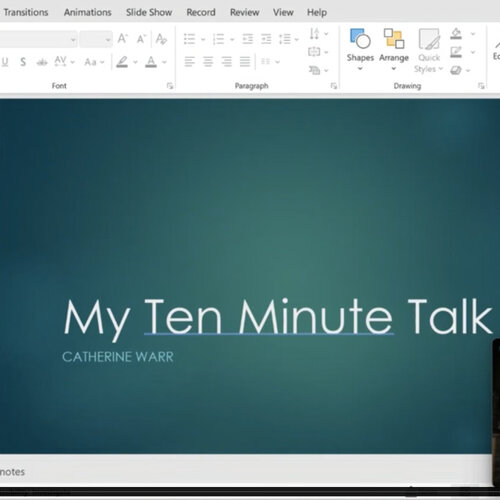
While we still miss in-person talks, local history societies across the country have done wonderfully to bring events online. BALH is no different and we have been trying our hand with our Ten Minute Talks, podcasts and workshops. We have also been running a new series of online lectures, bringing together great talks on a wide range of subjects for you to enjoy from home, Local History Hour, which runs on the last Thursday evening of each month. The format is conversational, with our hosts inviting two guests to speak from different perspectives on a given theme. We are offering a mixture of local case studies and national overview, a combination of storytelling and advice on how someone might go about researching a topic.
Local History Hour runs on Zoom Webinar. Attendees sign up in advance, and attendance is free to individual members of BALH, with a £5 charge for non-members. We are piloting a new scheme with our digital output, to offer benefit to the members of our Society members. For Local History Hour, the charge for these will be £3. We are also recording the sessions and making them available on our website on the same basis for one month, before making them freely available to all. For each talk you sign up for you’ll get a link, this will take through to the waiting room on the night.
Zoom Webinar works differently to the Zoom Meetings many of you will have become familiar with this year. When we open the doors of the waiting room to let you into the event you’ll be able to see and hear your host and speakers but they won’t be able to see or hear you. Instead, you may submit text questions via a Q&A box. At the end of the hour we’ll have time for the submitted audience questions.
So far we’ve hosted three excellent sessions on rebellion in medieval Kent, the English civil wars and early modern women’s lives which are now available on our website. Coming up on May 27th is ‘Burberry- Local Draper to International Fashion Brand’ with Dr Mike Winstanley introducing textile making and the drapery trade in the 19th century with Dr Barry Shurlock presenting a study of life and work of Thomas Burberry in Basingstoke which will include consideration of his wide trade connections, the business in town and Burberry’s role in the community. Our talk on June 24th is ‘Local and Parish Libraries in Early Modern England’. Anna-Lujz Gilbert will be presenting a national overview of libraries in localities and Dr Helen Kemp, librarian at Thomas Plume’s library in Maldon, Essex will be giving us a case study of Plume’s library, hopefully from the library itself! On July 29th is ‘Marginalised Lives in Localities’ with Professor David Killingray and Anna Cusack talking about where and how to look based on their research, focussed on 18th century London and following individual case studies.
Please look out for announcements of our talks during the year here in Local History News, our e-newsletter, website and social media accounts. We look forward to welcoming you all.
Partnership between Pharos Tutors and the British Association for Local History Show more
We are delighted to announce that Pharos Tutors and the British Association for Local History (BALH) have joined forces to produce an online course in local history:
Local History: Uncovering the Places and Communities connected to your Ancestors
Through the lens of local history, we can appreciate the broader historical context of our forebears and better understand their experiences. This four week course will guide you step by step through three key time periods, from c.1066 to the present day, using a variety of case studies and sources from across Britain to enhance your learning. The course is designed for those who are just starting out in local history research and for more experienced researchers who would like guidance, inspiration or practical advice.
Pharos Tutors is one of the leading family history education providers in the UK, providing online courses since 2005. Whilst historically the focus was on genealogy and family history based subjects, many of our more recent courses, such as Migration in the British Isles, Church & Community; Selected Records 1540-1800 and Discovering Your British Family and Local Community in the early 20th Century, incorporate other areas of historical research, such as local and community history. In this way our students are able to enrich and expand their research and perhaps, begin studies in separate but related areas.
As the national charity which promotes local history and serves local historians in Great Britain, BALH is ideally placed to provide the necessary expertise to develop a course in local history for Pharos students and Pharos was the ideal candidate to develop a local history course using its current teaching methods and platforms for BALH members.
The course is scheduled to run for the first time in September 2021 and places can be booked now. More information on the course can be found on the Pharos website: https://www.pharostutors.com/details.php?coursenumber=342 or by writing to info@pharostutors.com.
Follow Pharos Tutors on Twitter:
British Association for Local History Annual Report 2020 Show more
Who and what we are: The Association is an unincorporated charity governed by an elected Council. Its purpose is to encourage and assist the study of local history throughout Great Britain as an academic discipline and as a rewarding leisure pursuit for both individuals and groups. The elected members of Council are the trustees of the Charity. Trustees are listed elsewhere in this report with Officers of the Association and members of the advisory committees. As recently elected chair of the Trustees in a defining year I have enjoyed the encouragement, support and pro-activity of fellow Trustees who have adapted to all the changes we have had to make, including all our meetings on Zoom. I am personally very grateful for the enduring presence of Professor Caroline Barron, the President of BALH, who has eagerly encouraged all the new initiatives as the Association has adapted to a new way of working.
What have we done: We have made some radical changes in the year to respond to the impact of the global pandemic and its consequences. With the closure of libraries and archives we removed the paywall, so all bar the most recent issue of The Local Historian became free to access online. Our Events and Development Officer Dr Gill Draper created a new initiative early in the spring lockdown called ‘Ten Minute Talks’, inviting members to send us talks that may have been cancelled by the lockdown so we could share them with our members. This proved immensely popular and started our new online programme. While it had been part of our long-term development plan, we accelerated the development of our digital offering. The first step was to establish two fellowships – Social Media Fellow, Dr Daniella Gonzalez, and Digital Engagement Fellow, Dr Claire Kennan, joined the BALH team in September. Along with our Web Manager Paul Carter, they formed our Digital Team [digitalteam@balh.org.uk] and prepared exciting digital events to take place in 2021. To whet appetites, Daniella took to social media to keep everyone (members and not-yet-members alike) informed of our activities. The team also took up the mantle of establishing the new e-newsletter, initiated by Membership Secretary Dr Jonathan Mackman, to make it a bi-monthly publication working in collaboration with Local History News. Inspired by this activity, Trustee Dr Adrian Webb and Outreach Committee member Joe Saunders began work on our new online talk series Local History Hour, convening a programme for 2021. Through what has been a transformative year we have continued to enjoy our working partnership with KSAM, in particular their support in establishing a new way for members to pay their membership fee by Direct Debit. In the circumstances that 2020 threw at us we committed to continuing to offer accessible content to our members, despite having to postpone our first Regional Conference that should have been held in Taunton – on the very weekend that we were all asked to stay home to save lives – and cancelling Local History Day, making online contingency plans and looking forward to holding the events in person when circumstances allow. Another activity already in the pipeline for 2020 was our Local History Survey, which became even more important for us to understand our membership and how local history is faring. Later than planned, the survey was launched in November (initial results will be shared at Local History Day 2021).
What services are provided: Our two flagship quarterly publications, The Local Historian and Local History News, continue to be central to the work of BALH, providing articles and information on local history across Britain, and offering a source of inspiration and guidance for best practice in local history research. Among our publications in 2020 we revised and updated our ever-popular Internet Sites for Local History, edited by Alan Crosby. Our new website was launched in 2019, and in 2020 the website blossomed as a source of information for individuals and societies. In particular, the long-term project led by Dr Jonathan Mackman to have a comprehensive Directory of Local History Societies is near completion and a great source of information. The new e-newsletter (published bi-monthly) is a useful digest of all the updates and information on the website, such as the Ten Minute Talks, and the events to be held in 2021. We continue to offer the service to our society members is insurance to cover their activities.
Local History Day: Our planned LHD at the Institute of Historical Research, London, was postponed in June 2020. Instead, we held our first online event over Zoom as a replacement LHD in September 2020, with a fascinating and thought-provoking talk on ‘What Is Local History?’ by Prof. Catherine Clarke, Director of the Centre for the History of People, Place and Community at the Institute of Historical Research. We had over 100 online attendees which was a great start to what would become our new programme of digital engagement.
Our annual awards were also announced online on what would have been our Local History Day.
Awards for Personal Achievement were given to:
Brian Austin, Somerset
Brian Buss, Surrey
Barry Jolly, Hampshire:
Robert Ovens & Sheila Sleath (joint award), Rutland
Bill Reed, Wiltshire:
The 2020 Award for a Society Newsletter went to
Essex Society for Archaeology and History
Awards for Research & Publication were made as follows:[JL1]
The David Hey Memorial Article 2020
Brian Hodgkinson, ‘The Holland Causeway and Bridge End Priory: piety, people and communications in the Lincolnshire Fenland’, Lincolnshire History & Archaeology vol.50 2018 (winner long articles)
other long articles
Neil Wiffen, ‘Supplying the army: the contribution of Essex to provisioning the forces of Edward III, c.1337’, Essex Journal vol.54 no.1 (Spring 2019)
Ian Hancock, ‘Forestry between the Tyne and the Derwent 1770-1870’, Hexham Historian no.28 (August 2018)
David C. Neilson, ‘The operation and achievements of the Winchester pavement commissioners 1770-1866’, Hampshire Studies vol.73 (2018)
Caroline Adams, ‘The influence of the early modern gentleman on the changing landscape of West Sussex’, West Sussex History no.87 (Autumn 2019) (winner short articles)
other short articles
Sean Gubbins, ‘Hackney, Shoreditch and Stoke Newington and the Hearth Tax’, Hackney History vol.20 (2019)
Norman A. Alvin, ‘”Klondike Villas”: the back to the land movement in Bradford’, The Bradford Antiquary no.79 (2018)
Sue Andrews, ‘Why did the parish of Hadleigh not join Cosford Incorporation in 1779’, Suffolk Review new series 79 (Autumn 2019)
The Trustees believe that the Association continues to run effectively and according to the constitution and rules of its charitable status. Constant attention is being given to find ways and methods for the Association to function more effectively in reaching a larger constituency of people interested in local history. In all these endeavours the Trustees are grateful to all those who support BALH whether on paid contracts, on committees or as volunteers without whom the Association could not function.
Dr Jessica Lutkin, Chair BALH
President: Professor Caroline M Barron
Vice Presidents: Dr Christopher Charlton, Professor Claire Cross, Dr David Dymond, Professor Norman McCord, Mr Phillip Snell, Dr Kate Thompson
Board of Trustees 2020-21: Dr Virginia Bainbridge, Dr Katie Bridger, Dr John Chandler, Professor Claire Cross, Dr Paul Dryburgh, Professor David Killingray (Vice Chair), Dr Tim Lomas, Dr Jessica Lutkin (Chair), Dr Jonathan Mackman, Ms Susan Moore, Dr Jack Southern, Dr Winifred Stokes, Dr Iain Taylor (Treasurer), Professor Geoff Timmins, Dr Adrian Webb
Advisory Committees:
Outreach: Ms S Moore (Chair), Dr V Bainbridge, Dr K Bridger, Dr M Escott, Ms J Golding, Mr R Hunter, Dr A Jackson, Dr T Lomas, Dr J Lutkin, Dr J Mackman, Dr J Mattingly, Mr J Saunders, Dr J Southern, Dr I Taylor, Prof G Timmins, Dr A Webb,
Mr P A Carter (Web Manager) ex officio, Dr G Draper (Events & Development Officer) ex officio, Dr Daniella Gonzalez (Social Media Fellow) ex officio, Dr Claire Kennan (Digital Engagement Fellow) ex officio
Publishing: Dr J Chandler (Chair), Prof M C Cross, Dr D Dixon, Dr P Dryburgh, Dr M Forrest, Prof D Killingray, Dr M O’Sulllivan, Ms J Owen, Dr W Stokes, Dr K Thompson, Dr N Tringham, Dr M Winstanley
Dr A Crosby (Editor The Local Historian) ex officio, Dr J Howells (Editor Local History News) ex officio, Dr H Falvey (Reviews Editor) ex officio, Mr P A Carter (Web Manager) ex officio
Web Manager: Paul A Carter; Editor, The Local Historian: Dr Alan Crosby; Editor, Local History News: Dr Jane Howells; Reviews Editor: Dr Heather Falvey; Events & Development Officer: Dr Gill Draper Membership and Financial Services: Kingston Smith Association Management
BALH Local History Day 2021
Saturday 12th June 1.30pm to 4.30pm To be held on Zoom
British Association for Local History AGM
2021 Local History Awards
BALH Annual Lecture:
Local history after the pandemic: some thoughts for the future’
Prof. Nick Barratt
Director of Learner and Discovery Services, The Open University
As thanks for your continuing support of the BALH in difficult times this year’s Local History Day will be free to all to join online. Details for how to register online are available on our website at https://www.balh.org.uk/lhd2021 – registration will be necessary to receive the Zoom link and password.
AGM Agenda
1 Apologies for absence
2 Minutes of AGM held on 12 September 2020, and matters arising
3 Report from the Chair of Trustees
4 To consider annual report and accounts for 2020
5 To elect Members of the Board of Trustees Trustees: Dr Virginia Bainbridge, Dr Katie Bridger, Dr John Chandler, Prof. Claire Cross[JL2] , Dr Paul Dryburgh, Prof. David Killingray, Dr Tim Lomas, Dr Jessica Lutkin, Dr Jonathan Mackman, Ms Susan Moore, Dr Jack Southern, Dr Winifred Stokes[JL3] , Dr Iain Taylor, Prof. Geoff Timmins, Dr Adrian Webb.
6 To elect Officers of the Board of Trustees
7 To consider membership subscriptions
8 Local History Survey summary
9 Independent examiners of the Associations’ accounts
10 Any other business notified by 12 May 2021
Curiosities of articles Show more
By Alan Crosby
Reading the journals and newsletters of local history societies can reveal all sorts of quirks and oddities. The range and variety of the contents often intrigues me – there is seemingly no subject which is beyond the gaze of local historians - and quite frequently I muse on whether a comparable piece of research would be possible for my own area. Just looking through the contents lists of the journals with shortlisted papers for our BALH Publications Awards 2021 produced some fascinating examples. Who could fail to be delighted by the story of an Essex ratcatcher, or the history of the Worthing tomato (both of those papers won awards)?
The ratcatcher of Clavering featured in the Saffron Walden Historical Journal, and in the same issue were articles on the taxidermy collection at Audley End and the Saffron Walden Grand Japanese Bazaar of 1906. Scottish Local History included a paper about the roller-skating mania which swept Scotland in 1908 to 1911, while The New Regard (journal of the Forest of Dean Local History Society) included a paper which discussed Royal Observer Corps underground monitoring posts, three of which were constructed in the area in the late 1950s and early 1960s – an almost forgotten aspect of Britain’s Cold War planning (a total of 1518 were built in this period in the United Kingdom – where are your local examples?).
But many other gems are hidden in the pages of articles which at first sight are concerned with more mainstream topics. The 2020 issue of the Brentford and Chiswick Local History Society Journal includes a shortlisted article about the development of the Glebe Estate in the 1870s and 1880s, but my attention was also drawn to the foreword by the chairman, James Wisdom. There he refers to an article by Carolyn and Peter Hammond, entitled ‘Septimus Burton at Grove House’, which, he writes, leaves us ‘pondering the fate of the “Colossal statue of George IV”’. Who could resist that tempting morsel?
The article in question discusses the huge sale of the contents of Grove House, Chiswick, which took place on 21-23 December 1842 following the death of Septimus Burton, who leased the property from the Duke of Devonshire (Septimus was a brother of the more famous Decimus, the architect). At the end of the sale, according to the catalogue of 488 lots, came the contents of the outbuildings and the produce of the gardens, the animals on the small farm, the greenhouse plants, and a miscellany of oddments.
Let the authors take up the story: ‘even the very many green house plants (about 500 in all, including geraniums and cactus), the garden tools and the loads of hay and manure were also up for sale, as was a “very Handsome Colossal Statue of George IV, in his robes, in a fine state of preservation, on a massive pedestal” which rather bizarrely was stored in the green house’.
A colossal statue of a colossal king … George died in the summer of 1830 at the age of 67, weighing a conservatively-estimated 24 stone. He bulged out of the girdles and tightly-laced whalebone corsets which he wore – it was rumoured that it took three hours for him to be fully laced, and ill-wishers, of whom there were quite a few, claimed that left ungirdled and in its natural (?) state his stomach hung down to his knees. Surely an uncolossal statue of the king would have been a travesty of the truth, and ‘massive pedestal’ was certainly essential.
Doubtless a true patriot during George’s ten-year reign would have bought and displayed royal memorabilia (rather than the very numerous, freely-available and often obscene caricatures and parodying cartoons of His Majesty) but acquiring a colossal statue seems a particularly extreme form of patriotism. So where did the statue originate? And was it perhaps removed from public display at the beginning of the reign of George’s more modestly proportioned brother William IV, sold off at a bargain price or even offered free and gratis? And how did it find itself in the greenhouse at Chiswick? And most important, of course – who bought it, what happened to it, and is it still extant today? Answers on a postcard, please …
Trustee profile: Katie Bridger Show more
It was in 2012, somewhere behind the infamous blue front door of the Centre for English Local History (University of Leicester), that I was first introduced to the world of local history. I remember thinking that I would never be able to look at placenames, road signs and street names in the same way again, and I was right! Almost a decade later and 200 miles to the north of that blue front door, I now work for the Revitalising Redesdale project, a wonderful programme of celebration, conservation and enhancement focused on the cultural heritage, landscape and wildlife of the Redesdale valley in Northumberland.
I completed my PhD in the Centre for English Local History (University of Leicester) in 2018, during which I had the privilege to meet and work with many wonderful historians, local history societies and enthusiasts. I spent many happy evenings talking to local history and heritage audiences across the east Midlands about my research on the relationship between place and late medieval gentry identity.
During my PhD I was fortunate to work for some brilliant local history projects, from the Charnwood Roots project (2013-2017) to research into the founding donors of the University of Leicester. I was also an editorial assistant for the East Midlands History and Heritage magazine, the social media editor for the Midland History journal and an early career representative on the Advisory Board of the Centre for the History of People, Place and Community at the Institute for Historical Research.
The professional uncertainty of the postdoctoral world was very much brightened by the opportunity to work for more fantastic projects, including the Civil War Petitions project at the University of Leicester, the Star Chamber Project at The National Archives and the Gendering the Early Modern Commons project at the University of Hull. But the world works in mysterious ways, and some years after the Charnwood Roots project ended, it was that project which eventually led me to the north-east.
Being immersed in the fantastic wilderness of Border Reiver territory in Northumberland makes it impossible to separate the past from the present. In these challenging times I am certain that our connection with the places and stories around us – even those which may at first appear mundane – will only become stronger, and I look forward to playing my part in making that happen.
Notes News Issues Show more
Local History Day 2021
BALH’s major event of the year will be different as an online occasion, but we are as determined as ever to ensure it is our enjoyable annual celebration of local history. It is free to everyone this year, but be sure to register to join us on 12 June. Further information can be found on page one of the Supplement in this issue, and more details will be on the website in due course.
BALH Awards
Recognition will be given in virtual form to the 2021 recipients of awards during Local History Day, and we will post their certificates. A small sub-committee has been formed by Trustees to review the characteristics of the Personal Achievement Award; further details will be available in the next issue of LHN, together with a revised nomination form. Criteria for the other two Awards – for Research & Publication, and for a Society Newsletter, are not changing at this time, but please read carefully the information given about them on the inside front cover of each issue of LHN.
BALH Online Activities
The increasing quantity and variety of online activities offered by BALH’s Digital Team are proving successful and very popular. Thank you to everyone who has joined in, and to those who have sent suggestions for other topics they would like to see.
LHN 139
The balance of contents in this issue looks slightly different from normal. There were so many contributions of articles this time (everyone thinking, researching and writing through long dark days of winter?) that the ‘News’ sections have almost disappeared. Society activities feature strongly in the longer pieces, as indeed does news from archives. There are two interesting opportunities to volunteer from the comfort of your home, investigating parish boundaries (p 14) and evidence for early-modern industrial development (p 17). Restrictions also seem to have proved fruitful for publications of which there is a bumper crop. Anyone planning a publication would be wise to read Heather Falvey’s article on p 22, and to follow up the three additional sources at the end. Don’t forget there is more in Reviews and Listings sections of The Local Historian.
Reviews
Letters between a Victorian schoolboy and his family 1892-1895 Show more
Edited by David Lisle Crane
(1999, hardback, ISBN: 0 948545 11 9; pp. lxii + 542, 102 illustrations). Available free from the editor, davidlislecrane@yahoo.com
John Bibby
This compendious volume, though published some years ago, is now available free of charge and contains many gems that make it well worth attention. It will appeal particularly to those with interests in education of the 1890s, those interested in German immigrants, and especially to Local History Societies in Kent and Bristol, who may investigate distributing multiple copies to their members by contacting the author (details above).
It is built around 318 letters to, from, and concerning the young Tankred Tunstall-Behrens (1878-1939), starting on 16 September 1892 when the fourteen-year-old travelled unaccompanied from Kent to Clifton College in Bristol via London Bridge and Paddington: he had the assistance of three porters who cost 8d in total; the train fares cost 13s 1½d and the two cabs were 2s 8d each. On the same day, Tankred’s sister Tyra was being escorted to Roedean. Thus we have a well-off family, even if they are not related to the banking Behrens’s. Tankred was none-too-happy at Clifton (he had tried to get in at Rugby), but Tyra seemed to let nothing get her down. Predictably, she died young.
Pater and mater are the two strongest characters in the book: Behrens senior was a coffee merchant born in Wuppertal; his naturalization papers came through the day before Tankred was born. Mother was a Londoner, born to a “colonial merchant” family.
The thirty-page introduction by Julie Crane and extensive commentary sections attempt to put some structure on the story. There are also facsimiles, photographs and illustrations and a detailed dramatis personae. The book ends rather abruptly with a final letter in 1895, and one is left wondering what happened then. How did the sentiments and actions in this three-year period in Bristol ripple down the rest of his life?
Were teenage public-school boys of the late Victorian era embarrassed to have an out-of-the-ordinary Christian name like ‘Tankred’, or was such exceptionality a source of pride? What if your sister’s name is the equally unlikely name ‘Tyra’, while your younger brothers are simply prosaic ‘Brian’ and ‘Roy’?
Some such questions of family nomenclature and sentiment have featured in my current researches on William Pearson (1822-1907), whose letters and more importantly detailed bank account records remain at UCL to be investigated after the pandemic. William was born in a village near York, went to Edinburgh, had an illegitimate son, became a Q. C., communed in London with rich slave-owning refugee southerners from the USA, and idiosyncratically christened his youngest son ‘Carl’ –perhaps the only English child born in 1857 who received that name. Why? What did people think of this uncommon name? Did father and son ever discuss the reason?
Carl eventually showed something of his attitude by changing the spelling to ‘Karl’: he became ultra-germanophile and generally known as “KP”. Karl Marx was an acquaintance, but a more salient reason for the ‘K’ seems to have been repeated mis-spellings of “Carl” while he was in Germany. However, this does not address his parents’ motivations, nor even his own motivation to call his own son “Egon” – presumably in homage to the ethos of eugenics to which he was attached.
But what is in a name? If we had been named differently, would our life have been different?
Two Latin texts with parallel English translations Show more
By Heather Falvey
The Life of Guy of Merton translated and edited by Katie Hawks & Keith Penny (Merton Historical Society 2020 32pp ISBN 978-1-903899-80-9) £2.00 + 65p p&p from http://mertonhistoricalsociety.org.uk/publications/
Polydore Vergil’s Life of Richard III edited and translated by Stephen O’Connor (Richard III Society 2021 xiii+73pp ISBN 978-0-904893-21-2) £7.50 + £1.69 p&p from http://www.richardiii.net/ ‘Society Shop’
Latin documents are encountered by local historians in various contexts, perhaps the most frequent being medieval wills and manorial documents. Some types of documents, particularly legal ones, continued to be written in Latin in the early modern period. There are also many Latin manuscript copies dating from later centuries, and even published editions, produced when it was anticipated that those who consulted these books would be familiar with Latin, such as the Annales monasterii S. Albani, edited by H. T. Riley, published in 1870-71. The latter, very usefully, have detailed marginal notes that indicate the gist of the Latin text; however, in general, whether manuscript or printed, one needs to be able to read the Latin and provide a translation with the aid of various dictionaries and ‘guide’ books, and possibly, of online translation websites. The latter may or may not be useful depending on the nature of the document, not least because medieval Latin does not follow all of the grammatical ‘rules’ of classical Latin.
Two historical societies have recently published the text of a Latin document with an English translation on the facing page. These documents are not of a standard type, such as wills or courts rolls; purely coincidentally both are biographies, but of two very different individuals: Guy of Merton and Richard III.
The Life of Guy of Merton was written sometime between 1132 and 1151 but now survives in a fifteenth century copy held in the British Library. Katie Hawks’ Introduction explains what is known about the life of Guy of Merton (not a great deal) and that he founded Merton Priory and was chosen to reform the canons at Taunton and Bodmin, and died at Exeter. She argues that Guy’s Life was written because Merton Priory had no particular saint, ‘whose relics could provide a shrine and miracles or whose life could provide a hagiography’ (p.6); instead, for its fame and importance it had to rely on the exceptional piety of its founder and its canons. The Life was written as a letter from a canon Rainald to one Ralph, who was probably a secular cleric; it was a moral exemplar to be read out to encourage canons and other clerics in their moral and spiritual lives.
Polydore Vergil (c.1470-1555), an Italian cleric, who was archdeacon of Wells (Somerset), wrote his Life of Richard III as part of his project to write a history of England from the earliest times to the present day, the bulk of it being completed between 1506 and 1513. Three editions of his Historia were subsequently printed in 1534, 1546 and 1555. His original manuscript survives in the Vatican Library and although the 1534 published edition is modelled closely on it, some parts were substantially rewritten. As well as the main text of the manuscript, Stephen O’Connor’s edition provides, in footnotes, many passages where the text of the two varies significantly. Vergil’s Life is controversial in certain quarters, but it is his version of what was for him recent English history and he did record that after the battle of Bosworth the dead king’s body was on public view at the convent of Franciscan friars at Leicester, before being buried there.
Both publications provide illustrations of the original text: the forms of handwriting are markedly different. While Vergil’s manuscript has numerous crossings out and additions in the margin, the Merton hand is ‘about as easy-to-read as medieval manuscripts get’ (p.19).
The Merton Historical Society and the Richard III Society are to be congratulated on producing these texts. While there are various books to help with ‘standard’ types of Latin documents, these two publications are particularly useful because they reveal very different styles of Latin writing and their facing translations make the Latin relatively easy to follow.
The Vernacular/Polite Interface in Cumbria’s Historic Buildings Show more
Cumbria Vernacular Buildings Group occasional paper number 2, Sept 2020 34 pages
ISBN: 9781916351806 £5
For almost 70 years the Vernacular Architecture Group, which has over 700 members, has been studying and recording ‘vernacular’ buildings all over Britain. This remarkable body of mostly amateur scholars has also, since 1952, been in the forefront of conserving and protecting traditional buildings, first in Britain and more recently all over the world. Every year there are increasing numbers of overseas members joining. Within the organisation are also a large number of affiliated local groups who do recording and research in their areas, and it is one of these bodies, set up seven years ago, which has produced this new booklet, following a study day on November 2019 in Burgh by Sands.
The opening essay, of the four papers here published, is a most valuable study by a former president of the VAG, Adam Menuge, entitled ’Vernacular and Polite: reflections on a shifting frontier’. The author’s starting point is the late Ronald Brunskill’s definition of a vernacular building as ‘a building designed by an amateur without any training in design’. In Brunskill’s excellent illustrated handbook on Vernacular Architecture (now in its fourth revised edition) he qualifies this by saying that the main function of the building was practical, and that aesthetic considerations were minimal. With, in particular, the coming of the Renaissance, however, domestic buildings of better off people started to copy new fashions elsewhere, even bringing in an architect. This was the beginning of ‘polite’ architecture, which came to Cumbria quite late in the day.
The next paper, by Adrian Green (the current president of the VAG) looks in more detail at ‘Polite and Vernacular Architecture in Cumbria and Northumbria’. Here, in the four northern English old counties of Cumberland, Westmorland, Northumberland and Co Durham, he shows how the documentary evidence tells us about the relatively late arrival of ‘polite’ architecture. Dr Green, who teachers at Durham University, has also studied in detail the ‘high status’ domestic architecture in the area (the palaces of the Bishops of Durham, for example), so he is able to put the local vernacular into context.
The third essay is by Peter Messenger, a Cumbrian by birth and upbringing, who has recently completed a PhD on ‘Land ownership and vernacular buildings in Cumbria’, as a mature student. His essay in the booklet is fascinating and looks at how changes in customary tenure, which had been widespread in Cumbria until the 17th C, lead to the loss of vernacular architecture to the polite. He then gives several examples (with good colour photos), and shows that despite these changes, a complete replacement of Cumbria’s vernacular building tradition was avoided.
The final essay by Paul Lewis, is on Gaythorne Hall, a very remarkable ‘early Renaissance’ building in remote eastern Westmorland. The house actually lies five miles due east of Shap Summit (famous to railway buffs as the highest point on the west coast main railway line) in beautiful moorland, and was probably originally built as a hunting lodge, erected in the 16th century, as Pevsner pointed out over 50 years ago. While Gaythorne Hall provides a useful case study, this paper tells us less than Pevsner’s entry in the Buildings of England volume (now in its 2010 revised edition) and even though a plan of the house is included, it is but a tracing of a fine plan made and published by the RCHME for its Westmorland volume in 1936.
Overall, this publication is a worthwhile collection of papers, in the fine tradition of the VAG and its many active local groups.
https://www.vag.org.uk/index.htm
Tim Tatton-Brown
More local history books Show more
Milk Herefordshire, Bill Laws, Little Herefordshire Histories 1, 2013
Health Herefordshire, Marsha O’Mahony, Little Herefordshire Histories 2, 2020.
£5 incl p & p in UK each, Herefordshire Lore, www.herefordshirelore.org.uk
Herefordshire Lore, the county reminiscence group, has been recording and publishing local history since the late 1980s. These two booklets, of only 25 pages, demonstrate what can be done very effectively in a small space. Carefully selected text and images, and excellent design, have created worthwhile publications. Personal stories from this rich oral history material have provided detail on the daily round, and occasional excitements for both topics. The second, looking at health care delivery in Herefordshire over the last century, is particularly apposite at the present time. We meet outstanding individuals amongst hospital clinicians and community midwives; the fear of epidemics; folk medicines and remedies; and much more, on both sides of that watershed that was the arrival of the NHS.
George Martyn’s Barn, Main Street Keyworth. A History
Sheila Barton (ed)
2021 Keyworth & District Conservation Area Advisory Group and Keyworth & District Local History Society £7
George Martyn’s Barn was listed in 1976 because of its architectural and historic interest, believed to be the only surviving timber-framed building of its kind in Nottinghamshire, and the second oldest building in Keyworth (after the parish church). This 48pp generously illustrated booklet begins with a brief and wide-ranging introduction to its historical background. Four short chapters follow, describing developments in agricultural history and building technology prior to the 19th century. This inevitably leads to over-simplification, and we look forward to reaching more detail on the Barn itself. From chapter six this is done, making effective use of authoritative sources such as a dendrochronology survey, and a report on the Barn’s restoration in 1977. Excellent photographs illustrate its interior details in chapter ten ‘The inside story’.
Documentary research by the local history society using, for example, court rolls, parish registers, inclosure award, census returns, maps and more, links the history of the Barn to its owners.
The Conservation Area Advisory Group assumed the tenancy with Rushcliffe Borough Council in 2020. It has been officially opened in a Covid secure way, and will open to the public as restrictions are lifted. There are plans for exhibitions and events that highlight local cultural and social heritage. George Martyn’s Barn will surely be a valuable community asset.
Lillington in Lockdown,
Chris Rhodes, (ed) 2021
The 2020 Christmas Challenge
Lillington Local History Society, www.lillingtonhistory.org
These two A4 booklets come from a local history society on the outskirts of Leamington Spa in Warwickshire. Early in 2021 they asked Lillington residents to write about their experiences over the last year. All the contributions are included in the 32 pages of Lillington in Lockdown. It would have been an impossible task to select and edit. There are general reflections and highly personal accounts; prose, poems and notes; long and short; from old and young; and plenty of photographs. This will be a valuable addition to the society’s archive for future reference.
For the Christmas Challenge (for which idea the Spirit of Sutterby Local History Group in Lincolnshire is thanked) readers were asked to select one of three images of Lillington to use as a prompt for a memory, a fictional story or a poem. Nine authors responded with a fascinating variety of contributions. It is interesting that the painting of the church attracted six responses, the modern photograph two, and the extract from the baptism register of 1749 only one. I wonder what became of Thomas Harding and Dorothy Palstone’s ‘spurious’ child? The 2021 Easter Challenge offers Lillington School Clock, a 20th century photograph of tree planting, and a landscape painting looking to Leamington and Warwick from the Campion Hills.
Lant spouts continued
Readers intrigued by John Chandler's note on lant spouts in the last LHN (LHN 138 p 12) may like to know that Jennifer Stead's definitive historical study, 'The uses of urine', has recently been republished by Huddersfield Local History Society. First appearing in Old West Riding in 1981/2, the two-part study is included in Names, Places and People, a selection of 14 pieces from that late-lamented journal. Grouped around six themes - language and topography, local customs, the textile industry, historic houses, going to America and early modern morality - and introduced by HLHS Chair Cyril Pearce, the collection is available at a modest £6.95 (plus £2 p & p) from HLHS, 24 Sunnybank Rd, Huddersfield HD3 3DE, or www.huddersfieldhistory.org.uk/publications Well worth it for the urine alone!
Compendium of WW2 memories published
Radley History Club has made a PDF collection of the popular WW2 memories assembled by Christine Wootton, former Club Chairman. The PDF (2.3 MB) is downloadable from the Oral History page of the Radley History Club website. It is in written form, based on interviews from the oral history archives and material acquired by Christine during research on other topics. https://www.radleyhistoryclub.org.uk/oral-history/#WW2
The accounts are grouped into eight categories, the largest of which is about life in the farming village of Radley (then in Berkshire) during WW2. In addition to fascinating personal memories and photos, there are also accounts that describe a particular subject such as how the Women’s Institute fared in wartime.


Hugo Javier Freitas


Laura Yeoman