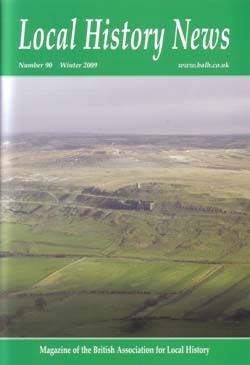
Local History News Number 90 Winter 2009
Contents
Rosedale Show more
ROSEDALE
In late November I went walking at Rosedale, in the North York Moors. Two days before there had been heavy snowfalls, and the moorland road from Castleton to Hutton-le-Hole was ‘passable with care’ where it runs over the summit and along the spine of the great ridge southwards towards the Vale of Pickering. To my right Farndale's fields and snowy slopes were lit by shafts of brilliant sunshine piercing the wintry cloud. To my left was Rosedale, which I planned to circumperambulate following the long-disused tracks of one of Britain’s most extraordinary railways, a branch of the North Eastern Railway, opened in 1861 and closed in 1928, and Victorian ambition at its most magnificent.
It really is a remarkable story (the railway, not the walk—though that had its moments … I didn’t realise that bog was quite so deep). The great iron boom of the 1850s, which spurred the meteoric growth of Middlesbrough from hamlet to industrial city in only twenty years, saw the ironmasters of Teesside and County Durham looking ever further afield for ore. In the heart of the North York Moors, at over 1000 feet above sea level and twenty miles from the Tees, were great deposits of ironstone (some 18 feet thick, and so rich as to be magnetic). How to get the ore from the mines to the furnaces down by the river? The Victorian answer, of course, was to build a railway … but this had to overcome formidable obstacles. There was a giddy ascent (or, far more hair-raising, adescent) of the scarp slope of the northern moors, accomplished by an incline nearly a mile long and with a maximum gradient of 1 in 5. Then the railway wound for six miles across lonely moorland to Blakey Junction, 1200 feet above sea level, where it divided; one branch following the west side of Rosedale, the other the eastern, serving mines, quarries and calcining kilns perched far above the valley floor.
I walked the line. It closed 80 years ago but the marks of the sleepers are still clear over long stretches, on this occasion picked out by snow. The engineering achievement is astonishing. The western branch contours sinuously along the slope, past the scanty relics of mines, to Bank Top, where giant arches of massive kilns and a few cottages, 925 feet above sea level, are all that survive of a briefly-thriving community. The eastern branch, though, is breathtaking—constructed on a man-made terrace hugging the steep and sometimes precipitous valley side, spanning tributary valleys on high curved embankments which seem too narrow ever to have carried a locomotive and its regulation fifteen laden wagons, and slicing through hillspurs in deep rock-sided cuttings. The railway was once so busy that it worked even at night—in the 1870s an average of 1500 tons of ore was sent down to Teesside every day—yet today it is impossible to imagine that this was ever so. The only sounds now are those of sheep and ravens, and the constant rush of waterfalls—no whistle of an engine or its laboured panting, or the squeal of wheels on rails as the trains inched their way round the tightest of curves.
All of this was accomplished by human endeavour which itself seems scarcely credible—to build these lines (at one point forty navvies were buried in huts in snowdrifts and nearly died of starvation), to labour in the mines and live in the (now long-demolished) cottage rows high on the bleak moorland, or to work the Rosedale railway in the teeth of gales and the fearsome snow for which the moors were notorious. I plodded through a mere two inches of it, back to the car, parked beside the summit cutting which in the terrible winter of 1894-1895 was blocked from 31 December to mid-April by drifts thirty feet deep.
Now the remains of the mines and kilns are treasured industrial monuments, and rightly so—from across the valley, the huge arches of the stone-built kilns seem like the nave arcades of a monastic ruin, and close to they are overwhelming in scale and grandeur. When the National Park was established in the mid-1950s they were seen as a blot on a beautiful landscape, but fortunately were not demolished, and by the mid-1980s conservation work and careful protection had become the order of the day. But they, and the dramatic and remarkable remains of the railway, are not only a reminder of a vanished industry. They are also a monument to the fortitude, endurance and toughness of a vanished community and a working environment that now commands awe and the utmost respect.
Professor Alan Everitt Show more
PROFESSOR ALAN EVERITT
Having been one of his earliest undergraduate students, I would like to offer this appreciation of Professor Alan Everitt FBA who died on 8 December 2008. He was the third Hatton Professor of Local History at the University of Leicester [1968-82'>more...
As second year Leicester undergraduates in 1966 we were naturally apprehensive about meeting the tutor who would [with Geoffrey Martin'>more... lead our special option studies into the English Town 1640-1727. We knew that he had recently been appointed a university lecturer in the Department of English Local History, having previously been Senior Research Fellow in Urban History and we also knew that we would be meeting someone with a formidable research record because his formative and highly acclaimed The Community of Kent and the Great Rebellion 1640-60 had recently been published. What we found was an extremely shy, private and uncoordinated man, who was for his part clearly himself apprehensive about teaching undergraduates. However we very quickly came to recognise the thorough-going nature of his research and of his understanding of English provincial towns in the seventeenth century. He was meticulous in his preparation and his expectations of us were very high indeed: to the degree that he set research-based assignments on a regular basis. What was even more remarkable was that he shared his current research with us. My instincts are that our group relationship with him was sealed was a bus expedition which he led from Leicester to Northampton. On that day of active field observation he both interpreted for us the topography of the centre of Northampton, in a way which is still clear for me over forty years later, and also took us to the Northamptonshire archives in Delapre Abbey to sample Northampton probate inventories, which were clearly part of his continuing research, because he subsequently gave us transcripts which he had prepared, and to which I still occasionally refer. In his own very private way, he was very interested in our progress and determined that we should succeed well.
Two years later he became Head of Department and Professor and I studied the wider reaches of local history on the MA course under his leadership. His pastoral care was very supportive. When I was deliberating over what field of research to choose, my inclinations were very strongly to complement his research into Kent and explore the parallel experience of Surrey but I was summoned to see him urgently one day because he had discovered somehow that a similar piece of research was about to be undertaken at Oxford and he wanted me to be sure that I would be working in a field which was uniquely mine, and so I came to study the economic and social importance of the English inn in a case study of Croydon in Surrey. This professionally and academically turned out to be very shrewd advice, although I am not sure that the research that he predicted ever did quite materialise as expected. Although Richard McKinley was my supervisor, Alan kept a very close interest in my research, sometimes inviting me to a very good supper to make sure he knew how my research was progressing.
His fieldwork style was very different from that of Hoskins. Like many I enjoyed the exhilaration of fieldwork with the latter but the intensity of fieldwork with Alan again reflected his meticulous nature. Whatever else may be said by comparison, it would be doubtful whether the Leicestershire and Rutland Police were ever alerted by a member of the public when Hoskins was on fieldwork. However this did happen in 1968 when, with Alan and another postgraduate student, we were exploring the burgage plots of Uppingham and trying to assess whether some of the adjoining buildings contained original timber-framing on the interior. A member of the public reported us as potential ‘peeping toms’, such was the thoroughness of our investigation!
What can I say in summary? Re-reading The Community of Kent and the Great Rebellion 1640-60, in its introduction Alan Everitt indicated that the interpretation was based on, and derived from, his Ph.D research but that it had been significantly been re-visited in the light of research elsewhere. That is how I shall remember him, a scholar intent on seeking the most robust interpretation of the materials currently available but ready to review his findings if circumstances changed. This is what made him such an exceptional urban historian, scholar and teacher.
Durham County History & Heritage Forum Show more
DURHAM COUNTY HISTORY & HERITAGE FORUM
Durham is a county of contrast with a diverse landscape and strong industrial and agricultural heritage. Roman invasion and settlement, the rise of Christianity through to industrialisation have made the land of the Prince Bishops what it is today. Historically the County boundary extended beyond its present day borders and included the areas around Washington, Sunderland, Gateshead and Hartlepool. It is to this historic county that the newly formed County Durham History & Heritage Forum looks for its membership.
The County Durham History & Heritage Forum is a new voluntary association set up for local history societies, heritage organisations and individuals interested in the history and heritage of the county. The Forum aims to provide networking opportunities for members through events and a website. It will also offer an outlet for promotion and publicity both for forum events and members’ own activities and projects.
This initiative has come about as a result of Durham County Council’s Community Heritage Project (CHP) recognising the benefits of networking, in particular for local history societies. CHP, funded by the Heritage Lottery Fund, has been organising training and networking events for the societies and groups over the last 5 years but as the project draws to a close it is hoped that the Forum will continue to offer some continuity for these societies, individuals and organisations. www.durhamweb.org.uk/historyforum
Oxfordshire Mr History Show more
OXFORDSHIRE MR HISTORY
Jeremy Gibson cannot remember a time when he didn’t love history, but it probably began when he was given a second-hand copy of A Nursery History of England, published before WWI. His interest in the minutiae of personal and local history was aroused with an introduction to heraldry by an inspiring prep-school master. However, it really started when a half-Scottish cousin was researching mutual ancestors. The Gibson family, so far as was known, descended from a wealthy late-18th century Liverpool brewer. More than fifty years later Jeremy discovered from the IGI that the family for a further century or so back were staymakers in nearby Warrington. The literacy of these tradesmen was evident from their educated signatures. He still has found no Scottish connection, but has ever since been enjoying visits to his cousin’s homes in Argyll.
For National Service Jeremy was fortunate in being posted to Woolwich for a clerk’s course at the time of the Coronation. More important to him was perjuring himself to gain access to the British Museum Library (then only open to those over 21) and, of longer-lasting significance, joining the Society of Genealogists. His army service gave him one ‘skill’ – rudimentary typing – of use ever since. Even then he was indexing register transcripts for the Society, and transcribing his own home parish register.
He spent two more years in London as a student at the London School of Printing and Graphic Arts, living a short distance from the Society, where he spent his spare time. He was elected to the Executive Committee, became Chairman of the Parish Registers sub-committee, and initiated an ambitious vast expansion of the National Index of Parish Registers.
Moving from London for Banbury, to spend his working life with the family printing firm, he determined to switch from genealogy to local history. By great good fortune, within weeks of his arrival, the well-known local historian ‘Ted’ Brinkworth started an Extra-Mural course on ‘New Light on Old Banbury’. This proved very popular and well-attended. Before it finished Ted and Jeremy got together and agreed, exploiting this enthusiasm, to found what became Banbury Historical Society.
At that time historical societies catering for ordinary towns, let alone villages, were rare. But the Society has prospered, and recently celebrated its fiftieth anniversary. The journal, frivolously named after two of Banbury’s well-known traditions, Cake & Cockhorse, started in 1959 and, initiallyunder the inspired editorship of Barrie Trinder, has never looked back. He was followed by a number of other worthy successors, at present a group led by Jeremy.
Whilst many societies produce journals or newsletters, Jeremy was keen to produce actual books. So, also since 1959, the Society has published a ‘records’ series, now totalling thirty (with at least two in the pipeline). Jeremy has been General Editor throughout, and wonders how many other such societies have had just one editor for 49 years? Representing one town and its hinterland has enabled the Society to concentrate in a way that no county society may, and policy has been much less constrained than in more traditional record publishing societies. Thus several narrative histories of villages or a period (the Civil War) are included; also a history of the town’s ‘chapbooks’, the first part of an early Victorian squarson’s diary, and, for the fiftieth anniversary, a colourful Banbury Past through Artists’ Eyes, which combines popular appeal with scholarship.
The 1970s saw the start of family history becoming one of the nation’s favourite hobbies. Numerous societies were founded, resulting in the formation of the Federation of Family History Societies. With his genealogical and publishing background, not surprisingly Jeremy, together with the late Gerald Hamilton-Edwards, was instrumental in starting the Oxfordshire Family History Society, of whose journal he was first editor.
The growth of the Federation and of the movement in general, gave scope for what turned into a series of pocket directories soon known as the ‘Gibson Guides’–around two dozen inexpensive booklets, which, in numerous editions, have sold in their hundreds of thousands. The reward for him and his co-authors is in knowing from the sales that they are of wide use to family and local historians alike. Subjects have included Wills and other probate records; Bishops’ Transcripts and Marriage Licences; Quarter Sessions Records; Victuallers’ Licences; Local Census Listings; Militia Lists and Musters; Tudor and Stuart Muster Rolls; Protestation Returns; Coroners’ Records; Poll Books; Electoral Registers; Land and Window Tax Assessments; the Hearth Tax; and Poor Law Union Records (4 parts). Most are still in print (available from The Family History Partnership).
An aspect of the ‘Guides’ that particularly pleases Jeremy is the merging of sources available in a wide range of places. The PRO (as it was) and county record offices produced guides to their own collections, but rarely noticed comparable records elsewhere. This situation has now, of course, been superseded to an extent by the internet, but they continue to provide an easy and concise summary of what is available where.
Although undoubtedly the Banbury Historical Society and the ‘Gibson Guides’ have been the two most important strands in Jeremy’s ‘historical publishing’ life, there are many more. Also in recognition of his achievements he holds Fellowships of SoG, SoA, and RHS. Involvement in the archival world for so long has generated treasured memories of friendships with doyens such as Francis Steer and ’Derick Emmison.
Jeremy has been able to indulge all his closest interests by avoiding the distractions of a close family. However, he was able to combine these on the occasion of the bicentenary of his Gibson great-grandfather, born in 1804. That gentleman, with inherited brewery wealth, married the daughter of the Bishop of Winchester, whose residence (in 1837) was FarnhamCastle. In June 2004, around 140 descendants and spouses, from throughout the world, gathered there (it is now a Church seminar complex). Jeremy remarked at the time, after all the family weddings he had attended during his lifetime, it was time he gave them a party himself.
Jeremy has always considered himself to be a local historian rather than a genealogist. This BALH Award gives him enormous satisfaction and pleasure – but it couldn’t have happened without all his fellow committee members and co-authors over fifty years and more – he just happens to have been the ‘front man’.
Jeremy wrote most of this profile himself! My thanks also to Deborah Hayter, Beryl Hudson and N J Allen. The heading is a comment from one of the referees. JH
Local History - Decline And Survival Show more
LOCAL HISTORY - DECLINE AND SURVIVAL
Two interconnected themes that have interested me much in my work as a local historian are those of decline and survival. Forms of decline and survival can be and in many cases have been evaluated by historians, that is, it may have been asked whether they were - in the language of 1066 and All That -‘a good thing’ or ‘a bad thing’. Was decline in some aspect of our past a positive thing, for example, or something regretted; was survival in some other part of our past something welcomed, or regarded as a negative? Indeed, today, do we tend in many instances to idealise rather than criticise what has declined; and are we inclined to take for granted rather than celebrate what has survived? Such questions give historians plenty to write and argue about in text after text, or perhaps in television programme after television programme.
I have followed up the interrelating of these themes in my research and teaching in various contexts, such as: the legacy of the dissolution of the monasteries, the divergent fortunes of ‘open’ and ‘closed’ villages through the twentieth century, the fate of the great overstock of nineteenth and early twentieth century non-conformist chapels, and the adaptation of the English seaside resort. Such stuff of history gives its study a certain melancholic or emotive appeal, and attracts a fair amount of subjective, partial and critical interpretation. Most of my work on decline and survival, if not in more recent times, has concerned what happened to country houses and landed estates over the last one hundred and fifty years: what passed away and what has remained, and is this is a good thing or bad thing for our heritage and for contemporary society?
Contemplating these related themes further, I would not have anticipated four or five years ago how my interest in analysing and evaluating contrasting evidence for decline and survival would be directed towards a consideration of the state of local history and local history education in the early twenty-first century. Recent articles in Local History News, The Local Historian and the Bulletin of the Association of Local History Tutors have discussed the decline in the local history education provided by universities, local authorities, the Worker’s Educational Association and others. Also, however, there is evidence for the survival, resurgence even, of local history activity in various other contexts, for example publicly funded project work based on community engagement and the digitisation of historical resources. A task does seem to be presenting itself of identifying what in local history and local history education is declining and what is surviving, and, far more hazardous, what aspects of change are ‘a good thing’ and what are ‘a bad thing’, and why?
These thoughts were the preamble to a paper presented to the annual conference of the Association of Local History Tutors in April 2008: ‘Local History in the Early Twenty-first Century: Interacting with the Digitised Past of Ilfracombe, North Devon’. The theme of what was to be this, the 26th and final conference of the Association was: ‘Local History Teaching and Learning at the Crossroads: Responding to Challenge and Change’. AsLocal History News has reported: in the face of declining membership and, related to this, wider retrenchment in local history education, the organisation elected in April to dissolve itself and investigate a merger with the BALH. Further discussion of decline and survival in local history and local history education can be found in Kate Tiller and David Dymond’s paper in The Local Historian, vol. 37, November 2007, and my own in vol. 41, November 2008.
Since giving the conferencepaper, observations in Devon and elsewhere, and liaison with those anxious about archaeology continuing education, have consolidated a little more my awareness and understanding of four areas in which local history education is showing new or renewed momentum. One is in the incorporation of education and training aspects into publically funded community archiving, digitisation and history publication projects - the proliferation of which certainly began before the turning of the Millennium. The second is present in the development of more sophisticated e-learning dimensions of historical websites, such as Explore England’s Past. A third is evident in the expanding local-community history education and outreach provision directed by the museums, libraries and archives sector. The forth comprises the new education initiatives being steered by local historical, archaeological and antiquarian societies.
On the subject of this forth area of renewal, Finberg had argued in the 1950s that the universities had taken local history in, providing an institutional home for what he called a ‘Cinderella’. Today, has Cinderella, if surely now more fully of age, found herself turning her back - or having to turn her back - on this mode of formal ‘indoor relief’? Is she, local history, now returning to a former way of life, one familiar to her existence in the first half of the twentieth century, lived out in an ‘outdoor’ system of localised and informal self-help? It remains to be seen whether this will be a good thing or a bad thing!
Strutt Of Belper Show more
STRUTT OF BELPER
At a special event recently in Derbyshire Record Office, David Hey, President of BALH, was the guest of honour. A resident of Derbyshire, Professor Hey was the first researcher to consult the records of WG & J Strutt, cotton spinners of Belper and major figures not only in the local textile industry but also in the social and economic development of their part of theDerwentValley in the 19th century. Estate and family records dating from the time of Jedediah Strutt, the inventor of the Derby Rib Frame, have long been available to researchers in Derbyshire Record Office, but until recently you had to travel toManchester to consult the business archives. With the generous co-operation of staff of Manchester Archives and Local Studies, this series of several hundred volumes has now been transferred to its county of origin so that everyone will benefit from access in one location.
The W G & J Strutt business records range in date from 1780 to 1936 and include series relating to production, sales, wages, mill buildings and houses, mill equipment and transport of goods. In addition, there are excellent series of records of mill schools from 1818 to 1883. Early volumes record, for example, whether the mill children attended school during the day or at night and note the amount of money deducted from their wages for schooling.
Margaret O’Sullivan
County and Diocesan Archivist
Derbyshire Record Office
County Hall
Matlock
DE4 3AG
Lost Church Found In Oxfordshire Show more
LOST CHURCH FOUND IN OXFORDSHIRE
One of the great strengths of the Victoria County History’s research is its combination of documentary history, maps, landscape evidence, architecture, and archaeology. By launching an attack ‘on all fronts’ we can understand the long-term development of a place in the round. The aim is not simply to build up a secure basis of facts – though this is essential – but also to make connections between different aspects of local life, including estate structures, economic activity, social character, and the expression of religious feeling. A final step can then be taken: showing what was distinctive about a particular area, while also indicating how its history fits into a wider pattern.
A recent joint project by VCH Oxfordshire and the South Oxfordshire Archaeological Group (SOAG) provides a good example of this approach, and shows its fruitful results. The project began with VCH work on Bix parish for a forthcoming VCH ‘red book’ on the town of Henley-on-Thames and the surrounding rural area. In the Middle Ages Bix was divided between two main manors, Bix Brand and Bix Gibwyn, and the lords of these manors both established their own churches before c.1200. But in the late Middle Ages a combination of absentee lordship and population decline meant that only one church could be sustained. This was Bix Brand, which survives as a ruin in the now isolated valley of Bix Bottom. The second church (Bix Gibwyn) was apparently demoted to a chapel in the 15th century, and abandoned in the 16th or early 17th century. Its site was later forgotten.
The main aim of the project was to re-discover the site of the ‘lost’ medieval church of Bix Gibwyn. It was hoped that by doing this we could provide a fuller reconstruction of the pattern of medieval settlement in the area. Thanks to SOAG’s enthusiasm it was possible to carry out preliminary geophysical surveys of several sites, and to follow these up with small-scale excavation. The most likely site for the church was an enclosure labelled ‘Old Chapel’ on an estate map of 1725, around 700 metres south of Bix Brand church. Formerly glebe land, the site had been sold in 1899 and subsequently used to build two cottages. In late 2008 an evaluation trench dug in the rear garden of one cottage revealed a row of three adult skeletons, aligned east-west. The bodies were radiocarbon dated to the late 12th to mid 13th century by the Research Laboratory at Oxford University. The inhumations appeared to have been made on top of an area of decayed mortar, perhaps the remains of an earlier building.
The discoveries generated considerable media interest, and seem to confirm the location of Bix Gibwyn church and its surrounding cemetery. Further work is planned, including a ground-penetrating radar survey, after which the project will be published in the journal Oxoniensia (as well as in the VCH).
The project findings have a number of wider implications. They help support the idea of substantial late-medieval settlement decay, and subsequent shift away from Bix Bottom towards Henley and the turnpike road by the 17th and 18th century. There is an immediate local parallel with Harpsden parish, south of Henley, where the medieval church of Bolney was abandoned in the 15th century. Further work on these places will deepen our understanding of changing settlement patterns, economy and society in the southern Chilterns more generally, an important area of dispersed settlement in southern England.
Dr Stephen Mileson is a member of the VCH Oxfordshire team
History On Film Show more
HISTORY ON FILM
The BFI (British Film Institute) has one of the largest and most diverse film archives in the world holding a vast array of films. These include fascinating documentary shorts and features, filmed from the earliest days of celluloid to the present day by enthusiasts and professional film-makers who recorded the social history of their time. Very much a living archive, the BFI National Archive is constantly acquiring new material whilst a highly skilled team of archivists restore and preserve riches from the history of the moving image for future generations to enjoy.
In 2007 the BFI, in partnership with the Independent Cinema Office (ICO) and the Heritage Lottery Fund, launched an initiative to make available to the British public some of this extraordinary material. There are four touring programmes currently available for community groups to book from the ICO on a range of formats including DVD from as little as £23. Here’s a quick look at them.
Bombs at Teatime, is a selection of fascinating films that provide an illuminating glimpse of Britain during the 1940s looking at how we lived, the Home Front and, particularly, domestic life. At times wry, affectionate, informative or surprising, these films document a time of great austerity as Britain sought to retain a sense of normalcy in the shadow of World War II. Gems include a farmer’s wife teaching her granddaughters the healthiest way to cook a cabbage and a portly man in the bath explaining the importance of saving water and showing us just how effective a five inch bath can be! Perhaps most striking is just how intimate and moving these portraits of domesticity and society in flux are.
Sixty years since India declared independence from British colonial rule, Before Midnight offers access to an unparalleled collection of films exploring life in Indiaduring the early 20th century. Featuring over 25 films and extracts, the programme takes viewers on a journey from the Northwest Frontier to Lahore, from Rajasthan to Darjeeling and includes images of what is now Pakistan and Bangladesh. Some of the most potent films in the collection are early home movies, many of which are being made publicly available for the first time, such as the Maharajah of Jodhpur’s epic scenes of a family funeral, or those of the Craster family, which offer an intimate picture of British family life.
With humour frequently in its sights, Housewives’ Choice explores the lives of British housewives from the 1920s to the 1950s. Not so long ago housewives had a number of very good reasons to be desperate. Not only did they have to look after their families in an age of depression, war and austerity, but they did so without the consumer durables that we now consider essential. This programme includes documentaries, cinemagazines, propaganda films and adverts. It also features films by two of the women who helped to shape the British documentary movement of the 1930s and 40s – Ruby Grierson (1904-40) and Kay Mander (1915-).
For many, British life in the inter-war years was characterised by a forward-looking idealism, an age in which tradition was celebrated and new ideas embraced in equal measure. The 1930s especially was the era of Mass Observation, an attempt to capture the minutiae of everyday British life, and the ‘Machine Age’ which saw developments in industry, consumer products and public amenities enabling the population at large to enjoy improvements to every aspect of work and leisure. Britain at Bay is a programme of films that vividly capture the final days of this age of innocence and the early days of the war. The programme includes Spare Time, Humphrey Jennings’ beautifully observed study of the British at play, andBritain at Bay, featuring Churchill’s famous ‘fight them on the beaches’ speech and a commentary by J B Priestley.
If you’d like more information about how to organise an evening of social history on film please get in touch with us on 020 7636 7120 or email beckyc@independentcinemaoffice.org.uk. Coming soon are new programmes looking at a century of life inLondon, British fashion and Britain’s industrial heritage.
1911 Census Show more
1911 CENSUS
Records will be released through the 1911 Census Online service in 2009.
On the night of Sunday 2nd April, 1911, millions of people across England, Wales, the Isle of Man and the Channel Islands, aboard Royal Navy ships at sea, in foreign ports and in military establishments overseas, completed, in their own handwriting, their Census returns.
The 1911 census is huge - it currently occupies 2 kilometres of shelving and is the first set of Census records for which the whole record was preserved. There are over eight million householder schedules (completed by the householders themselves) and a further 38,000 enumerators’ summary books. It comprises some 8.5 million pages and holds the details of more than 37 million people living in England and Wales in April 1911. Once digitised, the census will take up an equally large 0.5 petabyte of computer memory or, physically, 800 data tapes. The digital scanning will create 18 million images - 14 times the number created in advance of the 1901 census being launched online in 2002.
Until fairly recently, these remarkable records were scheduled for release in 2012. However, in 2007 the Information Commissioner determined that there was no reason why the information in this particular Census could not be released earlier, and beginning in 2009there will be a staggered release of images and transcription data starting with the major conurbations.
Certain sensitive information relating to infirmity and to children of women prisoners will be retained, and from 3 January 2012 the public will have full access to the entire1911 census, including the sensitive information not made available in 2009. Researchers anywhere in the world will be able to search across the fields of the census by name, address or The National Archives catalogue reference, and download high-resolution digital images.
Natalie Ceeney, Chief Executive of The National Archives said:
"The 1911 census holds more information than the 1901 census. It is also the first census where the householder's schedule has remained the master entry, rather than the enumerator's notes, so researchers are able, in most cases, to view their actual ancestors' handwriting when looking at 1911 census entries."
The 1911 Census brings to life a partly industrial, partly agrarian society with wide range of professions and skills carried out by a diverse population drawn from all corners of the globe. As well as the information required by the Census – fascinating in its own right - some respondents took the opportunity to express their views about current affairs. The British Empire was at its height, and some returns include passionate references to the imperial ambitions of the European powers, hinting at the global conflict that loomed three years in the future. The Women’s Freedom League, a suffragette organisation, had arranged a boycott of the census. One apparent sympathiser, who left the return otherwise blank, has written ‘No vote – no census. In view of restrictive legislation… I refuse to give details of my household asked for in this document'. Another - who has partially completed the form – declares: 'If I am intelligent enough to fill in this paper, I am intelligent enough to put a cross on a voting paper.'
In determining how best to manage the release of the 1911 census, The National Archives’ guiding principle was to offer the widest possible access in the shortest possible time frame. They opted for an online service with high quality digital copies in colour. Initial scanning work began in August 2007 and by the completion of the scanning phase, around 8.5 million pages will have been scanned.
Researchers will be charged 10 credits per transcript and 30 credits for each original household page. Visitors to the website can buy 60 credits for £6.95. Current findmypast.com customers’ credits and vouchers will be valid for use on the 1911census.co.uk site. Vouchers can be purchased from The National Archives bookshop and redeemed on findmypast.com. Credits can then be spent on both findmypast.com and 1911census.co.uk.
By logging on to www.1911census.co.uk users will be able to search for a name or an address without charge, allowing them to identify the people, households, institutions, or other places of interest, before paying to view the original record.
As part of the licensing process, access to the service in TNA’s reading rooms at Kew will be free. It will be possible to print material at Kew, but charges for printing from the 1911 Census service, as with other free to view service at Kew will apply. It will not be possible to save downloaded images at Kew and take digital copies away.
If users have any queries relating to the census records or the use of the site they will be able to contact a customer services team by email, webform or ‘phone. They will also be able to notify the same team of any transcription errors they come across.
TNA and its partner brightsolid have agreed that the service will be more than just another family history site. With the growth of the Internet, resources and tools to search and manage these resources mean that many more uses can be made of historical government records. The intention is that services will be developed and released after the initial launch that will address areas such as education, social science and the development of communities.
Valley Of Visions Show more
VALLEY OF VISIONS
The Valley of Visions is a name given to an area centred on Halling, Kent, on the west bank of the lower Medway, south of Rochester. A new project is studying the archaeology and history of this locality which encompasses several villages with early origins and much later traditions of industrial development, particularly the cement industry. Halling itself is a village recorded in Domesday Book and has the remains of a palace of the Bishop of Rochester overlaid by an embankment carrying an industrial tramway down to the banks of the River Medway. Archaeologists from the Valley of Visions project held an Open Day on 2 November 2008. This involved a variety of activities which effectively enthused children about local history, such as making mitres and gargoyles, and informed other visitors about current research on the ecclesiastical and industrial past of the area between the parish church, the bishop’s palace, and the Medway. I supplied photos of the day to the Valley of Visions Project and was contacted by a student at Holmesdale Technology College, Snodland, who participated in the Open Day who asked for some photos for the college’s newsletter.
On 22 November 2008 I gave a training day on Buildings Records for the Valley of Visions project. I gave an introductory presentation on the villages and settlements in this area, including Cuxton, Luddesdown, Burham, Wouldham and Snodland. We took a walk around Halling to observe its buildings in its environment: the bishop’s palace, the parish church and graveyard, the timber-framed houses clustered around the medieval market place, the site of Halling manor, the Halling parish marsh and meadows, the surviving dissenters’ chapel (Halling Baptist Church), the former school house and the nineteenth-century houses of the workers and the bosses in the cement industry. Then I gave a further presentation on how to find and use records relating to these buildings. Much fruitful discussion took place then and subsequently on other buildings which we could not visit on foot, notably Whorne’s Place, Cuxton, and Starkey Castle, summer residences near the Medway of the Lord Mayor and Recorder of London.
These occasions give me an opportunity to publicise BALH, its events and publications, and to stimulate those who attend to carry out further historical work on an interesting and under-explored locality.
Ps To Renforth Show more
PS TO RENFORTH
A music hall song ‘The Death of Renforth’ was written and performed by Rowland Harrison another Gateshead man and a contemporary of Renforth, described as ‘author and comic singer’. Allan’s Tyneside Songs in the 1972 reprint published by Frank Graham refers to an article in a local paper which states that Harrison could display ‘a great deal of pathetic power ‘ and that in his rendition of the Death of Renforth ‘the sympathies of the audience were frequently manifested’ (presumably he made them weep!)
It is quite possible that the two men knew each other well and that the song relates to personal experience.
There was thousands waited eagerly to hear the news come in
Everyone was certain wor Tyneside lads would win
The paper sellers shook their heeds, their faces aall torned red
Me blood it ran quite powerless
When aa saw the lad was dead
To see him waalkin roond the toon, whee wad hev thowt of that
He’d crack and give ye time of day with his bonny white felt hat
Renforth the king of scullers, we’ll see his like nee mair
He was the pride of aall Tyneside in a four oared race or pair
If ye met him in company he hadn’t much to say
He wad hear the conversation in a kindly sort of way
If a joke was passed he’d twist his face or give a quiet laugh
He never was the forst ye knaa to start away and chaff
He was looked up to be aall sorts, looked down upon by none
There’s many a heart feels very sad since wor Jimmy’s gone
Renforth the king of scullers etc
His races were the fastest times wherever he might be
He died away from aall his friends, parted by the sea
If he had been at home with us it wadn’t be so bad
He’s never been defeated wor bonny Tyneside lad
Renforth the king of scullers etc.
Note
The Tyneside dialect should be comprehensible on the page less so when encountered aurally ! ‘wor’ means ‘our’, still in current usage as in ‘wor lass’ the normal expression for a man’s wife or partner or ‘wor hoose’ where we live.
More Travels For The Development Oficer Show more
MORE TRAVELS FOR THE DEVELOPMENT OFICER
On a wet Saturday in November the West Surrey Family History Society held its Open Day at Woking Leisure Centre. This Open Day has been held since 2000 but this was the first year in which BALH was represented there. The title of the day suggested that it would be primarily of interest to family historians from west Surrey but this was far from the case. Family History societies from places as far afield as west Dorset, Glamorgan, Nottinghamshire, Lincolnshire, Suffolk, Manchester and Lancashire were represented, bringing their publications and the enthusiasm of their members. Many publications were on local history subjects, and BALH’s leaflets and sample publications were also snapped up by those who attended (approximately 1000 people). Attendees were able to hear twenty-minute taster talks on aspects of family history and to try out and consult various websites run by societies and commercial companies. There were also Help Desks and several independent publishers of books, resources on CD, and old postcards and maps.
Some specialist societies were present and their stalls were very popular. That of the Brookwood Cemetery Society was next to BALH’s. The Society was set up in 1992 to support the preservation, study and appreciation of Brookwood Cemetery which was opened in 1854 and is said to be the largest burial ground in the world. In 1852 a group concerned about provision for the thousands of burials of Londoners every year set up ‘The London Necropolis and National Mausoleum Company’. This acquired some 2000 acres of Woking’s common lands and initially laid out 500 acres for burials. The London and South Western Railway was engaged to convey coffins and mourners from a private station outside Waterloo station and into the cemetery grounds. In the grounds were two stations, one serving the part of the cemetery for Dissenters (the north side) and the other the part for Anglicans (the south side). You can still visit the cemetery by train from Waterloo, perhaps to join one of the Guided Walks by the Society on the restoration of the family mausoleums there. See the website www.tbcs.org.uk.
As well as family history societies based on locality, others such as the Romany and Traveller Family History Society and the Quaker Family History Society were present at the West Surrey Open Day. As a result of a contact made on the day I will be writing a piece as Events and Development Officer in Quaker Connections. It is useful for BALH to make contacts with all such societies and to offer the benefits of BALH membership. It is also an interesting day out, with no entry charge and even the car parking is free! Next year’s Open Day in Woking is 31 October 2009.
Reflections On The Hull Conference Show more
REFLECTIONS ON THE HULL CONFERENCE
‘From Hull, Hell and Halifax. Good Lord deliver us’ was an alleged thief’s prayer which has no application whatsoever to the Local History Study Day sponsored by BALH, The University of Hull History Department, East Yorkshire Local History Society and Hull City Council History Services on 1 November 2008. There was plenty here to pinch with the hearty approval of the organisers who had arranged a content-packed day under the umbrella title of ‘Means and Materials in Local History’. Even a stranger from the wilds of North Staffordshire found food for thought and stimulus to action. Days like this are meant to provoke responses – or, at least, they should be. Hence this personal reaction.
Hull is on a roll at present if football is your obsession, but it is also a beacon for local historians in the present gloomy situation of university-taught local history classes. Dr. John Walker of the University of Hull gave an optimistic account of activities in his department, both out in the community and within a six-year part-time programme for a BA in Regional and Local History. He talked about a staff of 15 to 20 in number and students on the degree starting with a two-year Certificate, following this with a two-year Diploma and completing the degree after another two years study. He spoke in terms of a content-led series of modules ranging from the consequences of the Crusades for East Yorkshire to twentieth century topics, but discussion at lunch-time with former students revealed complexities. For example, source investigations did not give, apparently, priority to palaeography or latin.
Dr. Sue Parkinson successfully overcame (I am tempted to say manfully!) the refusal of Powerpoint to work properly when she described her initiation into work for a new volume of the VCH concentrating upon ‘Howdenshire’. As with previous volumes this is to cover a largely rural district of scattered, relatively small, settlements. Editors for the VCH now have a more relaxed remit and some of the challenges this presents were touched on by Dr. Parkinson. However, this is a task only started during this last summer and there is scope for contributions from volunteers which would be welcome. It was not clear how much new VCH writing would be helped by the completion of the building project for the Hull History Centre, now half-way through. This was the exciting development which Martin Taylor enthusiastically surveyed in the first talk of the day. He had photographs of work on site taken the previous day, architects plans and artistic impressions of the finished building, to illustrate the drama of a building archivists usually only dream of and local historians are bedazzled by. Martin Taylor implied that even Osbert Lancaster in his most fervently parodic moments would have approved of this physical representation of the local historian’s task of telling the little histories which underlie the big histories. At £9.8 million, with a search room for twenty-two, a lecture theatre and plans for ‘audience development’ well advanced here is another aspect of the regeneration of Hull which brings it into the academic premiership so far as local history is concerned. The goal for opening is autumn 2009.
The morning session was much enlivened by a very personal approach to local history publishing explained by Dr. John Markham. Is it good, he asked; will it sell; and can I work with the author? The record suggests that this Beverley publisher has found positive answers more often than negative ones and that his practical advice is based on sound experience. He advocated high academic standards and relevant contextual explanations, advised close attention to the market and accepted the role of subsidised publishing (different from vanity publishing). Above all, publicity is vital for sales. His good-humoured optimism set up the audience for a much appreciated Marks and Spencer lunch!
The other half of the day contained three academic papers by David Smith, Paul Lever and Helen Good, the latter being the conference organiser. All were closely focussed on Hull and its environs, stuffed with information and significant contributions to local scholarship so far as a traveller from afar could judge. David Smith had a brick building called ‘Paull Holme Tower’ as a puzzle to explain; Paul Lever similarly dealt with a mid-Victorian booklet on ‘Hull Celebrities’ which raised questions of forgery and motivations for publication; Helen Good took The National Archives to task for the manner in which Star Chamber material is presented for study and gave glimpses of potential riches for the local historian once the system is cracked and methodical investigations undertaken. In effect, she introduced the audience to a source of value well beyond the bounds of East Yorkshire because Star Chamber up to 1641 was open to, and much used by, provincial litigants seeking redress for their personal complaints and disputes usually only of relevance to their localities. This is potentially a local historian’s goldmine disguised as a national repository.
And the reflections? The opportunity for networking and picking up ideas and information was welcome and plentiful; the brisk organisation and venue were conducive to personal profit (intellectual not financial), especially to those from the East Yorkshire area. There is a sense, though, that it is not only parochialism which bedevils local historians, it is also avoidance of group discussion. The other way of putting this is to say that our model for conferences and meetings is too much that of the pedagogue with a syringe injecting passive audiences with knowledge, and too little that of a chairman with a participating assembly of novices as well as experts. Our increasing reliance on electronic communications should actually be a stimulus to gatherings and interactive congregations to ameliorate the intellectual loneliness of sitting at the computer. The local historian can be doubly disadvantaged by ignorance of what goes on outside the chosen place, and by failure to arrange, and participate in, opportunities for constructive debate face-to-face.
Hidden Chains Show more
HIDDEN CHAINS
Hidden Chains: the slavery business in North East England 1600- 1865
John Charlton
Tyne Bridge Publishing 2008 ISBN 9781857951233 £10
In this book John Charlton seeks to show among other things that although there was a powerful anti slavery lobby in North East England and only scant connection with the slave trade as such, involvement with commerce in the products dependent on or supporting slave labour was as extensive as anywhere else in the kingdom. There were the obvious links like the neck and leg irons, chains and branding irons manufactured by Crowleys the Tyneside ironmasters and shipped out form the river. But the ‘hidden chains’ were powerful if less obvious, forged by the younger sons of gentry and local craftsmen who became wealthy as plantation owners, whose English educated sons became pillars of society back in the North East, and whose heiress daughters used their slave-generated dowries to enhance their marriageability. Similarly Tyneside merchants grew rich shipping out coal and other supplies not necessarily recognisable as associated with a slave owning society, and bringing back the produce of the plantations to delight the region’s dining tables. All this is attractively and vividly illustrated in this thought-provoking little book, which is a spin off from the Remembering Slavery Project launched in 2007 in collaboration with Tyne & Wear Archives and Newcastle upon Tyne Literary & Philosophical Society to commemorate the ending of the British slave trade.
Birth Of Eah Press Show more
BIRTH OF EAH PRESS
The theme of the 2008 Local History Day was local history publishing. Dr John Chandler of the Hob Nob Press talked about his experience as a publisher, and Dr John Hargreaves described his publishing experience as author and journal editor. Their talks raised many interesting questions about local history publications. A theme I returned to in my review article ‘Stories in pictures and local history publishing’ in the November volume of The Local Historian. In the final paragraph of this article I suggest that there is still plenty of scope for new approaches to local history publishing, and I outline as an example a series of monographs showing good practice in local history; books that combine academic rigour with accessibility.
For many years it has seemed to me that this is a gap in local history publishing. What is missing are monographs based either on original research or comparative synthesis, which are analytical, engage with debates, contain proper references, a bibliography and an index. At the same time are written in a style accessible to all local historians, and at a price they can afford.
When I was given a grant from the Goodliff Fund it was clear that it would be difficult to find an existing publisher to take it on. Huntingdonshire was not a large county (it is now subsumed in Cambridgeshire), and although primary sources exist it was clear that this would be a book of limited length. However, although place specific it contains material which will be of value to local historians writing about brewers in their own area, and it could be noted that often, comparative material is missing from many local history publications. All the lovely village and parish histories that pass through the The Local Historianreview desk are excellent, but it would be good if they could acknowledge that other places exist and explore differences and similarities with these through secondary sources. This would bring a new dimension to local history.
In exploring possibilities for publishing Brewers and Brewing in Huntingdonshire I rejected approaching small local publishers, good as they are, their books often lack references and comprehensive bibliographies. My search took me to a printer that will print short runs with an economic option of reprints, and a designer who set the text and designed the cover. I purchased a block of ISBN numbers, and identified publicity outlets. EAH Press was born.
Why publish analytical local history? One of the functions of any historian, professional or amateur is to interpret, share and communicate research findings. Too many Continuing Educations projects, masters’ dissertations and Ph.D. thesis remain in hidden drawers or languish on library shelves, forgotten because they are not in the public domain so that other historians can read them. Similarly, individuals and local history societies work for years on specific projects which if published would add greatly to our knowledge.
The Wonder Of Woolworths Show more
THE WONDER OF WOOLWORTHS
Not many people now remember A.E. Smailes, geographer who in the 1950s devised a method of ranking towns by reference to the range and type of their shops. In the days before supermarkets and out of town shopping it was a simple and surprisingly effective concept, easy to grasp and brilliant for those 6th form fieldwork projects: all you had to do was go to Borchester or Felpersham, walk along the High Street, check the existence of certain key shops—the defining indicators—and compare with a few other towns (you could even do it from the phone book if you wanted). But now, alas, the exercise will be impossible—not because of Tesco or the peripheral ‘mall’ but rather the grievous absence of Woolworths. To Smailes the presence of a Woolies was the most significant of all the measures of urban-ness. No Woolies? No town!
What a central place Woolies occupied in the lives of those of us of a certain age. For me, in the era when phone numbers had only 3 digits (we were Woking 984) it was one of the two bright moments in the dreary experience of shopping with the parents on a Saturday morning. The other was Carwardine’s, coffee and tea merchants in High Street: they roasted their own beans, and hot, blue and marvellously-scented smoke would issue from a pavement-level grill by the shop. To this day the smell of roasting coffee transports me to High Street, Woking, circa 1963. But the real highlight was down at the bottom of Chertsey Road. In a town which was then, to say the least, a retailing non-event, the cream façade and red and gold lettering of F.W. Woolworth, purveyor of magic to small children, was indeed a wonder. In the 1969 Pevsner volume on Surrey, the architectural writer Ian Nairn wrote of Woking that it was ‘a period piece, though not a creditable one’. He was right, but it is evident that he had not been to Woolies, for surely that would have changed his mind just a little?
It was warm, full of light and colour, and packed with exciting things. That was where we got our toys and sweets (not many—my far from prosperous expatriate northern parents couldn’t go in for extravagance). It was the biggest emporium in a town where almost everything else was still small, somewhat drab, very traditional and invariably family-run. In a place where the construction of a new post office in 1962 was a momentous event, and where you could buy postcards of The Roundabout, Woolies brought a breath of transatlantic sophistication, a scented breeze of the exotic (in truth, the exotic was just plastic and clumsy electrical wiring, silver paper and cellophane, but we weren’t analysing). Neither were we analysing the scent on the breeze, compounded of chocolate and toffee, more than slightly suspect perfumes, floor cleaner, nylon, a lot of soft and malodorous celluloid, and paper.
The paper … the most important feature of all. I was a studious child, and then, as now, derived immense pleasure from a pristine pile of crisp white sheets of paper just waiting for me to pick up pen or pencil and write (or nowadays, feed into printer and press button). So on special Saturday mornings, if I’d been really good and hadn’t kicked up a fuss, my treat would be an A4 packet of Woolies typing paper. That, I realise, is sad … but for me, Woolies has always represented typing paper above all else. Now I buy paper in large cardboard boxes containing 2500 sheets, but nothing can beat the pleasure, now firmly part of history, of those 25 sheets of paper in an envelope on a Saturday morning in the early 1960s.
News From Libraries Show more
NEWS FROM LIBRARIES
'Websites must be saved for history’ was a recent headline in The Observer, quoting Lynne Brindley, CEO of the British Library as saying that historians face a ‘black hole’ if websites and other digital records are not systematically and thoroughly preserved. The implications of fast-changing technology are demonstrated by the 1986 BBC Domesday Project, which readers may well remember. Apparently the method of recording (12in videodisks) was obsolete by 2000, and the material was only rescued by a specialist team working with the sole surviving laser disk player. The Observer 25.01.09 p 10.
Also from the British Library, beware if you might need to find something considered to be in their ‘low-use’ collections. From January 2009 ‘low-use’ items are being transferred to a new storage facility at Boston Spa. The first phase will see 10.6% of the total on the move and therefore unavailable to readers for a minimum of nine months. www.bl.uk/collectionmoves/
The Library of the Society of Friends has completed the online cataloguing of all its pre-1800 printed materials. This can now be searched at www.quaker.org/cat
The Local Studies Library in Chester recently received a gift from the Netherlands. Dutchman Jan van Griethuysen bought a book in a charity shop in The Hague, investigated where it came from, looked up the local studies catalogue to establish that they didn’t already have a copy, and posted it to Chester. Willaston a la carte: Recipes from Europe was compiled for a local celebration in 1992 and included contributions from Margaret Thatcher, St James’s Palace, numerous Ambassadors, and Willaston’s twin town of Reutingen. The latter supplied sauerkraut, pickled veal, Swabian cheesecake, and ‘somewhat spicy herb pancake’. Archives & Local Studies, Cheshire Records Office, Duke St, Chester CH1 1RL
News From Museums Show more
NEWS FROM MUSEUMS
The National Army Museum website wants contributions to its exhibition on the Black and Asian soldiers who have fought for and with Britain – ‘Unknown Warriors. Untold Herosim’. www.national-army-museum.ac.uk/baba
Canals for the Community is a partnership project between Etruria Industrial Museum, and British Waterways aimed at increasing use and enjoyment of Stoke-on-Trent’s canals. Monthly canalside walks will be accompanied by a local artist or historian.www.stoke.gov.uk/museums
The Hunterian Museum at the Royal College of Surgeons is joining the Charles Darwin anniversary celebrations with ‘Darwin’s London’ on 16 May, a day of talks that will offer entertaining and enlightening insight into the relationship between man and metropolis.www.rcseng.ac.uk
Greeenshall Farm & Workhouse Museum of Norfolk Life will be holding its 2009 History Fair on Monday 25 May. Local history societies and organisations from all over the county will be taking part. There will be enactments, historical crafts, and much more, including support from Norfolk Museums and Archaeological Service. www.museums.norfolk.gov.uk
Rural History Today is the newsletter from the British Agricultural History Society. In the January 2009 issue Bridget Yates writes about her research at the University of Gloucester into volunteer-run museums in the market towns and villages of England. The museum landscape is a complex mix of institutions run by national and local government, universities, private and commercial bodies, charitable trusts and charitable companies. About 10% of museums are run entirely by volunteers, mainly situated in rural areas, and in small towns and villages. Bridget would be delighted to hear from anyone with information on volunteer run museums started before 1950, or from other researchers in this area. Contact her by email s0411613@glos.ac.uk or bridget.yates@tiscali.co.uk
Over the third weekend in May, (15th – 17th), museums and galleries across the country will be opening late, and many will be staging special events. UK Museums at Night is funded by the Museums, Libraries and Archives Council, and links up with European-wide campaign La Nuit des Musees. Follow the link on the 24 Hour Museum website to find out what is going on near you.
www.24hourmuseum.org.uk
News From Archives Show more
NEWS FROM ARCHIVES
Earlier this year a consultant’s report on the archive sector recommended that three organisations, the Society of Archivists, the Association of Chief Archivists in Local Government and the National Council on Archives, should join together in order to speak with a single voice in support of the work of the sector.It was also proposed that bodies associated with the National Council such as BALH, the British Records Association and the Business Archives Council should retain a watching brief. These proposals are at present out to members of the Society of Archivists for consultation and the outcome is expected to be known in 2009.
There is a new online guide to BT archives which can be found at (this address will break at the end of our line, but should be typed without any spaces)http://www.btplc.com/Thegroup/BTsHistory/BTgrouparchives/Majorcollections/index.htm(alternatively, put BT archives into your search engine and it should come near the top of the list).
Did you listen to the recent programme on Radio 4 based on the Kings Cross Voices Oral History Project? Between 2004 and 2008 recordings were made to collect memories of the life of people of ‘the Cross’, reflecting the enormous range of occupations, communities and characters in this hitherto little documented part of central London. It is planned to make this unique sound digital archive available online, with transcriptions to read and recordings to hear. There is a taste already available at www.kingscrossvoices.org.uk
The Board of Trustees of the British Postal Museum and Archive have chosen the former Chain Testing Works at the Churchward Village site at Swindon as the intended location for BPMA’s new centre. This will provide state of the art storage and a public search room for the archives, and will restore full access to its museum collection. The building is a derelict site, Grade II listed, and described on the English Heritage ‘At Risk’ register as ‘a rare example of a railway chain testing house built in 1873’. The area is already home to the National Trust UK Headquarters, English Heritage National Monuments Record, and STEAM Railway Museum (plus the designer outlet village). BPMA’s proposals are still at an early stage but the prospects are exciting.
Sheffield History Reporter from Sheffield Archives and Local Studies would like to hear from anyone involved with industrial action in the area during the ‘Winter of Discontent’ – either as participants or feeling the impact. Emailarchives@sheffield.gov.uk
Homerton H-O-G tokens - a mystery. An article in Hackney History vol 14 sets out what is already established about these curious metal tokens (24 mm diam), and that is not a great deal. They are thought to relate to Homerton in Hackney and not in Cambridge; unlikely to be ‘Old Girls’ or ‘Old Gravel Pit meeting place’, or ‘Harley Owners Group’ (too early). Friends of Hackney Archives, archives@hackney.gov.uk
A list of recent acquisitions at Shropshire Archives reveals the typically diverse material regularly becoming available to local historians. Cinema programmes from the Granada, Shrewsbury in the 1950s, the research notes of folklorist Charlotte Sophia Burne who lived from 1850 to 1923, Dudleston Highway Surveyors’ Book (1826-1840), and the records of the National Farmers’ Union Shrewsbury Branch in the 20th-21st century, could hardly be more different, but each will be a rich resource for someone! Salopian Recorder is the newsletter of the Friends of Shropshire Archives. www.shropshirearchives.org.uk


Hugo Javier Freitas


Laura Yeoman