The Amateur Historian Volume 2 Number 11 April May 1956
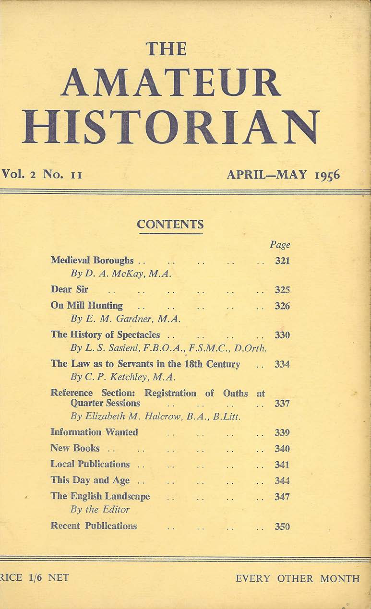
Contents
Medieval boroughs Show more
By McKay, D.A.
pp 321-325
Introduction to the source material which may be available for the study of medieval boroughs. The article covers the following major categories of records: Anglo-Saxon charters and other pre-Conquest material; Domesday Book; medieval charters and the charter rolls; quo warranto proceedings; fine rolls; inquisitions post mortem; inquisitions ad quod damnum; parliament rolls; patent rolls; town chronicles; municipal charters of all types; local court records; guild records; assembly books; and municipal accounts (of different officers). There is a translation of the charter granted by Henry II to Cambridge (1185) and suggestions for further reading.
On mill hunting Show more
By Gardner, E.M.
pp 326-329
Short article which suggests that the search for old watermills is a 'delightful hobby' and then explains some of the more useful documentary and other sources which might be used. These include old maps, the first edition of the one-inch OS map, tithe maps, and six-inch maps; directories; printed histories; transactions of local historical societies; medieval rolls and feet of fines; and the archive collections of local record offices and the Public Record Office ('very difficult for beginners'). Finally, it is suggested, conversation with living millers, and old drawings and prints, may help.
The history of spectacles Show more
By Sasieni, L.S.
pp 330-333
General account of the history of spectacles in Europe from the 13th century, with emphasis upon the library and museum collections of the British Optical Association in London. The article discusses the styles in which spectacles were made and the wide range of materials which were used. Reference is made to the organisation of the spectacle-making trade and to the absence of detailed knowledge about many of the processes involved until relatively recent times.
The law as to servants in the XVIII century Show more
By Ketchley, C.P.
pp 334-336
A useful summary of the legislation in force during the 18th century governing the rights, conditions of service, hours of work, remuneration and other employment matters concerning servants, including apprenticeship and craft regulation where it impinged on this area. It includes discussion of: servants engaged in trades; servants in husbandry; penalties for those who infringed the regulations and those to be exacted for servants who offended; maltreatment of servants; and regulation of specific trades. The article concludes with a transcript of a 1727 document from Bitton, Gloucestershire, which does not appear to be of much relevance to the rest of the discussion (see also 02 09 268-270; 02 10 309-311; 02 12 357-361).
Registration of oaths at Quarter Sessions: a new source for genealogists and ecclesiastical historians Show more
By Halcrow, Elizabeth M.
pp 337-339
A summary description of the main legislation governing the oaths which were required from the reign of Charles II onwards, to uphold the Church of England and to prevent Catholics and nonconformists from holding public office. It is suggested that these have a considerable value for a wide range of historical research. The article lists the legislation and notes the main provisions and intentions of each Act of Parliament. It provides a very useful synopsis of the legislation concerning oaths between 1673 and 1858, and concludes with a brief reference to several published lists and calendars.
[Hide]

Hugo Javier Freitas


Laura Yeoman