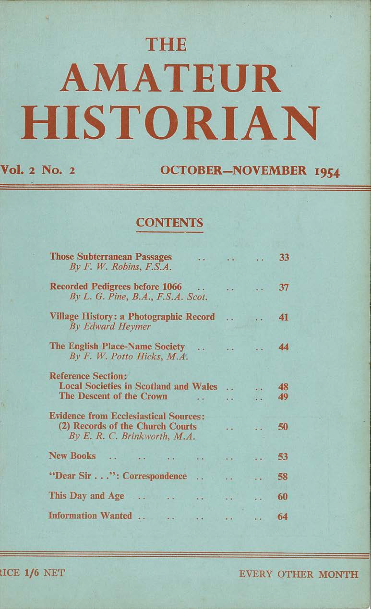
The Amateur Historian Volume 2 Number 2 October November 1954
Contents
Those subterranean passages Show more
By Robins, F.W.
pp 33-36
Beginning with an entertaining account of some of the well-known historical myths, and especially that of secret tunnels and passages (including one said to be 21 miles long) the article discusses the genesis of these very widespread and persistent legends, and debunks most of the features which are commonly associated with the stories. The true explanations - drains, sewers, water-supply conduits, cellars and undercrofts - are noted.
Recording pedigrees before 1066 Show more
By Pine, L.G.
pp 37-40
Demolition job on pedigrees of families noble and ignoble which claim to have traceable ancestry back to pre-Conquest and even Roman times. Pine effectively refutes most such instances and suggests that, apart from the royal lineage, there are only half a dozen or so genuine examples.
Village history: a photographic record Show more
By Heymer, Edward
pp 41-43
Discussion of the value of photography in recording aspects of local history: i) photographs of buildings, landmarks and street scenes; ii) indexing and captioning pictures; iii) equipment for picture shows; iv) exhibitions; v) collecting old photographs; and vi) photographs of documents and other historical items.
The English Place-Name Society Show more
By Hicks, F.W. Potto
pp 44-47
The EPNS was established in 1923 and the article discusses its progress in the following thirty years, covering its aims (notably, ensuring the highest possible standards of scholarship in place-name interpretation, and rejecting the amateurish and 'guesswork' approaches which previously were well-nigh universal); the publications' series of the Society, including the county volumes; the relationship between place-name studies and the history of counties and localities; and the importance of charters.
Records of the Church courts Show more
By Brinkworth, E.R.C.
pp 50-53
The second in the series 'Evidence from ecclesiastical sources' discusses the archdeacons' courts, which Brinkworth considers to be the most numerous and most accessible in terms of records, though he notes that archbishops, bishops and (for a time) rural deans also held courts. The procedures for the courts are described in detail, and there is a full account of how a court actually functioned. The nature and process of punishment is discussed and the article covers the main types of records generated by the courts, and in particular the Act Books. A series of examples from the 1584 Act Book of the Archdeaconry of Oxford illustrates the range and diversity of subjects and issues with which the courts dealt or claimed jurisdiction. These include slander, minor offences of violence, and misbehaviour in church and churchyard. It is noted that some offences, such as those to do with marriage, defamation, wills, tithes and dilapidations, were dealt with by different and more formal procedures, and produced libels, allegations and depositions. The article also considers faculties and other matters internal to ecclesiastical administration. A brief bibliography is given (see also 02 01 19-22; 02 03 82-86)
[Hide]

Hugo Javier Freitas


Laura Yeoman