The Amateur Historian Volume 3 Number 1 Autumn 1956
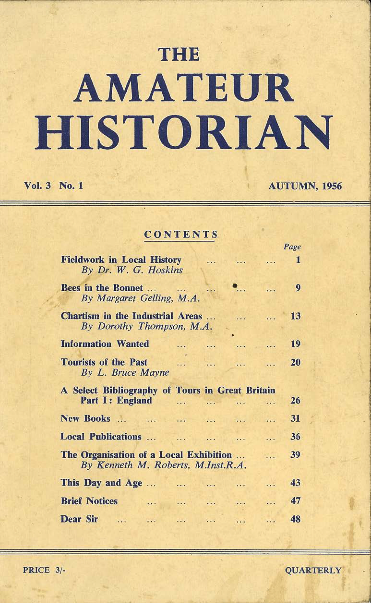
Contents
Field work in local history Show more
By Hoskins, W.G.
pp 1-8
The only article in The Amateur Historian or Local Historian by the man who has become identified as the founding father of modern local history. Hoskins makes the case for more intensive use of fieldwork in local history, and suggests a number of areas where fieldwork can be of special importance. These include investigations into the Roman period (he suggests that many more major sites await discovery); Saxon boundaries, especially when these can be examined in conjunction with charters and tithe maps; medieval sites, especially the existence of deserted villages (which were then just being recognised as a key feature of rural archaeological and landscape research) although the author recommends that any excavation should be handled by experts; local rumour and myth, such as monastic sites and underground passages; medieval park boundaries; buildings - the author suggests that fieldwork should always start with a simple inventory of buildings and features; and headstones.
Bees in the bonnet Show more
By Gelling, Margaret
pp 9-12
A study of a variety of popular but erroneous historical 'delusions', with words of caution for the researcher. The author quotes the well-known example of Alfred Watkins and his book The Old Straight Track, dealing with ley-lines - the assertion that long cross-country alignments between ancient sites were prehistoric trackways - and points out cogently the fundamental weaknesses of these arguments. Other examples quoted include attempts to show that the Romans divided the country into large rectangular blocks (centuriation) and variations on the famous but implausible Glastonbury legends. In all cases, she argues, solid evidence is either lacking, is wildly exaggerated, or is simply unsound.
Chartism in the industrial areas Show more
By Thompson, Dorothy
pp 13-19
In this study of the history of Chartism, the author suggests that investigations at local level can greatly help in understanding the national picture. In particular, detailed research into specific Chartist events, activities and personnel in individual communities or districts is shown to be of value, as is a study of the allies and supporters of the movement, which can highlight regional factors in success or failure and bring to the fore the possible economic and social influences. Links with other movements are highlighted, including trade and labour organisations and temperance and nonconformist groups. Thompson suggests a methodology, and points to several key sources: the records of local industry; local newspapers and Home Office files; Chartist broadsheets and papers; judicial records (since many Chartists found themselves in court); and personal papers such as diaries and autobiographies.
Tourists of the past Show more
By Mayne, L. Bruce
pp 20-31
In this description of the records kept by travellers in Britain since the 12th century, the author lists and comments upon a number of these accounts in more detail and discusses the contents and potential value of such sources for local history, architecture and topography. The article concludes with a useful bibliography.
The organisation of a local history exhibition Show more
By Roberts, Kenneth M.
pp 39-42
Account of the planning and implementation of a local history exhibition in Greenwich and Lewisham.
[Hide]

Hugo Javier Freitas


Laura Yeoman