The Amateur Historian Volume 3 Number 7 Spring 1958
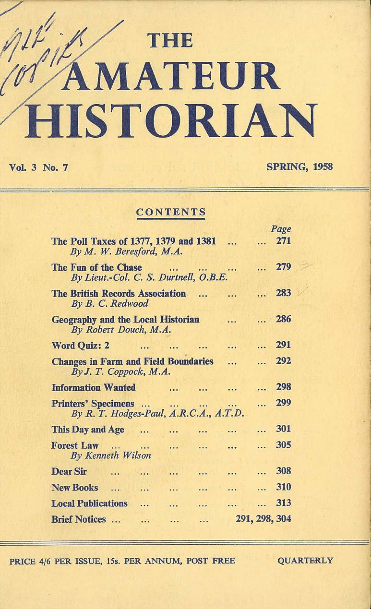
Contents
The poll taxes of 1377, 1379 and 1381m Show more
By Beresford, Maurice W.
pp 271-278
An important account - part of a series of articles on medieval population and tax sources - of the documentary material which relates to the 'flat rate' poll tax of 1377, by one of the leading local and economic historians of the second half of the 20th century. Beresford discusses the survival of these tax receipts; explains the structure of the documents; and discusses techniques for deciphering the text. He suggests that these resources are especially useful in population studies, although as the tax was not applied to those under the age of 14 or to beggars, and there was a certain amount of evasion, the researcher must be cautious in applying the evidence. It is emphasised that a comparative approach is more useful than studies of individual communities, but that much can be deduced about relative population densities, especially in comparing rural and urban areas (see also 03 08 325-328; 04 03 101-109).
The fun of the chase Show more
By Durtnell, C.S.
pp 279-282
Account of practical experience of genealogical research, based on a case-study of the origins of the surname Durtnell. The author describes the process of locating variations of the name in the Kent area, using parish registers, manor court rolls, probate records, title deeds, militia records and parochial accounts, in local record offices and archive repositories.
The British Records Association Show more
By Redwood, B.C.
pp 283-285
Introductory account of the origins of the British Records Association and the work which it does in helping to save and house archive collections.
Geography and the local historian Show more
By Douch, Robert
pp 286-291
Examination of the significance of geographical factors in the development of patterns observable in local history research. Douch refers to various factors which have influenced patterns of settlement, including rock structure and its impact on building styles and architectural industry; relief and its consequences, such as the significance of natural barriers, the growth of communications patterns, and the location of settlement; drainage, since the availability of water is a crucial factor in determining settlement location; climate, especially micro-climates which may have influenced the siting of farms; and soils and vegetation and their effects on agricultural activity. The author recommends the use of maps for further study and provides a specialist bibliography.
Changes in farm and field boundaries Show more
By Coppock, J.T.
pp 292-298
Review of the study of farm and field boundaries and changing patterns of farming. Field-sizes have tended to increase over time but there are considerable regional differences, and many examples can be found of fields that appear to have changed little since medieval times. Evidence may be derived from fieldwork and the patterns surviving 'on the ground', as well as from estate and enclosure maps. Tithe maps and early Ordnance Survey maps are perhaps the most accurate, although there is little detail on the precise character of boundaries and even less on farm (as opposed to field) boundaries. For these aspects, other sources are required to substantiate conclusions. The author comments on the variable quality of estate records and sale catalogues, and suggests methods for attempting to reconstruct farm boundaries. Finally, he discusses the social effects of these changes.
When they celebrated May-Day Show more
By Hoppé, E.O.
pp 298-299
Brief study of the May Day holiday and the traditional celebrations held on that occasion in various parts of the country: at the time of the article's appearance this holiday had long since lapsed.
Printers' specimens Show more
By Hodges-Paul, R.T.
pp 299-300
Short article on printers' specimens, which were the sample copies of work retained by local printers as part of their working 'archive'. This potentially rich resource is, should it survive, useful for a wide range of research into local history topics, because the specimens often include ephemera relating to the day-to-day activities of organisations - for example, business and commercial labels, school brochures, society publications, and church notices.
Forest law Show more
By Wilson, Kenneth
pp 305-307
An account of the development of 'forest law', which was enforced in areas usually (but by no means always) of sparsely populated land appropriated by the king or great nobles for hunting and the protection and preservation of game. Fines for agricultural encroachment and for harrying deer were especially heavy, but although they suffered considerably from the burden of these laws the forest dwellers also had a range of specific rights and privileges. The article explains 'keyhole tenure' - if a man could build a new dwelling in the forest between sunrise and sunset, and have a fire going in the hearth, he could settle there with full rights. Wilson refers to evidence for the existence of these dwellings. Reference is also made to the administration of the forests and to the complex arrangement of forest courts, and suggestions for further investigation are given.
[Hide]

Hugo Javier Freitas


Laura Yeoman