The Amateur Historian Volume 4 Number 3 Spring 1959
Contents
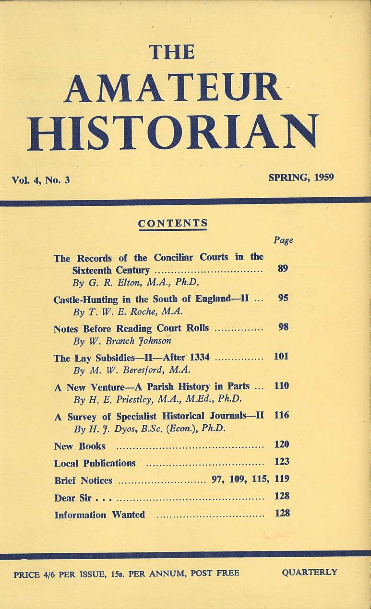
The records of the conciliar courts in the sixteenth century Show more
By Elton, G.R
pp 89-94
Introductory account, by one of the foremost constitutional historians of the 20th century, of the major Tudor courts: chancery, star chamber and requests. The article describes in detail the processes of medieval and 16th century legal practice and explains which categories of documentary records survive from the period. Elton also comments on the technical difficulties of interpreting these sources and indicates their potential value for the local historian.
Castle hunting in the south of England - II Show more
By Roche, T.W.E.
pp 95-97
The second article on the subject, comprising a bibliographic guide to English castles, including castle histories, and archaeological guides to ruins (see also 04 02 62-65).
Notes before reading court rolls Show more
By Johnson, W. Branch
pp 98-100
Introduction to the basic procedures for using court rolls, emphasising the way in which these important manorial records give information on the occupation, ownership and tenure of property. This coverage includes the use of legal Latin; possible incompleteness of records; details of the descent of property and the use of plans; the location of common fields; the appointment of officials; extracts from wills; and ancient customs and their influence upon procedures.
The Lay Subsidies (Part II) Show more
By Beresford, Maurice W.
pp 101-109
A more detailed discussion of the post-1334 taxation system (see also 03 08 325-328) in which taxable wealth was in the form of lay subsidies, whereby communities were assessed by a quota system, rather than by individual land ownership. This system changed little between the 14th and 17th centuries, but there were some further developments and refinements including i) efforts to obtain relief in times of economic hardship were accepted but some places attempted to use this method to evade taxation; and ii) attempts by the state to increase income to pay for increased expenditure led to attempts to modernise the system. Henry VIII sought to collect a new subsidy by assessment of property value, income or wages - this became more difficult to collect as assessors became more reluctant to carry out fresh valuations (see also 03 07 271-278; 03 08 325-328).
A new venture - a parish history in parts Show more
By Priestley, H.E.
pp 110-115
Account of the publication of a local history booklet, detailing the history of Upminster, Essex.
A survey of specialist historical journals - II Show more
By Dyos, H.J.
pp 116-119
Article, forming part of a short series on specialist journals, which reviews the approach and content of The Journal of Transport History, with commentary on its potential usefulness to the local historian.
[Hide]

Hugo Javier Freitas


Laura Yeoman