The Amateur Historian Volume 5 Number 8 Summer 1963

Contents
Local history in Czechoslovakia Show more
By Munby, Lionel M.
pp 247-250
Report on the state of local history in Czechoslovakia which begins by emphasising the importance of national identities and distinctive cultures - Bohemian, Moravian and Slovak - and the post-1945 reassertion of these characteristics after the German occupation. The article discusses the organisation of archives and the structure of research and investigation in the Communist era, and the consequent attention paid to modern local history. Archive use is rendered difficult by the multiplicity of languages and scripts in use before the late 19th century (for example, all official records in Slovakia were in Latin until 1848). The organisation of local history societies, educational use of local history, and the recognition of the importance of the subject in the conservation and restoration of historic sites are described.
A guide to Ordnance Survey maps as historical sources: IV The town plans and small-scale maps of England and Wales Show more
By Harley, J.B.
pp 251-259
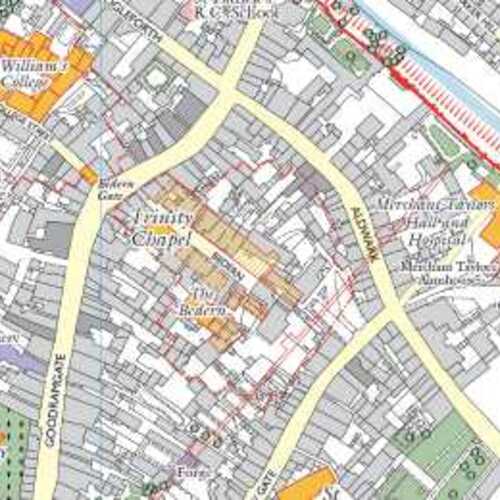
In the final article in the series, Harley discusses the very large-scale plans of English and Welsh towns. These are at scales of 1:1056 (5 feet to 1 mile), 1:528 (10 feet to 1 mile) and 1:500 (10.56 feet to 1 mile) and originated in the early 1840s with the 1:1056 survey of all towns with a population of more than 4,000 and lying north of a line from Preston to Hull. Artistically these are possibly the finest of all Ordnance Survey maps. The series was abandoned in the mid-1850s and replaced by a new survey at 1:528 scale, required for the new sanitary and urban improvement works. This, too, was soon abandoned (after a few towns in the north-east had been surveyed) and a third scale, 1:500, was substituted: eventually over 400 towns and cities were surveyed at this scale - for some this meant huge numbers of sheets (e.g. Manchester 262 and Nottingham 352). These maps are exceptionally detailed, showing the internal layouts of many buildings, and are an unrivalled source for the urban historian. The article reviews the special case of London, with its very large and numerous sheets at 1:1056, and also describes the post-1911 town plans produced for many communities, normally at the request of and expense of the local authority which required such a plan for a specific purpose. In the concluding section the article notes the miscellany of small-scale maps produced by the Ordnance Survey, including quarter-inch (1:253,440 or 1:250,000) and the short-lived half-inch series; the 1:625,000 maps; and various maps for special purposes, such as the county administrative diagrams. The article is illustrated with four plates showing extracts from the types of maps considered (see also 05 05 130-140; 05 07 202-211).
The unprinted census returns of 1841, 1851 and 1861 for England and Wales Show more
By Beresford, Maurice
pp 260-269
A detailed explanation of the content and historical value of the census enumerators' returns for the successive censuses 1841-1861, published at a time when this material was just becoming accessible to local historians. The article describes the procedure for taking the censuses and then discusses the layout and content of the manuscript returns, listing the information which is given and going on to suggest ways in which that information may be used. Among the topics for research which are noted are: genealogy and family history; the history of houses and streets; household composition; servants; multiple occupation; migration; and the occupants of institutions of all sorts ('revealed by the Registrar General's all-seeing eye'). There are instructions about using the census and locating it in the Public Record Office, notes on street indexes then available, and the practicalities of using the manuscript schedules in the days before they were microfilmed.
[Hide]

Hugo Javier Freitas


Laura Yeoman