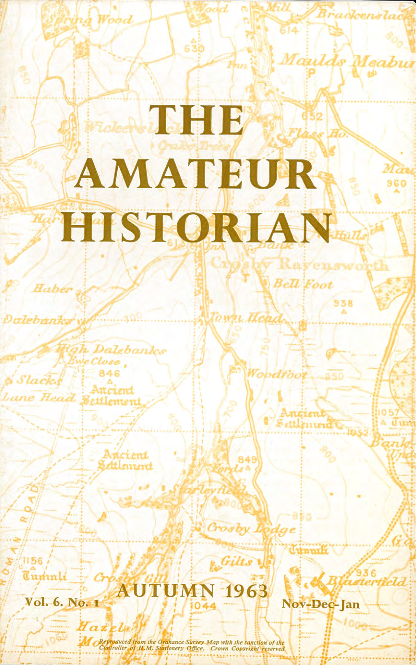
The Amateur Historian Volume 6 Number 1 Autumn 1963
Contents
Numismatics and local history Show more
By Whitting, Philip
pp 2-7
Discussion of the role of coinage and numismatic studies in local history, including local trade tokens. Tokens were produced in very large numbers in the 17th century, and there were many regional and local producers; they were originally used as 'small change', but were minted in larger denominations throughout the 18th century. The author comments on the various designs which are often encountered, and also considers the types of coins which may be found in hoards, which may have been hidden for many years and occasionally contain foreign currency. Commemorative medals are also noted.
Inland waterways: some sources for their local history Show more
By Duckham, Baron F.
pp 8-10
A review of the sources which are available for research into inland waterway history, including i) the parliamentary process and the Acts which established the canal companies; ii) the minute books, account books and other administrative records of the companies themselves; iii) the local newspapers, including the use of advertisements as a source of information; iv) official and government reports; and v) the records of railway companies, since many waterway undertakings were eventually bought by railway companies.
The use of local history: some comments Show more
By Marshall, J.D.
pp 11-17
The author suggests that although to many of those engaged in local history research it is clearly a serious 'leisure' activity, many academics now seem to suggest that local history is potentially a serious academic discipline. The author feels that the nature of the subject should encourage the development of a more liberal cross-disciplinary approach to local history research and analysis, and that in the process the existing trend towards the creation of distinctive identities and techniques might be facilitated. The poor reputation of the local historian is due in part to the antiquarian 'collector' attitudes of the past, which have resulted in a neglect of more problem-solving techniques. Data collection, Marshall argues, is no substitute for the creative study of people. He proposes i) the integration of general historical study, or possibly regional history, into local history teaching; ii) group research into limited themes; iii) co-operative research; and iv) more emphasis on regional studies.
Some sources of inn history Show more
By Johnson, W. Branch
pp 18-21
A methodology for the study of the history of inns and alehouses, focussing on the alehouse licensing procedures and documentation in the period before the mid-19th century. Johnson highlights the difficulties which will probably be experienced in tracing any records relating to individual inns, because of the problems of name changes and name duplication, and he suggests that inn signs do not constitute a reliable indicator. A list of possible sources is given.
The history of local theatres Show more
By Tapper, Oscar
pp 22-24
Study of provincial and local theatres in which there is extensive discussion of the source material which other historians can use for similar investigations and case studies. The sources identified include: i) local newspaper advertisements and professional newspapers - these allow detailed reconstructions of the run of plays performed at a local theatre; ii) the writings of drama critics and review columns in newspapers; iii) theatre licensing records; iv) playbills, programmes and related ephemera; and v) the holdings of local museums. The author suggests ways in which research can be undertaken and themes which could be pursued by local historians.
[Hide]

Hugo Javier Freitas


Laura Yeoman