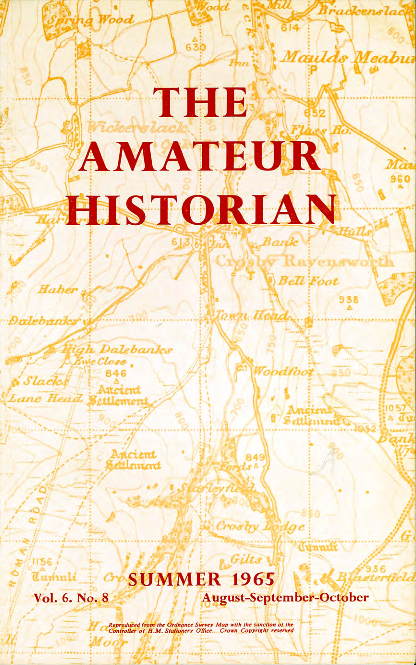
The Amateur Historian Volume 6 Number 8 Summer 1965
Contents
Documents in the Public Record Office: 3. the early Chancery proceedings Show more
By Fines, J.
pp 254-259
This article deals with the medieval records of the Court of Chancery. The proceedings of the court originated and developed in the 14th century as a medium for dealing with cases not catered for by Common Law, or in instances where there was unfair advantage against the plaintiff. Surviving records generally include pleas made to the Chancellor and provide a rich resource for information on social trends and economic activity. The range of cases is almost infinitely varied and among many categories of information may be found i) religious cases, such as those dealing with the unacceptable or illegal behaviour of parochial or monastic clergy, and with attacks upon or accusations against the clergy; ii) education, including evidence for the financing of private and university education; iii) trade and business cases, such as those which detail disputes with foreign merchants; iv) disputes over land and property, and the extensive records of litigation over inheritance and ownership; and v) disputes between craftsmen and artisans, and labourers, over wages, apprenticeships and other economic and social issues.
The use of local history: the position of the antiquarian Show more
By Cox, David C.
pp 260-261
A response to the debate in local history, and in the pages of The Local Historian, on the role and approach of so-called 'amateur' and 'professional' historians. The author defends the antiquarian, defining him or her as a locally-based and therefore resident expert on the history and features of a locality, who has probably very little relevance outside the community but is important within it.
Local history in Norway Show more
By Fladby, Rolf
pp 262-266
Review of the state of local history research and resources in Norway, dealing with the organisation of the subject in local communities, the level and extent of state or local government involvement, the importance of local history in education and a summary of the main archival and library networks in the country.
Maker of hiding places Show more
By Walker, Peter
pp 266-269
A study of the persecution of Catholics in the mid-16th century, and the efforts which were made to protect the Catholic priests, particularly in the building of hiding places in larger homes. Hiding a priest was punishable by death and searches were frequently made, so hiding places had to be extremely well-concealed and imaginative solutions were sought. Nicholas Owen, a Jesuit, was widely regarded as an expert maker of hiding places, although he was captured during the aftermath of the Gunpowder Plot of 1605.
English villages in the 18th and 19th centuries: a sociological approach Part I, The concept of a sociological classification Show more
By Mills, Dennis
pp 271-278
The author's study of villages in Lincolnshire, Leicestershire and Cambridgeshire is used to propose the adoption of a sociological approach to the study of rural communities. Mills divides villages into two major categories. The first is the classic closed villages, which were dominated by a local landlord, who owned at least half of the land in the village. He argues that these villages, with their characteristic 'estate' plan and appearance, were part of a pattern which survived at least until the end of the 19th century. Mills uses 'sociograms' to show the make-up of an estate village, and suggests that tenant farmers were the key element in the successful management of these estates. Other important social groups included estate servants and labourers. The second category identified by Mills was the open village. These tended to be much larger in population and were mainly freehold communities, where a large number of individuals farmed smaller acreages. These places also had more traders and craftsmen. Free of domination by the gentry, their inhabitants were more likely to express independence of thought, a phenomenon frequently reflected in the growth of nonconformity and in the emergence of self-help societies (see also 07 01 7-13).
[Hide]

Hugo Javier Freitas


Laura Yeoman