Local History News Number 160 August 2026
Contents
John Smeaton and the failure of the York Waterworks company 1779–92 Show more
By Steve Barrett
The origins and history of York’s water companies have been told in a number of books and articles over the years but I especially commend the article written in 1966 by Jeffrey Radley in his ‘York Waterworks and other waterworks in the North before 1800’ which thoroughly details the technical improvements implemented by the famous engineer John Smeaton.[1]
This article seeks to tell the story of the company during Smeaton’s tenure and his attempts to improve water supply by applying his engineering skills to the process.
In October 1779, with four other men, including the deputy high sheriff of Durham, Jerom Dring, Smeaton purchased the private waterworks company in York for £7000.[2] The new owners, together with a merchant, Michael Eastburn, engineer John Holmes and watchmaker William Clark, collectively agreed to both purchase and improve the supply of water to the city’s inhabitants. Smeaton and Holmes had already worked on previous waterworks in London. Smeaton was 55 years old at the time.
Despite the state of water supply in York, things were really no better in other local towns at that time. In Hull for example, it was not until 1795 that James Watt was employed to erect an efficient steam engine to raise water from the local Spring and Bush dykes from a newly built waterworks on the aptly titled Waterhouse Lane. Traditionally horses had worked the pump supplying water through wooden (elm) pipes to the growing industrial town.[3]
In the expanding town of Leeds, it was not until 1834 that a systematic plan for supplying water was implemented. The town engineer, Mr J. Chiesman, published ‘A brief review of plans for better supplying the town of Leeds with water’. Various plans had been formed over the years, but the council had seemed incapable of reaching a decision about what was the best method of supplying water. There were even implications of municipal corruption relating to the appointment of the town engineer. Chiesman was eventually appointed. It was agreed to build a series of reservoirs, including sites at Headingley, Thorner and Eccup. Gravity and steam power, through iron pipes, were now going to supply the townspeople with filtered water.[4]
Upon arrival in York, Smeaton was keen to improve the steam engine powering the supply of water from the river. His immediate action was to replace the iron boiler of the engine with a copper one. In as early as November 1779, experiments were taking place at the waterworks. These were in regard to the consumption of Allerton colliery coals and the results were positive with further orders placed with the colliery. The location of the pit meant that coal barges could travel to the waterworks, landing on the Ouse. There were however no plans to replace the wooden pipes which supplied the water under the city streets.
Despite Smeaton’s infrequent attendance at board meetings, the operation of the company was often completely deferred to him. The improvements were crucial as the existing infrastructure was proving to be both inefficient and wasteful.
Existing water pipes often did not produce an effective flow and where this was the case it was stated that ‘the pipes should be taken up’.[5] Theft of water from the standpipes was common.
By November 1780 a thorough survey of the whole network and working practice of the company was carried out by Holmes. His conclusions were shocking. The state of the water supply was clearly desperate throughout the city. Holmes had spent over 12 hours one day in November simply observing the Coney Street main pipe malfunctioning. It ‘ill performed partly owing to the wasts on the main and partly owing to the narrowness of some of the service pipes’.
Perhaps conscious of his stinging criticism of the water supply at the time of his investigation, Holmes made reference to the improvements made by Smeaton’s engine in drawing water from the river so quickly – ‘this improv’d engine which went well at 15 strokes per minute being four more strokes than its usual rate before the improvements’. Nonetheless, sediment was deposited everywhere. The only places with a decent service, Holmes concluded, were where the ‘declivity of the ground gave them that advantage’.
This really meant the use of gravity and harked back to 17th-century methods. His solution was threefold: dropping the mains pipes to get a stronger flow, utilising the power of gravity and also to ‘keep no more of the service pipe open than will take off the water that the engine raises and keep the reservoir as full as it can be’. Above all, the pipes must be regularly cleared of accumulated debris, ‘to stop them being choaked (sic) before the end of winter’.
There was a profound need to remove ‘ill judged practice’ and ‘misleading’ reports from the company workers.
The labourers from what I saw are either of them capable of making a change. It is needless to have three men employed – one to work the pick, another the spade and other on the pipes when by such practice two of them for the most part of the time must be unemployed.
Company secretary Thomas Petch was given a raft of orders upon his appointment – he had responsibility for rent collection, checking on the labourer’s progress and reporting to the committee every Monday morning. Petch was also tasked with producing a timetable for the customers to know ‘when the water is to be expected and when it will cease’.
Then, in December 1780 the focus of company concern became the steam engine mechanic, John Maidman:
Whereas there has been great neglect in the service of the town for want of due attention of John Maidman – the engine keeper in respect to working the engine it is ordered that any neglect of duty without any remission or stoppage will be made from his wages as the committee think proper… The cistern must be left filled every night with water under the like penalty… Labourers will lose their pay if they lose their tools.[6]
There were frequent breaches of the network still occurring, ‘which should be properly looked at when time will permit’.
The system was creaking and the company found itself unable for one reason or another to respond efficiently to the situation.
There were faint signs of progress and expansion however, with the Justices of the Peace requesting supply of water to York Castle prison in August 1781.
Personnel issues still continued to dog the company and in September 1781, a year after his first severe warning, the directors had had enough of John Maidmen, who:
is found frequently incapable by his intemperature in performing his business have this day come to a resolution to discharge him from their service finding all arguments and persuasion to reform in his conduct fruitless have consequently discharged him.[7]
It made little difference.
Very little was effective in stopping the theft of water from the water pumps and even 20 years later, the minutes of the Greycoat School in August 1801 recorded:
The door into Mr Bilton’s garden being forcibly opened by his order for the purpose of procuring water from the school pump – the Ladies after finding from Mr Jamieson that he (Mr Bilton) had no right to claim that privilege – ordered an iron bar and padlock to be put to the door to prevent it being opened.[8]
The first mention of using iron pipes rather than wood was in September 1782 with the replacement of the lead pipes at Ouse bridge organised by John Smeaton personally ‘freeing the arch from the danger of frequent digging and working thereupon’.[9]
These iron pipes were to be supplied by the Spence and King foundry at Hull – a joint venture by John Spence of York and Samuel King of Hull.
By August 1784 the process of replacing the old Newcomen boiler was begun, described in detail in Radley’s article. From the outset of the installation of the new boiler there was a dramatic rise in the power of the steam engine, drawing water from the river and then through a waterfall process pushing it through the pipes around the city.
However, within a few weeks of the new engine installation, the pipes were causing problems again:
The frost seeming to set in hard and many complaints having been made of lead pipes being frose it is ordered that standpipes be occasionally put in where it shall be thought to be most convenient. Also ordered that the pumps be diligently applied to the drawing of the water from standing in the wood pipes and running the chance of freezing there and stopping the course of the water.[10]
Lead continued to be used at the external point of the standpipes. There was no mention of filtration of the water from the river although there was a celebration held in 1785 with the lord mayor present, of the installation of ‘fire plugs’ along the network to help deal with outbreaks of fire.
Minor improvements were being made to the system. In 1786 it was ordered that Thomas Bradley (the blacksmith used by the company) have a present given him of two guineas for his ‘ingenuity in inventing a cock to prevent the wasting of water coming into people’s houses’.
Problems continued however and in July 1787 the pipes over the bridge at Fossgate ‘are shaken and out of repairs therefore ordered that the said trees be relaid’.
At this point, it may all have been too much for an ailing, celebrated engineer like Smeaton with a national reputation to preserve.
By March 1788 he had decided to sell some of his shares in the company to John Holmes, William Clarke and Michael Eastburn Junior, at £400 a share. In July 1792 Smeaton attended his last general meeting where it was reported that the company had the sum of £135 in the bank. He died the same year.
Smeaton’s legacy was quickly forgotten in York. Even 40 years later things were little improved.
In the book Ups and Downs of a Blue Coat Boy the anonymous author, born in 1815, reflecting on his school days in the early part of the 19th century described the water supply in York at that time. Wooden pipes still transported the bulk of the water supply, though planning to replace them with iron pipes of larger dimensions was under way. Even in the 1830s, he described the drinking water as ‘wretched’:
I have seen the water as it came from the tap as thick and muddy as if it were taken from a brickyard pond after six or eight lads had been bathing in it.[11]
The improvement of water quality still had a very long way to go.
Steve Barrett is a local historian and committee member of York and District Family History Society. He is also a member of the BALH Outreach Team.
1 Radley, J., 1966. ‘York Waterworks and other waterworks in the North before 1800’, available in the Borthwick Institute, University of York.
2 ‘Minutes 28/8/1780’, YWC 1/1/1 Smeaton Minute Book, 1779–94. Borthwick Institute.
3 Hull Corporation Water Department, 1947. ‘Kingston upon Hull water undertaking 1447–1947’, Minster Library ref: YMLSc5-2-5-5.
4 Chiesman, J., 1834. ‘A brief review of plans for better supplying the town of Leeds with water’, Minster Library YML Sc6-1-2-253.
5 ’Minutes 4/12/1780’, YWC 1/1/1 Smeaton Minute Book 1779–94.
6 Ibid.
7 ‘Minutes 28/8/1780’, YWC 1/1/1 Smeaton Minute Book, 1779–94
8 YCT/GCS 1/1/1 p.135. YCT/Greycoat School Archives CS 1/1/1. Borthwick Institute.
9 ‘Minutes 28/8/1780’, YWC 1/1/1 Smeaton Minute Book, 1779–94
10 ‘Minutes 13/12/84’, YWC 1/1/1 Smeaton Minute Book 1779–94
11 Ups and Downs of a Blue Coat Boy. London, 1876. Copy at Borthwick Institute, p.57.
Riots: a rich source for local historians Show more
By Barry Shurlock
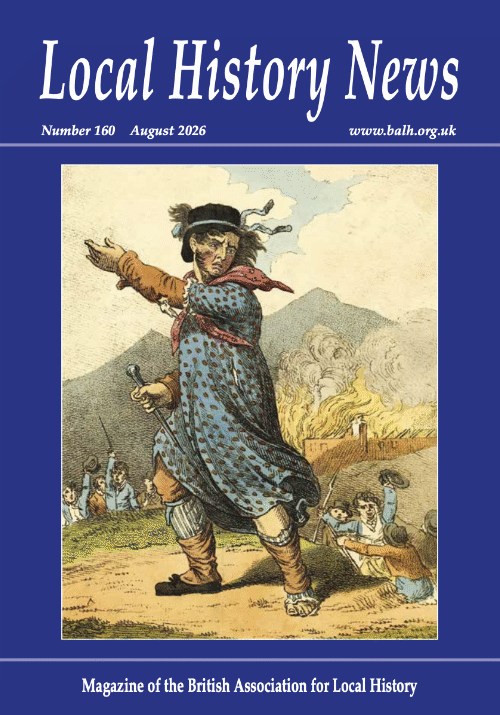
The common practice of turning discontent into protests, demonstrations, riots – and even outright violence – is a fact of life. Lists of riots demonstrate that disturbances of many different kinds have occurred in all periods. Some have become common knowledge – such the Peasants’ Revolt 1381, Peterloo 1819, the Luddites 1811–17, the Swing Riots 1830–31 and suchlike. But any list will also include many that most people have never heard of. And these are almost all of considerable value to the historian seeking to open a window on a community.
In terms of violence, the riot is on a spectrum that extends from discontent to war, with intermediates that include petition, peaceful protest, violent protest and even conflicts of armed groups with authority. All these kinds of disturbance have occurred repeatedly in the past, perhaps with a downward trend in violence, at least in Britain. They are a natural part of political life, even though many believe that the more violent types of action should never be invoked in pursuance of a cause.
One of the most extraordinary features of riots is that they impinge on many areas – not only, of course, government, law and party politics, but also religion, industry and trades unions, technical innovation, national economics, and the works of thinkers and commentators. Because a riot is almost by definition newsworthy, there are many associated sources that provide a window on life at the time, as well as court records, all of which help to understand people’s feelings, opinions and modes of living.
To take one example, in 1600 the undersheriff of Hampshire went to the small town of Whitchurch in the company of a creditor who sought repayment of a debt from a local farmer. As this was not forthcoming, the undersheriff and his men looked around the farm for goods to take in lieu. They first thought of taking horses, but the farm labourers ganged up in defence of their employer’s property, armed with a pronged fork and a pikestaff. The undersheriff then went after a small herd of cattle, whereupon the farm workers once again went on the defence, armed with billhooks. An almighty affray got underway, with the creditor’s men on horseback wielding rapiers. There is much more to this story – the main point beings that it paints a picture of a working farm and debt collecting at the turn of the 17th century that would be hard to find elsewhere.
Another twist in the Whitchurch saga is that charges of riot were brought before the Court of Star Chamber and its judgement became a legal precedent for the technical issue of ‘fraudulent conveyancing’. Known as ‘Twyne’s Case’, it became part of law in the USA after independence and is still cited there. A huge amount about Whitchurch at the time can therefore be found in an 84-page paper on the subject by Emily Kadens published in the American Bankruptcy Law Journal.
This is just one example of a rich tapestry of riots that occurred almost everywhere at all periods. Lists include one in Haydn’s Dictionary of Dates (in my edition of 1868 it runs to a page and half of small type, with many individual entries) and Wikipedia’s ‘England Riots’ and ‘Riots and disorder in England’. Late medieval riots were especially violent. In 1221, for example, Londoners trashed a convent, apparently because they objected to the privileged lives of the nuns: the ringleader was hanged and others had hands and feet cut off. And in 1262 there was a riot between apprentice tailors and goldsmiths, vying for patronage – perhaps the equivalent of a punch-up down the pub – except that on this occasion several young men were killed and 13 hanged.
As might be expected, Ireland was ripe for riot, verging on war – and no wonder, the Irish hated their Protestant colonial landlords, despised the Reformation, and were often stalked by starvation. In Dublin alone between 1724 and 1735, for example, there were some half a dozen riots a year and in 1798 the country saw a full-blown insurrection, almost a revolution, led by the Society of United Irishmen. It failed.
The early 1700s were a particularly riotous time in England, with the country under a Whig government tolerant of dissent. During a riot of 1710, mobs of Anglican Tories trashed nonconformist meeting houses, after an Oxford clergyman, Dr Henry Sacheverell, had been impeached for preaching against the government. The riots were a great success for the Tories, who gained a landslide victory in the general election later in the year. Then four years later came the Coronation Riots, protesting at the accession of a German king.
These and other violent disturbances in the early 1700s led the returned Whig administration to pass the Riot Act of 1714. For groups of more than a dozen it required an official, such as a JP or mayor, to ‘read the Riot Act’. Anyone who failed to disperse after an hour was guilty of a capital offence. Authorities could even lawfully kill people who failed to move off, as happened at Peterloo in 1819. Essentially, the Riot Act allowed authorities to decide when a disturbance constituted a riot, though it was largely ineffective. Serious disturbances continued, such as the no-holds-barred fight between Jacobite Tories and Whigs in the Mug-House Club off Fleet Street – so-called because each member had his own tankard.
In the early 1800s, the government was increasingly concerned with large crowds as more and more people moved into towns. Fearful of the equivalent of the French Revolution, they used the law and crowd control to hinder political reform. One measure was the founding in 1829 by Robert Peel of the Metropolitan Police, to improve crowd control using professional agents rather than the militia. It was an idea he had trialled in 1816, during his time as chief secretary for Ireland, as the Peace Preservation Force.
Food riots were especially numerous: in 1766, hundreds of cheese wheels were stolen in Nottingham and many disturbances took place elsewhere – in the Midlands and the Black Country, in Exeter, Honiton, Cirencester and Norwich. In 1795 women took action against high food prices in ‘The Revolt of the Housewives’– as historians John and Barbara Hammond dubbed it – in many places, including Carlisle, Ipswich, Aylesbury, Deddington, Bath and Fordingbridge, where a young girl was sentenced to three months’ hard labour for redistributing butter at an ‘affordable’ price. Between the 1720s and 1847 there were at least 23 food riots in Cornwall alone, according to local historian Francis Edwards. Other riots followed the Napoleonic wars after the introduction of the Importation Act 1815, which held food prices high by imposing tariffs on imported cereals. Not until 1846, when free trade became government policy, was it repealed.
Labour disputes are too numerous to cover here, but notable examples include the Swing Riots of 1830 and the Merthyr Risings a year later. In 1842, the Black Country became a theatre of riot by workers who made iron nails by hand. Thousands rose up against wage reductions and marched to Dudley, slashing en route the forge bellows of ‘scabs’ or strike-breakers. It was part of a wider pattern of riots in the north of England during July and August of the same year, including the Plug Riots, when rioters removed plugs from the boilers of steam engines that were replacing their labour.
There is an almost endless list of similar riots, each of which provides a window into some community. There are therefore many opportunities for local historians to enrich their studies, perhaps emulating such classics as Emmanuel Leroy Ladurie’s Montaillou or Eamon Duffy’s Voices of Morebath.
Local historian Jill Chambers has spent many years studying the Swing Riots in various southern counties, including Hampshire, where in 2030 The English Project, an educational charity based in Winchester, is planning a bicentenary commemoration of the ‘Captain Swing Riots’. A free download of Jill Chambers’ 289-page Hampshire Machine Breakers is available at: https://www.englishprojectcaptainswing.org/hampshire-machine-breakers.
Barry Shurlock is a retired medical journalist with a wide interest in local history, particularly in Hampshire.
Local history in the age of AI (1) Show more
By Jessica Field and pupils of Tring School*
For the past four years, I have run an extracurricular programme supporting Tring School sixth-form students to research and write local history articles for the Tring & District Local History Society newsletter (for which I serve as editor). The programme runs for six months and aims to build research skills as well as a lifelong interest in local history. This year’s cohort was the biggest yet: 18 students!
In previous years, student research typically started with Google and our local history website before turning to museum or local library sources. Recently, a new player has entered the field: generative artificial intelligence (AI). AI models like ChatGPT, Claude and Gemini can summarise, analyse and generate content – acting as automated research assistants. Heralded by some as the great equaliser and others as the death of independent thinking, their output quality and reliability vary massively – AI ‘slop’ was Merriam-Webster’s word of the year in 2025 for good reason.
Given its ubiquity, I was worried about running this year’s programme. How would I know whether the students researched and wrote their own articles? With the right prompts, AI’s natural language outputs seem fully original. I was also concerned with something more fundamental: what does AI bring to beginner local history research and writing in general? Will it help new researchers develop their skills or encourage more and more slop?
I needn’t have worried. The students were not only willing and able to prove hard graft in their work, they were also keen to critically reflect on AI through classroom discussion, research logs and a workshop – gaining insights that might help future generations of beginner researchers. What follows are their top lessons for anyone turning to AI for local history topic ideas, sources or help with writing – as we are all increasingly likely to do.
Good for (some) sources
Local history research must begin somewhere. Melissa, who studies philosophy and ethics and psychology alongside history at Tring School, suggests that if you have only the seed of an idea, an AI search ‘can be very helpful in directing the researcher towards where to start’. AI might be particularly beneficial if your local area’s sources are diffused across multiple sites – personal websites, social media reminiscences, institutional repositories, for example.
In fact, it can be hard to avoid AI if Google is your first port of call. When beginning her study into 18th-century witch executions in Hertfordshire via Google, Mia found that ‘Google’s Gemini AI overview automatically came up. It proved to be quite helpful at times because it gave me information that I didn’t know, along with a short analysis. There was usually a source link provided, so I could check for misinformation’. (As a top tip for the AI sceptics, Melissa explains that you can turn the summary off by adding ‘-ai’ at the end of your search query – as she actively does. But that requires conscious opt-out.)
A quick AI search can also be time-saving. Safia found that ‘AI directed me to sources it would have taken me longer to find on my own’. For her research on a 2014 archaeological excavation in Aston Clinton, though, she notes ‘there were still some inaccuracies’ – even when the AI clearly copied information from authoritative sources. Safia’s interest came from her mother’s involvement in the excavation as archaeological officer with Buckinghamshire County Council –first-person insight that AI couldn’t replace.
Melissa and Olivia worked together with Matilda researching an 1836 fire in Tring Silk Mill, and they also noted significant source blind spots in AI search results. ‘While it gave us ways to kickstart our article,’ Olivia explained, ‘it did not guide us towards key local print sources, such as Wendy Austin’s 2008 book Tring Silk Mill, or even digital news sources like the Bucks Herald.’ Yet small-print-run, locally published books and paywalled or hardcopy-only sources are central to quality local history.
Confident but not always correct
The trouble with AI gaps is that they are not always obvious. ‘AI doesn’t mention when it is unsure,’ explains Emmy, who has a keen interest in law and wrote about Tring’s role in shaping the legal terrain. ‘Instead, AI just finds anything that could be possibly linked to the topic.’ Bhav experienced hollow outputs when researching his piece on a proposed tramway in Tring in the 19th century: ‘Microsoft’s Co-pilot was repeating the same link or would sometimes give wrong information.’
This is because AI works on a sentence prediction basis – calculating the probability that one word will follow another – rather than actually ‘knowing’ about what you’re asking. AI models will fill gaps by confidently stating false information (i.e. hallucinating or confabulating). Local history is distinctly placed to expose these limitations as so much of our field is undigitised and so AI’s base knowledge is currently thin – but you have to have a sense of what’s missing. And that takes experience.
When faced with a paucity of online sources about the history of the Kop Hill Climb, a vintage vehicle event in Princes Risborough, Poppy found AI ‘took limited information and reworded in a way that exaggerated points or changed information’ – just to fill the gaps. Like Safia, Poppy could draw on the first-hand knowledge of her parents, who had volunteered at Kop Hill for years, which helped in spotting weak output. That kind of first-hand knowledge is irreplaceable – and the nuances of lived experience will always be structurally out of reach for AI.
The problem is, Lawrie explains, ‘it is annoying and time consuming to verify and fact check every single thing AI says. Particularly with a topic you don’t know much about, it is hard to instinctively tell what things seem to be reliable and which are less likely to be true.’
Model contrasting and prompt crafting
Some students experimented with different AI models and techniques. Lawrie studies history alongside maths, further maths and physics and was researching the impacts of the British Empire and industrialisation on Tring. He typed the same prompt into both ChatGPT and Claude to compare results, explicitly instructing them to state their sources.
‘Claude was very helpful,’ Lawrie explains. ‘It identified some key areas for potential further research and provided reliable sources – such as the council website and Natural History Museum in Tring. In contrast, ChatGPT’s sources were less authoritative and included timetravel-britain.com and Wikipedia.’ Lawrie recommends: ‘If you ask an AI model for sources it will (generally) provide you with them. You can verify by cross-referencing with another AI or a Google search to see if the responses agree with each other.’
Laura experienced similar in her research on Sir Francis Verney, an infamous early 17th-century corsair: ‘using ChatGPT I had to ask for sources, which then contradicted each other. Claude was very detailed and cited sources despite not being explicitly asked’.
Olivia used multiple different prompts to increase the breadth of detail: ‘What fires have occurred in Tring Hertfordshire?’, ‘What caused the Silk Mill fires in Tring?’, ‘How much damage did the Silk Mill fire actually do and how quickly?’ These simple techniques – using multiple models for the same query, trying different prompts for the same topic and requesting authoritative sources – are recommended when using AIs for research in general.
Additionally, Will recommends precision: ‘When I asked a specific question about Ruth Osborne’s murder [reportedly the last woman in England killed for being an alleged witch] in the 1700s and local attitudes towards it, AI came back with a useful BBC article. However, when I entered a broader query – “summarise information about the Ruth Osborne murder” – it came back with inaccurate information and no reliable sources. It said the murder took place in Tring when it was in Long Marston.’
Will also reminds us not to be too swayed by AI’s outputs, even when the prompt is strong and the response is well sourced. He points out AI models are riddled with ‘unconscious bias, as some of the data it is trained on uses stereotypes and false assumptions’. Traditional local history sources are not free of biases, of course – wealth, race and gender privileges have long shaped what has been preserved in physical archives as much as what has been digitised. Both sources of information require critical interrogation. But AI’s data sources and training processes are opaque, making interrogation difficult.
Helpful editor, but voice flattener
Beyond research, ‘it’s a great feedback resource for students who are new to writing articles and need a boost. It can give good advice about structuring an article,’ Olivia says. Though AI suggestions should be compared against other text examples and human feedback – its validatory algorithms mean responses can quickly fall into a self-reinforcement loop.
Other students also found AI useful in the editing process. Beatrice, Daisy and Seren co-authored a piece on the history of Butcher’s Bank, a 19th-century banking establishment in Tring. Seren explains, ‘it helped us to shorten our lengthy introduction’, after they had gathered extensive information from a range of sources – online, the museum and an interview: too much for one article.
Daisy also highlights a crucial inclusion benefit: ‘while it may be de-skilling for some, AI can point out punctuation or grammar mistakes that some students – for example, those struggling with dyslexia – may find helpful’. ‘One strength I care about,’ adds Beatrice, who studies business and psychology alongside history, ‘is that it is useful in finalising your work; specifically, suggesting improvements and grammar checking.’
However, you have to take care to preserve your own voice. As Mia explains, ‘in the past, I have found AI has “Americanised” my writing’. Bhav similarly cautions that ‘AI edits can make your work sound too robotic and lose a human voice’. Laura warns that ‘because it is free to use, it makes it a cheap short cut, which defeats the purpose of publishing an article in your name’. Local history readers trust that an article under a human byline is human authored.
Too useful to avoid, too damaging to ignore
There are sustainability impacts to consider, too. While we might turn to ChatGPT and the like for a ‘quick’ search about our street, town or family ancestry, such searches have a cumulative environmental impact.
‘As people become more dependent on AI,’ Mia explains, ‘it is used more often, and so huge amounts of water and energy are being used to power huge data centres. That water is often not recycled due to contamination risks.’ Olivia, Daisy, Beatrice and Laura all shared similar concerns – highlighting environmental damage as the one limitation they want future researchers to be mindful of. As Daisy explains: ‘The environmental impact of AI is too detrimental to just ignore.’
‘The genie is out of the bottle,’ though, as Lawrie says, ‘and nobody will be able to put it back. It is of course important that we are cautious about it but also that we don’t blind ourselves to its obvious usefulness by being too wary of its downsides.’
What these students demonstrate is that AI is neither the great equaliser nor the death of independent thinking. It’s ‘just’ another research tool; but a powerful and opaque one that requires diligence. It should be treated as an extension of time-worn local history practices – interrogation, scepticism and offline research – rather than a replacement of them.
To read the students’ excellent work, please visit: tringlocalhistorymuseum.org.uk/society/articles.html. We welcome comments: jessicaannefield@gmail.com.
Beatrice Riley, Bhav Patel, Daisy Haynes, Emmy Brown, Laura McDonald, Lawrie Heaton, Melissa Burnell, Mia Moore, Olivia Osmond, Poppy Basford, Safia Alqassar, Seren Newman and Will Bonser.
Local history in the age of AI (2) Show more
By Susan Moore
I have been an independent freelance researcher in historical documents all my long working life. I started when paper and parchment were the only ways of looking at documents. Microfilms soon followed, with the problems of the wrong exposure and missing pages. These were then replaced with online scanned and digitised documents with scanned images. One of my specialities is being able to read handwriting from medieval to modern times. And handwriting before about 1700 means learning not just one, but several, new alphabets. Every 50 years or so, the way some letters were written would change. There is much talk of AI being able to replace this skill and there are a number of projects to dedicated to teaching AI how to read certain documents. The best known in the world of historical research is probably the Material Culture of Wills, https://sites.exeter.ac.uk/materialcultureofwills/about, where transcripts of wills proved in the Prerogative Court of Canterbury are being created using AI and checked by real people. The wills are fairly formulaic, the handwriting scarcely changes over the centuries and so the accuracy rate is improving – but not yet 100 per cent, which means that they cannot be relied on for research as any error might take you on a false trail of research. However, these dedicated programs will probably be worth using in a few years.
What is much more worrying is seeing non-specialist researchers relying on tools such as Gemini, Claude or ChatGPT for their research. Hallucination is apparently a common feature of these tools, and in my field it is a real worry. I was generally greeting the new world of AI with a mixture of scepticism, fear and delight. After some correspondence with one of my research clients, fear and scepticism are fast overtaking delight.
This client thought that he could speed up the research by asking Gemini to do some of it for him, and with great enthusiasm he sent me the results. The records he looked at were tax records, known as lay subsidy rolls from the 16th century. These have never been scanned or digitised, although some have been transcribed in the past and published in county record society volumes. There is a useful and easily available database for these records which shows you the order that the places appear in the document. They are mostly arranged by hundred and then by parish or tithing. It does not include any names of the people who were listed for the tax.
My client excitedly sent me transcripts that Gemini had produced for him taken from tax records for the town of Farnham in Surrey. Gemini wrote:
Extract of the Horner Entries
Based on the transcription by the Surrey Record Society (Vol. 33) for the 1524 rolls and the original membrane for 1543, here is the corrected data extract for your researcher:
1524 Lay Subsidy (E 179/184/148)
Tithing: Wrecklesham
Robert Hornor: assessed in goods at £٢ (Tax: 12d)
William Hornor: assessed in wages at £١ (Tax: 4d)
Tithing: Dogflud
John Hornor: assessed in wages at £١ (Tax: 4d)
Tithing: Farnham (Borough/Town)
Henry Hornor: assessed in goods at £٢ (Tax: 12d)
1543 Lay Subsidy (E 179/185/222)
Tithing: Wrecklesham
Robert Hornor: assessed in goods at £٦ (Tax: 4s)
William Hornor: assessed in goods at £٣ (Tax: 12d)
John Hornor: assessed in goods at £٢ (Tax: 4d)
Tithing: Bourne/Badshot
Thomas Hornor: assessed in goods at £٢ (Tax: 4d)
This looks highly plausible. The tithings are ones that exist in or near Farnham. The references to the original documents look good, the layout showing the name of the person followed by the assessment of their wealth and the amount of tax due also looks good and are just what would be found in these records. My client was excited and thought this would save me a lot of trouble. Gemini said it had found these entries in the records published in Volume 33 of the Surrey Record Society series. Again, that sounds wonderfully plausible.
However, I thought I would check this information in the real records held at The National Archives. The document reference E 179/185/222 is indeed a lay subsidy roll, and it does refer to Surrey. But it does not refer to Farnham or to Wrecklesham or Badshot. It refers to completely different places, Ewell, Chessington and Banstead. Gemini was having a fit of the hallucinations!
A look at the original record E 179/184/148 was a little more hopeful. It does indeed include Wrecklesham and Farnham (though not Dogflud). I looked at these records to see if Robert Hornor, William Hornor, etc were included and whether the amounts were accurate. They were not. There was not one single entry for the name Hornor in this record. So once again Gemini was hallucinating and giving information that looked highly plausible but was 100 per cent incorrect.
Remembering that Gemini had said that it was basing this information on Volume 33 of the Surrey Record Society publications, I thought I would check this, to see if perhaps the errors actually came from the record society, which would have been very unusual as record society publications are normally extremely accurate. What did I find? Gemini had been hallucinating again! Volume 33 of the Surrey Record Society publications concerns railway board minutes and is nothing to do with 16th-century tax records.
So how much faith can we have in Gemini for this sort of work? Zero! A fictitious publication, reciting the wrong places, with made up names and amounts. It all looked so plausible, but bore no relation to the actual records.
Tax records are not the only ones where Gemini is a little inventive. This same client had used Gemini to translate some manorial account records that were written in Latin. This would be challenging to any non-specialist researcher as the records are handwritten and in Latin, but they are fairly formulaic. I asked a medieval specialist to look at Gemini’s version and his comment was:
It shows how much nonsense the AI has produced. What it did produce looks pretty plausible, until you compare it to the original Latin!! Some bits bear absolutely no resemblance to what’s in the document – I started looking around to make sure I was looking at the right bit...!?! And it hasn’t a clue with numbers.
Numbers were incorrect, words were incorrectly transcribed and incorrectly translated, and in some cases numbers were included by Gemini where there were none.
So, am I out of a job as a specialist historical researcher? No, Gemini is quite incapable of doing my job. What is very worrying is that this client believed what Gemini had told him, until I pointed out the errors. How many other researchers are going to rely on the hallucinations of Gemini and the other AI tools for their historical research?
From submission to shelf: understanding the publishing process Show more
By Megan Taylor
For many local history societies, sending a new journal, transactions volume or record publication to arrive in members’ letterboxes is one of the highlights of the year. Months – and often years – of research and preparation are distilled into a finished publication that becomes part of the historical record.
Yet what happens between a manuscript being submitted and the printed volume arriving on a doorstep?
While every publication is different, most follow a similar journey. Understanding the process can help contributors, editors and committee members work together more effectively and avoid some common pitfalls along the way.
The first submission
The process begins with a manuscript. This might be a journal article, a collection of record transcriptions or a full-length local history study. At this stage, the focus is on content: has the author presented a clear argument, used appropriate sources and provided all the material needed to support the work?
Publishers and editors will often carry out an initial assessment to determine whether the submission is suitable for the publication in question. For society publications, this is often undertaken by editors or editorial committees, sometimes with the assistance of external readers.
Once a manuscript has been accepted in principle, attention turns to preparation. This stage often involves refining the text, checking references and ensuring that any illustrations, maps or photographs can be reproduced legally and clearly.
One of the most common causes of delay is permissions. Authors are usually responsible for obtaining permission to reproduce copyrighted images or extensive quotations, and it is far easier to deal with these early than shortly before publication. Publisher guidance commonly stresses the importance of keeping track of permissions throughout the project.
The role of editing
Authors sometimes worry that editing means their writing will be substantially rewritten. In reality, the aim is usually to improve clarity, consistency and accuracy while preserving the author’s voice.
Editors may query ambiguous points, check factual details, standardise formatting and ensure the manuscript follows the publication’s house style. For society publications, this process can be particularly valuable where articles come from contributors with different levels of publishing experience.
After any structural editorial work comes copyediting. This is one of the least visible but most important stages.
A copyeditor reviews the manuscript carefully, looking for errors, inconsistencies and places where meaning could be clearer. They also ensure that references, captions, headings and other elements follow agreed conventions. Although readers may not necessarily notice good copyediting, they often notice when it has not happened.
Turning words into pages
With the text finalised, the publication moves into production. This is where the manuscript begins to look like a book or journal rather than a Word document.
A typesetter arranges the text, images, tables and other elements into pages designed for print or digital publication. Decisions about page layout, fonts, heading styles and image placement help create a publication that is both attractive and easy to read.
The result of this work is a set of proofs.
Proofs are not drafts for major rewriting; rather, they are an opportunity to identify mistakes that have slipped through earlier stages. Authors and editors should read proofs carefully, checking names, dates, captions and references as well as the main text.
Small corrections are expected, but extensive changes at this point can be expensive and may disrupt publication schedules. Publishers often advise carrying out a particularly thorough review at this stage because only limited corrections can usually be accommodated later.
From press to post
Once corrections have been incorporated, files are prepared for printing. Covers, paper specifications, image reproduction and final quality checks all take place before the publication goes to press.
Increasingly, digital editions may also be created alongside or instead of printed copies. Finally, printed copies are dispatched to members, libraries and other subscribers. For many societies, this is the culmination of a long collaborative effort involving authors, editors, reviewers, designers, printers and volunteers.
How societies can help
Perhaps the most valuable contribution a society can make is good preparation. Clear editorial guidelines, realistic schedules, complete image permissions, alt text for images (in digital versions) and carefully checked manuscripts can save considerable time later.
Encouraging contributors to follow guidance from the outset also reduces the need for substantial corrections during production. Publishers frequently recommend preparing materials early, keeping permission records organised and reviewing proofs thoroughly.
Publishing can sometimes seem mysterious from the outside, but the underlying process is straightforward: review, refine, design, check and distribute.
Understanding these stages helps explain why producing a high-quality publication takes time. More importantly, it highlights the many people whose expertise transforms a manuscript into the finished volume that ultimately lands in members’ letterboxes – ready to inform, inspire and preserve local history for future generations.
If you would like some advice or a discussion around your society publication goals, please get in touch with our BALH Publishing Team via: editor.lhn@balh.org.uk. Megan Taylor is partnerships manager at Boydell and Brewer, www.boydellandbrewer.com
Project Philip & Mary: call for partners Show more
By Cheryl Butler
When Robert Stanrode wrote his introduction to the Southampton Cloth Hall book for October 1553 to September 1554, he recorded that it was the first year of the reign of King Philip and second year of the reign of Queen Mary. Philip II of Spain had arrived at Southampton with a large entourage in July 1554 en route to Winchester and marriage with Mary Tudor. Southampton had long been a favoured port for visiting Spanish aristocrats. Philip’s father Charles V had used the port in 1522 and his great-aunt Catherine of Aragon was only prevented from landing there in 1501 due to the weather. Southampton merchants had long traded with Spain and were part of the English trading community in San Lucar de Barrameda. The town must have hoped for an increase in Spanish trade to replace that of the Italians, who had ceased to use the port to any great extent from 1532. The town had struggled economically in the mid-16th century, unable to pay their fee farm and relying on wealthy local burgesses to bail out the finances. With Philip’s arrival culminating in the granting of the monopoly of the sweet wine trade to the town it looked as if the town was going to reclaim its place as a significant Tudor port.
There are a number of account books which survive for the reign of Mary Tudor which give an overview of the town’s trade: The Cloth Hall books record the cloth coming into the town from places local to Southampton, such as Romsey and Alresford, but also from further afield, particularly Kendal. The Linen Hall books record the trade from the Channel Islands, also dominated by cloth but this coarser material like canvas. The Weigh House Book shows significant amounts of woad being traded by Portuguese merchants, and there was a small but important Portuguese enclave in the town. The Port Books highlight coastal and international trade.
A group of dedicated volunteer palaeographers are currently transcribing all the surviving trade related books held in the Southampton Archives. These will eventually form part of the Southampton Records Series which is due to go online in the next couple of years. The digitisation of record series volumes means that more information can be added to the transcriptions and scholarly introductions, with images, graphs and appendices. As part of the project the team are already linked with researchers in Spain and the Channel Islands who will help us identify the merchants from those areas. We would like to link with local history researchers in England who can help with supplying more information on the merchants bringing goods into Southampton.
We have details of merchants from the following areas who are listed in the Cloth Hall books – if any local group or individual is interested in looking into local archives to see if they can supply more details on the merchants, please get in touch. We can supply names, dates of travel and types of cloth being used. Some towns just have the odd merchant; places like Kendal have many merchants, with family dynasties travelling to Southampton, and even had a special room allocated in the Dolphin Inn.
If you are interested in getting involved please email Dr Cheryl Butler, cheryl.bernadette.butler@gmail.com
REGIONS (bold more than one mention, underlined means multiple merchants): Albery, Yorkshire; Alresford; Alton; Ambery; Ambleside, Lake District; Andover; Basing; Chichester; Clanfield (probably Hampshire could be Oxfordshire); Cranborne, Dorset; East Eston, probably Yorkshire; Fareham; Fisherton, south Wiltshire; Fordingbridge; Gilford; Hadley, Suffolk; Hambledon, Hampshire; Hungerford, Berkshire; Kendal, Cumbria; Kingsclere, Hampshire; Leeds; London; Maidstone; Marlborough; Midhurst, West Sussex; Netherhampton, Wiltshire; Newbury; Newport; Nottingham; Overton, Hampshire; Petersfield; Petworth, Sussex; Reading; Ringwood; Romsey; Salisbury; Steep, near Petersfield; Subberton, probably Soberton in Meon Valley; Thackam, probably Thatcham, West Berkshire; Tichfield; Wakefield, West Yorkshire; Waltham (could be Kent or Lincolnshire); Westbury, Wiltshire; Whitchurch, Shropshire; Wight; Wimborne; Winchester; Wuscettin.
News round-up Show more
With thanks to: Barbara Alam, Geoffrey Braddy, John Chandler, Jonathan Comber, Helen Falvey, Rob Francis, David Griffiths, Bill Linskey, Roger Ottewill, Richard Owen, Nigel Tringham
The 14th Lambeth Heritage Festival will take place in September. There will be more than 75 events across the London borough of Lambeth, including walks, talks, tours, exhibitions and workshops. There will be a Local History Fair, with exhibitors from across the borough, on Saturday 5 September in the Brixton Tate Library. The full programme is available here: lambethlocalhistoryforum.org.uk
The Time Team group has been working on Dig Village projects for nearly 25 years. Many were archaeological sites but they have also concentrated on complete village archaeology. Thanks to the support we get from Time Teams followers on Patreon, they are able to work with one or two villages each year, and are looking for further villages. They fund the archaeological work and the writing up of the reports and the aim is to develop a community-style project, the model of which was created by Professor Mick Aston and stressed the involvement of the community and local schools. Examples can be found on Time Teams YouTube channel (e.g. www.youtube.com/watch?v=oxGL9ArqJgY). If your society or community might be interested in discussing this, please contact Barbara Alam via barbara@timeteamdigital.com
The first new VCH Wiltshire volume for 15 years was launched on 9 July at Chippenham Museum. Volume XX covers the town of Chippenham (one of the largest in Wiltshire), its extensive parish, and those of six neighbouring rural or formerly rural communities in north-west Wiltshire. The project is funded as a charitable trust, and most of the research and writing has been done by four freelance historians (Mark Forrest, Rosalind Johnson, Louise Ryland-Epton and John Chandler), working intermittently on it over the last decade. It is published by Boydell and Brewer at £95. Volume XIX, covering the Mere area, is almost ready for final editing, and volume XXI, south-east Wiltshire, is about half-written. After this, four more volumes should complete the VCH coverage of Wiltshire. (See back cover.)
The winners of the latest Alan Ball Awards for local history publications, organised by CILIP and presented in June, were as follows:
• hard copy winner – Roger Illsley, Wrighting the Wrongs: The Story of a Dundee dynasty
• hard copy runner-up – Helen Parker Drabble, Yet: A story of triumph over childhood separation, trauma and disability
• e-publication winner – Sunderland Point Community Association website
• e-publication runner-up – Cheltenham South Town website
• community publication winner – Chris Wilson (ed), Home Front to Frontline: Lustleigh’s united response in World War Two (Lustleigh Society)
• community publication runner-up – Keeping East Lancashire in the Picture, Lancashire Archives
• small publication winner – A Beacon of Curiosity: Essays on social and industrial history in honour of Enid Gauldie, Abertay Historical Society
• small publication runner-up – A Wander Through Ovaltine, Dacorum Heritage.
This year’s Heritage Open Days will take place from 11 to 20 September in England (www.heritageopendays.org.uk). Similarly, Open Doors in Wales (cadw.gov.wales/visit/whats-on/open-doors) runs 1–30 September, Doors Open Days in Scotland (www.doorsopendays.org.uk) across all four weekends in September and in Northern Ireland, the European Heritage Open Days are 12–13 September (www.communities-ni.gov.uk/articles/european-heritage-open-days). Open House London (programme.openhouse.org.uk) is 12–20 September.
A reminder that All About That Place is back this year. Join the family and local history virtual event of the year, taking place from Wednesday 7 October to Friday 16 October. Could you give a 10-minute pre-recorded talk? The organisers are open to all ideas, from your research on a particular person or place, to your top tips for tech, to social history, to archive explorations, to ways of sharing your findings. Details here: sog.org.uk/all-about-that-place-call-for-speakers
Students at New Hall School in Chelmsford – built on the grounds of Henry VIII’s Tudor Palace of Beaulieu – say they are inspired after workers repairing a ha-ha uncovered possible Tudor-era tunnels containing pottery, bones and glass bottles, prompting staff to call in experts to investigate.
A leading architectural historian, Jennifer Alexander, argues in a new study that so-called witches’ marks (apotropaics) like daisy wheels/hexafoils on medieval buildings are actually stonemasons working marks and training exercises – not mystical protection symbols – challenging previous interpretations by English Heritage and Historic England and prompting further research.
The 11th-century Bayeux Tapestry has arrived under tight security at the British Museum from France for a nine-month loan – the first time it has returned to England in centuries – and will go on display in September.
After a six-year campaign, St Mary de Crypt in Gloucester has won £1m from the National Lottery Heritage Fund to examine and conserve its nationally significant wall paintings – including a Tudor Adoration of the Magi that overlays an older medieval (possibly Saxon) mural – with plans for replica and 3D tactile displays, research into techniques, and community engagement.
The Pin Factory Annexe in Gloucester – a 16th-century tithe barn converted into one of the worlds earliest pin factories in 1743 – has been renovated with £150,000 from Historic England to restore its facade and replace sash windows, preserving the historic building for the community.
Kelso Abbey – closed to the public in 2022 over safety concerns about decaying stonework – may reopen by the end of July ahead of its 900th anniversary after Historic Environment Scotland and local groups carried out masonry inspections and short-to-medium-term repairs (removing dangerous stones and securing others with resin and nets), though HES has not yet confirmed a reopening date.
Societies Show more
Cleveland and Teesside Local History Society is looking forward to celebrating the 20th anniversary of its biennial local history prize essay competition. The winners award, known as the Packett Prize, was first made in 2007, following a generous bequest by one of the Society’s own members, the late Mr John T. Packett. There is no set length for entries in this competition, but most of the successful essays in the past have been in the region of 2,000–3,000 words. Suitable topics for the Packett Prize must relate in some way to part of the Cleveland and Teesside area, but entrants don’t need to belong to the Society to take part. Entries from professional historians will not be accepted, but anyone else can take part as long as they do their own research. As well as the main prize of £250, there is also the chance to win £50 for a piece of work that shows promise. Beginners are welcome. The Packett Prize is returning after a four-year break, occasioned firstly by the Covid-19 pandemic and the associated lockdowns, and then by the 200th anniversary of the Stockton and Darlington Railway (an associated Research the Rails award had a £1000 prize, which was won by Gillian Bryant with her essay Be it remembered: William Lister, iron founder and engine builder). The closing date for entries for the reinstated Packett Prize is 31 March 2027. Full details can be found via ctlhs.co.uk.
Hampshire Field Club & Archaeological Society is holding a conference, Unlocking Hampshire’s Past, at St Peter’s Pastoral Centre in Winchester on Saturday 19 September. It will include the launch of Barry Shurlock’s book Celebrating Hampshire Historians (see LHN 156). Other speakers will include Roger Ottewill on popularisation, Jean Morrin on VCH Hampshire and Barry Jolly on Hampshire’s oldest local history group. Bookings via www.ticketsource.com/hantsfieldclub
The Woolhope Club, the antiquarian society for Herefordshire, will be celebrating its 175th anniversary. Founded as the Woolhope Naturalists Field Club in 1851/2, the group was known from the beginning for its expeditions around the county and beyond, and today still holds field meetings in the summer as well as lectures in the winter. Further details of its activities can be found at www.woolhopeclub.org.uk
The Bishops Stortford History Society celebrated its 70th anniversary in 2025 with a variety of activities. This included a History Day in September, with talks, a second-hand history book sale, displays from other local history societies, refreshments and music from the Colchester Waits. The group also published a definitive history of the towns Norman castle, The Bishops Castle: Waytemore and Bishops Stortford by Mike James and Ruth Halliwell. This year will see a new publication on the towns Corn Exchange. The society also embarked on a project to install blue plaques around the town to commemorate various individuals who contributed to it over the centuries. Four are now in place and six more will be installed later this year. This year has also seen a surge in membership, which is now well over 100.
The next History Exhibition at the Old Prison on the Fosseway in Northleach is to be held on 16–18 October. One table will be to promote the 800th anniversary next year of the signing of the Market Charter for Northleach in 1227 by King Henry III; a website has been created, northleach800.org. and events are already being planned, including a re-enactment of medieval times during the 2027 Charter Fair and the recreation of stocks on the Market Place. As before the October history exhibition involves the Friends of the Cotswolds, who own and run the Old Prison; Northleach Historical Society; the town council; various local trusts, including the Town Trust and the Sly Trust; Sherborne Archive; and the Chedworth Roman Villa. Five subjects (apart from the 800th anniversary) have so far been selected: the 45 shops and businesses of Northleach, both past and present; the deep plunge pool discovered in the bathhouse at Chedworth Roman Villa; deer coursing at Lodge Park, a National Trust property in Sherborne, together with a profile of the Astronomer Royal James Bradley, who was born in Sherborne and brought up in Northleach; a model of HMS Starwort, the corvette sponsored by Northleach during the Second World War; and a collection of historic local photographs from the Sly Collection. Admission will be free.
Avon Local History & Archaeology and the Bristol section of Bristol & Gloucestershire Archaeological Society are planning a local history day or half day to mark the 500th anniversary of William Tyndale’s translation of the Greek new testament. Tyndale had local connections in south Gloucestershire and Bristol. The date is Saturday 19 September 2026, and the venue is Tyndale Baptist Church, Redland, Bristol.
Bicester Local History Society is celebrating its 40th anniversary. The group formed from an evening class exploring the 1851 census. A book on the origins of Bicester’s street names is planned for publication this year. www.blhs.org.uk
Museums Show more
The Shetland Museum & Archives is marking 150 years since the birth of self-taught, pioneering photographer John D. Ratter with an exhibition of his more than 3,400 preserved glass negatives, which vividly document Shetlands landscapes, people, traditions and remote sites from the late 19th century to the 1950s.
The Museum of London will reopen in its new Smithfield Market home as Museum London on 28 November – the culmination of a £437m move from its London Wall site closed in December 2022.
Herefordshire Council has scaled back its Grade II* museum and art gallery redevelopment – dropping a proposed upper floor and roof terraces and delaying work to next summer – after costs were found to be £14m over the original £20.5m budget, a move hailed by the Hereford Civic Society which says it vindicates earlier criticisms, while a planned new Shire Hall library will also be reduced.
Redditch History Society reports that the towns local history museum – which moved from Market Place to the Kingfisher Centre last year after flooding – is under threat of closure, having been served notice on the current lease. The trustees are looking for new premises.
National Museum Cardiff may be temporarily closed for urgent repairs — the PCS union says it is in early talks with operator Amgueddfa Cymru, which stresses no final decision and that any closure would follow a full review and consultation, as a £60m maintenance backlog, rising costs and a deteriorating historic building (after a brief February 2025 shutdown) have prompted plans and the appointment of a design team to explore improvements.
Campaigners from Save Our Museum say visitor numbers at the Museum of Oxford have fallen 70–80 per cent and income is 61 per cent below projections since a £4 entry fee was introduced in January, prompting calls to reverse the charge while Oxford City Council says it is monitoring figures and will consider a new business plan in the autumn.
Following a vote by Walsall Council’s cabinet, plans to transfer the Grade II-listed Walsall Leather Museum to Walsall College for SEND use have been scrapped, with councillors set to renegotiate the signed lease and funding so the museum can remain in its historic Littleton Street West home – a decision welcomed by campaigners.
Ripon Workhouse Museum has reopened after a major National Lottery Heritage Fund-backed refurbishment that repaired its Grade II-listed building, opened the original cellar for the first time since 1930 and introduced immersive exhibits as part of a wider £3.3m project.
Archives Show more
Hull History Centre has opened Industrial River: The Photographs of William Jackson, a display running until 21 November that presents 32 striking photographs (1933–1949) and archival material documenting the working rivers, docks and maritime life of Hull and the Humber.
The Roots and Reflections project, backed by a £95,000 National Lottery Heritage Fund grant, recorded 100 Gloucestershire residents oral histories spanning 80 years and these have now been deposited in Gloucestershire Archives.
The Mills Archive Trust is running a pair of webinars on Caring for Your Collection by Zoom on 21 and 28 November. Mills Archive Trust, a nationally accredited repository of milling history, has two decades of experience of looking after older and more recent records, and the group wishes to share these archival skills with others, whether individual collectors or groups. For further details see millsarchive.org/caring-for-your-collection
An extensive Thomas Hardy archive – believed to be the largest, comprising more than 100 boxes with over 5,000 letters, notebooks, sketches and draft manuscripts – has been catalogued, partially digitised and made freely available by appointment at the Dorset History Centre, with the catalogue online after a 2024 project supported by Dorset Archives Trust. The archive has also recently acquired a 1313 royal charter from Edward II reaffirming King Johns grants to Forde Abbey.
Warwickshire County Record Office has launched an online catalogue of the nationally significant Greville family archive from Warwick Castle – a five-year project cataloguing more than 800 years of maps, legal records, letters and other material dating back to the 12th century—making thousands of previously hidden entries publicly accessible and accompanied by new exhibitions at Market Hall Museum and St Mary’s.
Staffordshire County Council has launched Among the Footpaths and Fields, a travelling heritage exhibition drawing on historic records, photographs and objects to celebrate village life across the county as it tours libraries in South Staffordshire and Staffordshire Moorlands over the next year (finishing in Leek next July). More details on the Staffordshire History Centre website, www.staffordshirehistory.org.uk
Crowd Cymru has won the 2026 ARA Archive Volunteering Award. Crowd Cymru is the UK’s first national, bilingual digital archives crowdsourcing initiative, enabling people across Wales and the world to interact with the nations documented memory as a connected team. It brings together local authority and university archives across Wales along with a global team of volunteers to make archives more digitally accessible, fully described and inclusive. Since 2022, over 120 Crowd Cymru volunteers have transcribed and tagged over 6000 pages of archival material, making them easier to search and discover digitally. Crowd Cymru is a collaboration between Bangor University, Cardiff University, Carmarthenshire Archives, Conwy Culture, Glamorgan Archives, Gwent Archives, National Library of Wales, Swansea University, University of Wales Trinity Saint David and Peoples Collection Wales. gwentarchives.gov.uk/en/partnership-and-projects/crowdcymru
Dacorum Heritage Trust has asked Dacorum Borough Council to support converting The Bury – a vacant Grade II* listed former private residence in Hemel Hempstead built in 1790 and most recently used as council offices – into a borough-wide heritage centre to house its 132,000-item collection, improve storage and security, and host exhibitions and community activities, with the council saying it is considering proposals but has made no decision.
Plans have been submitted for a £13 million North East Wales Archives centre in Mold, bringing Flintshire and Denbighshire’s historic collections together in a purpose-built facility beside Theatr Clwyd. The design draws on North Wales’ industrial and cultural heritage through locally sourced brick and limestone, steelwork-inspired features, and brick patterns resembling traditional blanket weaving. Flintshire County Council is expected to decide on the application by 9 September.
Libraries Show more
Kettering’s cultural hub, formerly known as Cornerstone, has reopened under its original component names – Alfred East Gallery, Kettering Library, Manor House Museum and Manor House Gardens – following a £4.8m restoration to the 1904 Grade II-listed building.
The National Library of Scotland in Edinburgh has opened Rain (until 30 April 2027), an exhibition exploring how rainfall shaped Scottish science, literature, history and identity – including James Hutton’s 18th-century theory of rain and Charles Macintosh’s rainproof fabric. This year’s annual appeal from the NLS is Recording the lives of Scots, seeking funds to restore Scotland’s national film archive, founded 50 years ago. See auth.nls.uk/support-us/ways-to-give/appeal
Online news Show more
Electronic Enlightenment is a leading digital resource for 18th-century correspondence, bringing together scholarly editions and newly transcribed manuscripts. The collection is updated regularly, recent additions including correspondence from Erasmus Darwin and Josiah Wedgwood. See www.e-enlightenment.com
The Society for Name Studies of Britain and Ireland has a new Exploring Names section at its website. This relates to both place and family names, and provides a wealth of helpful guidance and information. Visit www.snsbi.org.uk/exploring-names
Digital Britannia is a new digital map of Roman Britain compiled by Mike Haken for the Roman Roads Research Association. The data is available to download in various formats, including GIS, GeoJSON, shapefile and KMZ. Full details at roadsofromanbritain.org/digital-britannia/background.html
The Public Record Office of Northern Ireland has launched a new website at www.proni.gov.uk – digital records are available via the Explore Archives Online tab.
More than 100,000 Victorian prison records from Scotland are now online at www.scotlands people.gov.uk/search-records/prison-registers/prison_records
TheGenealogist.co.uk has added more than 33,000 records from London poll books (1768, 1774, 1818 and 1841) and more than 378,000 Yorkshire parish records covering Leeds, Bradford, Harrogate, Knaresborough and more.
The great and good of Basingstoke Show more
On 1 June Basingstoke Archaeological and Historical Society (BAHS) hosted a special event, attended by over 60 guests, to launch Six Notable Women of Late Victorian and Edwardian Basingstoke. Researched and authored by Jennie Butler and Roger Ottewill, both closely associated with the Victoria County History Hampshire project, this was the seventh publication in the Basingstoke Histories series. Comprising six biographical essays, it highlights some of ways in which women made their presence felt at local level during what has been dubbed the first wave of feminism. Elizabeth Rollin Sealey, was the first headmistress of Basingstoke Board Girls School, and Alice Blatch, the first woman in Basingstoke to secure elective office as a member of the School Board, followed by Ellen Mitchell and Sarah Jane Wallis both of whom served as Poor Law Guardians. Harriot Stanton Blatch, an American who lived in Basingstoke for twenty years, was an influential early campaigner for the right of women to vote and to secure the same educational opportunities as men and Catherine Edney, a diligent contributor to the religious life of Basingstoke, specifically the Sunday school of London Street Congregational Church. Copies of the book priced at £6 (plus £2.70 p&p) can be obtained via the publications page of the BAHS website, bahsoc.org.uk/publications. It is hoped that it may inspire local historians in other towns to undertake a similar project where this has not already been done.
Good ideas to borrow… Show more
All Saints Church in Toftrees, near Fakenham, has launched a website providing photographs, inscriptions and exact map locations for more than 100 graves. A team of eight volunteers compiled the searchable database to preserve faded or hard-to-find memorials – see toftreeschurch.co.uk.
Huddersfield remembers Joshua Hobson Show more
On 8 May members of Huddersfield Local History Society gathered at his newly refurbished obelisk to remember Joshua Hobson (1810–76), on the 150th anniversary of his death.
As the inscription records, Hobson was an intrepid champion of the poor, the advocate of a free press, a bold and faithful journalist and useful public servant. From a poor background and with little or no formal education, he worked from his early teens as a joiner and handloom weaver. As a champion of the poor, he was engaged in the great campaigns of the 1820s and 1830s for the extension of the franchise, the regulation of child labour through the Factory Acts and resistance to the punitive New Poor Law of 1834.
As an advocate of a free press, in 1833–34 he published the unstamped newspaper Voice of the West Riding, sold for a penny without paying the obligatory tax – for which he served two terms of imprisonment. Then from 1838 he was publisher and printer of the Northern Star, based in Leeds but in practice a national voice for the Chartist movement.
His career as a useful public servant began in Leeds, where he was elected to the Corporation as a Chartist. Returning to his native Huddersfield in 1844, he became a leading advocate for municipal and sanitary reform (see The Local Historian 39(3), August 2009). In alliance with others, of varied political persuasions, he was instrumental in establishing the towns first effective local government body, the Improvement Commissioners, in 1848, which he then served for six years as clerk of works, its principal officer. Major achievements of those years were St Georges Square, one of the finest urban spaces in the North; the country’s first public model lodging house for itinerant workers; and Edgerton Cemetery itself, where his body now lies.
Leaving the Commissioners in 1854, in contentious circumstances, he returned to journalism as editor of the recently founded Huddersfield Chronicle, placing his strong views on many subjects before his fellow citizens at great length and in splendid Victorian prose until his death in 1876.
HLHS has marked his career in two ways this year. We have funded the re-lettering of his inscription, which had become illegible. Hobson’s leading role in the Northern Star was also laid out by Dr Vic Clarke, of Leeds University, in the 12th Luddite Memorial Lecture on 27 April. This annual event, hosted jointly by the Society and the University of Huddersfield, commenced after the bicentenary of the Luddite uprising of 1812, and concerns any aspect of the radical history of the area. Dr Clarke also spoke at the cemetery event, alongside local historians Alan Brooke and David Griffiths.
Another successful collaboration with the Historic Towns Trust Show more
By Laura Yeoman
This spring saw BALH once again partner with the Historic Towns Trust for a new series of engaging online lectures. Each lecture focused on a particular map currently being prepared by the Historic Towns Trust and the research that has underpinned its production.
In January Joe Saunders spoke about his work as a research assistant on the Atlas of London on the Eve of the Great Fire project (1666). This is believed to be the biggest mapping project the Historic Towns Trust has undertaken to date. The project team is hoping to launch the map in early 2027, and elements are likely to be available online as well as in print form.
After taking the audience through the work of the project team and how the project is being managed, Joe explained his role in the creation of a working directory of named features using Microsoft Access. The directory currently includes 3,500 distinct features, such as streets and bridges, organised by parish and by grid reference. Joe also talked about the importance of the 19th-century Ordnance Survey ‘base map’ being used for the mapping work, and the complexities involved in marrying up bibliographical sources and the working directory with the base map data, using two worked examples from recent pilot projects – St Botolph’s church in Billingsgate and St Giles in the Fields.
In February Jackie Eales, President of BALH, spoke about her work on the Historic Towns Trust Atlas for Canterbury. This partnership, which includes the Historic Towns Trust, Canterbury Christ Church University and the Canterbury Archaeological Trust, has come about after a pilot project – the Historical Map of Canterbury – was published in 2020. This new Canterbury atlas will cover 2000 years of history and stop at the beginning of the 20th century due to the huge number of 20th-century changes to the area.
As part of her talk, Jackie took the audience through Canterbury’s role as a pilgrim centre and then French immigration to Canterbury, which began with 100 families arriving in around 1575. She also highlighted historical maps which were being used to support the creation of the atlas, including those created by John Speed in the 17th century, and by William and Henry Doidge in the 18th century.
Jackie also spoke about the fact that the atlas is covering what survives in the city, including the UNESCO World Heritage site, as well as buildings which are no longer extant, such as those destroyed in the Baedeker Raid on Canterbury in 1942. She also explained the complexities of the city, where many timber-framed buildings are now hidden behind Georgian facades, making it very difficult to date them.
In March, attention moved to Wales, with Helen Fulton, professor and chair of medieval literature at the University of Bristol, talking about her work leading the project to create a Historic Towns Trust Atlas for Brecon and Hay-on-Wye. The map will be in colour with a historic gazetteer. At present it is available in English, but the aim is to have it published in Welsh as well.
Helen introduced the audience to the area of the Welsh Marches, spanning the border of what is now England and Wales, and the fact it had multiple languages and influences. She then focused her lecture on late medieval Welsh praise poetry and Brecon’s role in praise poem production. Through this, she highlighted the fact that there was a commercial relationship between patrons and poets in this period, including between English patrons and Welsh poets. The poems can be used to document shifts in surnames over the medieval period, which gradually moved from Welsh to English in the Brecon area, with the shift being seen in reverse (from English to Welsh) in other areas such as Wrexham. The use of Welsh variants of surnames, but English loan words, also shows the fluidity of language. Helen went on to use case studies of a number of poets and poems, which shed light on the medieval families of the area and their ancestors.
In April the series moved to Scotland for the final lecture in the 2026 series, with Margaret Connolly, professor of palaeography and codicology at University of St Andrews, talking about her work on the project team for the forthcoming Historic Towns Trust map of St Andrews. St Andrews is particularly known today for its university and as the home of golf, with beautiful beaches and leisure tourism, but in the past it was also a major centre for medieval religious pilgrimage and the centre of the Scottish Reformation. The aim for this map is to extend people’s fragmented knowledge of St Andrews, and, as Margaret pointed out, the historical map is the perfect format for presenting these types of multiple histories simultaneously.
Margaret explained the history of St Andrews as a medieval religious centre, including the locations for various churches, the cathedral and priory, the castle (the principal residence for the bishop of St Andrews), and the original city walls. She also highlighted the street layout, with the ecclesiastical power centre located at the east end of the town, the development of St Andrews after the Reformation, its role in education over time and the later impacts of the railways and the golf and leisure industries.
Margaret also explained that the greatest challenge in the compiling of this map is how to represent so many different features over time when the geographical location itself is very small. In some areas not everything that should be marked on the map can be, so the project team are having to make decisions about what to show on the map and what to explain separately in the accompanying gazetteer.
All four lectures in the series were very well attended, and each talk was followed by a lively question and answer session. If you would like to find out more about the Historic Towns Trust series of maps, or how you can donate to support their work, please see their website: www.historictownstrust.uk/maps
How local history teaching may be changing in schools Show more
By Tim Lomas
A review of the school curriculum is currently in progress. All subjects, including history, are being covered and what is taught is being revised and clarified in a process described as evolutionary rather than revolutionary. This should help protect the status of history, including local history, in schools. The redrafting of the history curriculum is being coordinated by the Historical Association. They have been operating under parameters devised by the government including:
• ensuring a robust understanding of British history including its diversity to embrace, among others, Black and Asian diversity
• ensuring also a robust understanding of wider-world societies in the past
• providing greater clarity on what is compulsory and what is not statutory to encourage greater flexibility that reflects the needs and interests of individual school cohorts
• adopting a knowledge-rich approach that emphasises the importance of disciplinary and substantive knowledge including a critical appraisal of historical sources and evidence, how the past is studied and how historical claims are made
• how local history and contexts can be studied to teach history through where pupils live.
This may not result in rapid changes in schools. There is a long and gradual introduction:
• Summer 2026: first drafting finalised
• September 2026: widespread public consultation
• January–May 2027: new revised curriculum for pupils aged 5 to 14 appears in schools
• September 2028: the new curriculum becomes statutory for all schools
• September 2030: GCSE phase 2 subjects (which include history) begin with first examinations being sat in summer 2032
• September 2032: first teaching of new history A-levels leading to first examinations in summer 2034.
Things can change – after all there will be general elections before full implementation is complete and likely other ministerial changes over this period of several years. Nevertheless BALH will engage fully with the process and will be producing a response for the autumn public consultation commenting especially on the role and status of local history.
Local history around the Yorkshire Dales (BALH conference report) Show more
By Jude Rhodes
On Saturday 2 May the BALH held its first conference in Grassington, North Yorkshire, which proved to be a popular venue choice, the tickets selling out a month before the event.
Perhaps the destination, combined with a bank holiday weekend, attracted attendees from further afield, making the event the focal point of a weekend break – one couple came from the south-west of England, with many English counties represented in the audience.
Special thanks go to our speakers who provided an excellent breadth of local history in and around the Yorkshire Dales. It is worth noting that the definition of the Yorkshire Dales for the event was left open; identifying a specific geographical area can lead to confusion depending on how an individual views it. I tend to think that the Yorkshire Dales consists of all dales within North Yorkshire but this is misleading as Upper Teesdale is now in County Durham, and Ryedale, even though in North Yorkshire, is not associated with the Yorkshire Dales. Another way people define the Yorkshire Dales is to use the boundary of the National Park, but this does not include Nidderdale, a National Landscape (former AONB).
Following a welcome to the conference, I presented a talk about a single barn, a cowhouse, in Grassington using the barn to demonstrate local, and some national, history changes in the 16th and 17th centuries through the sale of lands from the lord to tenants who were given the opportunity to become freeholders. The barn in focus is not a typical field barn: it demonstrates the status of a yeoman in 1682 who inherited from his father where the family were enabled to grow their estate. The barn remained in the ownership of the same family, the Wrathalls, until 1840 when it was sold to another local yeoman identified on the tithe apportionment map of 1846.
The talk explained the use of national park heritage statement historic buildings reports as well as historic environment records as a resource in research.
My use of a malapropism did not go unnoticed when I described George Clifford, 3rd earl of Cumberland, as a courtesan rather than a courtier (apologies to the Clifford family!) – the good humour from the audience represented the warmth of informed and engaged attendees through the day.
A flawless and engaging talk followed by Esther Rutter on the lives of Marie Hartley, Ella Pontefract and Joan Ingilby, whose books sit on the shelves of many people interested in the Yorkshire Dales and which provide an insight into rural life from the 1930s.
Esther provided a background to the working partnership of Hartley and Pontefract: they met early in life through living in close proximity to each other near Wetherby. Marie had attended art college in Leeds and London where she painted outdoors; Ella had become an accomplished writer. Their friendship and talents provided the perfect combination for them to publish their illustrated books of the Dales including Swaledale, Wensleydale and Wharfedale before they moved to Askrigg, where they restored a cottage. This provided a new title for a book Yorkshire Cottage, illustrated again with Marie’s wood engravings.
Following the death of Ella in 1945 Marie partnered with their mutual friend Joan Ingilby, who moved to Askrigg in 1947. Marie and Joan continued to publish books based on their travels through the Dales collecting stories from the local people for historians to enjoy today.
Marie Hartley and Joan Ingilby founded the Dales Countryside Museum in Hawes where artefacts described in the books can be viewed.
Esther well captured the lives of these dedicated women to bring the Yorkshire Dales to the reader through their books.
Following the lunch break, David Cant shared his wealth of experience and understanding of the architecture and buildings with his talk about studying local history through traditional buildings of the Yorkshire Dales.
David explained how the buildings have evolved over time with examples of the cruck structure of a pair of large, curved timbers to form the shape of the roof; some are still evident in the Dales though are becoming scarcer due to deterioration.
The long houses in the Dales were originally divided into one side for the livestock and the other for the residents – these can be seen with the large agricultural doorways to the left; historically there was one entrance where the stock turned left and the people turned right.
The talk helped to interpret the changes of buildings over time: raised roofs, blocked doorways, removed chimneys and altered windows. Attendees will view the buildings of the Dales with an informed consideration of where and why a building was created and the changes over the centuries.
The Yorkshire Vernacular Buildings Study Group website has an interactive map identifying a large number of buildings in the Yorkshire Dales which have been studied and recorded – see yvbsg.org.uk/reports/reports-map
The final talk of the day was delivered by Sally Robinson on the fascinating Fewston Assemblage which enthralled the audience through a discussion of the remarkable collection of churchyard bones discovered through controlled building. The talk, titled Churchyard Secrets Revealed, explained how the development of a new heritage centre at the church of St Michael and St Lawrence in Fewston required the need for some graves to be exhumed.
The archaeologists and osteoarchaeologists expected to reveal about 50 sets of skeletal bones but incredibly the remains of 154 individuals were revealed, where 21 could be identified to as specific individuals. The research provided fascinating insights into the life of the residents, including evidence for pauper apprentices who had been brought to the village to work in the local mills from London, Hull and Norwich.
A team of volunteers from the Washburn Heritage Centre worked with the archaeologists from the University of Durham and the University of York to analyse the findings and to liaise with surviving descendants of the individuals. The project strove to provide dignity and respect to the individuals and their families with a reburial service to celebrate the remembrance of those who had died.
Due to the number of sets of remains and artefacts, the accompanying diaries, being in a rural location and of the post-medieval period, the Fewston Assemblage is deemed as of global significance. The work has resulted in a permanent exhibition and published books about the assemblage which provide detail to the project – see https://washburnvalley.org/churchyard-secrets
Thanks go to the Society of One Place Studies, the Washburn Heritage Centre, North Craven Heritage Trust and Huddersfield Local History Society for providing an interesting mix of local history topics and resources.
Thanks also go to BALH Outreach Team members Joe Saunders and Jo Burnham for their dedication and hard work in helping to keep the attendees refreshed with teas and coffees and assisting with presentation technicalities.
The decision to not provide lunchtime catering did not prove to be an issue as those who brought a packed lunch enjoyed sitting in the refreshments room chatting with fellow local historians; others were able to stroll into the village to sample available lunch options.
With the conference being deemed a success it is hoped to run a similar event in Grassington, perhaps in 2028. Look out for all future events on the BALH website: www.balh.org.uk
Jude Rhodes is chair of the BALH Outreach Team.
Ask BALH Show more
Send your enquiries to: editor.lhn@balh.org.uk
Megan Taylor’s piece on ‘How to publish for posterity’ (LHN 159, p.13) prompted me to write. I am the editor of the Transactions of the Anglesey Antiquarian Society. Our indexes are updated annually and are available online, but there are only some rather ‘home-made’ scans of very early numbers on our website. Long before my time the AAS was invited to participate in a National Library of Wales online journal project but after much debate our committee decided that we would not participate. There were two major concerns. The first was copyright, which for our publications is held by the author of the article and not the Society, and the second was a fear that digitisation would undermine sales of our stocks of past Transactions. It was fiercely debated at the time. Time and the committee have moved on, and there is now agreement that digitising back numbers, keeping the last three years for members only, would be an extremely good idea, and I have been tasked with looking in to how this might be achieved. And how much it might cost! The designer/layout man for the last ten years or so can supply digital print files or pdfs, which might be suitable for conversion to web publishing, and we could build that into future editions (it is an annual publication), but certainly for earlier editions we would need to have decent scans made. As a first port of call, I thought I would ask you whether you have any advice on this matter or know of societies who have gone through a similar exercise.
Sylvia Pinches, Anglesey Antiquarian Society
LHN editor Andrew Chapman: ‘Complicated’ is the one-word answer perhaps, given this is a mixture of copyright and practical issues. I certainly agree with you that it’s better to digitise than not to! Can other societies offer specific responses from their experience?
From my perspective: the copyright side is tricky but depends rather on what sort of terms – if any – may have been stated to those contributors. It’s common enough for journals to want to reuse material in digital form but there’s no automatic right to do that unless the original terms allowed for it. On the practical side: hosting PDFs online is easy – but other forms will depend on what you mean by ‘conversion to web publishing’: if you mean as some form of HTML web pages, conversion can be a palaver – PDFs are intentionally a fixed form, and while they can be converted to ‘reflowable’ forms, it usually requires some manual work. As you say, earlier material is a question of scanning – which will presumably result in PDFs anyway. OCR technology has come on leaps and bounds lately, which helps.
Book reviews Show more
By Mike Kipling & Heather Falvey
Tim Goulder, Mary’s Crescent: A four-day walk from Portchester Castle to Chichester Cathedral, through the South Downs National Park (Countryside Books, 2023, 96pp, ISBN 9781846744174) £9.99
Inspired by a walk along the Camino de Santiago and by many days of country walking during his career as a Hampshire GP, Tim Goulder has devised a 47-mile trail in Hampshire and West Sussex which visits eight sites of Christian Marian devotion. Six of these are village churches, but the walk begins at the priory church of St Mary within the outer bailey of Portchester Castle and ends in the lady chapel of Chichester Cathedral. The route shape and objective give the walk and the book their title, ‘Mary’s Crescent’.
The book is more than just a trail guide, however, with 25 of its 96 pages devoted to a short introduction to interior ecclesiastical architectural features and their function in pre-Reformation times. Simple explanations of roods, aumbrys, sedilia, etc, are illustrated with excellent colour photographs from the eight sites, taken by Tim or his son Chris.
The walk itself, which the author carefully does not call a pilgrimage, is divided into four sections of between 10 and 13 miles designed to provide access to convenient accommodation or transport options. Heading inland from Portchester, the route ascends Portsdown Hill, passing by Fort Nelson, one of ‘Palmerston’s follies’, a chain of Victorian forts built to defend Portsmouth naval dockyards from an inland assault if a successful invasion had happened elsewhere on the coast: all the main armaments faced away from the sea. The walk then heads up the Meon valley to end at Droxford, where the first parish church dedicated to St Mary is found. As with all the eight sites, there is a brief outline of its architectural history, a ‘what to look for’ of internal features and delightful sketches of the exterior and the main internal features by Simon Privett.
The second leg of the trail largely follows the South Downs Way, climbing first Old Winchester Hill with its huge Iron Age hill fort and magnificent views, then meandering along past Butser Hill, the highest point of the Downs, before descending into Buriton with its 12th-century St Mary the Virgin. Day three continues along the South Downs, with diversions to St Mary and St Gabriel in South Harting, with its unusual 1850s spiral staircase to the bell tower, and to St Mary at North Marden, a single-cell church, originally a chapel of ease. The final day visits the churches at Singleton and East Lavant and passes Goodwood racecourse, before descending into Chichester and entering its great Norman cathedral. The destination is the 13th-century lady chapel, with its ceiling paintwork restored in 2007 based on some surviving but faded remnants of the Tudor original.
The book is replete with many helpful references relating to the sites themselves, as well accommodation, refreshments and travel, with URLs provided for most. There is also an accompanying website, although the URL given no longer works. It can now be found at sites.google.com/view/marys-crescent-walk, where there are more detailed navigational aids (the book has only one sketch map), additional circular walks and much more. Mike Kipling
Tony Shelton, Journeys Round a Lonesome Childhood (Merton Historical Society, 2026, 28pp, ISBN 9781903899892) £2 + p&p
Tony Shelton was born in Mitcham in 1942 and left in 1960 to attend Manchester University. His sister was considerably older, so effectively he was brought up as an only child; however, although his booklet’s title appears to reflect this, he recently learned that the area where his family lived, about 200 metres inside the boundary where Mitcham met Streatham, was once known as Lonesome. A return visit in the early 1980s revealed a much-changed area, although ‘everything was smaller and narrower and shorter’ – partly because he was somewhat taller.
Beginning at his 1920s terraced house in Windermere Road, with its garden and air-raid shelter, he reveals the road as it was in the 1940s and 50s, its inhabitants and its various callers, such as the Liverpool Victoria Insurance man, the coalman, milkman and breadman. As in most neighbourhoods, children played out in the street.
Memories of other parts of Mitcham take the form of ‘journeys’ from his house, which can be followed on the useful sketch map. On foot he went ‘Round the corners, on Rowan Road’ to various shops and Smith Meters, a large petrol pump and meter factory. In Meopham Road were still old, foul-smelling piggeries. Walking ‘Up the road’, among other places, took him (and his friend) to Saturday morning pictures at the Rex in Norbury. Journeys ‘On the bus’ refer to the London Transport 118 route, northwards and southwards, the latter included travelling to primary school, and he describes different housing on the route, such as prefabs. Jumping on and off buses when they slowed down at corners was possible then. The 118 carried on towards Mitcham Common, on the edge of which stood a large margarine factory, formerly Tower Creameries. The Common was a place to explore with friends, imagining all kinds of creatures in ‘The Swamp’. Further on was the site of the twice-yearly Mitcham Fair and down London Road was a new Chinese restaurant – very exotic. After Mitcham Common was Mitcham Grammar School, where Tony went in 1953. The final journeys are ‘On my bike’, which took him far beyond his walking range. He mostly cycled to school. A ride up Lock’s Lane took him to Renshaw’s factory, where his mother worked making cake decorations, and also to the library, where his lifelong love of books (and libraries) began. In ‘Leaving’ he recalls that he was pleased to leave and found ‘the gritty North’ far more exciting, but 60 years later he realised that his childhood ‘patch’ was far more interesting than he once thought.
Tony’s memories of growing up in Mitcham add to Merton Historical Society’s growing catalogue of local people’s reminiscences of the area during the 20th century. He admits that he found more information about where he grew up in ‘the rich material’ in the MHS’s newsletters and other publications and drew on them to provide some factual context. (He occasionally queries whether he actually remembered something, or whether someone had told him about it.) His memoir reveals people and places in and around Mitcham in the 1940s and 50s, but would also chime with, and prompt, memories elsewhere as well as in this area. Heather Falvey
Books for review should be sent to: Dr Heather Falvey, 119 Winton Drive, Croxley Green, Rickmansworth WD3 3QS – or contact her via reviews.editor@balh.org.uk
The key street of Kent? While out walking… Show more
By Andrew Chapman
Marooned at the side of a busy roundabout in Kent stands a local history interpretation board telling of a lost village nearby. It’s hard to imagine who would ever be passing by on foot to read it – it’s at the confluence of a febrile dual carriageway and the A2, and even the little side road also coming off here leads only to a couple of dozen houses, then off into the countryside.
I was only there for peculiar reasons of my own – a personal pilgrimage from London to Canterbury (where I spent my teenage years), giving a talk about my walk at the end of it for an event at Christ Church University. My pilgrimage was at times a grimly determined one, following the A2 all the way from Southwark as it connected to various places in my family history, plus this was mostly the actual route Chaucer’s pilgrims would have taken – not the generally fanciful ‘Pilgrims Way’. The latter goes from Winchester to Canterbury, with a spur from London known as the Becket Way. However, the Pilgrims’ Way is pretty much a Victorian invention – with a neat twist of nominative determinism, in 1855 the antiquarian Albert Way proposed the route, which was then picked up slightly too eagerly by the Ordnance Survey and then popularised by writers such as Hilaire Belloc. There’s scant evidence that real Canterbury pilgrims used it – though it does follow prehistoric ridgeways over the North Downs.
Chaucer gives us better clues to where pilgrims from London actually went. He only mentions seven places between his starting point in Southwark and Canterbury, but if you plot them on a map, the route is very obviously along the Roman road we call Watling Street. That too is a misnomer, but we’ll come to that.
The interpretation board in question commemorates the settlement of Key Street – this village was mostly obliterated by road developments for modern traffic in the 1980s and 1990s, hence the busy roundabout. The sign takes in more than two millennia of history – from a nearby Iron Age settlement to the arrival of the Romans, who after the Claudian invasion used local gravel to build their highway that the A2 still follows.
In medieval times, there was a chapel here dedicated, as were many others along this road, to St Thomas Becket; and 200 years after Becket’s murder, Wat Tyler and fellow revolting peasants would march up this way to London. The sign notes that the roundabout is the site of the Key Inn, which stood here for 300 years and was already a century old when the Swing Rioters came by (this road has seen many rebellions). Much more besides is packed onto this excellent sign, for which we owe thanks to Bobbing Parish Council and Sittingbourne Heritage Centre.
Now, all that remains of all this is the sign and a brief section of the A2 having the name Key Street still. The name itself adds an interesting extra dimension, as in fact it is a corruption of ‘Caius’ – a version of ‘Caesar’. This is also reflected in the name of a hamlet half a mile westward, Keycol, a corruption of Caii Collis – Caesar’s Hill. On the Victorian OS maps, today’s Keycol Hill is marked as ‘Crockfield’ from the sheer number of finds from a huge Roman cemetery here. Terracotta potsherds can still be found in this area – and in nearby Newington there’s now a reconstructed Roman temple discovered as recently as 2019. A Crock Cottage today offers another little echo through time.
It’s strange that we even call this Watling Street. We’re normally told that we don’t know what the Romans called their roads, and the names we use for them are Saxon – but the eponymous Waeclingas people were actually the folk of St Albans, nowhere near here, but of course lying on the continuation of Watling Street that slices diagonally north-west across England (and forms the subject of an enjoyable 2017 book by counterculture writer John Higgs).
And maybe in this case, here in Kent, we really do know what the Romans called this route. In Saxon and Jutish times it was still Caising Straet, in other words Key Street – or, originally, Caesar’s Road.
I can picture the scene now: Caesar and his army on their second foray to Britain in 54 BCE, marching up the Britons’ rough track that was already here in pursuit of the troublesome Cassivellaunus. They cross the marshy land east of what’s now Sittingbourne, where perhaps there was a rough settlement (insert your own joke here). And then they hit a strange British phenomenon: a confluence of tracks, coming together in the form of a ring – I imagine the Britons may have referred to it as something like kɨlx-manā (in modern Welsh a cylchfan or ‘circle place’), but let’s call it a ‘roundabout’ – where Caesar’s centurions, like history itself perhaps, might confusedly march around in circles…
BALH appoints new Project Manager Show more
By Martin Watts
On behalf of the BALH, it gives me great pleasure to announce that, following a thorough appraisal and interview process, the Project Manager contract has been awarded to Victoria Northwood. The contract will initially run from 1 July until 31 December 2026. This important role will boost our capacity to deliver and grow an exciting programme of online and in person outreach events, member activities and small grant awards.
Victoria is a freelance archive and heritage professional based in London and south-west England. Before becoming self-employed, she served as director of Bethlem Museum of the Mind, where her responsibilities included fundraising, developing exhibitions and events, leading marketing and communications, and managing stakeholder relationships and contracts.
Victoria has been a Trustee of the British Records Association (BRA) for nearly ten years, initially serving as honorary secretary and currently as vice chair. As part of the executive committee of this volunteer-run organisation, she has contributed across a wide range of activities, from peer reviewing journal submissions to supporting events. In her role as honorary secretary, she managed the annual Janette Harley Prize, overseeing promotion, liaising with applicants, coordinating submissions for the judging panel, and communicating outcomes. She also organised the in-person BRA conferences held in 2019 and 2025.
Victoria brings broad sector experience, including leading and supporting local authority archive and local studies services and local museums. As vice chair of the BRA, she sits on assessment panels for two grant programmes managed by The National Archives – Resilience and Records at Risk. Reviewing over 100 applications each year from archives, museums and heritage organisations gives her valuable insight into the current priorities and challenges across the sector.
I am sure everyone will join me in welcoming Victoria to the BALH.
Notes News Issues Show more
By The BALH team
Reminder: BALH has a new Head Office address
A postal redirection will be in place for six months to ensure continuity during the transition. However, we kindly ask members to update their records and use the new address for all future correspondence:
BALH Head Office, Fountain Precinct, Balm Green, Sheffield S1 2JA
admin@balh.org.uk
Can you help the Outreach Team?
Would you like to share your passion for local history by joining the Outreach Team? We are a dynamic group, with a wide variety of interests and levels of expertise, who aim to bring local history to everyone. Representation from the East of England, North of England, Scotland and Ireland would be very welcome. We have groups focusing on events, on education and on networking with individuals and organisations. Contact Jude Rhodes by email at outreach@balh.org.uk for an informal chat.
New at the BALH website
The BALH website – www.balh.org.uk – has a new Society in Focus feature, showcasing the work of member societies across the UK. For our first feature, we’re highlighting the Lancashire & Cheshire Antiquarian Society. Read the feature via www.balh.org.uk/JPF236
New at the BALH blog is a post on European migration to Argentina and Uruguay (see www.balh.org.uk/JNZ237). Recently added Ten-Minute Talks cover subjects such as the Plymouth Blitz, Manchester and Salford Women’s College and the relationship between Milford-on-Sea, Hants and Queen’s College, Oxford – watch them at www.balh.org.uk/ten-minute-talks. And don’t forget the BALH Local History Matters podcast – in the latest episodes, Mark Stewart discusses the mysterious ‘loggerheads’ found across Shrewsbury and Nick Smith speaks about the work of the Rowntree Society. Listen now via www.balh.org.uk/podcast or subscribe through Apple or Spotify.
Ask BALH
Remember, if you have questions about local history research or any aspect of running a local history society, do send them to our ‘Ask BALH’ feature via editor.lhn@balh.org.uk and we will aim to provide answers.
BALH publications: your group can benefit
We offer copies of BALH publications at a generous discount for resale by member societies, if ordered in multiples of five or more. Please contact John Chandler, chair of the Publications Committee, for further information: jh.chandler@hotmail.com.
Next copy deadline
The copy deadline for the November issue of Local History News (No. 161) is 5 October. Please send news, letters, articles and proposals to editor.lhn@balh.org.uk. Event announcements should be for large events only taking place from December onwards (for earlier ones, send details to the BALH website via digital manager@balh.org.uk).
Helping local historians
BALH aims to advise and inspire local historians. To do this we share excellent research from which you can take encouragement, we inform you of events and new books and offer support in the process of doing your local history through our website, publications and events. It is in this vein that we are asking readers to help us help others with their local history. You possess a wealth of knowledge about the practicalities of local history, whether this is researching, writing, giving talks, publishing, teaching, running societies and more.
Please do get in touch if you feel you can share some of your knowledge with us in either a short, written piece for Local History News (please send your proposal to Andrew Chapman, editor.lhn@balh.org.uk), our blog and/or a recorded ten-minute talk (contact digital manager@balh.org.uk).
A reminder: Local History News welcomes your newsletters, both as sources for news items here and for consideration in the annual BALH Newsletter Award: please send digitally if possible, to editor.lhn@balh.org.uk and to reviews.editor@balh.org.uk, otherwise by post to BALH Head Office, Fountain Precinct, Balm Green, Sheffield S1 2JA.




Hugo Javier Freitas


Laura Yeoman