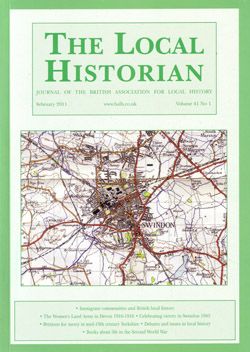
The Local Historian Volume 41, Number 1 February 2011
Contents
Editorial Show more
By Alan Crosby
The editorial voice has been silent of late, not because I’ve stopped having thoughts and opinions but because, even with the expansion of The Local Historian, space is still precious, and you would no doubt prefer an article or more reviews to my meanderings. Looking back, the increasing size of TLH has been a major liberating factor in its development. Until November 2004 most issues had 64 pages (occasionally a longer issue allowed for a particularly substantial article). From the beginning of 2005 it increased to 72 pages, in 2008 to 80 pages, and in 2009 to 88.
This has allowed much more scope and flexibility. Not only is it possible to publish more articles, but also a better mix of longer and shorter contributions is feasible (as this present issue exemplifies). We have greatly increased the number of reviews in each issue (though even so it is necessary to have plenty more on the on-line reviews section of the BALH website, and Evelyn Lord does heroic work in drawing together round-up style reviews which cover a couple of dozen publications each). But the expansion of the journal has also allowed the development of debate and discussion, an element which had rarely been included hitherto. Serious and continuing consideration of the future of local history—its structures, rationale and philosophies—is an important dimension to the work of the British Association for Local History, and The Local Historian is a suitable medium for airing these questions.
Eleven years ago the now-famous article by George and Yanina Sheeran, ‘Reconstructing local history’, was published in TLH. In November 2009, to mark its tenth anniversary, the authors contributed another stimulating and challenging article, ‘No longer the 1948 Show’. Since the appearance of the latter I have been surprised, and pleased, by the reaction to it. There has been a great deal of interest in what the article has to say, and even among its not inconsiderable number of critics the almost universal reaction has been that it has ‘set people thinking’. That can’t be a bad thing. It has also prompted a number of readers to construct substantial contributions of their own, picking up key points and discussing them at some length.
One aspect of these which I have relished is that they include some very witty asides and clever verbal dexterities—I have laughed aloud at some of the wry observations, and to be entertained by what could otherwise be so solemn and sobering is an unexpected bonus. My editorial view is that contributions to debate are always welcome, and that the debate does not have to be confined to the future of the subject and all those great issues of age, gender, class, objectives, outcomes and philosophies. It can also be about practical questions and the better (or, alternatively, the less satisfactory) ways of tackling research, writing and publication. In this context I welcomed the piece by Michael Faraday (pp.60-61), concerning the publishing of editions of historical documents, which follows on from a point made in a recent review.
Debate is one ‘theme’ of this issue. The other is war and the experience of the Home Front as, by accident rather than design, two full articles and a series of book reviews came together. The First World War is now disappearing from human recollection, and the Second World War is slipping inexorably into ancient memory. But interest in both among local and family historians seems to grow as first-hand experience vanishes (a phenomenon which is of course far from unique to the theme of war and conflict). In August and September 1914 we will commemorate, rather than celebrate, the centenary of the outbreak of the Great War and the 75th anniversary of that of its successor. This will usher in four years of anniversaries, all with their special and terrible resonances—1915 Gallipoli, 1916 The Somme, 1917 Vimy Ridge and Passchaendale … these and a multitude of other hauntingly-evocative names will ring in our ears, grainy footage of jerkily-moving men will be shown, and across the land the war memorials will be circled in red. And many more articles on aspects of the war will be researched and written.
While military historians have looked at those who went and those who never returned, many local historians have been investigating the experience of the people left behind. In recent years The Local Historian has included articles on war memorials and commemoration in Sussex and Ulster; Great War military tribunals in Wiltshire and Warwickshire; military gravestones in Essex; the Home Front in the Second World War; the Channel Islands under German occupation; the 1942 wartime census; military requisitioning in Cromarty, 1943; and the Women’s Land Army in Craven 1939-1945. The range and subject and place is testimony to the enduring interest of the two conflicts, and also to the sense that understanding and interpreting the local experience can immeasurably enrich and enhance the wider picture. As with so much else, the story of Britain in both World Wars was once described in the history books using generalised, ‘top down’’ terms (more or less implying that ‘local’ means ‘national broken up into small pieces’). Now the perspective is being reversed: to a considerable extent, the national experience is seen as the composite of innumerable local ones. Of course, there was an immensely strong and powerful national framework of laws, policies and directives, as well as the unfolding events of war itself, but its impact was far from uniform, and local case-studies provide vital evidence from which to build up a more complete and reliable view.
In this issue of TLH we have two more case studies to add to our list. The Women’s Land Army in the Second World War is now a familiar topic, but Bonnie White investigates instead its First World War predecessor, looking at the experience of Devon and recounting the struggles of its organisers and the recruits. The authorities, faced with completely unprecedented circumstances, created the WLA in 1916 and in doing so not only made a material contribution to agricultural management in the second half of the war, but also provided an invaluable example for those in charge 23 years later to follow. Chris Sladen analyses the impact of victory in 1945 upon the people of Swindon, showing how they celebrated—whether or not according to official directives—and highlighting the clear discrepancies between the mythologised view of VE and VJ Day, and the reality on the ground in a large provincial town. And we review no fewer than five books which look, from the perspective of diarists or analysts, upon the day-to-day experience of life during the Second World War. From the journal of a bad-tempered and irritable solicitor in Worthing, to a controversial book on the wartime Channel Islands, these reveal the diversity of emotional and practical responses to war. As the reviewer Peter Searby says, they ‘add subtlety to the account … of a patriotic nation united against fascism’.
Immigrant Communities And British Local History Show more
By David Killlingray
This important article in our ‘Themes in local history’ occasional series draws attention to one of the greatest and most basic weaknesses in the overall range of local history research and writing – the scarcity of material on the local history of ethnic and immigrant communities. It emphasises that local historians have tended to avoid this aspect of the history of British communities, despite the manifest fact that this is one of the most crucial changes in society, demography, culture, faith and visual appearance in the last hundred years and longer. Killingray begins the main part of the paper with an overview of the history of immigration and minority communities, from the sixteenth century to the twenty-first, drawing attention to the importance of patterns of settlement as well as numbers involved. He then analyses the character and value of writing on the subject, using the following key themes: i) the fact that other disciplines, such as geographers and sociologists, have dominated the field; ii) the separate (or otherwise) nature of Black history; iii) the special requirements of researching and investigating the history of ethnic communities; iv) the problems of sources in an often unwritten culture; v) the need to look at journals and published works from other disciplines; and vi) the real and pressing need to begin to address these issues and to tackle the challenging theme of immigrant and ethnic communities. In the course of the article Killingray also observes that, for the future, local historians will emerge within these communities, sharing the critical and analytical values of British local history’s best practice. There is a comprehensive set of notes and references.
Sowing The Seeds Of Patriotism? The Womens Land Army In Devon 1916-1918 Show more
By Bonnie White
The Women’s Land Army has received close attention from historians, including local and regional historians, in recent years. However, almost all focus has hitherto been on the experience of the Second World War, and far less research and analysis has considered the WLA which was established halfway through the First World War, in 1916, and functioned until the end of 1918. The first incarnation not only represented a determined attempt to tackle an unprecedented national crisis of food supplies and agricultural productivity, but also formed an invaluable template for those who, at the outbreak of the Second World War, addressed the same emergency requirements. Further, analysis of the WLA in 1916-1918 will allow this aspect of women’s wartime work to be given its proper place alongside better-known activities such as labour in munitions factories. In this article Bonnie White presents a detailed case-study of the experience of setting up, organising and working within the WLA in Devon, one of England’s largest and most rural counties. The article considers the process of recruitment, in the context of competition for women’s labour and the role of other organisations such as the Women’s War Service Committee. It then assesses attitudes to female labour and the notion of women working in the agricultural sector. The procedures for joining and training are described, together with the expected roles, tasks and codes of behaviour for WLA members. There is a substantial final section which gives a retrospective on the experiences of the women concerned, and the value and significance of the scheme
In Rejoicing Let Us Preserve Decorum: Victory Celebrations In Swindon 1845 Show more
By Chris Sladen
This essay draws on written and oral recollections of celebrations in Swindon, a largely industrial town of about 50,000 people, for VE and VJ days in 1945. It sets out to probe deeper than the usual glib statements concerning the coming of peace, and in particular to consider whether the experience of a town such as Swindon differed from that of London, which was much more widely reported and is often to be somehow representative of the nation as a whole. Chris Sladen begins by dissecting the evidence for how the news arrived in Swindon, pointing out that it had been anticipated for some months but its precise timing was of course unpredictable. The formal and official announcements came on 7 May, with celebrations due for 9 May. He then considers the nature of celebration, looking at food and drink, entertainment, street parties of official delegations to different parts of the town. He concludes that there was nothing remotely resembling the ‘bacchanalia’ experienced in London, and that for many the end of the war in Europe was met with calm satisfaction but little outward display. The consequence was that VJ Day, in August, was a significant anti-climax, and was marked by few public celebrations and little obvious festivity. The most enthusiastic seem to have been the American troops stationed nearby, for whom this signalled not only the end of fighting but also the likelihood of going home. The discussion at the end of the paper focuses on the nature of reporting, comparisons with the events of 1918, and the wider issue of public attitudes at the end of the Second World War, crystallises by Labour’s dramatic victory in the 1945 general election. This paper is an important addition to the corpus of local case studies on the commemoration of war and victory.
Petitioning For Mercy In Mid-nineteenth Century Yorkshire Show more
By Dick Hunter
This article examines the petitions arising from convictions at Yorkshire courts in the mind-nineteenth century, with a detailed case study which examines the events surrounding and following the conviction of Sarah Ann Hill, who in December 1851 was sentenced to death for the murder of her new-born child. The principle of petitioning for clemency or redress was well established, either to reduce a death sentence to transportation, or to lessen the term of transportation, or to allow a convict to serve a term in Britain rather than overseas. The article begins with an overview of the procedures and draws attention to the significant number of important published works on the subject, but repeats Carter’s assertion that local historians have almost entirely neglected this topic, even though uniquely detailed evidence may be given. The circumstances in Yorkshire are then analysed, with tables showing conviction rates at York Assizes and the nature of the sentences handed out (death, transportation for life, transportation for differing lesser terms, and imprisonment in any one of seven penal establishments in the county). There is careful analysis of the impact of petitioning, which ranged from free or conditional pardons to other mitigation (though it is noted that 79 per cent of petitions were unsuccessful). The case study of Sarah Ann Hill recounts her tragic case in detail, with analysis of how and why her death sentence was commuted to transportation. The final section places this in the context of the increasingly vigorous campaign against the death penalty, or at least in favour of its much-reduced use.
A Survey Of Articles In Periodicals 2009-2010 Show more
By Evelyn Lord
Evelyn Lord
The aim of the annual survey of periodicals is to draw attention to articles of interest to local historians, published in journals that are not submitted for listing inThe Local Historian. Some of these are national in scope, such as History, while others are specialist publications—the Agricultural History Review for example—and this year one regional journal, Northern History, is included. The survey is divided chronologically, with a short general section at the end. Time and space do not permit an examination of all journals likely to have articles of interest to local historians, and some which offered such papers in the past had no relevant articles in 2009-2010. The trend seems to be towards papers with an international or political bias; a sign of the times perhaps. If the readers of this article have suggestions for journal titles that can be explored for next year’s round up, I would be grateful to have them.
Medieval period
Ever since W.G. Hoskins drew attention to the use of lay subsidies as demographic and economic evidence, local historians have used these sources with varying results, which in turn has produced a voluminous historiography on the subject. Two of the articles on medieval England are concerned with towns, and one (by S. Rigby) uses lay subsidies for a discussion on the size of the urban population of small towns. The article includes a table with the numbers of taxpayers for 100 provincial towns between 1377 and 1524. The second article, by John S. Lee, takes a functional approach. He uses John Leland’s descriptions of small towns as evidence for their economic functions. Although he does not define ‘small’ he does classify types of markets, including those in decline. M. Bailey and M. Gardner both look at the division of land in medieval eastern England. Bailey reconstructs changes in field systems in medieval Suffolk, and Gardner argues that the parallel fields seen on the marshland between the Lincolnshire Fens and the Humber estuary, which appear on nineteenth-century maps, had their origin in the division of wetlands in the twelfth and thirteenth centuries. P. Slavin uses 2700 manorial demesne accounts from Cambridgeshire, Essex, Huntingdonshire, Norfolk, Suffolk and the Soke of Peterborough to look at goose-rearing and management from c1250-c1400. He discusses the role of geese in the medieval economy, and points out that they were more expensive to rear than other poultry, and therefore a higher return was expected.
The two final papers in the medieval section are on the gentry and religion. P. Latimer examines the assimilation into elite society of three Anglo-Scandinavian families living on the Furness peninsula, and shows how they became assimilated into the local aristocracy. V. Spence’s article on ‘late medieval piety to religious conformity’ is a case-study of the religious life of Kirby Malhamdale, an upland parish in the Yorkshire Dales.
Early modern
Like the Anglo-Scandinavians of Latimer’s paper, Sir Philip Musgrove needed to be reassimilated into polite society at the Restoration. C.S. Colman’s article covers the career of this Westmorland Royalist in the post-Restoration era. Sir Philip had been caught up in the politics of the seventeenth century. Others resorted to much more direct action. Kett’s Rebellion of 1549, that peculiarly Norfolk event, is given another airing by J. Whittle, who uses manor court records to identify at least 6000 people involved in the rebellion, showing that they were often substantial landholders. The rioters could be charged with felony, and although in the early modern period being found guilty could mean the death sentence, one aim of the courts was to make money for the Crown so that the sentences were often commuted to fines. K.J. Kesselring explores this aspect of felony in a series of local case studies from across the country. Star Chamber records are another source of evidence for public protest. They are used by B.A. McDonagh to find cases concerning the Yorkshire Wolds in the sixteenth century. Some 28 suits were discovered, all concerned with property rights. Litigation over property often resulted in maps of the contested area being drawn. W.D. Shannon describes an adversarial map, drawn in 1531 as evidence in a dispute over land in Lytham, Lancashire.
Famine and the standard of living in the sixteenth and seventeenth centuries are examined by R. Hoyle, J. Healey and W. Baer respectively. Hoyle argues that historians should pay more attention to the agrarian roots of famines in early modern England, and uses a case-study of East Lancashire 1622-1624 to develop his argument. He locates the origin of the famine in poor harvests and high prices (no surprise there!) and uses burial records, oat tithes and wheat and barley prices as evidence. Some comparative material would have enhanced this article, as this episode of hardship was not confined to Lancashire, and a definition of what constitutes a famine would have been useful. Also concentrating on Lancashire is J. Healey’s article on the development of poor relief in that county from c1598-1689. This starts from the false assumption that there have been few local studies on the operation of the Tudor Poor Law (read the literature, especially in The Amateur Historian and The Local Historian). The article concentrates on the Shuttleworth family, who were JPs during this period, and were charged with administering the Poor Law. It includes a list of the poor taken in various Lancashire hundreds. Harvest and grain prices were crucial to the standard of living. W. Baer looks at the standard of living in Stuart London using the 1638 Settlement of Tithes and rents, to arrive at speculative household budgets. The last paper in this section is also on London. Y.T. Tjondrowodje examines the growth of private baptisms in seventeenth century London, and why these became both popular and necessary.
The eighteenth century
The eighteenth century was a time of major change in industry, farming, communications and transport, and witnessed the beginning of a more humanitarian society and growing concern for the welfare of others. One strand of this, which came to fruition in the nineteenth century, was the abolition of slavery. An article inSlavery and Abolition by G. Plank describes the activities and journal of one of the first anti-slavery authors, John Woolman, a Quaker from New Jersey who, in an attempt to understand what it was like to be a slave, dressed in slave rags, and went barefoot round the country, staying in slave hovels. In 1772 he arrived in England. He spoke in London at the annual meeting of the Society of Friends, and then went barefoot on his travels, ending up in Yorkshire, where he contracted smallpox. A significant part of the economy of Bristol was based on slavery. M. Dresser draws attention to this in ‘Remembering Slavery and Abolition in Bristol’, which dwells particularly on the life of Edward Colston (1636-1721), merchant, philanthropist and slave owner. Another West Country man was George Boswell of Puddletown, an innovative farmer whose life and works are described by J. Bettey.
One change in the eighteenth century was a disenchantment with orthodox religion and the growth of dissent. The philosophy of dissent was propagated through Dissenting Academies, the alternative to the grammar or public school for the sons of dissenters. D.A. Reid examines the educational philanthropy taught as rhetoric in rational dissenting academies in Warrington, Manchester, Hackney and Exeter. Another element of eighteenth-century change was in transport and the development of turnpike trusts. D. Bogart examines the relationship of turnpike trusts and property income. Although this is written from a national viewpoint, it includes a case-study on Bedfordshire, based on W. Emmison’s work. A statistical warning can be attached to this article, but its conclusions on the contributions which turnpike trusts made to economic growth in England set up a model that can be tested on local evidence. Enclosure and turnpikes were part of this economic scene. B.A. McDonagh concentrates on the enclosing activities of four elite women in Northamptonshire. Enclosure altered the landscape, and in the eighteenth century the landscape was also altered to suit the needs of sportsmen. Two articles by J. Bevan and E.L. Jones are on the increasingly popular topic of foxhunting and blood sports. Bevan focuses on the East Midlands (prime hunting country) and Suffolk to explore the relationship of foxhunting and the landscape. She claims to challenge the work done by W.G. Hoskins on this, but fails to convince. The enclosed landscape and the hunts are not placed within a wider regional context—for example she does not note that part of the Soar Valley, one of her case study areas, was already heavily industrialised in the eighteenth century, as at Sileby (wrongly spelt in the article) and Mountsorrel. Jones assesses the effect of shooting on game preservation on the landscape, farming and the environment, with particular attention paid to the effects of game preservation on wild life.
The agricultural revolution was not confined to England, but was also of major importance in Scotland, as shown by M. Johnstone’s article on farm rents and improvements on six estates in East Lothian and Lanarkshire between 1630 and 1830. The penultimate article in this section carries on a theme which appeared in the last reviews round-up: livestock rustling in Wales. N. Woodward has moved on from sheep-stealing to study horse-stealing in Wales between 1730 and 1830. The article shows that this was a lucrative occupation, as without any form of identification, horses should be sold on quickly and were in great demand. The final article, by R.G. David, is on the whaling fleets of Whitehaven in Cumberland 1760-1791, redressing the lack of local studies on the smaller whaling ports of the eighteenth century.
The nineteenth century
Inevitably there are more articles on the nineteenth century than other periods, and equally inevitably many of these are on the operation of the Old and New Poor Laws. It is true that both left a wealth of information behind them, which entices historians, but many of the articles state the obvious and say nothing new. Work on the Poor Laws which challenges the orthodoxy, and suggests new avenues of research and models to test, would be welcome. T. Nutt’s article is on illegitimacy and paternal financial responsibility, a hot topic today. It considers paternal responsibility through the operation of the bastardy clauses in the Old Poor Law, and examines how these changed after 1834, with special reference to the rate of recovery of expenses from erring fathers. A. Levene examines parish apprenticeships under the Old Poor Law in London, looking at patterns and motivations of the overseers. The article identifies 3000 children, tabling their ages and the occupations they went into. A. Negrine also looks at children, but has chosen a relatively under-explored topic, the treatment of sick children in the workhouse. This is a case-study of Leicester Workhouse, and shows that eventually the Leicester guardians moved sick children out to the Countesthorpe Cottage Homes, and did the best they could. Pauper letters addressed to the overseers of the poor have proved fruitful avenues of research. P.D. Jones uses pauper letters from the south of England to extract requests for clothing and the responses of the overseers. Individual paupers appear in S.A. Shave’s article on the lifecycles of eight individuals from Motcombe in Dorset, showing how they responded to poverty. Death came at the end of all. A. Hinde and M. Edgar look at the mortality of stone workers on the Isle on Purbeck in the nineteenth century, and conclude that their mortality rate was less than that of coal and mineral miners.
Keeping the poor out of mischief was one of the concerns of the authorities. Allotments were seen as one way of defusing disorder and keeping inhabitants out of the alehouse. It is no surprise that factory masters were willing to give up land to provide allotments for their workers. C. Leivers examines this in the context of five locations in Derbyshire—the textile areas of Cromford, Belper and Darley Abbey, and the coal and iron communities of Staveley and Clay Cross. The provision of reading rooms was seen as another way of persuading the community into the straight and narrow path to righteousness. C. King looks at the rise and decline of reading rooms in Norfolk, showing that these were bestowed upon the working class by the elite. Illustrations in this article show that although the reading room might have gone the buildings often remain in use.
Domestic service is another popular nineteenth century topic. S. Pooley discusses the relationship of class and gender in the context of domestic service in Lancaster, 1880-1914, while R. Gant uses census enumeration books to examine domestic service in the small market town of Crickhowell, 1851-1901. Domestic servants were an essential part of the wider local community. E. Royle looks at this community through the vicarage window as described in the nineteenth-century visitation returns for the diocese of York. A different type of local community, which developed rapidly in the nineteenth century, was the suburb. A. Skinner explores the people who helped to develop East Oxford, many of whom were from religious orders connected to the Oxford Movement. Quaker communities and kinship are described by P. Richardson, who uses the West Country Fox family as evidence to demonstrate the importance of kinship and network ties, which spread as far as North America. S. King looks at ‘love, religion and the making of marriage in early nineteenth century Lancashire’, using an autobiography and a series of love letters as evidence.
Dissenting religious communities appear in J. Few’s article on the Bible Christians in nineteenth-century North Devon, and a complementary article is by P. Locksley on ‘Millenarism in the Pennines, 1800-1830’, which includes a discussion on sects such as John Wroe’s virgins of Ashton-under-Lyne, and less well-known groups. Undoubtedly, John Shaw, a hardware factor from Wolverhampton, would have come across these as he travelled across the north of England selling his wares. His travels and journals are described in an article by A. Popp.
The twentieth century
There are four articles on the twentieth century, dealing with industrial pollution, social housing, leisure, and war time agriculture. B. Doyle’s very topical article on managing industrial pollution in Middlesbrough 1880-1940 identifies the sources of pollution, its impact on the local environment in terms of the quality of life, and public responses to this. M. Hollow’s article is on the Park Hill Estate in Sheffield, built between 1957 and 1961. This estate overlooks the city and was designed to provide an integrated environment of good quality dwellings and open spaces. In reality the result was the usual problems associated with large housing schemes. ‘The Battle of Butlins’ by J.P. Gruffuyd shows that in 1939 Billy Butlin agreed to a secret deal with the Admiralty to build a training camp near Pwlhelli in North Wales, which would be transferred back to him for use as a holiday camp at the end of the war. Despite local opposition to it being turned into a holiday camp, Butlin won the day. The National Farm Survey has proved useful to local historians. D. Harvey and M. Riley take this one step further and suggest that the aim was to create a British National Farm and a national policy on agriculture. Oral history from Devon supplements the documentary and map evidence.
General
There are three articles that have no specific period but are of interest to local historians. The first of these by P. Razzell, C. Spence and M. Wollard harks back to the heady days of The Population History of England 1841-1871 and The Open University course DA301. It is an evaluation of the Bedfordshire burial registration 1538-1851, and concludes that variations in burial registration are mostly random events. Much more groundbreaking is an important article by K.D.M. Snell on the value to local and social historians of parish magazines. These are often rejected as evidence, although the magazines convey ideas about the parish community and how it operated not available elsewhere. Finally, there is an account of a travelling exhibition mounted by the Leicestershire Record Office: ‘Bringing It Home’ illustrated the story of slavery and its abolition as told through local records. This article is part of a number on the local legacies of slavery in Britain.
Articles referred to in this survey
W. Baer, ‘Stuart London’s standard of living; re-examining the Settlement of Tithes, 1638 for rents income and property’, Economic History Review vol.63 no.3 (August 2010) pp.613-637
M. Bailey, ‘The form, function and evolution of irregular field systems in Suffolk, c1300 to c1500’, Agricultural History Review vol.57 pt.1 (2009) pp.15-36
J. Bettey, ‘George Boswell of Puddletown (1735-1815): progressive farmer and author’, Agricultural History Review vol.57 pt.1 (2009) pp.58-69
J. Bevan, ‘Agricultural change and the development of foxhunting in the eighteenth century’, Agricultural History Review vol.58 pt.1 (2010) pp.49-75
D. Bogart, ‘Turnpike trusts and property income: new evidence on the effects of transport improvements and legislation in eighteenth-century England’, Economic History Review vol.62 no.1 (Feb 2009) pp.128-152
‘Bringing it Home: Making Local Meaning in 2007 Bicentenary Exhibition’, Slavery and Abolition vol.30 no.1 (2009) pp.259-275
C.S. Colman, ‘Sir Philip Musgrove and the re-establishment of the Old Regime in Cumberland and Westmoreland, c 1660-1664’, Northern History vol.47 no.2 (Sept 2010) pp.246-270
R.G. David, ‘Whitehaven and the Northern Whaling Fishery’, Northern History vol.47 no.1 (March 2010) pp.117-134
B. Doyle, ‘Managing and Contesting Industrial Pollution in Middlesbrough, 1880-1940’, Northern History vol.47 no.1 (March 2010) pp.135-154
M. Dresser, ‘ Remembering Slavery and Abolition’, Slavery and Abolition vol.30 no.1 (2009) pp.223-246
J. Few, ‘Uproar and Disorder? The Impact of Bible Christians on the communities of nineteenth century North Devon’, Family and Community History vol.12 no.1 (May 2009) pp.37-50
R. Gant, ‘Domestic service in a small market town, Crickhowell, 1817-1901’, Local Population Studies vol.84 (Spring 2010) pp.11-30
M. Gardner, ‘Dales, long lands and the medieval division of lands in Eastern England’, Agricultural History Reviewvol.57 pt.1 (2009) pp.1-14
J.P. Gruffyd, ‘The Battle of Butlins: vulgarity on the North Wales Coast, 1939-1949’, Rural History vol.21 no.1 (April 2010) pp.75-95
D. Harvey and M. Riley, ‘Fighting for the Field: Developing the British National Farm in the Second World War’,Journal of Historical Geography vol.35 (2009) pp.495-516
J. Healey, ‘The Development of Poor Relief in Lancashire, c 1598-1689’, Historical Journal vol.53 no.3 (2010) pp.551-572
A. Hinde and M. Edgar, ‘Death on a strange isle: the mortality of the stone workers of Purbeck in the nineteenth century’, Local Population Studies vol.84 (Spring 2010) pp.55-70
M. Hollow, ‘Governmentality on the Park Hill Estate: the rationality of public housing’, Urban History vol.37 no.1 (2010)
R. Hoyle, ‘Famine as agricultural catastrophe: the crisis of 1622-1624 in east Lancashire’, Economic History Review vol.63 no.4 (Nov 2010) pp.974-1002
M. Johnstone, ‘Farm rents and improvement: East Lothian and Lanarkshire, 1670-1830’, Agricultural History Review vol.57 pt.1 (2009) pp.37-57
E.L. Jones, ‘The Environmental Effects of Blood Sports in England since 1750’, Rural History vol.20 no.1 (2009) pp.51-66
P.D. Jones, ‘I cannot keep my place without being dressed: pauper letters, parish clothing and pragmatism in the south of England, 1750-1830’, Rural History vol.20 no.1 (2009) pp.31-49
K.J. Kesselring, ‘Felony, Forfeiture and the Profits of Crime in Early Modern England’, Historical Journal vol.53 no.2 (2010) pp.271-238
C. King, ‘The rise and decline of the village reading room’,Rural History vol.20 no.1 (2009) pp.163-186
S. King, ‘Love, religion, and power in the making of marriage in early nineteenth century rural industrial Lancashire’, Rural History vol.21 no.1 (April 2010) pp.1-26
P. Latimer, ‘Assimilation in North-Western England from the Norman Conquest to the early thirteenth century’,Northern History vol.47 no.1 (March 2010) pp.49-66
J.S. Lee, ‘The functions and fortunes of English small towns at the close of the middle ages: evidence from John Leland’s itinerary’, Urban History vol.37 no.1 (2010) pp.3-25
C. Leivers, ‘The provision of allotments in Derbyshire industrial communities’, Family and Community Historyvol.12 no.1 (May 2009) pp.57-64
A. Levene, ‘Parish apprenticeship and the Old Poor Law in London’, Economic History Review vol.63 no.4 (Nov 2010) pp.915-941
P. Locksley, ‘Millenarism in the Pennines, 1800-1830: building and believing Jerusalem’, Northern History vol.47 no.2 (Sept 2010) pp.297-317
B. McDonagh, ‘Subverting the ground: private property and public protest in sixteenth-century Yorkshire Wolds’,Agricultural History Review vol.57 pt.2 (2009) pp.191-206
B. McDonagh, ‘Women, enclosure and estate management in eighteenth century Northamptonshire’,Rural History vol.20 no.2 (October 2009) pp.143-162
A. Negrine, ‘The treatment of sick children in the workhouse by the Leicester Poor Law Union’, Family and Community History vol.13 no.1 (May 2010) pp.34-44
T. Nutt, ‘Illegitimacy, paternal financial responsibility and the 1834 Poor Law Commission Report’, Economic History Review vol.63 no.2 (May 2010) pp.353-361
G. Plank, ‘The First Person in Anti-Slavery Literature: John Woolman, his clothes and his journal’, Slavery and Abolition vol.30 no.1 (March 2009) pp.67-91
S. Pooley, ‘Domestic servants and their urban employers: a case study of Lancaster 1880-1914’, Economic History Review vol.62 no.2 (May 2009) pp.404-429
A. Popp, ‘From town to town: How commercial travel connected manufacturing and markets during the industrial revolution’, Journal of Historical Geographyvol.35 (2009) pp.642-667
P. Razzell, C. Spence and M. Woollard, ‘The evaluation of Bedfordshire burial registration, 1538-1851’, Local Population Studies vol.84 (Spring 2010) pp.31-54
D.A. Reid, ‘Radical dissent and the rhetoric of educational philanthropy in the dissenting academies of Lancashire, Hackney and Exeter’, Northern History vol.47 no.1 (March 2010) pp.97-116
P. Richardson, ‘Kinship and networks in a Quaker family in the nineteenth century’, Family and Community Historyvol.12 no.1 (May 2009) pp.22-36
S.H. Rigby, ‘Urban population in late medieval England: The evidence of lay subsidies’, Economic History Reviewvol.63 no.2 (May 2010) pp.393-417
E. Royle, ‘The parish community through the vicarage window: nineteenth-century clergy visitation returns’,Family and Community History vol.12 no.1 (May 2009) pp.6-21
W.D. Shannon, ‘Adverserial map-making in Pre-Reformation Lancashire’, Northern History vol.47 no.2 (Sept 2010) pp. 392-342
S.A. Shave, ‘The Dependent Poor? (Re)constructing the lives of individuals ‘On the Parish’ in Rural Dorset’ Rural History vol.20 no 1 (April 2009) pp 67-97
A. Skinner, ‘Unearthing the past: an exploration into the people behind the development of a Victorian suburb’,Family and Community History vol.12 no.2 (Nov 2009) pp.84-100
P. Slavin, ‘Goose management and rearing in late medieval eastern England’, Agricultural History Reviewvol.58 pt.1 (2010) pp.1-29
K.D.M. Snell, ‘Parish Pond to Lake Nyasa: parish magazines and senses of community’, Family and Community History vol.13 no.1 (May 2010) pp.45-69
V. Spence, ‘From late medieval piety to religious conformity in a northern parish: Kirby Malhamdale, 1454-1603’, Northern History vol.47 no.1 (March 2010) pp.68-96
Y.T. Tjondrowordoje, ‘Stories baptismal registers told: private baptism in seventeenth century England’, Historyvol.95 no.2 (April 2010) pp.177-193
J. Whittle, ‘Lords and tenants in Kett’s Rebellion, 1549’,Past and Present no.207 (May 2010) pp.3-52
N. Woodward, ‘Horse-stealing in Wales, 1730-1830’,Agricultural History Review vol.57 pt.1 (2009) pp.70-108
Review Article: Five Books About Life During The Second World WarReview Article: Five Books About Life During The Second World War Show more
By various
A SOLDIER IN BEDFORDSHIRE 1941-42 edited Patricia and Robert Malcolmson (Bedfordshire Record Society/Boydell vol.88 2009 xviii+194pp ISBN 978 0 85155 074 9) £35
DORSET IN WARTIME The Diary of Phyllis Walther 1941-1942 edited Patricia and Robert Malcolmson(Dorset Record Society vol.15 2009 153pp ISBN 0-900339-15-2: 978-0-900339-15-8)
WORTHING AT WAR The diary of C.F. Harriss ed. Paul Holden (Phillimore 2010 xviii+206pp ISBN 978 1 86077 618 2) £14.99
CAMBRIDGE AT WAR The diary of Jack Overhill 1939-45 edited by Peter Searby (Cambridgeshire Records Society vol.19 2010 liii+354pp ISBN 978-0-904323-21-4) £18
OUTPOST OF OCCUPATION How the Channel Islands survived Nazi rule 1940-45 by Barry Turner (Aurum Press 2010 312pp ISBN 978 1 84513 512 6) £20
Reviews
Hexham in the seventeenth century Show more
By Alan Crosby
Wrenbury wills and inventories 1542-1661 Show more
By Heather Falvey
Nick Barratt's guide to your ancestors' lives Show more
By Kate Thompson
London and the kingdom Show more
By Rosemary Horrox
VCH Sussex 5 Littlehampton and district Show more
By Brian Short
The early town books of Faversham Show more
By Gillian Draper
John Denton History of Cumberland Show more
By Margaret Shepherd
Family history in Lancashire: issues and approaches Show more
By Kate Tiller
HEXHAM IN THE SEVENTEENTH CENTURY Economy, society and government in a northern market town by Anna Rossiter (Hexham Local History Society 2010 294pp ISBN 978-0-9565078-1-5 pb) £15 printed to order
Anna Rossiter, for many years a leading member of the Hexham Local History Society, died much too young in 2007. This book, based on her MA dissertation awarded by the University of Newcastle in 1997, has been produced by the Society with the active assistance of her husband, Nick. The society has an excellent record of publications, and Hexham in the Seventeenth Century is not only a worthy addition to its list but also an important and welcome contribution to our understanding of small market towns in the early modern period. The Society decided to publish on a ‘print on demand’ basis, using the services of the on-line production company Blurb.com. Those wanting to purchase a copy (hardback or paperback) can use the Society’s website http://hexhamhistorian.org/pages/shop.php and click on links which allow direct ordering. This greatly reduces both the financial risk to the Society, and the potential cost of the book. The quality is good, although some of the illustrations have not reproduced well, and it is an approach to publishing which other local history societies might consider. Another innovation is that the entire book is also downloadable (for a charge) in pdf format.
It is no criticism to say that the book bears the hallmarks of a dissertation. I suspect that had she been able to do so the author would have revised it quite extensively. In particular, there is a great deal about the technical aspects of her methodology, and very frequent explanations of the problems with the sources which, while valuable to a specialist, might be of less concern to the general reader. The very positive aspect of the genesis of the work is that it has exemplary referencing (Anna was trained as an archivist, so her use of sources and her identification of them is impressive), there is a comprehensive bibliography, and throughout the book an entirely praiseworthy and effective strategy of making comparisons—between Hexham and other small market towns which have been studied in depth; between Hexham and the nearest (all things are relative!) provincial capitals, Newcastle and Carlisle; and between Hexham and its great rural hinterland, much of it the ancient territorial unit of Hexhamshire. There is a deep sense of understanding about these relationships and linkages, and a constant reminder that towns and countryside had powerful symbiotic connections.
As Anna notes in her preliminary chapter, historians had tended to avoid the analysis of unincorporated market towns, perhaps because of a relative lack of primary sources in comparison with corporate places. In the fifteen years since she was working on her dissertation that deficiency has to some extent been rectified, but much of her argument remains valid. When analysing the town, its society and economy her main sources were manorial records, parish registers, probate records and the hearth tax. These have been exploited skilfully and in depth, with numerous statistical presentations (always wisely hedged with cautions) and extensive quotation from contemporary records. The structure of small town society is demonstrated not only by general conclusions but also by, for example, a valuable attempt to produce specific biographical evidence about minor officeholders and members of the Four and Twenty. Their relationship with Hexham’s manorial lords, and their place in the town’s commercial community, are important themes. The crucial importance of the leather industry and related trades, a feature so widespread in towns of this sort, is revealed by, among other sources, the excellent evidence of parish registers (in the last two decades of the century an occupation is stated for about 86 per cent of adult male burials, something to stir feelings of envy among those of us studying comparable places).
Hexham is a wonderful town, with an exceptionally long and varied history, a delightful character, a superb abbey and a beautiful setting amid the moors, hills and fine rivers of Tynedale. But, as Anna notes, like many such towns it had been neglected by serious historians. This excellent book fills a major gap: it is invaluable in helping us to understand a formative period in the history of Hexham, but it will also be of great interest to local and urban historians much more widely.
ALAN CROSBY




Hugo Javier Freitas


Laura Yeoman