
The Amateur Historian Volume 4 Number 4 Summer 1959
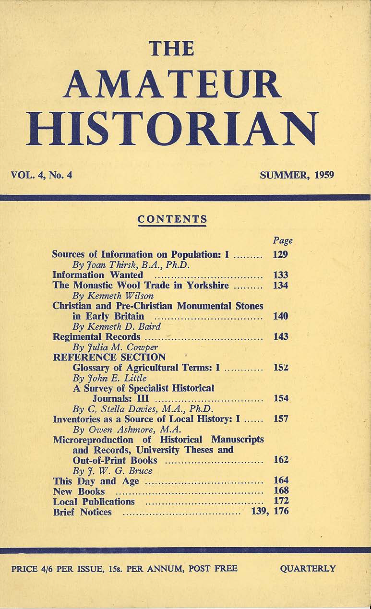
Contents
Sources of information on population 1500-1760 (part 1) Show more
By Thirsk, Joan
pp 129-133
This article, by one of the leading social and economic historians of the second half of the 20th century, discusses population changes in the period 1500-1760 and indicates reasons for various local differences in these changes. Dr Thirsk suggests that there were three major factors contributing to such variations: i) the local variability of death rates; ii) differences in the attractiveness of individual towns and villages, as places for working and living; and iii) local variation in attitudes to, and treatment of newcomers and in-migrants. She suggests a link between economic change and changes in population size, and recommends that to research these issues in more detail, the local historian could make use of parish registers, subsidy assessments, chantry certificates, and ecclesiastical censuses (see also 04 05 182-184).
The monastic wool trade in Yorkshire Show more
By Wilson, Kenneth
pp 134-139
A study of the origins of the wool trade in Yorkshire, and its close connection with the county's many monastic houses. The Cistercians, in particular, farmed sheep on a large scale on extensive estates, producing wool and also butter and cheese. The wool was in huge demand in mainland Europe and the monastic houses such as Fountains grew wealthy as a result, despite problems with disease and the Scots. In the 12th century the monasteries were taxed on their exports, which forced them to make their production even more efficient. The author uses accounts to detail the processes of producing wool and the transportation to the continent, noting that several Yorkshire towns and ports grew in importance with this trade.
Christian and pre-Christian monumental stones in early Britain Show more
By Baird, Kenneth D.
pp 140-142
Description of early Christian symbolism - in particular, the use of the cross - with examples from different parts of the British Isles.
Regimental records Show more
By Cowper, Julia M.
pp 143-152
An assessment of early regimental histories. Before the late 18th century the existence of records relating to this subject is variable and the author notes particularly the problems in locating reliable information on 17th century regiments. She suggests that the following sources will prove the most useful, though not all will be available in any individual case: officer lists; War Office papers; records of Courts Martial; clothing regulations; marching Order books; letters and journals; contemporary histories; military text books; reminiscences and autobiographies. Numerous examples are quoted and each source and example is evaluated.
Glossary of agricultural terms: 1 A simple glossary of agricultural terms Show more
By Little, John E.
pp 152-153
First of two articles in which Little explains some of the more common technical terms which the local history researcher is likely to encounter when using early modern and 18th century written records on agricultural themes (see also 04 05 195-197).
A survey of specialist historical journals - III Show more
By Davies, C. Stella
p 154-156
One of a several-part series, this article reviews the aims and contents of The Agricultural History Review and comments on its usefulness to the local historian.
Inventories as a source for local history: 1 Houses Show more
By Ashmore, Owen
pp 157-161
The first of a series of important and influential articles which drew attention to the potential offered by probate inventories in local history research. This is now a standard documentary source but in the mid-1950s had been very little used and was unfamiliar to most researchers. In this analysis of the evidence given for household contents the author recommends the use of probate inventories for the study of houses and household furnishings, as they potentially allow reconstruction of the dwelling place, the number of rooms and their contents and decoration. Typically, the inventory would feature i) furniture and bedclothes; ii) evidence of changing styles and fashions in furnishings and house arrangements; iii) table linen and utensils; iv) silver plate; v) pictures, books, clocks, lighting and other consumer or luxury items; vi) kitchen equipment; vii) larder inventories; and viii) brewhouses, bakehouses and dairies (see also 04 05 186-195; 04 06 227-231; 04 08 320-324).
Microreproduction of historical manuscripts and records, university theses and out-of-print books Show more
By Bruce, J.W.G.
pp 162-164
Explanation of how documents and manuscripts could be copied onto micro-film, which then (1955) represented the most advanced form of security copying available.
[Hide]

Hugo Javier Freitas


Laura Yeoman


