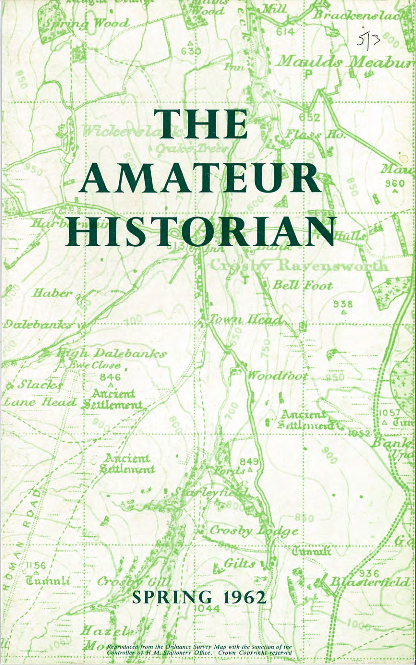
The Amateur Historian Volume 5 Number 3 Spring 1962
Contents
Local history in early estate maps Show more
By Baker, Alan R.H.
pp 66-71
Study of the potential of early estate maps in helping to reconstruct the morphology of past landscapes. For example, they often clearly show the details of enclosure patterns and field boundaries, as well as changes to field patterns over time (such as enlargements and consolidation of units). In a number of case studies the complexity of land-holding in the 17th century is shown, with discussion of regional variations, and there is some coverage of common fields and common waste. The article suggests that estate maps reveal little or no detail of the process of cultivation, but can be of major value in identifying boundaries, field-names, place-names, woods and commons.
The records of the Inns of Court - a bibliographic aid Show more
By Bland, D.S.
pp 72-76
Bibliographical guide to the records of the Inns of Court from circa 1400. The author recommends their use for research into family histories and heraldry, but warns of the declining prestige of the Inns as centres of legal education in the late 18th century. Chambers were often let and a number of spurious claims exist.
Document copying Show more
By Bensusan, Arnold E.
pp 77-79
A brief introduction to methods for copying documents using photographic equipment.
A local history in half-crown volumes Show more
By Hutton, Kenneth
pp 81-84
Account of the publishing of a local history booklet on Hatfield, Hertfordshire.
Public health in medieval England Show more
By Swain, M. Burnham
pp 85-89
An examination of medical practices in medieval England, suggesting that blood-letting was common, people ate heavily and few took exercise. Although most monasteries grew medicinal herbs, the church forbade them to practise medicine. Surgery was basic and there was little understanding of infection - diseases were recognised but often confused. Cities were crowded, dark and filthy; food was poor; skin disease was rife; and soldiers and sailors brought new affliction from their travels abroad. The Black Death of 1348-1351 wiped out around half the population. Subsequent legislation attempted to deal with public health issues by clearing the cities of animals, by dealing with refuse and by starting investigations into the causes of disease.
[Hide]

Hugo Javier Freitas


Laura Yeoman