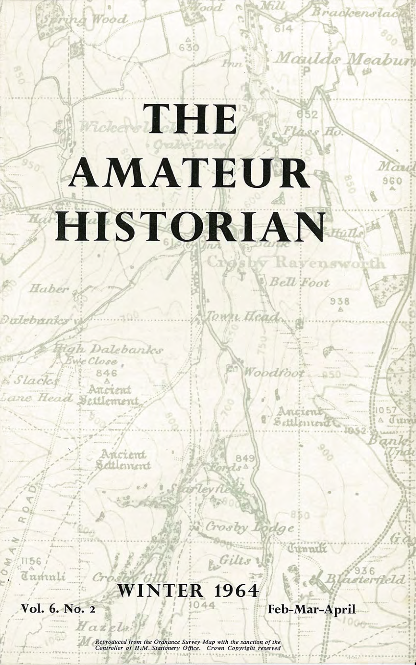
The Amateur Historian Volume 6 Number 2 Winter 1964
Contents
The study of local history Show more
By Everitt, Alan
A response to the earlier article on this subject by J.D. Marshall (06 01 11-17) and his suggestion that more emphasis should be placed on regional history, and that professional historians should supply ideas and identify the problems or issues which merit research. Everitt agrees that studies must take into account the regional dimension, but suggests that local history research should have a specific end in view and that community boundaries are more important than geographical ones. He proposes that research and investigation should be approached on a thematic basis, looking at, for example, the relationship between population and resources; relationships between lords and the rest of the community; the use of biographical material; investigations of patterns of family life; the influence of travel and transport; and the use of contemporary literature as evidence.
Guide to the contents of the Public Record Office Show more
By Hector, L.C.
pp 45-48
A general review of the published guides and other finding aids which describe the contents of the Public Record Office, with some comment on the range of documents available.
The village church band Show more
By Boston, Noel
pp 48-54
Following the destruction of many organs during the Civil War, the services in many village churches were without musical accompaniment. The post-Restoration period therefore saw the development of church ensembles, using portable instruments which could be brought to and from the church. The author discusses the specific example of Mattishall in Norfolk to illustrate the range of instruments which were employed, as well as referring to a variety of primary sources. The music included a wide range of psalms which could be sung to different tunes, and a typical repertoire is given.
Trade tokens and local history Show more
By Jacob, Kenneth A.
pp 55-61
Study of 17th century trade tokens, which were issued by local tradespeople to serve as a substitute coinage at times when there was a serious shortage of small change in circulation, and also providing a useful advertising medium. The tokens were usually of copper or brass and were inscribed and decorated - they might have the maker's name but would almost invariably include the name and town (and less frequently the business) of the trader who issued them. They might also have a motif or symbol illustrating the trade. The author outlines a methodology for studying trade tokens, using the example of Cambridgeshire. Lists of those who issued tokens are given, and Jacob suggests that the traders can be identified by cross-referencing with other sources such as maps, plans and some early directories or household listings.
[Hide]

Hugo Javier Freitas


Laura Yeoman